• Home
  • About Me
  • THE LIST Through the Years
  • Top Twelves and More
  • The End Credits Song Hall of Fame

Rhyme and Reason

~ Poetry Meets Film Reviews

Rhyme and Reason

Tag Archives: Romance

Version Variations / VC Pick: A Star Is Born (1937, 1954, 1976)

27 Monday Feb 2017

Posted by sgliput in Movies, Poetry, Reviews, Writing

≈ 9 Comments

Tags

Drama, Musical, Romance, VC Pick, Version Variations

Image result for a star is born 1937

Image result for a star is born norman maine oscar

Image result for a star is born 1976 grammy


For every star to glory born
And lifted from obscurity,
Another sinks to dark and scorn,
An endless cycle now well-worn
But no less pitifully.

Some seek, some flee the weight of fame,
For which so many mourn.
They love the players, hate the game,
Who lose the lights around their name
That more stars may be born.
_________________

MPAA rating for 1937 version: Not Rated (should be PG)
MPAA rating for 1954 version: PG
MPAA rating for 1976 version: R (mainly for language)

My VC has been urging me to review the 1976 version of A Star Is Born, one of her favorites with Barbra Streisand, and I saw it as an opportunity to compare all three movies of the same name in a long overdue Version Variation review. It’s a Hollywood story that has become well-known through repetition, earning a remake every twenty years or so. The original was in 1937 with Janet Gaynor and Fredric March; the second retooled the tale as an epic musical with Judy Garland and James Mason; and the third is my VC’s favorite, another musical with Streisand and Kris Kristofferson. Ironically, I believe I was exposed to each of them in backwards order and enjoyed the story more the further back I went. And to anyone who thinks this story is too old to be relevant over forty years after the last version, there is yet another remake in the works for next year, starring Bradley Cooper and Lady Gaga. Time will tell how that compares with the others, but let’s take a look at the similarities and differences between the past versions.

What every incarnation of A Star Is Born has in common is the central story of an ambitious female newcomer who catches the eye and support of a celebrity with a reputation for being difficult, and as her star rises, his fades with heartbreaking results. While the necessity for the existence of a remake is always questioned, A Star Is Born is one case where every new version updated it for the times in completely understandable ways. The 1937 film had Hollywood as its setting, with Janet Gaynor’s Esther Blodgett dreaming of rising from a country girl to a starlet of its Golden Age. Judy Garland’s version is also about Hollywood but at the height of its musical phase; Garland’s Blodgett is already an established singer, and it’s her voice that prompts Mason’s Norman Maine to help her to shoot for something bigger through the studio system. By 1976, Streisand’s version ignores Hollywood in favor of the rock-and-roll scene of the ‘70s; the voice of her renamed Esther Hoffman catches the ear of not a movie star but rock star John Norman Howard (Kristofferson). All three films see Esther and her self-destructive benefactor share wedded bliss that is sadly short-lived, and the final scenes, while handled in different ways, are essentially the same.

Image result for a star is born 1937

Let’s start with the original 1937 film. It was the last one I saw, and knowing how unimpressed I usually am with dated movies of its era, I watched it more for the sake of comparison than for personal interest. Yet, surprisingly, I found it to be the best version of them all, which I suppose should be expected of the original work. The first A Star Is Born has no music like the other two, and thus the story is more boiled down to the basics of its plot, without the often unnecessary window-dressing of a musical number. In doing so, it also includes important details left out in the 1954 version, such as the origin of Esther’s screen name Vicki Lester.

Above all, the original’s greatest asset that the other two can’t match is its script, pointed and eloquent in just the right measure. While it received seven Oscar nominations, including the honor of being the first color film to be nominated for Best Picture, it’s no surprise that its one win was for Best Writing (plus an honorary award for its color photography). One important character that is totally absent from later versions is Esther’s Grandmother Lettie, played with witty spunk by May Robson. It’s her grandmother that gives Esther the initial encouragement to become a star, and her shrewd counsel at both the movie’s beginning and end may be my favorite bit of grandmotherly wisdom on film. All of the other performances are outstanding, with not one devolving into overacting, and Gaynor and March deserved their acting nominations, even if they didn’t win. (On a side note, I thought it interesting that Lionel Stander, who plays the studio’s unsympathetic publicity manager, sounded exactly like Harvey Fierstein’s raspy voice. I doubt there’s any relation, but it would be funny if Fierstein played the same role in the next remake.) Dated or not, the original A Star Is Born is the best, as its 100% Rotten Tomatoes score attests, and it has somewhat changed my views on prejudging a film based on its age.

Image result for a star is born 1937 lettie

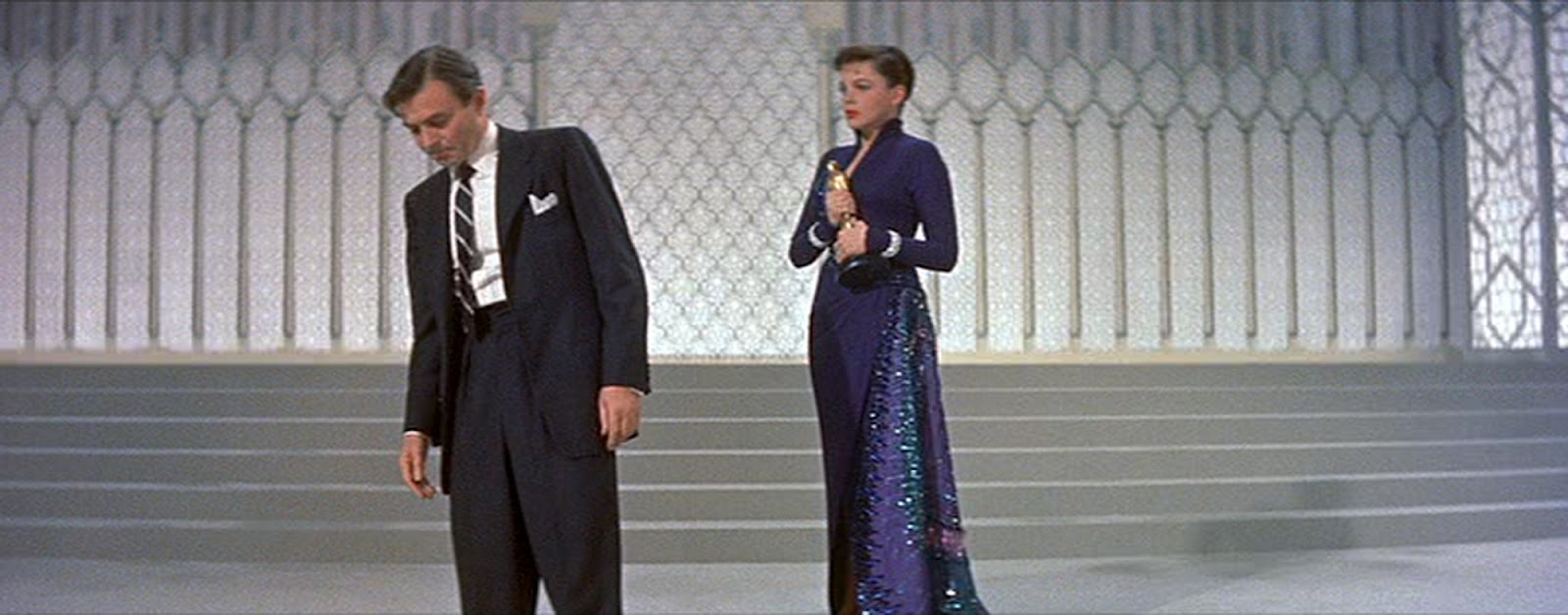
As for the 1954 version with Judy Garland, Esther is presented not as an aspiring nobody but as the lead singer of a musical ensemble, whose performance at a gala is interrupted by Norman Maine’s drunken antics. (Danny McGuire, her friend from the original, becomes her bandmate in this version.) Won over by her voice, Norman invites her to stay in Hollywood for a screen test, and after some bumps in the road, she becomes a star of musical cinema. Many scenes, especially in the second half, are recreated from the first film, often word for word, such as the studio head’s visit to Maine in a sanitarium or Esther’s intervention when her husband is about to be sent to jail. What the remake adds is a surfeit of musical numbers, ranging from small personal songs to lavish song-and-dance routines. One sketch detailing Esther’s supposed rise to stardom plays out like Judy Garland’s version of Gene Kelly’s “Broadway Melody” number in Singin’ in the Rain.

All the additional music helps the remake stand apart from its predecessor, but with essentially the same story, it’s hard not to feel that the extended scenes of choreography are merely padding to warrant its somewhat tiresome three-hour runtime. Like Janet Gaynor before her, Judy Garland was nominated for Best Actress but lost to Grace Kelly that year, a snub that was widely criticized, but I can understand. As marvelous as she was as a singer, Garland never struck me as a great actress, and I found her most emotional scenes rather forced, the kind of dated acting that Gaynor actually avoided in the earlier version. Another odd discrepancy is that the original film is still intact, but portions of the 1954 film have been lost and recreated with still photographs. Even if Garland’s incarnation has some drawbacks, it’s still entertaining in the musical department, and, nailing the suave but broken sides of the character, James Mason plays probably the best Norman Maine role of all three films.

Image result for a star is born 1954

And now the moment my VC has been waiting for, Barbra Streisand and the oh so handsome Kris Kristofferson in the 1976 retelling of A Star Is Born! Since this is the greatest departure from the original film, I’ll start with what my VC loves about it, particularly the music. She’s always loved Streisand’s voice, if not her personally, and like Judy Garland before her, Streisand was the premier singer/actress of the time. (Whether Lady Gaga is for our generation has yet to be seen.) The whole soundtrack is updated to excellent classic rock standards, and unlike the previous version, Streisand’s film won an Oscar for Best Song, the theme “Evergreen,” which rather pales in comparison with the more dynamic showstoppers, like “The Woman in the Moon.” Both she and Kristofferson are also quite good in their acting roles, though not in any award-worthy way, an opinion on which my VC vehemently disagrees with me.

I do wish I could like this version as much as she does, but it has even more problems than the ’54 film. For one, the great script of the original is nowhere to be found, despite clear echoes of the earlier films’ events, like Norman interrupting Esther’s award ceremony (here the Grammys rather than the Oscars). Perhaps the most frustrating aspect for me is Kristofferson’s character of John Norman Howard. Like the previous Norman Maines, he’s a drunken, self-destructive jerk at times, whose behavior is harder to understand here. He frequently makes terrible decisions, even when not drunk; for instance, this is the only version where he cheats on Esther, and while my VC insists there’s a deep motive behind it of self-resentment on his part, I’m afraid I just don’t see it. His final act of the film is also perplexing; in the other versions, it is because Norman fears Esther will throw everything away on him, while here, he has a chance at a comeback but refuses to take it for supposedly the same reason.

Image result for a star is born 1976

All three versions of A Star Is Born have their strengths: the shrewd dialogue of the original, the sprawling musical numbers of Garland’s incarnation, the bittersweet and passionate ending of Streisand’s (the only one to actually end with a performance). While my VC’s favorite is not mine, it did give me a reason to check out the others, the first of which is now among my favorite films from the 1930s. This story of Hollywood success, love, and loss has proven its staying power, and although I’m always dubious about remakes, this is one tale that can support further retellings.

Best serious line (from the 1937 version): (Grandmother Lettie) “Tragedy is a test of courage. If you can meet it bravely, it will leave you bigger than it found you. If not, then you will have to live all your life as a coward, because no matter where you may run, you can never run away from yourself.”

Best funny line (from the 1937 version): (Esther’s aunt) “Of course, no one ever listens to me!”   (Grandmother Lettie) “They do if they’re within ten miles of ya.”


Rank for the 1937 version: List-Worthy
Rank for the 1954 version: List Runner-Up
Rank for the 1976 version: Honorable Mention


© 2017 S.G. Liput
451 Followers and Counting


VC Pick: The Goodbye Girl (1977)

15 Wednesday Feb 2017

Posted by sgliput in Movies, Poetry, Reviews, Writing

≈ 6 Comments

Tags

Comedy, Drama, Romance, VC Pick

Image result for the goodbye girl 1977

It’s easy come and easy go,
As every broken heart will know,
And broken hearts are loath to feel
While all the cracks attempt to heal.

If every stranger you befriend
Becomes a stranger by the end,

You might treat love with some dismay
And be surprised by those who stay.
____________________

MPAA rating: PG (should be PG-13 for language)

Coming on the heels of Valentine’s Day, the next film chosen by my trusty Viewing Companion (VC) is one of her favorite romances, the kind I wasn’t really looking forward to seeing but ended up liking all the same. As much as I wish Richard Dreyfuss had won an Oscar for Mr. Holland’s Opus, at least he had already received one (the youngest actor ever at that point) for his role in this adaptation of a Neil Simon play, a classic hate/love story between conflicting personalities that inevitably leans toward the satisfying love side.

Dreyfuss plays Elliot Garfield, a struggling actor who subleases an apartment from an old friend, only to find that friend’s former girlfriend Paula (Marsha Mason) and her precocious daughter (Quinn Cummings) already living there, having been abandoned when her ex skipped town. Despite Elliot having every right to force them out and Paula having “nine tenths of the law,” he allows them to stay under strict conditions, and the three grudgingly share the apartment. It’s easy to feel sorry for both Paula and Elliot at different times, and both have their quirks and character flaws. Paula is a wreck trying to get by as a single mother and find work as a dancer after ten years out of practice, while Elliot’s hopes for theatrical glory are dashed by a director who wants him playing Richard III as a flaming homosexual stereotype. Their trials are equal parts funny and pitiful, enlivened by an outstanding script full of eloquent barbs, as one can expect from a Neil Simon production.

Image result for the goodbye girl 1977

The fact that Paula and Elliot can both be sympathetic and abrasive fleshes out their characters and helps them feel real. Paula’s demanding anxiety and Elliot’s neurotic tendencies may grate on each other at first, but the longer they’re together, the better their personalities mesh. Where that relationship goes is an understandable source of worry for Paula, whose affairs with actors never end well, but The Goodbye Girl lends hope that one can always find that person who won’t let you down. Seeing The Goodbye Girl again, I can certainly see why my VC is so fond of it, and while I prefer some other hostility-melting-into-romance rom-coms (You’ve Got Mail, for instance), its clever banter and developed characters make it the classic it is.

Best line: (Elliot, to Paula) “If you were a Broadway musical, people would be humming your face.”

Rank: List Runner-Up

© 2017 S.G. Liput
451 Followers and Counting


VC Pick: The Lake House (2006)

10 Friday Feb 2017

Posted by sgliput in Movies, Poetry, Reviews, Writing

≈ 6 Comments

Tags

Drama, Fantasy, Romance

Image result for the lake house 2006


A house is not a home, it seems,
Until it houses someone’s dreams,
And even if its tenant leaves,
Some part remains beneath the eaves.

Although no new dreams now reside
Within a home unoccupied,
The traces of its owners past
Remain in spirit, left to last.

These ghosts, perhaps, I’d like to meet.
Perhaps I have upon the street.
We both have shared a home, almost,
And when I move, I’ll be the ghost.
__________________

MPAA rating: PG

In honor of Valentine’s Day and her upcoming birthday, I’ll be reviewing a VC pick each week for the next month, and The Lake House is the first in her honor. As my VC well knows, I do love a good supernatural romance, especially when its otherworldly elements set it apart from the typical romantic clichés. I found The Lake House to be one of the better members of the genre, pairing Keanu Reeves and Sandra Bullock again twelve years after Speed.

Image result for the lake house 2006

Based on the 2000 Korean film Il Mare, The Lake House follows Dr. Kate Forster (Bullock) and architect Alex Wyler (Reeves) as the former moves out of the titular glass home and the latter moves in. The hook is that they’re doing so two years apart, with Alex in 2004 and Kate in 2006. A mail-forwarding note that Kate leaves behind somehow ends up in Alex’s mailbox two years earlier, and the two discover that they can communicate with each other through their time-traveling letters. I personally love the idea of a pen-pal relationship spanning time itself, and even if the mailbox’s mysterious powers are never explained, the chemistry between Bullock and Reeves is just as evident here as it was in Speed, despite the fact they’re separated from each other much of the time. Also in fine form are Shohreh Aghdashloo as Kate’s doctor friend and Christopher Plummer as Alex’s father and architectural teacher who actually built the lake house.

Oddly enough, the film that kept coming to mind as I watched The Lake House was last year’s anime hit Your Name, another film where two likable characters are separated by time and tragedy and rarely get to meet face to face. Going into the similarities would require too many spoilers, but while Your Name was a better film overall, it’s worth noting the parallels to this earlier movie and the still earlier Il Mare.

Image result for the lake house 2006

While some might consider The Lake House maudlin, I thought its emotional scenes were highly effective, whether it be the inner longing of Alex’s visit to Kate before she knows of their relationship or the retrospective of Alex’s rocky bond with his father.  As for the ending, I saw the “twist” coming a mile away, but the film kept me in doubt as to whether its separation romance would go the way of City of Angels (did NOT like) or Sleepless in Seattle (DID like). As my VC pointed out to me, the chemistry and anticipation of love between the two leads kept us invested in the outcome, and while it toyed with my expectations, the end at least provided the kind of old-fashioned satisfaction that too many modern romances try to avoid for some reason.

The only explanation I have that The Lake House isn’t List-Worthy stemmed from a review I read after seeing it, which pointed out the holes in its time-travel aspects. As much as I want to disregard them, I must admit it’s true; even the most basic laws of time travel are pretty much ignored. For instance, Alex plants a tree outside Kate’s apartment to surprise her, and in her time, it suddenly appears. While it’s a neat visual and a sweet gesture, that tree planted two years earlier should have always been there, such that Kate would never know it hadn’t been there before. Though my VC doesn’t mind, for reasons like this, The Lake House has gone down a tiny bit in my estimation, but it’s still a lovely and poignant romance, just one that shouldn’t really be thought of any deeper than a Shyamalan movie.

Best line: (Alex, of the lake house) “Dad knew how to build a house, not a home.”

VC’s best line: (Alex, after glimpsing Kate in 2004) “I don’t know if you remember, but we saw each other. That is, I saw you. You never told me… how beautiful you were.”   (Kate) “Well, maybe you saw someone else. That was a bad hair year for me.”


Rank: List Runner-Up


© 2017 S.G. Liput
451 Followers and Counting

 

Me Before You (2016)

20 Friday Jan 2017

Posted by sgliput in Movies, Poetry, Reviews, Writing

≈ 4 Comments

Tags

Drama, Romance

Image result for me before you film


If I were trapped within a chair,
My body useless, simply there,
I think I’d grieve in my despair,
And call my lot in life unfair,
And lift up many a desperate prayer,
And doubt in ways I’d never share,
My life too broken to repair.

And what I’d do once rage had waned
Cannot be sure or preordained,
But I believe my life restrained
Could still hold joy since life remained,
Not merely to be entertained,
But be fulfilled. Though life be pained,
Does that mean it should be disdained?
__________________

MPAA rating: PG-13

Me Before You has all the potential you could want for a summer romance flick—a touching and emotional story, two appealing leads with chemistry, a difficult and tragic subtext. But there are two ways that a film like this can go, and sadly this one takes the worst possible route. Just a warning: spoilers are unavoidable in discussing the film’s great stumble so I won’t be dancing around it.

I suppose I should say up front that I really enjoyed most of Me Before You. The first two thirds of it make for a highly engaging romance, one that develops where neither lover would have expected. After losing her job, young Brit Louisa Clark (Emilia Clarke) ends up applying as a home caregiver for wealthy quadriplegic Will Traynor (Sam Claflin), who is confined to wheelchair and bed at all times. His bitterness keeps her at a distance at first as someone his mother hired against his will, but Louisa’s natural charm and hesitant spunk slowly win him over, as well as some bonding over movies (including the excellent French film Of Gods and Men). I kind of fell in love with Emilia Clarke in this movie; she wears her awkward emotions on her sleeve with the mere expression of her eyebrows, and she’s such a winsome lead that it’s no surprise that Will falls for her too.

Image result for me before you film emilia clarke

But then Me Before You delves into the controversial area of doctor-assisted suicide, a subject too complex for a teary romance to address properly. Jojo Moyes, the author of the book on which it is based, wrote it after hearing of a paralyzed athlete choosing suicide at a Swiss clinic, so with that as her inspiration, both Will and the film march to that inevitably unsatisfying conclusion with grim resolve.

There’s so much wrong with how it is handled, it’s hard to know where to begin. For one, there’s the fact that it didn’t have to be this way. After learning of Will’s suicide plans, Louisa tries to give him every reason she can muster to want to live and expects to change his mind until he proves her hopes to be in vain. If she had been successful, the story could have been a lovely and life-affirming tale, but that’s not what the storyteller intended at all.

In addition, Will’s response to Louisa spoils the most basic of romantic rules, loving the other more. By gently rebuffing Louisa’s efforts, Will is essentially saying, “You’re not good enough to live for.” Is it any wonder that Louisa reacts with anger and grief? It’s as if Will is given someone to make his life worth living, and he rejects her, supposedly for her own good. Because of the film’s predestined goal, it’s all about Louisa loving Will enough to accept his choice rather than Will loving her enough to stay. Then again, doesn’t the title Me Before You suggest that? I thought it had a strangely selfish ring to it, and now I see why. Not that Will sees it as selfishness; he believes he’s freeing Louisa and his family from his burden, but he ignores their pleas and the fact that it’s not as if they’re struggling financially.  The film does try to bring other points of view in, such as Will’s mother’s objections and Louisa’s mother declaring his choice to be “no better than murder,” but again, the end result was decided from the beginning.

Image result for me before you film emilia clarke

I don’t pretend to understand the agony that many with quadriplegia or other debilitating conditions endure, but I have to believe that life is better than death. Will comments that he loved his life before his accident and that it could never be the same. While that’s true, just because his life is not the same doesn’t mean it isn’t worth living. Success stories like Helen Keller, Stephen Hawking, and Joni Eareckson Tada have proven that life need not be made void by handicaps, and many happy lives have risen from considerations of suicide, considerations that might have killed them early had they had access to the means, as Will does by the end. It’s a matter of hope and life, not dignity, and Will’s final words of encouragement to Louisa to “just live” are hollow next to his actions.

Me Before You could have been a lovely romance, and most of it is, with delightful early performances from Clarke and Claflin that are more crowd-pleasing than Oscar-winning. Yet the film’s stab at bittersweet euthanasia as an ending just ruins everything that came before, revealing its sympathy for the culture of death in a wholly unsatisfying way.

Best line: (Louisa, with the kind of touching line that is sadly ignored by Will) “You make me happy, even when you’re awful. I would rather be with you—even the you that you seem to think is diminished—than with anyone else in the world.”


Rank: Dishonorable Mention


© 2017 S.G. Liput
441 Followers and Counting


The Emperor’s New Clothes (2001)

16 Friday Dec 2016

Posted by sgliput in Movies, Poetry, Reviews, Writing

≈ Leave a comment

Tags

Comedy, Drama, Romance

Image result for the emperor's new clothes 2001 film


How would it be
Do you think, do you think,
If a giant of men were required to shrink,
If a shaker and mover who loved his own name
Who terrorized armies and reveled in fame
Were forced to live simply, obscurely, and sad,
Assuming, of course, he did not first go mad?
I would be curious, and yet if it were so,
I doubt that the world and I ever would know.
________________

MPAA rating: PG

Sometimes a film is blessed by perfection in casting. Ian Holm is such an ideal Napoleon Bonaparte, both in talent and height, that he’s played “the little corporal” three separate times, in the mini-series Napoleon and Love, in Time Bandits, and lastly in The Emperor’s New Clothes, a semi-comedic revisionist account of Napoleon’s post-exile days based on a Simon Leys novel.

We all know Napoleon was exiled to St. Helena after the Battle of Waterloo, but what we don’t know (supposedly) is that he switched places with a deckhand lookalike (also played by Holm) and escaped back to France. Why do we not know such a story? Because the plan failed in complete secrecy. While the fake Napoleon enjoyed being famous and pampered a bit too much, the real one endured the yoke of obscurity only to find unexpected appeal in the romance of a simple life, one that didn’t involve conquering the European mainland.

The Emperor’s New Clothes could have been a stronger film and doesn’t inject its clever concept with as much humor as I would expect or hope, but it’s a satisfying one even so. While strong supporting roles are filled by Iben Hjejle as Napoleon’s love interest and Tim McInnerney as her jealous suitor, Holm in his double role is the star of the show.

Image result for the emperor's new clothes 2001 film

At first, his Napoleon grumbles over the injustice of his lack of recognition and support, but once he accepts it, he becomes what Napoleon might have been without his despotic mindset, still a brilliant strategist but one bent on less militant pursuits, like distinguishing himself as the best melon salesman in Paris. Yet if you don’t think that the real Napoleon would give up his ambition so easily, the film doesn’t either and offers a hauntingly persuasive twist to make his acceptance and the story as a whole more credible. While the revisionist theory could have had a more humorous bent to it, The Emperor’s New Clothes brings Napoleon Bonaparte down to a relatable level and gives him a far more fulfilling fate than his real-life counterpart.

Best line: (Napoleon, preparing to leave St. Helena) “Six years of English cooking… six years of staring at these dreary walls… and at your gloomy face. You’re quite ugly, did you know that? I haven’t had the heart to tell you.”   (Louis) “Yes, sire.”


Rank: List Runner-Up


© 2016 S.G. Liput
437 Followers and Counting


VC Pick: Continental Divide (1981)

13 Tuesday Dec 2016

Posted by sgliput in Movies, Poetry, Reviews, Writing

≈ Leave a comment

Tags

Comedy, Romance

Image result for continental divide film


While some prefer a city life
With urban pleasures close at hand,
Still others call for space and land,
For rivers clear and mountains grand,
And do not seem to understand
A noisy, city life.

Some love the woods unpopulated;
Some love the bustling avenues;
And some appreciate both views
And do not know which one to choose.
To pick but one and one refuse
Sometimes is complicated.
____________________

MPAA rating: PG (should be PG-13 for language)

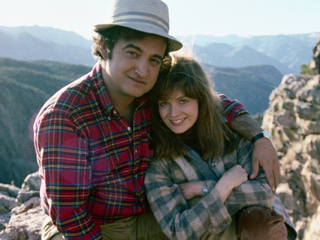
My VC had me watch Continental Divide some time ago, and I never remembered it being anything special, aside from the unlikely casting of John Belushi as a romantic lead. He plays Ernie Souchak, a provocative newspaperman who pushes too hard on a crooked politician and, for his own good, is sent to the Rocky Mountains to write a story about eagle expert Nell Porter (Blair Brown). Helpless as he is and remote as they are, Nell grudgingly agrees to allow him to stay in her cabin, and we all know what can happen when this attractive woman and…well, this man share a cabin for an extended period of time. Yet, eventually they must deal with the fact that the two of them have different homes and different passions that will inevitably keep them apart.

Seeing Continental Divide again, there’s still nothing that would make this a favorite romance of mine, but it was far better than I recalled. The script isn’t as funny as I would expect for a John Belushi film, but the screenplay by Lawrence Kasdan (Empire Strikes Back, Raiders of the Lost Ark, The Big Chill) still establishes two likable characters even before they become lovebirds. As mismatched as they seem at first glance, Belushi and Brown do share some burgeoning chemistry so I see why my VC sighs that “they make such a cute couple.” Yet, what makes the film special is the mountainous setting and Nell’s nature-centric lifestyle; the expansive vistas of Colorado offer a gloriously romantic backdrop to the log cabin love affair.

Image result for continental divide film

Continental Divide often has the look and feel of a TV movie, and my VC thinks it would have made a promising TV spinoff, if not for Belushi’s death months after its release. The film eventually presents the expected challenges of a long-distance relationship, and while the resolution won’t please everyone equally, the relationship on display is worth some charming optimism.

Best line: (Souchak) “The air was thin. She was average cute. She was the only girl up there. The air was thin!”


Rank: List Runner-Up


© 2016 S.G. Liput
437 Followers and Counting


Sing Street (2016)

08 Thursday Dec 2016

Posted by sgliput in Movies, Music, Poetry, Reviews, Writing

≈ 5 Comments

Tags

Comedy, Drama, Musical, Romance

Sing Street Trailer (2016)

(Best sung to “The Riddle of the Model,” see the video at the bottom, and yes, I know the original lyrics are better)

No life is ever perfect.
It doesn’t play along.
How will we ever surf it,
Except to sing a song,
A song with inspiration
In everything we love and hate.
It’s pleasure and frustration
But in a musical debate.

It’s called creativity.
It’s all the work of the human heart.
Few if any can see it from the start.
Positivity
Won’t let it fall apart.
Can you see
The origin of genius?
__________________

MPAA rating: PG-13

Would it be wrong to say that the 1980s had the best music? Sure, there are plenty of modern favorites I have, but it’s amazing how many great songs originated in that decade that has become a bastion of nostalgia of late. It is that music scene of Duran Duran and U2 that is the backdrop for Sing Street, the humble origin story of an Irish high school band clearly inspired by everything ‘80s music did well.

Though young Conor (Ferdia Walsh-Peelo) is forced to move to a different Dublin school, where he must put up with bullies and a cold-hearted principal, he goes out on a limb to invite the lovely aspiring model Raphina (Lucy Boynton) to a music video shoot. All he needs then is a band, which he cobbles together from schoolmates and talented acquaintances with surprising ease. Despite some growing pains, it’s clear they’re more talented than your typical garage band, and the music becomes a sort of escape from the oppressive futility of his dysfunctional home life and unpromising future.

Image result for sing street drive it like you stole it

In several respects, Sing Street brought to mind Cameron Crowe’s 1970s-set Almost Famous, another film with a great soundtrack of classic tunes. Raphina may not be as enigmatic as Penny Lane, but Conor is just as taken with her as William was in the earlier film, though in this case Conor gets an actual romance. In addition, Conor’s brother bears traces of Philip Seymour Hoffman’s character in Almost Famous, with his musical snobbery and creative encouragement. (For the record, I do enjoy Phil Collins music, no matter what Conor’s brother says.) In particular, both films seem to capture a love for the music of the times and a sympathy for the imperfect fellows who develop and appreciate it, sharing that same love and sympathy with the audience.

True, there are things I wish were different, such as the ambiguously optimistic ending scene and the typical caricature of the vilified priest as the bad guy. Nevertheless, there’s a lot that Sing Street does right, especially the music, from background songs courtesy of Genesis, Spandau Ballet, and many more to original hits that sound like they could have been plucked from some unproduced 1985 album. The band’s efforts at producing music videos are as low-budget but quirky as any number of ‘80s videos, while a dream sequence concert of the original song “Drive Like You Stole It” is the marvelous high point of the film and perhaps the musical high point of the whole year. Honestly, I hope it wins Best Song at the Oscars, however unlikely that seems.

Image result for sing street film musical number

Besides the music, the characters feel real, likable, and worthy of support, with Conor especially growing in confidence and even rightly treating the school bully first with indifference and then with compassion. Above all, there’s a certain artistic thrill and satisfaction to watching these young people experiment and create something that’s actually, surprisingly good. With the talent on display, the hopes for their future are implicitly high, and I can easily imagine Sing Street, both the band and the movie, being the object of fond nostalgia in years to come.

Best line: (Raphina) “Your problem is that you’re not happy being sad, but that’s what love is, Cosmo— happy sad.”

Rank: List-Worthy (tied with Almost Famous)

© 2016 S.G. Liput
435 Followers and Counting

The Age of Adaline (2015)

01 Thursday Dec 2016

Posted by sgliput in Movies, Poetry, Reviews, Writing

≈ 2 Comments

Tags

Drama, Fantasy, Romance

Image result for the age of adaline


If I had all the years ahead,
My future stretching infinite,
I’d laugh at death and waste my breath
And take my time to start and quit
And eat more than I would admit.

No matter what the daily rut,
I’d rarely worry with my glut
Of days and decades in reserve,
For patience straightens every curve
And makes all roads a new shortcut.

Or so I think….
As days and decades further sink
Into the endless stream I cross,
Along with friends and love that ends,
This gift may be an albatross.
Who wants an eternity of loss?
________________

MPAA rating: PG-13 (could even be PG)

The Age of Adaline is the kind of film that I knew I would enjoy based solely on the trailer and the ingenious title with a double meaning. I love films that follow one character through decades of drama, and The Age of Adaline does so with a fantasy twist reminiscent of The Curious Case of Benjamin Button and Winter’s Tale. As the opening narration explains, Adaline Bowman lived a normal life in the early 1900s, full of the typical joys and sorrows, but an accident that should have killed her instead gave her inexplicable longevity. She never ages past her original 29 years, and while many women would consider that a blessing, it feels more and more like a curse as the decades pass, friends and family get older, the world changes, and she doesn’t.

Blake Lively was the perfect choice for Adaline, embodying both World War II-era and modern-day elegance and giving the audience an essential glimpse into her emotional state. A tear-jerking look-back at all the dogs she has owned over the decades was a brilliant way to help us understand her magnified grief. Flashbacks are used to good effect with the same purpose, clarifying why Adaline is always on the run from potential love interests and anyone who might catch on to her secret…that is, until she meets the charismatic Ellis (Michiel Huisman) and the familiar William (Harrison Ford).

Image result for the age of adaline

The Age of Adaline fulfills its fantastical, romantic purpose with a sophisticated polish, both in the big picture and the details. (Anthony Ingruber as a young William was scarily good with his Harrison Ford impression. Look at him in the picture above; why isn’t he being considered for that Han Solo spinoff?) Unfortunately, the film does slip on occasion, specifically when Adaline’s “miracle” takes place, the narrator giving some hogwash about an undiscovered trait of DNA that freezes the aging process. Groundhog Day didn’t try to explain Bill Murray’s time loop, nor did Benjamin Button spell out Brad Pitt’s backwards aging. They didn’t have to, and The Age of Adaline’s attempt to explain the unexplainable falls flat, I’m afraid. In addition, the emotions at play aren’t as deeply wrought as in similar films, and I couldn’t help but feel that I’d seen the final scene of hopefulness somewhere else before.

My VC and I have similar tastes for this genre, and she enjoyed it too, sort of, saying afterward, “It was a great movie, except it’s ridiculous.” Blame the pseudo-science I mentioned earlier for that, but the “great movie” part still remains, thanks in large part to the outstanding performances across the board. Sometimes when a film is my kind of movie, I can forgive and even ignore its faults. The Age of Adaline fits that bill, and my expectations were met.

Best line: (Ellis) “You know they have a saying in Italy. ‘Anni, amori, e bicchieri di vino, no che contato mai.'”
(Adaline) “Years, lovers… wine cups?”
(Ellis) “Years, lovers, and glasses of wine. These are things that should never be counted.”
(Adaline) “You have no idea.”


Rank: List-Worthy


© 2016 S.G. Liput
428 Followers and Counting


Your Name (2016)

22 Tuesday Nov 2016

Posted by sgliput in Movies, Poetry, Reviews, Writing

≈ 5 Comments

Tags

Animation, Anime, Comedy, Drama, Fantasy, Romance


See the source image

If someday I should forget you
Or the moment that I met you,
I hope, easing your regret, you
Know, although you fade
In memory, your soul and mine
Are too attached to disentwine.
You are the one for whom I’ll pine
Till all the world’s unmade.
__________________

MPAA rating: Not rated yet (should be PG, maybe PG-13)

I’ve been awaiting Makoto Shinkai’s next feature film for some time now, and it seems that his latest movie has finally earned him acclaim and notice outside of anime fan circles. Kimi No Na Wa, or Your Name, is being heralded as proof of Shinkai coming into his own as “the new Hayao Miyazaki,” and this his fifth feature film has been hugely successful in Japan, where it is currently the seventh highest-grossing film ever.

Honestly, I’m just thrilled that I was able to see Your Name so soon after its release (as opposed to waiting perhaps a year for the DVD), but the fact that it is such a winner for writer/director Shinkai makes it even better. I’ve had a rocky regard for his past films, which are always visually beautiful and emotional but range from confusing (The Place Promised in Our Early Days) to depressing (5 Centimeters Per Second) to absolutely wondrous (Children Who Chase Lost Voices). I can’t say Your Name is the faultless masterpiece that many reviewers are making it out to be, but it’s an enchanting and praiseworthy fantasy drama that seems like the culmination of all that his less successful films tried to be.

Image result for kimi no na wa

On the surface, Your Name is a body-swap comedy between a city boy named Taki in Tokyo and a country girl named Mitsuha. Sick of her provincial surroundings and embarrassed by her feminine duties at her grandmother’s Shinto shrine, Mitsuha wishes she could be a handsome boy in Tokyo in her next life, a fancy that soon becomes reality. At random times, the two wake up in each other’s bodies and awkwardly try to live each other’s lives until they can get back to their own the next day. Their memories of the other-body experiences remain hazy afterward, like a dream, but the reactions of their friends and family make it clear that the switch is indeed real. Through notes, advice, and complaints left for each other, they get to know each other on a deeper level than most, while having a key element of any relationship—face-to-face contact—just out of reach.

Based on the trailers, one might think the body-swap humor was the main point of the film, but it actually makes up only the first third, with the rest of the film taking a far deeper and more meaningful course. Had the film remained like the first forty minutes, it would have been a somewhat fun and strange if unremarkable story, but as long as the tonal shift doesn’t bother viewers, it’s the final hour that explains Your Name’s popular acclaim, going off in unexpected and poignant directions. While publicity shots like the one below suggest that Taki and Mitsuha have greater contact, they’re separated by more than distance for the majority of the film. When they do have fleeting connections, it’s the stuff of cosmic, tragic romance, which brings people like me close to tears, even if I don’t quite get there.

Image result for kimi no na wa

Your Name does stumble on occasion, particularly when Shinkai indulges in repeated music video-like montages, like the one at the end of 5 Centimeters Per Second. The J-pop contributions of the band Radwimps actually complement the film well, but the montages sometimes give the film a rushed quality that could have been improved. The non-linear storyline also leaves the significance of some scenes in doubt, especially at the beginning… that is, until the importance of certain flashbacks becomes clearer. I would highly recommend seeing the film more than once, since the layers of its plot are better appreciated when viewed with the whole picture.

Other traces of Shinkai’s past work actually improve on his portfolio. Like The Place Promised in Our Early Days, there are a boy and girl’s sci-fi-ish separation and the threat of massive destruction, while the presence of a comet streaking across the sky brings to mind the space probe of 5 cm. One moment toward the end was even straight out of the unsatisfying conclusion of 5 Centimeters Per Second, prompting me to say “No, don’t you dare end it like that!” Luckily, it didn’t. I also appreciated a neat little cameo for a character from Shinkai’s previous film The Garden of Words.

Your Name is as beautifully animated a film as any I’ve seen in recent memory, with Shinkai’s usual attention to detail for light and shadow being exemplified. A sojourn to an expansive crater out in the countryside is especially memorable, with some gorgeous fall colors on display. Details abound, both in the scenery and the story, and attention is paid to fleshing out not only Taki and Mitsuha but also their friends and family members, making for a comprehensively touching film.

Image result for kimi no na wa

There’s so much to admire in Your Name, from the intricate but engaging plot to the moments of visual beauty, that few should mind its weaknesses, such as the quasi-spiritual “explanation” for the body swap itself. It has a good chance at snagging a Best Animated Feature nomination at the Oscars, which would make it the first non-Studio Ghibli anime film to do so, and even if I suspect Zootopia is the favored winner, Your Name would also be deserving. I still consider Children Who Chase Lost Voices to be Shinkai’s unsung masterpiece, but films like it and Your Name are what might make him a household name one of these days.

Best line: (Mitsuha’s grandmother, to Mitsuha/Taki) “Treasure the experience. Dreams fade away after you wake up.”


Rank: List-Worthy


© 2016 S.G. Liput
424 Followers and Counting


VC Pick: Roxanne (1987)

14 Friday Oct 2016

Posted by sgliput in Movies, Poetry, Reviews, Writing

≈ Leave a comment

Tags

Comedy, Romance

Image result for roxanne film


‘Tis no simple means
By which women are wooed.
‘Tis not for the boorish
Or foolishly rude.
The poets have proffered
And songsters suggest
What romantic remarks
Are the sweetest and best.

And men have spent centuries
On making sense
Of how to atone
After giving offense.
The language of love
Is a varied pastime,
And most would agree
‘Tis a mount worth the climb.

Fear not if you stumble
In stoking the flame.
The right words to women
Are rarely the same.
__________________

MPAA rating: PG

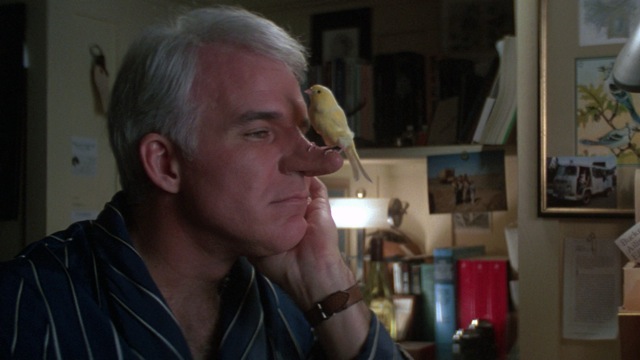
Roxanne, which my VC has been urging me to review for some time, features Steve Martin at his most charming. Martin himself adapted the 1897 play Cyrano de Bergerac (which interestingly provided the English language with the word “panache”) into this modern comedic retelling. The major events of the famous love triangle are faithfully translated from 17th century France to picturesque Nelson, Washington in the 1980s. Martin is C.D. Bales, the effortlessly charismatic fire chief who knows how to castigate those who insult his unusually long nose, while Daryl Hannah is his crush Roxanne, who is sadly enamored of the handsome numbskull Chris (Rick Rossovich).

To me, Roxanne is a film that excels in individual moments much more than the big picture. There are some brilliant comedic scenes, such as C.D.’s listing off twenty witty ways to insult his nose or the hilarious balcony scene (“I was afraid of worms, Roxanne! Worms!”), and I always get a good chuckle out of C.D.’s sexual teasing of a gaggle of gullible old ladies.

Yet, even with the verbal cleverness and the slapstick of C.D.’s bumbling fire crew, the romantic plot has never seemed particularly memorable to me. Martin certainly sells his eloquent passion for Roxanne, and Daryl Hannah is a beautiful love interest (a good normal role as opposed to her acting strange in Splash and Legal Eagles). Their love is worth rooting for, and I was reasonably satisfied by the end. Yet the original play concludes tragically, and Martin’s invented happy ending does feel rather easy and tacked on, earning just a smile rather than the grinning sigh that the best rom coms achieve. It may not make it one of my favorites, but Roxanne has enough “panache” to be a worthwhile charmer.

Best line: (C.D., telling some old ladies about supposed aliens in town) “They wanted to ask me about older women.”
(Nina) “Why?”
(C.D.) “Because they wanted to have sex with them.”
(Sophie) “Where?”
(C.D.) “Here! Right here in Nelson. They wanted to start a colony of supermen who would have sex with older women because they said, and I quote, ‘they really know what they’re doing.’”
(Lydia) “We do!”
(Sophie) “It’s been so long!”
(Dottie) “Oh, girls, girls! Do you actually believe that there are creatures from outer space who want to have sex with older women? [pause] Let’s go and check it out!”


Rank: List Runner-Up


© 2016 S.G. Liput
413 Followers and Counting
 

← Older posts
Newer posts →

Recent Posts

  • You Can See Everything (2026)
  • Colony (2026)
  • Dust Bunny (2025)
  • Don’t Breathe (2016)
  • The Sheep Detectives (2026)

Recent Comments

You Can See Everythi… on 2018 Blindspot Pick #8: Dear Z…
Colony (2026) | Rhym… on Peninsula (2020)
Colony (2026) | Rhym… on Cartoon Comparison: Train to B…
The Sheep Detectives… on Wildwood (2026)
The Sheep Detectives… on #40: Babe (1995)…

Archives

  • November 2026
  • September 2026
  • June 2026
  • May 2026
  • January 2026
  • December 2025
  • May 2025
  • April 2025
  • March 2025
  • February 2025
  • January 2025
  • December 2024
  • May 2024
  • April 2024
  • March 2024
  • February 2024
  • January 2024
  • December 2023
  • November 2023
  • October 2023
  • September 2023
  • July 2023
  • June 2023
  • May 2023
  • April 2023
  • March 2023
  • February 2023
  • January 2023
  • December 2022
  • November 2022
  • October 2022
  • September 2022
  • August 2022
  • July 2022
  • June 2022
  • May 2022
  • April 2022
  • March 2022
  • February 2022
  • January 2022
  • December 2021
  • November 2021
  • October 2021
  • September 2021
  • August 2021
  • July 2021
  • June 2021
  • May 2021
  • April 2021
  • March 2021
  • February 2021
  • January 2021
  • December 2020
  • November 2020
  • October 2020
  • September 2020
  • August 2020
  • July 2020
  • June 2020
  • May 2020
  • April 2020
  • March 2020
  • February 2020
  • January 2020
  • December 2019
  • November 2019
  • October 2019
  • September 2019
  • August 2019
  • July 2019
  • June 2019
  • May 2019
  • April 2019
  • March 2019
  • February 2019
  • January 2019
  • December 2018
  • November 2018
  • October 2018
  • September 2018
  • August 2018
  • July 2018
  • June 2018
  • May 2018
  • April 2018
  • March 2018
  • February 2018
  • January 2018
  • December 2017
  • November 2017
  • October 2017
  • September 2017
  • August 2017
  • July 2017
  • June 2017
  • May 2017
  • April 2017
  • March 2017
  • February 2017
  • January 2017
  • December 2016
  • November 2016
  • October 2016
  • September 2016
  • August 2016
  • July 2016
  • June 2016
  • May 2016
  • April 2016
  • March 2016
  • February 2016
  • January 2016
  • December 2015
  • November 2015
  • October 2015
  • September 2015
  • August 2015
  • July 2015
  • June 2015
  • May 2015
  • April 2015
  • March 2015
  • February 2015
  • January 2015
  • December 2014
  • November 2014
  • October 2014
  • September 2014
  • August 2014
  • July 2014
  • June 2014
  • May 2014
  • April 2014
  • March 2014
  • February 2014
  • January 2014
  • December 2013

Categories

  • Blindspot
  • Blogathon
  • Christian
  • Movies
  • Music
  • NaPoWriMo
  • Poetry
  • Reviews
  • TV
  • Writing

Meta

  • Create account
  • Log in
  • Entries feed
  • Comments feed
  • WordPress.com

Blog at WordPress.com.

  • Subscribe Subscribed
    Rhyme and Reason
    Join 799 other subscribers

    Have a WordPress.com account? Log in now.

  • Rhyme and Reason
    View site in Reader
    Manage subscriptionsSign upLog in
    Report this content
    Collapse this bar