• Home
  • About Me
  • The List
  • THE LIST (2016 Update)
  • THE LIST (2017 Update)
  • THE LIST (2018 Update)
  • THE LIST (2019 Update)
  • THE LIST (2020 Update)
  • THE LIST (2021 Update)
  • THE LIST (2022 Update)
  • Top Twelves and More
  • The End Credits Song Hall of Fame

Rhyme and Reason

~ Poetry Meets Film Reviews

Rhyme and Reason

Tag Archives: Mystery

Ready Player One (2018)

21 Saturday Apr 2018

Posted by sgliput in Movies, NaPoWriMo, Poetry, Reviews, Writing

≈ 2 Comments

Tags

Action, Drama, Mystery, Romance, Sci-fi, Thriller

See the source image

(Today’s NaPoWriMo prompt was for a poem inspired by the myth of Narcissus, who loved his reflection so much that he turned into a flower. Ah, those crazy Greeks…. This is an example of what I love about NaPoWriMo, because an ordinary poem of mine for this movie would have been quite different.)


I am the mirror that captured Narcissus,
A pool that reduced him to frailty and pride.
I am the mirror that heard the queen’s hisses
When told that Snow White was the more glorified.

I am the mirror no longer a mirror,
Tranformed over time to expand my appeal.
The more I’m admired by people, the dearer
I am to their lives, making all else unreal.

A whole generation and those in their wake
I’ve snared in a world they create to comply,
A mirror to show the world them for their sake,
Allured and immured by the power of “i”.

I’m praised for convenience, for freedom, for fun,
A magnet for eyes lest their view be too wide.
It’s up to the viewer what evil I’ve done;
I’m merely the mirror for frailty and pride.
___________________

MPAA rating: PG-13

There have been four movies I’ve seen so far in 2018 that I’ve genuinely loved, which, since it’s only April, is one a month (not bad). And it thrills me to no end that one of them is the film I declared my #1 movie that I hoped would be good. Steven Spielberg’s adaptation of Ready Player One didn’t blow my expectations away, like Train to Busan or The Greatest Showman, but I went in wanting to love it and found plenty of reasons to do just that.

See the source image


As someone who enjoyed Ernest Cline’s novel immensely, I can confirm that the film diverges quite a bit from its source material. Yet, unlike other decent but disappointing adaptations (Eragon, Inkheart), Ready Player One the film still adheres to the spirit of its source, and the fact that Cline himself cowrote the screenplay assuages my concerns about the many plot aberrations. Even so, the core story is intact: a massive multiplayer scavenger hunt through the virtual world known as the OASIS, a world and hunt created by dead eccentric James Halliday (Mark Rylance, who plays his social anxiety a bit too wooden). The entire world is in search of Halliday’s hidden Easter egg, which grants ownership of the OASIS to the winner, but no progress is made until Halliday fan Wade Watts (Tye Sheridan) earns the first of three keys, making him a target for the evil, power-hungry IOI corporation (led by an accent-less Ben Mendelsohn).

All that is straight out of the book, but in the leap from page to screen, changes are inevitable. If you’ve read the book, your enjoyment of the movie just might depend on how much such changes bother you. My VC, for example, enjoyed the film but harbored reservations about the rampant alterations of its second half. (She said, if she hadn’t read it first, she’d outright love the movie.) Yet, I think many of the changes work in the film’s favor. True, the book is better, but there are many parts of it that wouldn’t transfer well to the screen, such as the months that go by between breakthroughs or the important plot advances that consist of beating literal arcade games. Turning one of these challenges into a demolition derby race, for example, makes it far more exciting cinematically, while changing Halliday’s much-studied journals into a gallery of virtual records makes Wade’s research more visual. Also, the replacement of certain pop culture references with others is likely the result of copyright compromises and the filmmakers’ desire to play with particular “toys.”
See the source image

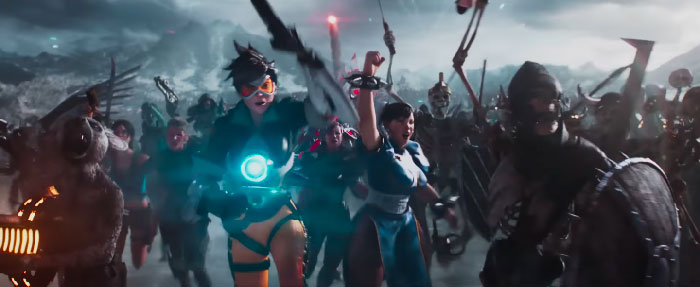
And boy, do they lay on the pop culture references, 90% of which swirl by far too quickly to fully appreciate. Yet the recognition that comes in those moments is an unparalleled thrill for nerds like me. Where else are you going to see the time-traveling DeLorean race the bike from Akira or Overwatch’s Tracer charging into battle with the Iron Giant? The cameos also vary depending on the viewer’s personal tastes; a friend of mine recognized a Lancer weapon from Gears of War, I geeked out at the site of the roulette wheel space station from Cowboy Bebop, while my VC chuckled at an incantation from Excalibur, all references that one of us “got” and the others didn’t. Thanks to the CGI mastery on display, there were several (likely entirely animated) sequences where I just sat there with a goofy grin on my face in a little place called geek heaven.

Except for the idea of not liking any changes in general, I can understand many of the complaints I’ve heard about what is essentially an alternate version of the Ready Player One story readers knew. Some of the rules of the OASIS are glossed over, potentially leaving questions for unfamiliar viewers. The characters aren’t nearly as developed as their counterparts on paper, lacking defined character arcs, and there’s little attention paid to the problems of this dystopian world outside its virtual refuge. The romance might be too rushed and convenient, the avatar of Wade’s friend Aech looks nothing like I imagined from the book, the very long runtime is felt by the end, and they should have included WarGames, dang it! It’s true; Ready Player One is not a perfect film, but I’ve rarely been better entertained in true Spielberg blockbuster fashion.
See the source image

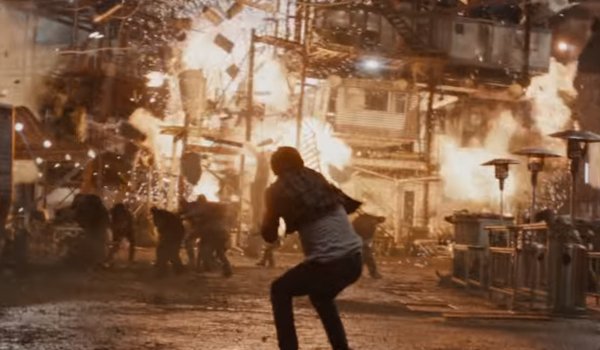
It’s really quite simple: I am Ready Player One’s target audience. I’m the nerd who revels in shared geekery, while appreciating half-realized lessons about the value of a life outside of technological obsession. I think that, drawing its inspiration from a great book, this Ready Player One is a great movie, boasting a visual awesomeness that puts most movie spectacles to shame.

Best line:  (Halliday, echoing Groucho Marx) “I created the OASIS because I never felt at home in the real world. I just didn’t know how to connect with people there. I was afraid for all my life, right up until the day I knew my life was ending. And that was when I realized that as terrifying and painful as reality can be, it’s also… the only place that you can get a decent meal. Because, reality… is real.”


Rank: List-Worthy


© 2018 S.G. Liput
563 Followers and Counting


Chronesthesia (Love and Time Travel) (2016)

08 Sunday Apr 2018

Posted by sgliput in Movies, NaPoWriMo, Poetry, Reviews, Writing

≈ Leave a comment

Tags

Drama, Mystery, Romance, Sci-fi

See the source image

(Today’s NaPoWriMo prompt was for a poem involving mystery and magic, so I went with an idea about the magical mundane, which kind of applies to the movie too.)


“My life is just a gear at work, a daily push and pull;
I’m far too busy living life to find it magical.
I’m like a mule with blinders on, who only knows the road,
While fields stretch out on every side and might relieve my load.
I’d like to turn my head, but I don’t have the will or time
To care for what’s outside myself when there’s a hill to climb.”

What does it take to rouse such men from marching to their tombs,
To wake them to the magic that around their bubble looms?
A glimpse into the future or a strange phenomenon,
Or simply noticing the world and those by whom it’s drawn?
When life seems more a burden than the gift it should be, try
Roads you don’t know or say hello and see where wonders lie.
_____________________

MPAA rating: Not Rated (probably R, just for language)

Independent movies are funny things: you never know when one is going to be a pretentious bore or a down-to-earth charmer, but the charmers are always a pleasant surprise. Such is Chronesthesia, a New Zealand import that was given the name Love and Time Travel when released to other countries. It’s a film that I think should put debuting writer/director/star Hayden J. Weal on the map, proving alongside Peter Jackson and Taika Waititi that New Zealand is home to some first-rate filmmakers.

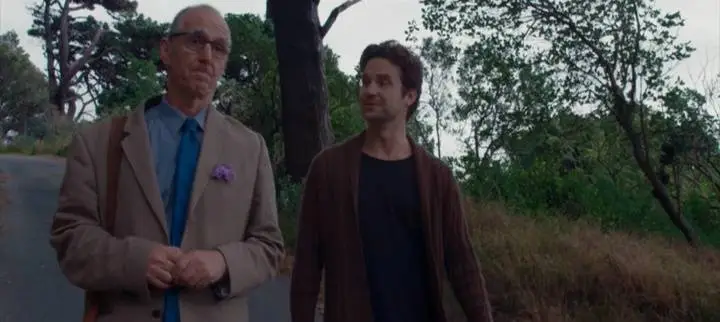
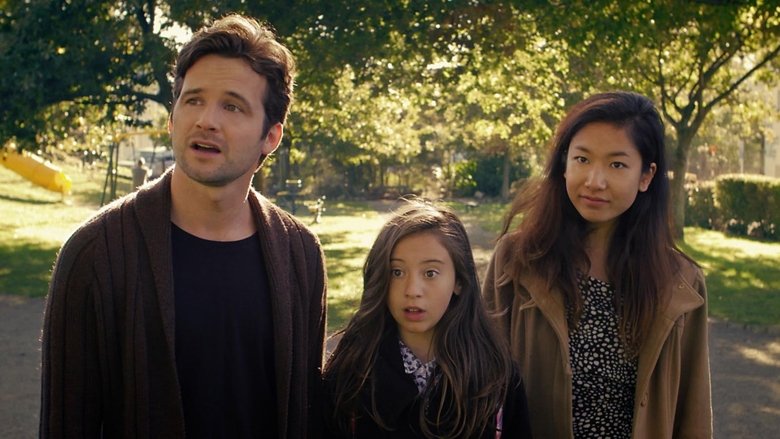
As the beginning states, chronesthesia is “a mental ability enabling awareness of one’s own future. In short, mental time travel.” Weal plays Daniel Duncombe (who at times reminded me of both Chris Pratt and Martin Freeman, strangely enough), a gloomy barista who seems none too eager to break out of his stagnant existence. He’s the sort who would rather jog alone than say a word to a stranger, keeping his earbuds in to avoid conversations. Then one day, he discovers the words “Turn Right” written on his bedroom window, followed by similarly enigmatic messages like “Alleyway” and “He misses her.” Before long, these mysterious notes lead him to meet new people and discover the unexpected connections between them.

See the source imageThat description may sound vague and generic, but it really is a story that is best experienced firsthand. Whether it’s an old man in search of someone or a young girl with a crush, everyone Dan meets helps him grow in some way, and watching him shed his taciturn cocoon was a joy to watch unfold. The biggest relationship he forms is a romance with a psychology student named Sophia (Michelle Ny), one that feels as natural as all screen romances should try to be, and she becomes a patient advocate of sympathy for those with mental illness, such as a friend of hers with schizophrenia.
Chronesthesia may hint at it strongly, but there’s very little in the way of actual science fiction here, with the time travel aspect mostly relegated to unconscious “trips” of jerkily edited flashbacks (or flashforwards). If you’re hoping for some serious sci-fi or even an explanation for Dan’s ability, you’ll be disappointed, but in this case, the time flashes are secondary to the relatable human story at work, one full of supportive empathy and improbable serendipity. The only actor I recognized was Julian Dennison, the young boy from Hunt for the Wilderpeople, but every actor does a marvelous job, particularly Weal with his gradual blossoming of humanity.See the source imageIn many ways, this is the kind of movie I just tend to like, mingling sci-fi or fantasy elements with an overarching lesson about the interconnectedness of mankind, much in the vein of fellow indie gems Shuffle and Ink. While this too is a low-budget film, it doesn’t look it, boasting lovely cinematography and a beautiful classical score as well. The script is also fraught with worthwhile themes of interpersonal connection, such as the value of listening to those in society everyone else might dismiss. Of course, there are things I could have done without, such as the unnecessary profanity, but this is a satisfying film that has only improved with time and thought, an underrated gem that deserves to be more widely known.

Best line: (Sophia) “You have no idea how much your actions affect the people around you. People have a lot more influence than they realize.”

 
Rank: List-Worthy

 
© 2018 S.G. Liput
551 Followers and Counting


Wonderstruck (2017)

04 Wednesday Apr 2018

Posted by sgliput in Movies, NaPoWriMo, Poetry, Reviews, Writing

≈ 1 Comment

Tags

Drama, Family, Mystery

See the source image

(Today’s NaPoWriMo prompt was to describe an abstract concept in terms of more concrete words, so I picked the obvious choice for this film, namely wonder.)


Wonder is a pair of eyes
Wide and twice their normal size,
Rising in an optic smile
In case the mouth can’t do likewise,
Hanging open in surprise,
Not caring if it hangs awhile.

Wonder is in aeroplanes
Thrilling 1903 brains,
Moving pictures scaring crowds
Who flinched at filmed approaching trains,
And computers making gains
That no one dreamed, at least out loud.

Wonder is in works of art
Seen before they’re known by heart,
Creatures people rarely find,
The goosebumps of a ball game’s start,
Zoos, museums that impart
Their awe, and firsts of every kind.

Wonder is a city block
New, once-sheltered tourists walk,
High skyscrapers tilting heads.
It’s found in mountaintops of rock,
In galaxy and swooping hawk;
There wonder weaves its welcome threads.
_______________________

MPAA rating: PG

Did anyone else notice the preponderance of 2017 movies with “wonder” in the title? We had Wonderstruck, Wonder Woman, its biopic cousin Professor Marston and the Wonder Women, Woody Allen’s Wonder Wheel, and the inspirational Wonder with Jacob Tremblay. Amazon Studios’ Wonderstruck may have gotten lost amid all the others, but it’s the one that most strives for the actual “wonder” in its name.

See the source image

I say “strive” because it doesn’t quite reach it, though I can certainly appreciate the effort. Based on a Brian Selznick novel, the story is something of a double period piece, with two stories playing out fifty years apart. In 1977, an orphaned boy named Ben (Oakes Fegley, just as genuine and in need of a haircut as in Pete’s Dragon) suffers an accident but manages to sneak off to New York City in search of his mysterious father. Parallel to Ben’s quest is that of young Rose (Millicent Simmonds of A Quiet Place, who is actually hearing impaired), a deaf girl in 1927 who also searches New York for her mother. Each story nails the visual aesthetic of its time period, with Ben’s yellow-tinted settings, music, and surrounding fashions screaming ‘70s, while Rose’s experiences are like The Artist, all in black-and-white and silent to reflect both her deafness and the silent films she loves.

I will applaud Wonderstruck for its gentleness and commitment to remaining family-friendly when such films are rare these days. Its stylistic choices and excellent acting also add to its appeal, while the editing between the two stories can be a little too frequent at times. I suppose my main complaint is it tries too hard to inject “wonder” and mystery in a way that feels like padding by the end. Just like with Hugo, another Selznick adaptation, so much time and interest are spent on the mystery that its sort of a letdown when you find out it’s something that could have been told within minutes, making me wonder why certain characters are so cryptic. At one point, a character waits to reveal the truth until she takes Ben across town, even as he restlessly wants to get to the point, not unlike me.

See the source image

Ultimately, Wonderstruck is a curiosity, with a palpable love for museums and storytelling and a touching ending, and like Hugo, the passion on display goes a long way to keeping viewers engaged, though the visuals can’t match Scorsese’s film. It’s nice to see that a quality live-action family film can still get made, even if it’s not quite as fascinating as it means to be.


Rank: Honorable Mention


© 2018 S.G. Liput
549 Followers and Counting


Get Out (2017)

26 Friday Jan 2018

Posted by sgliput in Movies, Poetry, Reviews, Writing

≈ 2 Comments

Tags

Drama, Horror, Mystery, Thriller

See the source image

“Get out! Get out!” said common sense,
“You know that something’s wrong.
You linger at your own expense,
But shan’t do so for long.
You feel your muscles growing tense,
Your nerves a warning gong.
Would safety ever cause suspense?”
Yet still you play along.

When signs of danger first commence,
You’ll surely waver on the fence,
But when the strangeness of events
Grows ever more and more intense,
You’ll quickly wish you’d scorned pretense
And listened to your common sense
And all the warning signs about
The fact you should have gotten out!
_____________________

MPAA rating: R (for frequent language and some violence)

Not being a big fan of horror, I tend to only watch those that have a significant amount of positive buzz, and Get Out is about as positively buzzy as any movie of 2017, especially now that it’s received several Oscar nominations. Despite his reputation as a comedian, director Jordan Peele crafted a narrative that clearly tapped into America’s social consciousness more than anyone expected, and now that I’ve watched it, I can see why.

Get Out definitely has influences from other films, notably The Stepford Wives, but it’s really more of a dark twist on Guess Who’s Coming to Dinner, another ripple-causing film about race. When black photographer Chris (Daniel Kaluuya) goes with his white girlfriend Rose (Allison Williams) to meet her family, he’s hesitant about how he’ll be received, but her parents (Bradley Whitford and Caroline Keener) seem generous and warm to him, perhaps a bit too warm. More troubling is the odd behavior of the black servants and visitors on their wealthy estate, who seem bizarrely genteel and, well, don’t act like black people, one telling contradiction being when a fist bump from Chris is met with an oblivious handshake. The horror!

See the source image

Despite its loose categorization as a horror-comedy (the comedy is relegated to one side character), Get Out does seem to hearken back to an older class of horror movie, the kind where a large chunk of the movie is kept tame and spent noticing strange causes for unease before coming to a crazy head near the end. For an apparently low budget production, though, Peele makes it look excellent, creating that uneasy mood with disquieting music and some evocative visuals. Plus, it starts with one of those extended one-shot scenes I so admire. The acting is also good across the board, though I don’t think Kaluuya’s performance warranted a Best Actor nomination, despite a few strong dramatic moments.

Of course, the quality of the movie is beside the point since everyone seems much more interested in its social satire, and the fact that wealthy liberals are the target did come as a surprise. Rose’s parents are textbook white liberal elites, as are their wealthy friends at a dinner party, all of whom fawn over Chris to an uncomfortable degree. “Black is in fashion,” as one guest states. It’s a cogent example of passive racism. Get Out shows that the way progressives often highlight racial differences, even in an apparently supportive or positive manner, can still make minorities uncomfortable. Shouldn’t the goal be for such differences to not matter at all? While there were still a few moments that annoyed me (why are cops always implied to be racist?), the social themes help Get Out aspire to a higher class of horror, reminding me of how The Silence of the Lambs (another February release) also stayed relevant throughout a whole year and transcended its genre at the Oscars.

See the source image

As strong a film as Get Out is overall, I still wouldn’t have foreseen its Best Picture nomination, but I can understand it. As much as I suspect that its many nominations were an easy way for the Academy to avoid the whole #OscarsSoWhite controversy, its timeliness does deserve recognition. That said, with its 99% Rotten Tomatoes score, it does veer into the overhyped category, for me at least. Plus, there’s something about the ending that makes me feel it missed a chance for an ideal final moment. I won’t say it for spoilers’ sake, but one extra line at the end would have been a perfect closer, so I can’t help but feel a tiny bit disappointed when I think a film squandered an opportunity, however small it may be. It’s still a better ending than the alternate one I’ve heard about, though. Get Out has exceeded more than a few expectations, and even if it’s not as faultless as many say, the fact that it’s still being talked about a year later means it did something right.

Best line: (Chris, with a good reminder of how minorities can feel) “All I know is sometimes, when there’s too many white people, I get nervous, you know?”

Rank: List Runner-Up

© 2018 S.G. Liput
535 Followers and Counting


The Disappearance of Haruhi Suzumiya (2010)

18 Monday Dec 2017

Posted by sgliput in Movies, Poetry, Reviews, TV, Writing

≈ Leave a comment

Tags

Animation, Anime, Christmas, Drama, Mystery, Sci-fi

See the source image

The world can vex,
Annoy, perplex,
Explicitly and in subtext,
Till one objects
“Life’s too complex!
Just pain in our collective necks.”

Yet when life’s skewed
And comes unglued
And changes unforeseen intrude,
One’s sour mood
And attitude
Can be renewed by gratitude.
___________________

MPAA rating: Not Rated (should be PG-13)

Setting aside the multitude of stand-alone anime films, like those from Studio Ghibli, there are just as many movies based on anime series, which tend to fall into certain categories. There are those that essentially provide a recap for the series, such as the first two films based on Puella Magi Madoka Magica. Then there are those that tie into a series but can stand apart and be enjoyed with or without prior knowledge of the franchise, such as Cowboy Bebop: The Movie. But more often than not, a film designed to follow up the events of a TV series relies on previous knowledge of said series, which is hard to get just right. Sometimes it’s difficult to capture the same magic the show had or the spin-off just falls flat; as much as I loved the time travel story of Steins;Gate, for example, its reasonably good film continuation didn’t feel necessary. (By the way, I highly recommend all these shows I’m namedropping.) Yet if any movie proves that it’s possible to revive a series and deepen everything that came before, it’s The Disappearance of Haruhi Suzumiya.

See the source image

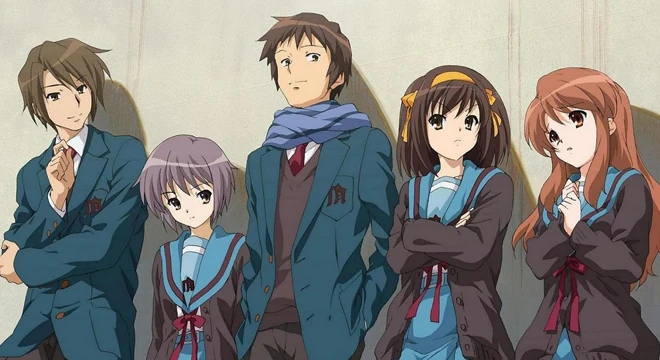
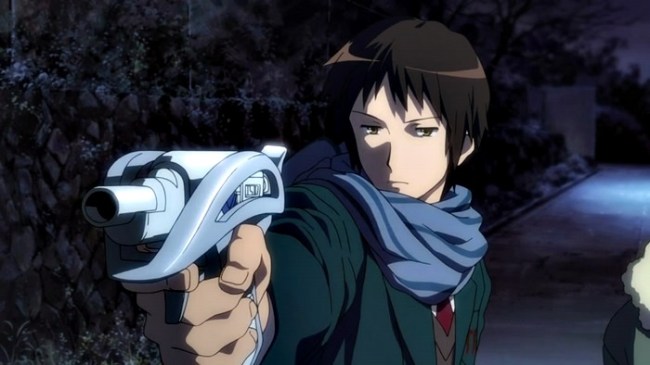
For those who don’t know, The Melancholy of Haruhi Suzumiya is a 2006 anime adaptation of a light novel series, which quickly grew in popularity, and its title character is one of the more recognizable anime icons. The main character, though, is Kyon (in the middle above), a high school student who falls into the orbit of the lovely, pushy, and highly capricious Haruhi (with the headband), involuntarily becoming a member of her new fun-seeking club dubbed the SOS Brigade. The other three club members Haruhi recruits turn out to be less-than-normal students and inform Kyon that Haruhi has godlike powers to reshape reality, which she doesn’t and mustn’t know about. Thus, the 2-season series follows their everyday adventures with the robot-like alien observer Yuki Nagato (the girl with purple hair), the time-traveling pushover Mikuru Asahina (girl with orange hair), and the good-natured but mysterious esper/psychic and king of exposition Itsuki Koizumi (the boy on the far left).

All of that information is much easier to digest in the series, which is light-hearted and charming for the most part. Haruhi tends to be obnoxiously bossy, such as exploiting poor Miss Asahina for sex appeal, but her craziness is nicely contrasted by Kyon’s straight man, who always complains and offers some perfectly amusing deadpan commentary. It’s a series that periodically incorporates science fiction into its prosaic high school setting and can be both fantastically complex and aggressively mundane, such as one episode with a four-minute stretch of nothing but Nagato silently reading or the infamous Endless Eight, in which eight consecutive episodes replayed the same events because the characters were stuck in a time loop. (The show gets a lot of heat and accusations of laziness for the Endless Eight, but it’s actually pretty impressive that the animators found eight different ways to present the same events and redrew each one.)

See the source image

If you’re not sure if all this sounds worth watching, it is, and not just because there’s a murder mystery and a talking cat and a giant alien cricket. It’s not because Melancholy itself is particularly amazing or great, though it is pretty entertaining. It’s because the show allows you to fully enjoy The Disappearance of Haruhi Suzumiya, the 2010 movie that supposedly drew plot from season 2 and forced the showrunners to fill time with the Endless Eight. It’s quite a feat that the movie makes the show worth watching, rather than the other way around. I honestly can’t think of another series-based movie that can say the same.

I’ve heard all kinds of praise for Disappearance, with fans naming it their favorite anime movie or claiming it ought to place in iMDB’s Top 250 (it’s currently #42 on iMDB’s animation list). And now that I’ve seen it, I can’t say I disagree. It’s an outstanding piece of animation that surpassed my expectations in every way. As the title indicates, Haruhi suddenly vanishes on December 18 (yes, I waited till today to post this review), the world apparently rewritten so that no one remembers her, except for Kyon, who is understandably perplexed at this inexplicable change. All the supernatural characters seem to be ordinary people now, and Kyon must figure out how to return the world to “normal” and perhaps even question which world is better.

See the source image

One of the more notable aspects of Disappearance is that it’s 163 minutes long, making it the second longest animated film of all time. It’s basically the equivalent of eight episodes of the series, yet despite its length, I was never bored. It’s hard to explain how unusual that is because the film is by no means action-packed. In contrast to the humor of the series, its tone is slow, serious, and melancholy. Unlike most anime films, there are no sweeping vistas or high-flying adventure; instead, it’s mostly winter cityscapes and interior scenes. How is it then that it held my attention from start to finish?

Well, aside from the fact that I’ve grown very fond of these characters, the plot manages to maintain interest in both the story and characters with some truly incredible pacing. Even with such a long runtime, there’s a lot of plot to cover, and the increased time allows characters’ motivations and the significance of their actions to sink in and add so much to their development. I don’t usually like to watch long movies, but this is one case where its length is carried largely by narrative and dialogue alone, and I’m glad nothing was cut, though I suppose Kyon’s awkward disorientation over his changed life could have been shortened.

See the source image

Whenever the pace threatens to lag, something significant is revealed and the moving orchestral score kicks in, making for some memorable scenes that feel like momentous turning points (the kind of scenes that would probably end an episode if this were broken up as part of the series). For example, the reappearance of one murderous character who should be dead is filled with the same looming menace as the coming of Jaws. In addition, despite the restraint compared with more fantastical anime, the animation is exceptional and quite detailed, with special attention paid to very expressive faces and the clouds of smoke that are breathed out in the cold Christmastime weather.

As much as I wish I could say to everyone “go watch this movie” with no strings attached, I must admit that the series is a prerequisite for understanding who everyone is. Even though seventeen minutes are spent establishing the status quo before Haruhi’s disappearance, almost every episode of the show is referenced at some point, which is great for those who’ve seen it, less so for those who haven’t. To cut some corners, I’d say you’d only really have to watch the first six episodes of season 1, the first episode of season 2, and the last entry in the Endless Eight. The rest aren’t as necessary, though you may not understand little things like Kyon trying to talk to a cat. I especially loved when time travel entered the equation of the film, and we got to revisit past scenes with a Back to the Future-style altered perspective, again something new viewers could just roll with but nostalgic viewers will understand better.

See the source image

Despite its potentially burdensome length, The Disappearance of Haruhi Suzumiya is a brilliant conclusion to a good series, transforming the show’s bright charm into subtle emotion and atmosphere. Hyperactive Haruhi herself can be irritating in large doses, so her absence for part of the film actually helps it and allows for some strong development for Kyon and especially Nagato, whose typically robotic face and voice finally get to reveal emotion in this alternate world. I also must point out, as others have before, that the English dub is one of the best out there. As the most significant voice actor, Crispin Freeman as Kyon provides some extensive and superb dialogue, such as an 8-minute soliloquy justifying a fateful decision, one which manages to engender both sympathy for him and regret for how it impacts another character. I’ve seen people refer to this speech as one of the greatest interior monologues of all time and with good reason, as it’s a key validation of his character.

I can usually tell how I feel about an animated film by whether I want to immediately watch it again after it’s over, and yes, all 163 minutes of Disappearance did just that. No, it’s not my new favorite anime film, but to those hesitant to watch a series just to see an overlong movie, I’ll just say you’re missing out.

See the source image

Best line: (Haruhi, to Kyon about Christmas) “You have to believe in a dream if you want to have one in the first place. If you don’t believe, even the dreams that can come true won’t.”


Rank: List-worthy


© 2017 S.G. Liput
519 Followers and Counting


Déjà Vu (2006)

15 Friday Dec 2017

Posted by sgliput in Movies, Poetry, Reviews, Writing

≈ 2 Comments

Tags

Action, Drama, Mystery, Sci-fi, Thriller

See the source image

It’s hard to run from déjà vu.
It always straggles up on you,
And when you least expect to feel
This creeping sense of the surreal,
It seems you’ve done this all before,
Now back for some half-known encore.

You tell yourself it’s nothing, but
Deep down you have to wonder what
This inkling is: mere happenstance
Or time’s stab at a second chance?
It’s hard to run from déjà vu.
Didn’t I just say that too?
_______________________

MPAA rating: PG-13

Now that I’m finally done with this semester’s finals, I can now get back into review mode. Last year, I did a review a day throughout December, and while that may not be feasible, I’m planning to post a little more often through the end of the year.

See the source image

I guess all I need to do to discover a new favorite is to find a sci-fi movie that received middling reviews, and chances are that I’ll enjoy it far more than the critics did. I’ve noticed that trend with the likes of Surrogates, In Time, and Cloud Atlas, and now Déjà Vu joins the list. I’ve always been partial to time travel stories, and this one played to everything I love about the genre—intricate plotting, cool gadgetry, twists both expected and unexpected—making me wonder why the critics found it so lackluster.

Denzel Washington is good as always as ATF agent Douglas Carlin (pronounced car-LIN), who proves his experience and investigative talent after a crowded New Orleans ferry is destroyed by a terrorist’s bomb. Recruited by an FBI agent (Val Kilmer), Carlin is pulled into a secret government program with access to a temporal window into the past, allowing investigators a comprehensive look at the scene four days prior. However, time flows at the same speed through this window, so they have one go-round to figure out the bomber’s identity and his connection to a separate murder victim (Paula Patton). But let’s just say things are less than transparent, and there’s more to this technology than meets the eye, as Carlin discovers firsthand.

See the source image

I wasn’t sure how much I’d like Déjà Vu based on Tony Scott’s directing style: bright, kinetic, and reminiscent of his later film Unstoppable, though with less zooming of the camera. Yet it kind of works in the film’s favor, particularly for the time window that allows the FBI to buzz around from any angle in the past. The fast pacing also adds to the thrill of the action scenes, like a just plain cool car chase in which Carlin pursues the killer (Jim Caviezel) in the past, trying to drive through past and present-day traffic.  There’s plenty of technobabble from the FBI scientists, including that pencil-through-paper wormhole explanation also used in Event Horizon and Interstellar, but Carlin’s grounded approach keeps the device’s practical uses from getting too confusing.

Time travel movies are often judged on how well they avoid the pitfalls of the genre.  Plot holes can often spoil such films for some people, from Kate and Leopold to The Lake House to About Time (though I still loved that one), while careful attention to the paradoxes involved can elevate a story to classic status. Déjà Vu falls somewhere in between. I believe it does follow the proper mechanics of time travel but simply doesn’t explain it as clearly as it could, mainly at the end. There’s a lot of careful setup, as when Carlin investigates crime scenes only for us to later see how everything got that way, and watching such attention to continuity always gives me an odd satisfaction as the full story is revealed. One idea mentioned is parallel timelines being created by significant enough changes to the past, a concept that reminded me a lot of the anime Steins;Gate, and this is the key to explaining what appears to be the most glaring plot hole of the climax. Now that I think about it, though, there’s one character who shouldn’t remember…. Oh, I don’t care; the rest of the movie is good enough that a little plot hole at the end can be easily forgiven.

See the source image

Déjà Vu has all the right ingredients for a great time travel thriller, and while I can recognize what others would consider drawbacks (minor plot holes, slightly disappointing villain, a victim who can’t seem to stay fully clothed in her own apartment), the whole package was still splendidly entertaining. I like my mind teased every now and then, so finding this unexplored member of the time travel genre made my day.

Best line: (Carlin) “For all of my career, I’ve been trying to catch people after they do something horrible. For once in my life, I’d like to catch somebody before they do something horrible, all right? Can you understand that?”


Rank: List-Worthy


© 2017 S.G. Liput
519 Followers and Counting


VC Pick: Fletch (1985)

03 Sunday Dec 2017

Posted by sgliput in Movies, Poetry, Reviews, Writing

≈ Leave a comment

Tags

Comedy, Mystery, Thriller, VC Pick

See the source image

Hello, sir, I’m Roland Dough,
I work for someone you don’t know,
And last I checked,
I must inspect
The volume of your stereo.

While I’m here, I thought I’d ask
If you’ve seen any shady stuff,
Like backroom deals
Or big reveals
Or guys like me who just can’t bluff.

Of course, you’ve not seen me before;
I think I’d know if I was seen.
I just stopped by
To satisfy
My need to be in every scene.

No, no, don’t bother getting up.
Your stereo broke; what a shame!
I’m finished, so
I’d better go.
It’s time to pick another name.
__________________

MPAA rating: PG (perhaps PG-13 nowadays)

My VC has a habit of having me rewatch films I saw only once years ago, just to see if my vague memories are reliable. In this case, I recalled Fletch favorably, even if every detail of the plot had long ago been jettisoned from my mind. But now that I’ve seen it again, that’s a crying shame, because I enjoyed Fletch a lot more than I expected. Chevy Chase’s comedy can be hit-and-miss for me, but when he’s good, he’s good.

See the source image

Chase plays investigative reporter Irwin Fletcher (one guess what his nickname is), who is in the middle of an undercover drug bust when he is picked up by dying millionaire Alan Stanwyck (Tim Matheson), who promises to pay Fletch to kill him. Since not asking questions isn’t in his DNA, Fletch then sets out doing what he does best, following leads, dressing up, and lying through his teeth in pursuit of the truth.

While it’s based on a book series I didn’t know existed, I felt Fletch might have been intended to mirror the success of Beverly Hills Cop. Both of them cast an SNL alum as an improvisational investigator, backed by similar-sounding Harold Faltermeyer scores. Whereas Axel Foley had a gun to do off-hours police work, Fletch is entirely dependent on his wit and sharp tongue, and it’s great fun watching him scramble to plug the holes in his stories. Throughout the film, he impersonates a doctor, a beach bum, a country club guest, an insurance investigator, and probably some I’m forgetting, all with hilarious fake names, and Chevy Chase sells the verbal gymnastics with aplomb.

See the source image

It was also fun recognizing some of the secondary cast, from Geena Davis as his news office buddy, Joe Don Baker as a corrupt police chief, and even The Waltons’ Jim-Bob (David W. Harper) as a young car thief, not to mention small roles for George Wyner, Kenneth Mars, George Wendt, and M. Emmet Walsh. (The “Moon River” scene with Walsh as a doctor was literally the only thing I remembered from last time.) It’s a talented cast and an intriguing, weaving plot, but Chase is the anchor, whose wry narration and slick spontaneity make Fletch possibly his best role, though I still prefer Foul Play overall. Now to remind myself of the sequel I also saw only once called Fletch Lives, though I hear Fletch Dies never got off the ground. Just kidding, though there’s still talk of a re-cast prequel called Fletch Won. This franchise may not be dead yet.

Best line: (Dr. Dolan, speaking of someone Fletch doesn’t know) “You know, it’s a shame about Ed.”
(Fletch) “Oh, it was. Yeah, it was really a shame. To go so suddenly like that.”
(Dr. Dolan) “He was dying for years.”
(Fletch) “Sure, but… the end was very… very sudden.”
(Dr. Dolan) “He was in intensive care for eight weeks.”
(Fletch) “Yeah, but I mean the very end, when he actually died. That was extremely sudden.”


Rank: List Runner-Up (a very close one)


© 2017 S.G. Liput
517 Followers and Counting


2017 Blindspot Pick #10: Donnie Darko (2001)

14 Tuesday Nov 2017

Posted by sgliput in Blindspot, Movies, Poetry, Reviews, Writing

≈ 3 Comments

Tags

Drama, Mystery, Sci-fi, Thriller

See the source image

I’m crazy, they say,
Since I see things that they
Cannot see, know, or even believe.
I’m crazy, although
I know which domino
Will destroy all that we now perceive.

I’m crazy, of course,
There’s no spirit or force
That could show me the things I have seen.
I’m crazy, perhaps,
But when things do collapse,
Maybe then they’ll all know what I mean.
_________________

MPAA rating: R (for language throughout and brief violence)

Well, it’s about time I got to see this movie. Considering its cult popularity, I’m surprised how hard it was to find a copy through my usual sources, a search that delayed this review as my intended October Blindspot. So now that I’ve watched Donnie Darko, what do I think of it? I’m honestly not sure! I can’t pin down exactly how I feel about this independent favorite. Not since Cloud Atlas has a film left me so befuddled, but at least that movie impressed me enough to know I liked it.

See the source image

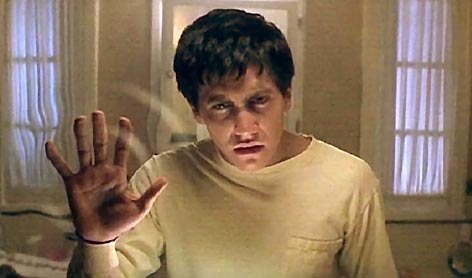
Along with October Sky, Donnie Darko helped establish Jake Gyllenhaal as a rising star of the early 2000s, and they certainly proved his range.  While his Homer Hickam in October Sky was all starry-eyed inspiration, Donnie Darko is a rebellious and mentally troubled teen who is told the world will end by a man in a demonic bunny costume. You can’t get much more different than that! Although I much prefer October Sky, Donnie Darko is consistently, um…I guess the word is interesting. I found myself engrossed in what would happen next simply because I wanted to know what the heck was going on with this teenage malcontent and his delusions of a bunny man named Frank.

There are a lot of disparate elements and compelling side characters in Donnie Darko, and I’m not convinced they all come together as they should. There’s Donnie’s budding romance with the new girl in class (Jena Malone). There’s a local motivational speaker (Patrick Swayze) whose positivity methods are derided. There’s a committed English teacher (Drew Barrymore) whose literature choices are denounced by the self-righteous gym teacher (Beth Grant). There are a bullied oriental girl who Donnie sympathizes with and a senile old woman (Patience Cleveland) who keeps checking her mailbox and once wrote a book on time travel. And in the midst of all this is Donnie, antisocial, prone to cynical outbursts, and a regular with his hypnotherapist (Katharine Ross). A special mention too for Jake’s sister Maggie Gyllenhaal as his sister in the movie as well. It may seem like I just listed all the characters for no reason, but that’s kind of how I felt watching the movie, as if each of these characters only mattered when they interacted with Donnie and didn’t go anywhere without him.

See the source image

Surrounded by a general sense of gloom, Donnie’s visions are intriguing as we wonder whether they’re real or just a product of paranoid schizophrenia, and there are plenty of memorable scenes, whether from Donnie’s sardonic barbs, the dreamy moments of destruction, or the well-utilized soundtrack with songs from Tears for Fears, Duran Duran, and Echo and the Bunnymen. (Get it, Bunnymen? It is set in 1988, after all.) I had a vague idea of how it would end, but I’ll admit that one scene totally shocked me and the final scenes were unexpectedly poignant, even as I wasn’t sure how much I really understood.

Donnie Darko is a lot of things at once: an angsty teen drama, a sci-fi thriller version of Harvey with psychological underpinnings and brilliant foreshadowing, a critique on holier-than-thou hypocrites, a black comedy with some weirdly funny dialogue. That bizarre Smurf conversation could only come from an independent movie. As I came to terms with my belief that the plot only makes sense if it’s all a delusional premonition in Donnie’s head, I did some research and found that there’s a much more complicated backstory with tangent universes and manipulated dead that isn’t really touched on in the film (at least the theatrical version I saw) but offers plenty of food for thought in trying to justify this overly complicated version of events. I guess it all comes down to the fact that what ends up happening had to happen, but I think the real “why” to this convoluted tale is only really known to writer-director Richard Kelly.

See the source image

I’m not decided on how much I actually liked Donnie Darko, but it certainly got me thinking, which is always welcome. I can see why it earned a cult following, at least among those who enjoy the effort of trying for it all to make sense.

Best line (or at least the one I got a kick out of): (Emily, to her sister Susie) “Beth’s mom said the boys’ locker room was flooded and they found feces everywhere.”   (Susie) “What are feces?”   (Emily) “Baby mice.”   (Susie) “Aww.”


Rank: List Runner-Up?


© 2017 S.G. Liput
517 Followers and Counting


The Ring (2002)

30 Monday Oct 2017

Posted by sgliput in Movies, Poetry, Reviews, Writing

≈ Leave a comment

Tags

Drama, Horror, Mystery, Thriller

You were warned, were you not?
You were warned, and yet you thought,
“What harm could come from silly things
Like some old tape?”  The phone then rings,
And on the other end, you hear
A voice that whispers low and clear,
“Seven days.”
You look about
And start perhaps to have some doubt,
Unsure if you were dumb or brave
To laugh at legends, shrug and cave,
And possibly dig your own grave.
__________________

MPAA rating: PG-13

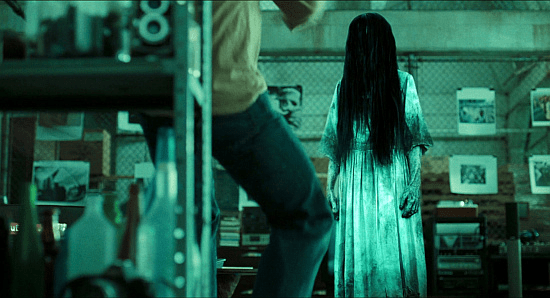
Urban legends are perfect subjects for horror because there’s always that one rumor or curse or half-serious tale of a crazed murderer that happens to be true, if only the protagonist can figure it out before they bite the dust. The Ring fits that mold well while adhering to the style of haunting, suggestive horror that I enjoy most.

Based on the Japanese book and film Ringu, The Ring is about a cursed video tape that kills its viewers seven days later, as illustrated by the familiar but tense opening with two teenage girls at home alone. When one dies, journalist Rachel Keller (Naomi Watts) decides to investigate the mysterious circumstances and watches the cursed tape herself, unwittingly exposing herself and her son Aidan (David Dorfman) to the evil unleashed by the bizarre images onscreen.

As I said, The Ring is “my kind of horror,” in that there’s far more effort on creating dread and atmosphere than on blood and guts, which I suppose is ironic considering it was directed by Gore Verbinski of Pirates of the Caribbean fame. Although it’s taken me this long to actually see it, its mop-headed villain girl (named Samara here, Sadako in the Japanese original) has become rather iconic, and I already knew of the film’s most famous scenes, such as the phone call whisper of “seven days” or the memorable television scene toward the end. (I guess there are several television scenes, but you probably know which one I mean.) Going in with such knowledge perhaps dampened the effectiveness of the scares, but I still appreciated the occasionally misleading tension and the gradually uncovered mystery.

It does fit my preferred style of horror, as did The Others and The Babadook, but there was something lacking in The Ring. Naomi Watts’ performance is fairly strong alongside costars Dorfman and Martin Henderson as her skeptical ex-husband, but there wasn’t as much of an emotional core to the story as there was in the other two films I mentioned. Plus, as the layers of the mystery were peeled back, it became a bit too convoluted, with too many puzzling twists that could only be explained by the argument that “there’s something supernatural afoot.”

The Ring didn’t quite have the dramatic oomph or shocking twist (it does try for both) that would elevate it to join my favorites, but it’s a potent horror flick nonetheless, with several evocative potential meanings for its title. The video tape plot device will immediately date it in years to come, but that isn’t automatically a negative since it doesn’t diminish the scares. I haven’t heard many good things about its two sequels, the most recent being Rings from this past year, so I think I’ll stick with this original for now, or if I’m feeling bold, maybe I’ll try the Japanese original original. One thing’s for sure, though: I definitely won’t be sitting anywhere near the screen!

Best line: (Richard Morgan, Samara’s father, to Rachel) “What is it with reporters? You take one person’s tragedy and force the world to experience it… spread it like sickness.”


Rank: List Runner-Up


© 2017 S.G. Liput
517 Followers and Counting


VC Pick: The Red Violin (1998)

27 Wednesday Sep 2017

Posted by sgliput in Movies, Poetry, Reviews, Writing

≈ Leave a comment

Tags

Drama, Meet 'em and Move on, Mystery

Image result for the red violin film

Where was this music before it came here
To strum my emotions and tickle my ear?
Where did this instrument formerly play
Before it revived to distinguish this day?

In hand-crafted wood, in dormancy kept,
Awaiting their moment, the melodies slept
Until the right hand, the right passion and skill
Compelled euphony from its prison to spill.

What hearts has it shattered? What lives has it blessed,
As lifelong companion or transient guest?
I cannot be sure of what lies in repose
In the unwritten symphony it alone knows.
_____________________

MPAA rating: R (mainly for a couple scenes with unnecessary nudity)

My VC obviously knows what I like. I had never even heard of this Canadian drama, but the way she described it piqued my interest. Indeed, it turned out to be exactly what I’d hoped, a Meet-‘Em-and-Move-On movie, my favorite unofficial subgenre in which a character’s life or journey introduces them to a parade of acquaintances and influences that typically brings their story full circle. Forrest Gump and War Horse are good examples, but whereas those follow a person or animal, The Red Violin follows the titular instrument as it passes from owner to owner through centuries, finding new meaning in the hands of each player.

Image result for the red violin film

The Red Violin is really five stories in one, and while it’s not as potentially confusing as Cloud Atlas, the narrative does jump around a bit. In a way, it begins at the end, with the violin being put up for auction, before leaping back to its creation at the hands of an Italian master (Carlo Cecchi) in 1681. From there, the violin passes on to 18th-century Austria, 19th-century England, and Communist China. I absolutely loved the editing that wove connections between stories that share little in common other than the violin. In between each new tale, we return to the 1600s, where the violin maker’s wife receives a tarot card reading, and we revisit the auction house in 1997, where every bidder has a unique reason for wanting this particular violin.

There’s a great deal of authenticity to each vignette, allowing us to grasp the time and place even without an explanatory subtitle. Each tale plays out in the language of the country—Italian, German, English, Chinese, etc.—and there aren’t many recognizable actors to call attention to themselves, Samuel L. Jackson being the only big name star. (Some may also recognize Jason Flemying, Colm Feore, and Greta Scacchi.) The music is fantastic, both the feigned violin playing itself and the compositions, both graceful and aggressive, by John Corrigliano, who won the Oscar for Best Score, and it adds even more sophistication to the elegant camerawork and production design.Image result for the red violin filmBy the end, I wasn’t positive how I felt about The Red Violin, but my admiration for it has grown with time. I especially admire how, in its journey through history, the violin becomes a symbol of everything music can stand for: a true love, a damaging obsession, an inspiring muse, a steep cost, a science to study, a cause for persecution, a treasure worth protecting. It’s imperfectly ambitious and didn’t provoke the strong emotions I usually expect from a Meet-‘Em-and-Move-On, but it was still an engaging and epic journey, punctuated by a revelation that wasn’t exactly a twist but more of a slow realization confirmed by the end. Beautiful, sad, and passionate in equal measure, The Red Violin is proof that my VC’s tastes sometimes do match my own.


Rank: List-Worthy


© 2017 S.G. Liput
511 Followers and Counting


← Older posts
Newer posts →

Recent Posts

  • We Didn’t Start 2025 (Recap)
  • NaPoWriMo 2025 Recap (Finally)
  • Sonic the Hedgehog 3 (2024)
  • It Happened One Night (1934)
  • Spellbound (2024)

Recent Comments

associatesofshellymann's avatarassociatesofshellyma… on My Top Twelve La La La So…
Kit's avatarKit Nichols on Bonnie and Clyde (1967)
lifelessons's avatarlifelessons on Look Back (2024)
Carol Jackson's avatarCarol Jackson on The Thief of Bagdad (1940…
Stephen's avatarStephen on Love Story (1970)

Archives

  • January 2026
  • December 2025
  • May 2025
  • April 2025
  • March 2025
  • February 2025
  • January 2025
  • December 2024
  • May 2024
  • April 2024
  • March 2024
  • February 2024
  • January 2024
  • December 2023
  • November 2023
  • October 2023
  • September 2023
  • July 2023
  • June 2023
  • May 2023
  • April 2023
  • March 2023
  • February 2023
  • January 2023
  • December 2022
  • November 2022
  • October 2022
  • September 2022
  • August 2022
  • July 2022
  • June 2022
  • May 2022
  • April 2022
  • March 2022
  • February 2022
  • January 2022
  • December 2021
  • November 2021
  • October 2021
  • September 2021
  • August 2021
  • July 2021
  • June 2021
  • May 2021
  • April 2021
  • March 2021
  • February 2021
  • January 2021
  • December 2020
  • November 2020
  • October 2020
  • September 2020
  • August 2020
  • July 2020
  • June 2020
  • May 2020
  • April 2020
  • March 2020
  • February 2020
  • January 2020
  • December 2019
  • November 2019
  • October 2019
  • September 2019
  • August 2019
  • July 2019
  • June 2019
  • May 2019
  • April 2019
  • March 2019
  • February 2019
  • January 2019
  • December 2018
  • November 2018
  • October 2018
  • September 2018
  • August 2018
  • July 2018
  • June 2018
  • May 2018
  • April 2018
  • March 2018
  • February 2018
  • January 2018
  • December 2017
  • November 2017
  • October 2017
  • September 2017
  • August 2017
  • July 2017
  • June 2017
  • May 2017
  • April 2017
  • March 2017
  • February 2017
  • January 2017
  • December 2016
  • November 2016
  • October 2016
  • September 2016
  • August 2016
  • July 2016
  • June 2016
  • May 2016
  • April 2016
  • March 2016
  • February 2016
  • January 2016
  • December 2015
  • November 2015
  • October 2015
  • September 2015
  • August 2015
  • July 2015
  • June 2015
  • May 2015
  • April 2015
  • March 2015
  • February 2015
  • January 2015
  • December 2014
  • November 2014
  • October 2014
  • September 2014
  • August 2014
  • July 2014
  • June 2014
  • May 2014
  • April 2014
  • March 2014
  • February 2014
  • January 2014
  • December 2013

Categories

  • Blindspot
  • Blogathon
  • Christian
  • Movies
  • Music
  • NaPoWriMo
  • Poetry
  • Reviews
  • TV
  • Writing

Meta

  • Create account
  • Log in
  • Entries feed
  • Comments feed
  • WordPress.com

Recent Posts

  • We Didn’t Start 2025 (Recap)
  • NaPoWriMo 2025 Recap (Finally)
  • Sonic the Hedgehog 3 (2024)
  • It Happened One Night (1934)
  • Spellbound (2024)

Recent Comments

associatesofshellymann's avatarassociatesofshellyma… on My Top Twelve La La La So…
Kit's avatarKit Nichols on Bonnie and Clyde (1967)
lifelessons's avatarlifelessons on Look Back (2024)
Carol Jackson's avatarCarol Jackson on The Thief of Bagdad (1940…
Stephen's avatarStephen on Love Story (1970)

Archives

  • January 2026
  • December 2025
  • May 2025
  • April 2025
  • March 2025
  • February 2025
  • January 2025
  • December 2024
  • May 2024
  • April 2024
  • March 2024
  • February 2024
  • January 2024
  • December 2023
  • November 2023
  • October 2023
  • September 2023
  • July 2023
  • June 2023
  • May 2023
  • April 2023
  • March 2023
  • February 2023
  • January 2023
  • December 2022
  • November 2022
  • October 2022
  • September 2022
  • August 2022
  • July 2022
  • June 2022
  • May 2022
  • April 2022
  • March 2022
  • February 2022
  • January 2022
  • December 2021
  • November 2021
  • October 2021
  • September 2021
  • August 2021
  • July 2021
  • June 2021
  • May 2021
  • April 2021
  • March 2021
  • February 2021
  • January 2021
  • December 2020
  • November 2020
  • October 2020
  • September 2020
  • August 2020
  • July 2020
  • June 2020
  • May 2020
  • April 2020
  • March 2020
  • February 2020
  • January 2020
  • December 2019
  • November 2019
  • October 2019
  • September 2019
  • August 2019
  • July 2019
  • June 2019
  • May 2019
  • April 2019
  • March 2019
  • February 2019
  • January 2019
  • December 2018
  • November 2018
  • October 2018
  • September 2018
  • August 2018
  • July 2018
  • June 2018
  • May 2018
  • April 2018
  • March 2018
  • February 2018
  • January 2018
  • December 2017
  • November 2017
  • October 2017
  • September 2017
  • August 2017
  • July 2017
  • June 2017
  • May 2017
  • April 2017
  • March 2017
  • February 2017
  • January 2017
  • December 2016
  • November 2016
  • October 2016
  • September 2016
  • August 2016
  • July 2016
  • June 2016
  • May 2016
  • April 2016
  • March 2016
  • February 2016
  • January 2016
  • December 2015
  • November 2015
  • October 2015
  • September 2015
  • August 2015
  • July 2015
  • June 2015
  • May 2015
  • April 2015
  • March 2015
  • February 2015
  • January 2015
  • December 2014
  • November 2014
  • October 2014
  • September 2014
  • August 2014
  • July 2014
  • June 2014
  • May 2014
  • April 2014
  • March 2014
  • February 2014
  • January 2014
  • December 2013

Categories

  • Blindspot
  • Blogathon
  • Christian
  • Movies
  • Music
  • NaPoWriMo
  • Poetry
  • Reviews
  • TV
  • Writing

Meta

  • Create account
  • Log in
  • Entries feed
  • Comments feed
  • WordPress.com

Blog at WordPress.com.

Is this your new site? Log in to activate admin features and dismiss this message
Log In
  • Subscribe Subscribed
    • Rhyme and Reason
    • Join 814 other subscribers
    • Already have a WordPress.com account? Log in now.
    • Rhyme and Reason
    • Subscribe Subscribed
    • Sign up
    • Log in
    • Report this content
    • View site in Reader
    • Manage subscriptions
    • Collapse this bar