• Home
  • About Me
  • The List
  • THE LIST (2016 Update)
  • THE LIST (2017 Update)
  • THE LIST (2018 Update)
  • THE LIST (2019 Update)
  • THE LIST (2020 Update)
  • THE LIST (2021 Update)
  • THE LIST (2022 Update)
  • Top Twelves and More
  • The End Credits Song Hall of Fame

Rhyme and Reason

~ Poetry Meets Film Reviews

Rhyme and Reason

Tag Archives: History

The Imitation Game (2014)

04 Tuesday Apr 2017

Posted by sgliput in Movies, NaPoWriMo, Poetry, Reviews, Writing

≈ Leave a comment

Tags

Biopic, Drama, History

Image result for the imitation game film

(Today’s NaPoWriMo prompt was to incorporate an “enigma” or something hidden into the poem, so I thought a movie about solving Enigma would be perfect. For my own secret message, try stringing together the underlined letters.)

The German Codes in safety rode
Upon the winds of radio,
And passed with ease their strategies
To Mystify the Allied foe.

Bright minds were scratched and Egos matched,
The Riddle daily taxing Brains
Who knew their best At this math Test
Could still Harm lives and Squander gains.

Unraveling this Risky thing
Was not for one man to Explain.
What Cracked And tamed the Numbers game?
A mind Combined To break the chain.
________________

MPAA rating: PG-13

Benedict Cumberbatch seems most comfortable playing the smartest guy in the room, even if he only thinks he’s the smartest guy in the room. Sherlock, Doctor Strange, etc. exemplify this, and The Imitation Game allowed him to apply that proven characterization to a real-life figure, Alan Turing, a mathematical computer pioneer who helped crack the German Enigma code during World War II.

Cumberbatch is the film’s strongest asset, channeling the same troubled-genius mentality as Russell Crowe in A Beautiful Mind, not so much in the mental health aspects as in his blinding self-confidence and difficulty working with others. His acting, as always, is beyond reproach and distinguishes Turing as a man of vision frustrated by the inflexibility of his superior (Charles Dance) but too single-minded himself to recognize the need for collaboration with the rest of his team of genius mathematicians. Keira Knightley’s Joan Clarke serves as an attractive reminder that a talent for numbers is not Turing’s alone, and it’s an insightful pleasure watching Cumberbatch engage with her and his fellow teammates to perfect his decoding machine. The espionage angle involving a major general from MI6 (Mark Strong) is also peppered with intrigue.

Image result for the imitation game film

The performances, Alexandre Desplat’s score, and the period-piece re-creations are top-notch, but the film’s historical accuracy leaves much to be desired. Many “based-on-a-true-story” movies take artistic license, but learning after the fact that most of the events of the film occurred completely differently is rather disappointing. Likewise, the film’s ultimate transition from code breaking and war strategies to a social tragedy centered on the treatment of Turing’s homosexuality lost my interest. This aspect of Turing’s life was clearly important and lamentable, but it felt tacked on and even a tad manipulative when paired with the historical liberties. The Imitation Game is handsome and well-acted and even consummate in its first half, but the dual intentions of the filmmakers to merge two kinds of stories, one about war decoders and one about social injustice, feel like a forced fit that doesn’t live up to its early promise.

Best line: (Turing’s childhood friend Christopher, and later Joan) “Sometimes it’s the very people who no one imagines anything of who do the things no one can imagine.”


Rank: Honorable Mention


© 2017 S.G. Liput
461 Followers and Counting


Hidden Figures (2016)

13 Monday Feb 2017

Posted by sgliput in Movies, Poetry, Reviews, Writing

≈ 2 Comments

Tags

Biopic, Drama, Family, History

Image result for hidden figures film


The chronicles of history are filled with famous names,
Who’ve earned our generation’s praise or bear their age’s shames.
We think we know the few worthwhile players of the past,
And yet the world was shaped by more than names we learned in class.

Behind each role we’re tested on and public figure known
Were men and women, making crucial impacts of their own.
Perhaps they knew obscurity would be their likely end,
But history’s more hidden tales are those to recommend.
__________________

MPAA rating: PG

I’m honestly amazed that I did not already know the story of Katherine Johnson and her fellow black female compatriots at NASA. I remember noticing a theater display for Hidden Figures on my way out of watching Rogue One and thinking, “Oh, NASA—that might be interesting.” The same day I saw an episode of Timeless that featured Katherine Johnson as the historical figure of the week. That’s when I did some research and knew this was a film I had to see, which I finally did with my mom.

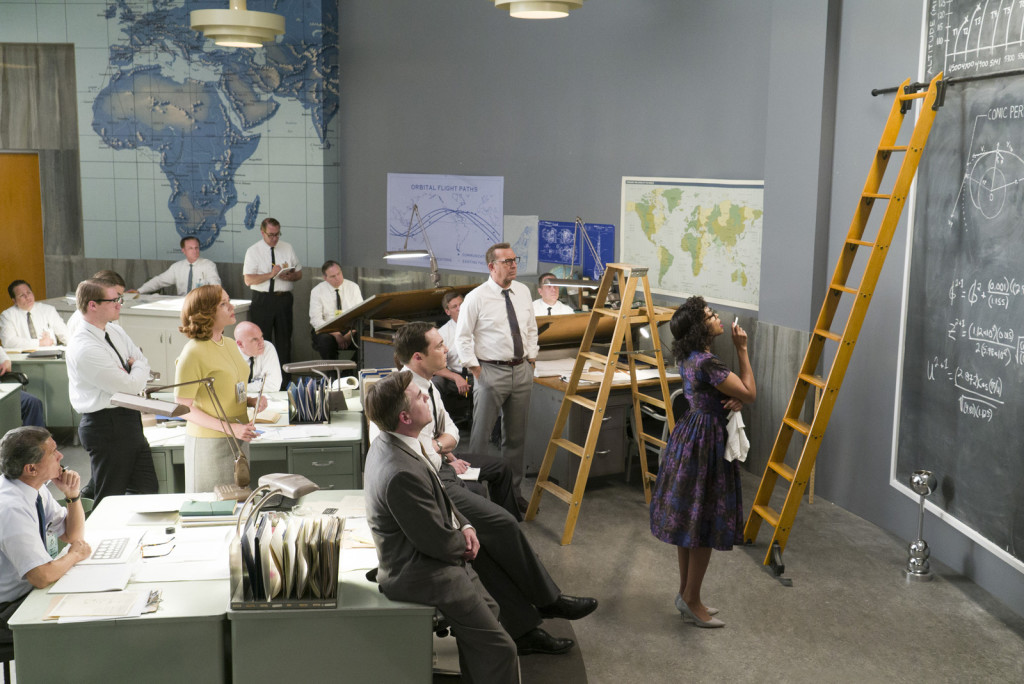
She used to work at Kennedy Space Center during the early Space Shuttle launches, and my grandfather was involved at a relatively high level in the Mercury, Gemini, Apollo, and Shuttle missions, so the space program means a lot to our family. Which makes it all the more astonishing that neither I nor my mom had ever heard of these “hidden figures,” who calculated trajectories and landing coordinates even better than their white, male coworkers. Taraji P. Henson plays Katherine Goble (eventually Johnson), whose knack for algebra earns her the role of “computer” for the Space Task Group, a thankless job of number-crunching with more than a little prejudice aimed her way. Also working at Virginia’s Langley Research Center are Mary Jackson (Janelle Monáe), who strives for the right to be an engineer, and Dorothy Vaughn (Oscar nominee Octavia Spencer), who seeks the elusive title of supervisor over her team of black female computers. In addition to the talented cast of African Americans, including Mahershala Ali as well, Kevin Costner delivers an excellent supporting role as Katherine’s no-nonsense boss who refuses to let bigotry impede the mission at hand. (I rather wish Costner had gotten a Supporting Actor nomination; Ed Harris did for Apollo 13, and there’s nothing Harris did that Costner doesn’t do just as well.)

Image result for hidden figures kevin costner film

I expected to love Hidden Figures going in, with its inspiring role models and old-fashioned enlightenment of unsung history, and I did, perhaps not quite as much as I expected but not in any disappointing way. I felt that the racism early on was a bit heavy-handed, with entire rooms of white men staring at Katherine as if she had two heads, yet I wouldn’t be surprised if that was indeed how it was. Likewise, there are many historical liberties taken for the sake of the story, whether it be composite characters created to get points across or details streamlined to simplify the story. For instance, Costner is made to look like he’s running Mission Control, but he’s at Langley, not Houston. Yet, for the most part, I didn’t mind the license taken, since it served the story to no historical detriment. (There are some interesting true-to-life details thrown in, though, such as the flooring material that snags Mary Jackson’s high heel; my mom can attest to that annoyance.) I also don’t agree with the few complaints I’ve heard about the film’s predictable underdog conventions; when it’s done right, it makes for a great movie, and it’s never been done with these characters and this particular slice of history. For the record, my mom absolutely loved it, except maybe for some of the semi-repetitive soundtrack from Pharrell Williams.

Hidden Figures is a film I believe all African Americans, all women, and everyone else for that matter ought to see. Beyond being an entertaining true story, it’s a film rife with positive messages, both obvious and subtle. Mary Jackson and Dorothy Vaughan may be bitter about their superiors’ scorn, but they don’t take it lying down. Dorothy herself tells Mary not to complain but to do something about it. It’s a court plea in Mary’s case, while Dorothy shows incredible foresight in noticing the incoming IBM meant to replace her human computers and becoming an expert in computer coding to make herself and her team valuable. Her visit to the library is backdropped by a street protest, and while the protest clearly got more attention at the time, it’s her attempts at personal betterment that are more laudable.

Image result for hidden figures film

While Hidden Figures may follow familiar story beats, it’s a marvelously acted feel-good film that ennobles intelligence and mathematics and casts a long overdue spotlight on the unrecognized heroines of NASA. Even if the initial reactions of their biased coworkers can be frustrating, the talent and intellect they displayed are undeniable, as is the satisfaction of seeing it vindicated. They served their nation well, and there was no color-coding to the worry and interest directed at sending Americans into space, evident from black and white families both anxiously watching John Glenn’s historic flight. At our present point in history, what could be more inspiring?

Best line: (Katherine, responding to being underestimated) “I will have you know, I was the first Negro female student at West Virginia University Graduate School. On any given day, I analyze the binomial levels of air displacement, friction, and velocity. And compute over ten thousand calculations by cosine, square root, and lately analytic geometry. By hand. There are twenty bright, highly capable Negro women in the West Computing Group, and we’re proud to be doing our part for the country. So yes, they let women do some things at NASA, Mr. Johnson. And it’s not because we wear skirts. It’s because we wear glasses. Have a good day.”


Rank: List-Worthy


© 2017 S.G. Liput
451 Followers and Counting


That’s Entertainment! (1974) and That’s Entertainment, Part II (1976)

10 Tuesday Jan 2017

Posted by sgliput in Movies, Music, Poetry, Reviews, Writing

≈ 2 Comments

Tags

Documentary, History, Musical

Image result for that's entertainment 1974 film


For centuries, great entertainers
Wowed the crowds and made them cheer,
With song and dance, speech, and romance,
Their famous names known far and near.

Yet soon they died, their plays and songs
Preserved in libraries and hearts;
We saved the page, but those on stage
Were soon forgotten from the arts.

Not till the novelty of film
Could actors prove their artistry
And ply their skill to awe and thrill
With hope of immortality.
_______________

MPAA rating for both: G

It’s hard enough trying to keep up with all the new releases that pass through the cinemas week after week, but what about the plethora of old classics stretching back to the 1920s? What about the hundreds of musicals that MGM churned out back in the days when contracted actors were assigned roles rather than offered them? Where does one start? Well, That’s Entertainment! is an excellent reference point, a star-studded documentary that also serves as a highlight reel of old musicals, famous and obscure.

Older musicals often seem to have just a thin plot meant solely to string together spectacular song-and-dance numbers, and That’s Entertainment! gets rid of the connective tissue to provide a musical tour of MGM’s forgotten pageantry. The early days of 1929’s The Broadway Melody may not be all that impressive, but within a few years, MGM had the musical extravaganzas down to a science. I’m well familiar with favorites like Singin’ in the Rain and The Wizard of Oz or famous scenes from On the Town (the three sailors singing “New York! New York!”) and Royal Wedding (Fred Astaire dancing on the ceiling), but there are boatloads more that I’d never even heard of, such as the series of suspiciously similar small-town romances starring Mickey Rooney and Judy Garland. Most of the clips are worth watching just as highlights, but a few have made me curious to check out the films themselves, such as the navy grandeur of Hit the Deck (1955) or the High School Musical forerunner Good News (1947).

Image result for royal wedding fred astaire

Sprinkled throughout the singing and dancing are introductions filmed by a variety of stars in 1974 as they wander the decaying MGM backlot where these musicals were filmed decades earlier. (The sets were torn down shortly after filming.) The star power is incredible, including Frank Sinatra, Gene Kelly, Elizabeth Taylor, Jimmy Stewart, Fred Astaire, Mickey Rooney, and the late Debbie Reynolds. Each screen legend introduces the work of one of their friends and costars, passing the baton as the film progresses. Old film buffs are sure to recognize the less widely known stars from the old film clips more than casual viewers like myself, but seeing some of these stars in action helped me appreciate the talents of performers whose reputations have waned over the decades. I wasn’t familiar with the incredible tap dancing of Ann Miller, the water-fountain displays of Esther Williams, or the impressive voice of Kathryn Grayson, but I’m glad I am now.

The film also features a few familiar faces in unexpected musical roles. Mainstream musicals may be anomalies these days, but back in the day, they were everywhere, and stars didn’t always have a choice of whether to sing or not. I never thought to see Jimmy Stewart trying to carry a tune, much less Clark Gable dancing to “Puttin’ on the Ritz” in 1939’s Idiot’s Delight. Let’s just say, there’s a reason they eventually left the dancing to Gene Kelly and Fred Astaire.

Speaking of Kelly and Astaire, they actually teamed up to host That’s Entertainment, Part II, proving that there was far too much material in MGM’s vault to fill only one documentary. (There’s also a Part III from 1994, but I didn’t get to see that one.) While it features the same retrospective montage of film clips, Part II feels even less like a documentary, thanks to the more sensational production values and the entertaining interludes of Kelly and Astaire as the sole hosts. In the first That’s Entertainment, Astaire admitted that his favorite dance partner was actually Gene Kelly, whom he had danced with only once in 1946’s Ziegfeld Follies. In Part II, the two reunite to dance together again, which was actually Astaire’s last dance on film, and they reportedly did so just to prove that they hadn’t lost their mojo, even in their sixties and seventies.

Image result for that's entertainment part II

As with the first film, the musical moments are plentiful and dazzling, again with a few stunning dance numbers that are undoubtedly the centerpieces of their films. I won’t soon forget the operatic rebellion of New Moon, the athleticism of Kiss Me, Kate, or the amazing extended shot of a young Bobby Van literally hopping across town in Small Town Girl. Plus, the almost disturbing sight of Fred Astaire, Nanette Fabray, and Jack Buchanan singing on their knees dressed as babies in The Band Wagon. Plus, I did get to recognize a few familiar scenes, including one for Cabin in the Sky, an all-black older musical I happened to randomly watch last year. In addition, there are more than just musical scenes. Part II also has tributes to screen greats like Spencer Tracy and Katherine Hepburn and comedians like the Marx Brothers, including the famous packed stateroom scene from A Night at the Opera.

That’s Entertainment! and its sequel reveal just how much fabulous musical cinema is on the verge of being forgotten, and I’m quite glad that MGM kindly boiled down its heyday into these affectionately repackaged collections. I only knew of these films from my mom, who talks about how they opened her eyes to the Golden Age of Hollywood musicals, and in some ways, it did the same for me. The tunes are both new and familiar (I had no idea that the music to “Make ‘Em Laugh” predated Singin’ in the Rain and was used in The Pirate), the choreography and star power are staggering, and the whole package is, well, entertaining. I doubt I’ll ever get around to seeing all the films featured, but at least I know I’ve seen all the best parts.

Image result for good news 1947

Best line: (Liza Minnelli) “Thank God for film. It can capture a performance and hold it right there forever. And if anyone says to you, ‘Who was he?’ or ‘Who was she?’ or ‘What made them so good?’ I think a piece of film answers that question better than any words I know of.”


Since documentaries are ineligible for my List, it’s the return of the five-star system.
Rank for both: Five Stars out of Five


© 2017 S.G. Liput
437 Followers and Counting

 

My Name Is Bill W. (1989)

21 Wednesday Dec 2016

Posted by sgliput in Movies, Poetry, Reviews, TV, Writing

≈ Leave a comment

Tags

Biopic, Drama, History

Image result for my name is bill w. 1989


Although I sit in the cabinet,
I shall not stay for long.
My contents undeniably tempts
My owner with its song.
Its call is far too strong.

Though some can sip with a managed lip,
A few can’t get enough.
No need to think when an amber drink
Can smooth life when it’s rough.
One swig, and “That’s the stuff!”

I’ve been his friend for years on end;
He’s rarely missed a day.
This latest trick, I hope, won’t stick,
Or I may fade away.
I’m lonely since A.A.
____________________

MPAA rating: TV movie (should be PG)

Back in 1986, James Woods and James Garner starred in a Hallmark Hall of Fame movie called Promise, a tale of an older brother (Garner) who must come to terms with caring for his schizophrenic sibling (Woods). While the acting is phenomenal and it remains one of the most celebrated TV movies ever with Emmys, Golden Globes, and a Peabody to its name, it fell short of greatness for me thanks to a downer of an ending. Three years later, Woods and Garner teamed up again in this other Hallmark Hall of Fame member titled My Name Is Bill W., and what was apparently intended as a reunion turned out to be even better than their original collaboration.

My Name Is Bill W. is the story of the founders of Alcoholics Anonymous, particularly Bill Wilson (Woods), who begins as a happy husband with great business aspirations in the stock market. Over the years after World War I, he schmoozes investors and stock opportunities to work his way up the ladder of success, all with drink in hand. The habit of a few drinks to loosen lips and pocketbooks quickly becomes a lifestyle for him, much to the dismay of his faithful wife (JoBeth Williams), and he soon starts to spiral into alcoholism. It’s difficult to watch a man willingly destroy his life, but at least we have the promise of a revelation, one which unites Wilson and fellow drunk Bob Smith (Garner) into a dynamic duo dedicated to supporting alcoholics everywhere in need of hope.


Image result for my name is bill w. film

Both main actors are in top form, with JoBeth Williams being an extra surprising standout as Wilson’s long-suffering wife, and other strong roles go to Gary Sinise and George Coe. With the inebriated mistakes and desperation he pulls off so convincingly, it’s no wonder that Woods won an Emmy, just as he did for Promise three years earlier, though it’s sad that Garner didn’t win for either.

Above all, the film warns against the dangers of overdrinking, not by demonizing alcohol itself but reminding us that some people simply lack the self-control of others, whether it be “a disease” as one doctor states in the film or a psychological addiction. It’s clear from Bill Wilson’s life that oftentimes a desperate man can only pick himself up after hitting his lowest point, but his story serves as a caution for anyone who refuses to listen to the love and advice of their friends and family. What might have been a tragedy thankfully turned out to be an inspiration because, for Bill Wilson, a man whose life was ruled by alcohol both in its excess and its absence, success didn’t simply involve dragging himself out of the gutter, but helping others to do the same.

Best line: (Bill) “It’s like any journey, Fred. It begins with the first step.”


Rank: List-Worthy


© 2016 S.G. Liput
437 Followers and Counting


Sophie Scholl – The Final Days (2005)

07 Wednesday Dec 2016

Posted by sgliput in Movies, Poetry, Reviews, Writing

≈ 4 Comments

Tags

Drama, History

Image result for sophie scholl the final days


‘Tis when we are threatened by powers that be
That mettle is measured and morals are key.

‘Tis easy conceding to dangerous ifs
When everyone speeds toward the same social cliffs.

‘Tis harder to risk reputation and friend
For ethics that many refuse to defend.

‘Tis faith we must have in a world full of spite
To recognize wrong when it persecutes right.
________________

MPAA rating: PG
Language: German (with English subtitles)

One of the key motivators behind the Valkyrie plot to kill Hitler was to prove to the world that not everyone was willing to submit to his oppressive regime. While those involved with Valkyrie were high-ranking officers, the same commitment applied to many German civilians as well, such as the White Rose, the group of students who made their clandestine defiance known through anti-Nazi graffiti and leaflets. An Oscar nominee for Best Foreign Language Film, Sophie Scholl – The Final Days is about one of the White Rose’s most famous members, focusing on the resistance movement not in practice but in ideals.

Except for a tense scene of Sophie and her brother distributing the White Rose’s illegal literature, the majority of the film is concerned with Sophie Scholl’s imprisonment and trial and how she responded to the Nazis’ threats and slander. As portrayed by Julia Jentsch, Scholl is a model saint, praying for strength, enduring the knowledge of her fate with faith and patience, and answering her accusers with a calm confidence of spirit. While she denies her involvement at first, the interrogation points clearly at her guilt, and she refuses to show remorse for her support of free speech and all she knows to be right. One especially potent exchange with her interrogator condemns the crimes and standards of the Nazi movement so powerfully that even her opponent seems moved by her convictions, right before an act that implicates him as another Pontius Pilate sending an innocent to death.

Image result for sophie scholl the final days

A defense of free speech and conscience rights, Sophie Scholl – The Final Days is heavy with dialogue but rich in moral fortitude and quiet courage. The final scenes are restrained yet forceful, and every actor is on point, especially Jentsch as Sophie and Fabian Hinrichs as her brother Hans. Sophie and her fellow prisoners clearly accept their fate with trepidation, but history has proven them as heroes and martyrs.

Best line: (Sophie) “Trucks came to pick up the children at the mental hospital. The other children asked where they were going. ‘They’re going to heaven,’ said the nurses. So the children got on the truck singing. You think I wasn’t raised right, because I felt pity for them?”


Rank: List-Worthy


© 2016 S.G. Liput
435 Followers and Counting


The Finest Hours (2016)

06 Tuesday Dec 2016

Posted by sgliput in Movies, Poetry, Reviews, Writing

≈ Leave a comment

Tags

Drama, History, Thriller

Image result for the finest hours


The wind was tired of being still
And spun its wings with fearful will.
It threaded threats with every thrust
And shook the sea with every gust,
Reminding man he was but dust
In fear of nature’s means to kill.

Beneath the atmospheric rant
That conjured waves with every pant
Were men in danger of the gale
And men who braved the wintry wail,
Enrolled to risk, too bold to fail
Or yield to whisper-winds of “Can’t.”
________________

MPAA rating: PG-13

The Finest Hours is essentially The Perfect Storm with a happier ending, but this is one case where the tragedy outshines the victory. Despite this, The Finest Hours is a good film and a worthy tribute to the brave men who, in 1952, saved the crew of a bisected ship in a daring tempest-tossed rescue.

The heroism is admirable, but the characters performing it are less than memorable. Chris Pine is the strongest player, playing Bernie Webber, a Coast Guard crewman whose diffident nature is the polar opposite of Pine’s Captain Kirk persona. Due to a past failed rescue, Bernie doubts himself, as do several residents of his Massachusetts town, but he proves himself by rising to the occasion when he is sent out in search of the distressed SS Pendleton. As honorable as Bernie is, there are moments where his character is peculiarly hesitant, such as an early moment where a marriage proposal is met by an unexplained, glossed-over “no.” On the other side of the disaster, Casey Affleck as the Pendleton’s engineer Ray Sybert rallies the crew with his expertise and good sense, but despite hints to the contrary, he’s never developed past a heroic blank slate.

Image result for the finest hours


Smaller moments with side characters work better, such as the helpful resolve of Bernie’s fiancée Miriam (Holliday Grainger) or a discerning realization of one of the townsfolk who blamed Bernie for his past failure. It was also nice to see Graham McTavish from The Hobbit trilogy outside of his dwarf makeup. In addition, the inclement effects recreate the danger of the nor’easter threatening everyone at sea and keep the extended rescue scenes tense and treacherous.

I can’t say I didn’t care for the characters in The Finest Hours, but I didn’t know them well enough. As much as I usually prefer happy endings, The Perfect Storm is a better film, if only for the stronger characterization, but The Finest Hours still brings a laudable dose of maritime valor to the screen.

Best line: (Bernie) “They say you gotta go out. They don’t say you gotta come back.”


Rank: List Runner-Up


© 2016 S.G. Liput
434 Followers and Counting


The Man Who Never Was (1956)

18 Friday Nov 2016

Posted by sgliput in Movies, Poetry, Reviews, Writing

≈ 4 Comments

Tags

Classics, History, War

Image result for the man who never was


I dreamed a man deprived of soul
Had drifted to the shore.
He waited, though I did not know
What he was waiting for.

At last, a passerby took note,
And, soon borne by a crowd,
The body seemed within my dream
To be uniquely proud.

The passive face had made its way
From sea to land to grave,
And none could tell this empty shell
Had come more lives to save.

I wouldn’t know myself, except,
I saw his soul, which wore
A knowing glance, pleased with the chance
To be worth waiting for.
______________________

MPAA rating: G

Hollywood loves to find those fascinating true-life stories, especially if they involve war, Nazis, and spies, and The Man Who Never Was proves that was the case even back in the 1950s. Based off a novel written by Ewen Montagu, who headed the World War II operation that occurred only thirteen years before the film’s release, The Man Who Never Was details the British plan to convince the Axis Powers that the Allies would invade Greece rather than Sicily, a plan that involved an anonymous dead body and fake intelligence reports.

After a half-serious suggestion from his assistant (Robert Flemyng), Navy Lieutenant Commander Ewen Montagu (Clifton Webb) ponders how to possibly divert German forces from Sicily, where the Allies will invade within months. He decides that the enemy could be misled by a dead body found with false documents but only if the ruse is convincing enough. It seems like a straightforward plan and one that had actually been used in the past, but the film presents this Operation Mincemeat as quite a tricky challenge, as Montagu and his team ensure that every detail is thoroughly persuasive in crafting the persona of “Major William Martin.” Nothing is taken for granted, from the signatures of real generals endorsing the fake letters to the everyday contents of the man’s pockets, which must appear to reflect Martin’s habits and even his love life. And of course, there’s the sticky task of cajoling the family of the recently deceased to release his body for an unspecified undertaking for the greater good.

Image result for the man who never was 1956

In many ways, I doubt The Man Who Never Was could have been made nowadays, at least in its original form. The military strategies are never dull, but there’s no wow factor that would make this a blockbuster. It fascinates with its procedural shrewdness and attention to detail. Even when the mostly true story embellishes with a Nazi spy (Stephen Boyd, three years before playing Messala in Ben-Hur) sent to London to verify Martin’s identity, his tactics are subtle, and the climax is a rare example of the best course of action being no action at all. As Montagu says with a well-placed poem quote from Milton, “They also serve who only stand and wait.”

The only element that keeps this film from being List-Worthy in my opinion is Gloria Grahame, who plays the lover of a real soldier while doubling as William Martin’s fake fiancée. In a film where every other performance is kept earnest and believable, Grahame’s emotional histrionics feel out of place, even if they do play a role in the plot. Plus, her face seemed strangely shiny in all of her scenes, though that’s a personal quibble on my part.

As realistic spy stories go, The Man Who Never Was is an understated gem, with a well-deserved 100% on Rotten Tomatoes. While it appears several details fall short of historical accuracy, it’s a thoughtful and well-acted procedural sure to please those in search of neglected tales from World War II.

Best line: (Admiral Cross, after hearing the plan) “It’s the most outrageous, disgusting, preposterous, not to say barbaric idea I’ve ever heard, but work out full details and get back to me in the morning!”   (Montagu) “Thank you, sir!”


Rank: List Runner-Up


© 2016 S.G. Liput
422 Followers and Counting


Experimenter (2015)

18 Sunday Sep 2016

Posted by sgliput in Movies, Poetry, Reviews, Writing

≈ 2 Comments

Tags

Drama, History

Image result for experimenter film


Our human nature is a lake
Where most content themselves to take
A shallow view for comfort’s sake,
But few will dare the deep.
The poets plumb it with their verse,
And nihilists would make it worse
While sages study to reverse
Its ever-waning creep.

When someone dives and brings to light
A bit of psyche to indict
That questions what is wrong and right,
How often do we balk!
We point the finger, hide from view,
Insist that it cannot be true,
And say we’re wiser than the few
Who failed temptation’s knock.

To fear a truth and disregard
Depravities that perish hard
Will leave us only further marred
By lessons left unlearned.
The depths we’d rather not explore
Are those we most should not ignore,
For by the schemer who knows more
Is human nature turned.
________________

MPAA rating: PG-13 (for one lone obscenity and some subject matter, could even be PG)

I had never heard of the Milgram experiment before Experimenter, but its social impact is considerable. While hearing of the shock-based college study brought to mind Venkman’s similar parody at the beginning of Ghostbusters, the actual experiment touched upon serious questions ranging from the compliance of Nazi subordinates to social engineering and people’s natural reluctance to rebel against authority. It’s thought-provoking research, which inspired an equally provocative film.

While Experimenter is a scrutiny of Stanley Milgram himself as well as a restaging of his most famous work, it begins where his fame did: the shock experiment. As Milgram (Peter Sarsgaard) watches from behind a one-way mirror, his assistant brings in two volunteers, one to answer questions and receive electric shocks for wrong answers and one to administer the questions and shocks. The shock-ee is actually part of the ruse and re-creates sounds of pain from a closed room, while the shocker is urged to continue increasing the voltage no matter what. A majority of participants lacked the will to resist and yielded to pressure to deliver supposedly life-threatening shocks, simply because they were told to. Only 35% refused.

The orchestrated scenario forms the beginning of the film but is also intercut with Milgram’s life, including meeting his eventual wife (Winona Ryder). During all this, Sarsgaard speaks directly to the audience, discussing the experiment and his findings like a purveyor of mental provocation. Indeed, that’s how he sees himself and his job as a social psychologist; he’s merely presenting facts for academia and the public to discern as they will and is surprised at the controversy he attracts. More people seem critical of how he tricked his participants than of their actual responses. Later, Milgram tries to diversify his reputation with different social experiments, like confirming the “Six Degrees of Separation” principle that applies to more than just Kevin Bacon, but he’s always pulled back to his original shock experiment, both by colleagues and in the public eye.

Throughout the film are examples of how Milgram’s work was viewed. He’s forced to conduct followup interviews to test the emotional “damage” done to participants. Uninformed strangers complain about how he shocks people, not even understanding the details of the experiment. When Milgram informs his class that President Kennedy’s been shot, no one believes him, thinking it’s just a hoax to elicit a reaction. In addition, the filmmakers employ some curious creative choices, such as changing some backgrounds into stage-like painted backdrops. At certain points during Milgram’s fourth-wall-breaking narration, an elephant appears behind him, suggesting that he is always followed by “the elephant in the room.”

Sarsgaard does an outstandingly muted job in the role of Milgram, as does Ryder as his wife, though their marital struggles are a bit too generic to compare with the social questions presented. I was surprised at some of the minor supporting players: Jim Gaffigan ventures away from comedy as one of Milgram’s accomplices, while Dennis Haysbert plays Ossie Davis, who appeared with William Shatner in a 1976 TV movie about the Milgram experiment called The Tenth Level. Even the late Anton Yelchin appears in a barely noticeable role as an aide to the experiment.

Experimenter‘s deliberate pace doesn’t make it the most entertaining of biopics, but it’s a psychologically stimulating study that, like Milgram, asks difficult questions for the viewer to consider. As one of Milgram’s colleagues posits about atrocities, “The techniques change, the victims change, but it’s still a question. How do these things happen? How are they institutionalized?” The answers may be disturbing, but they are better off acknowledged than scorned. We as humans hate to think of what any one of us could be capable of under the worst conditions, but the worst parts of human nature are not all-inclusive. Thirty-five percent refused to continue the experiment. Would that include you?

Best line: (Milgram) “Human nature can be studied but not escaped, especially your own.”


Rank: List Runner-Up


© 2016 S. G. Liput
410 Followers and Counting

World Trade Center (2006)

11 Sunday Sep 2016

Posted by sgliput in Movies, Poetry, Reviews, Writing

≈ Leave a comment

Tags

Disaster, Drama, History

Image result for world trade center 2006 film


Do you recall the sirens?
The smoke-enveloped holes?
The billow blurred
And heavenward
Conveyed the victims’ souls.

Do you recall the terror
Of what was next to come,
The utter hell
As bodies fell
And minds and hearts went numb?

I didn’t watch the pictures
Ingrained on every brain.
I’ve seen them since
And felt the wince
That others bore with pain.

Like me, a generation
Has grown up towerless.
The shock and awe
That once was raw
We’ve had years to suppress.

One might regard us lucky,
The way we understand,
A distance free
From history
That many saw firsthand.

Although the blow is muted
For those younger than I,
We won’t let fade
The price once paid
By heroes when they die.
________________

MPAA rating: PG-13

Last year, I wanted to commemorate 9/11 by seeing the deeply effective United 93, and this year I did the same with World Trade Center, the slightly less acclaimed film from the same year. Based on the real-life experiences of Port Authority police officers John McLoughlin and Will Jimeno, who were buried under the rubble of Ground Zero, World Trade Center poignantly recreates the cavalcade of emotions of that infamous day.

From the first scenes, the film conjures the calm before the storm as everyday people perform their morning routines. Neither Jimeno (Michael Peña) nor his no-nonsense sergeant McLoughlin (Nicolas Cage) seems notable in their roles, yet when a plane flies into the North Tower of the World Trade Center, neither hesitates to venture into its lower levels. These early scenes highlight the uncertainty of the moment: conflicting reports of the severity of the damage, falling bodies, officers and civilians alike staring in shock at the smoking tower; and most of the scenes of the building seemed to be actual footage rather than a re-creation.

Despite the potent depiction of familiar events, most of the film is concerned with the aftermath, from McLoughlin and Jimeno struggling to stay alive beneath the debris to their worrying families. While a few scenes are confusing and the pacing becomes a bit paralyzed during their wait, the story still holds a relatable force in each family’s agonizing anticipation and the relieved cheer at any good news. Both Cage and Peña deliver excellent performances, as do Maria Bello and Maggie Gyllenhaal as their respective wives, and the ordeal is compelling enough that tears are probable by the end. (Also, Lost alert for William Mapother or “Ethan” as a Marine.)

World Trade Center is an admirable tribute to the first responders of 9/11, an impartial testimony thankfully free of the political messages for which its director, Oliver Stone, is known. I especially respect the religious overtones so often absent or limited in disaster movies; here, they extend to desperate prayers, God-led duties, and even a literal manifestation of Jesus. Even so, with its recognizable stars and anxieties common to most disaster films, it feels like a 9/11 movie, whereas United 93 felt like observing the actual events. Nonetheless, both are worthwhile commemorations of the courageous sacrifices made fifteen years ago.

Best line: (McLoughlin) “9/11 showed us what human beings are capable of. The evil, yeah, sure. But it also brought out the goodness we forgot could exist. People taking care of each other for no other reason than it was the right thing to do. It’s important for us to talk about that good, to remember. ‘Cause I saw a lot of it that day.”


Rank: List Runner-Up


© 2016 S. G. Liput
407 Followers and Counting

The Walk (2015)

29 Wednesday Jun 2016

Posted by sgliput in Movies, Poetry, Reviews, Writing

≈ 4 Comments

Tags

Drama, History, Thriller

Image result for the walk 2015


Spanning the gap                                                     between each tower,
Not a trap,                                                               but source of power,
Hangs a cord                                                            you pray is taut,
In which is stored                                                     your only shot.
Your heart is racing, mind is bracing for the danger you’re embracing,
It’s, you know,                                                         a dream worth chasing.
You stand so high                                                     upon the brink,
The edge of sky,                                                       the towers’ link.
The world must fade,                                                the thought of loss
Or accolade,                                                             to walk across
The peril you                                                            yourself have set
For public view                                                         and public fret.
You must not fear;                                                    you must not stumble.
Wisdom here                                                            will keep you humble.
Take a breath                                                           and tread with care;
Think not of death                                                    when in the air.
Dreams unskilled                                                      can get you killed,
Yet all are thrilled                                                     when they’re fulfilled.
________________________

MPAA rating: PG

Except for those who remember the headlines back in 1974, most were probably first introduced to Philippe Petit’s daring tightrope walk between the Twin Towers by 2008’s Oscar-winning documentary Man on Wire. I, however, did what anyone would do who isn’t well-versed in documentaries; I waited until Hollywood made a “real” movie about it. Luckily, Robert Zemeckis took up the project and created a film that is not only entertaining as a fact-based drama but actually makes me curious to see the “real real” story in Man on Wire.

Joseph Gordon-Levitt effortlessly adopts a French accent to play Petit from the beginning of his tightrope career to his greatest achievement. In many ways, he’s the definition of a misunderstood artist, bearing the weight of a dream that most people consider foolhardy, even his own father. We watch as he “learns the ropes” from high wire master Papa Rudy (Ben Kingsley), gains a few supporters like the lovely Annie (Charlotte Le Bon from The Hundred-Foot Journey), and draws ever closer to his ultimate dream of traversing the space between the towers of the World Trade Center, which was still under construction at the time.

Since his exploit is clearly illegal, involving much trespassing and personal risk, the lighthearted dream morphs into something of a heist, as Petit scopes out his target, meets accomplices, and memorizes careful plans that could easily go wrong. The climactic walk itself is a marvel of invisible effects work (alas, no Oscar nomination), placing Gordon-Levitt in what appears to be the most dangerous place imaginable. I happened to watch The Walk with my mom and dad on either side of me, neither of whom knew how Petit’s dream would end, and I got a huge kick out of watching their reactions. I, of course, did know and was able to watch much more calmly and chuckle as they practically went into anxious convulsions with more unrelieved tension than Petit’s tightrope. Suffice to say, the protracted finale is not for anyone even mildly afraid of heights.

The Walk is a highly enjoyable biopic that lets Petit’s dream come to fruition with pleasant fluidity, making him someone worth celebrating while acknowledging his mysterious obsession with his goal. Why does he want to walk between the towers when it’s so dangerous? To prove he can? To be the first to try? Because they can’t resist? Even though this question is asked right from the start, it’s never fully explained, but I suppose the answer isn’t far from why mountaineers climb Everest. It doesn’t make sense to us mundane folk, but the thrill and the satisfaction of accomplishment are everything to them. In recreating the Twin Towers and one man’s fascination with them, The Walk also takes on a bittersweet note in the final scene. The World Trade Center towers may no longer stand, but Petit’s dream at least lets them live on in our memory as more than just the site of tragedy.

Best line: (Barry, who works in the WTC after being told of Petit’s plans) “It’s something only a twisted, antisocial, anarchistic, pissed-off malcontent would have anything to do with…. You have your inside man!”


Rank: List-Worthy


© 2016 S. G. Liput
391 Followers and Counting


← Older posts
Newer posts →

Recent Posts

  • We Didn’t Start 2025 (Recap)
  • NaPoWriMo 2025 Recap (Finally)
  • Sonic the Hedgehog 3 (2024)
  • It Happened One Night (1934)
  • Spellbound (2024)

Recent Comments

associatesofshellymann's avatarassociatesofshellyma… on My Top Twelve La La La So…
Kit's avatarKit Nichols on Bonnie and Clyde (1967)
lifelessons's avatarlifelessons on Look Back (2024)
Carol Jackson's avatarCarol Jackson on The Thief of Bagdad (1940…
Stephen's avatarStephen on Love Story (1970)

Archives

  • January 2026
  • December 2025
  • May 2025
  • April 2025
  • March 2025
  • February 2025
  • January 2025
  • December 2024
  • May 2024
  • April 2024
  • March 2024
  • February 2024
  • January 2024
  • December 2023
  • November 2023
  • October 2023
  • September 2023
  • July 2023
  • June 2023
  • May 2023
  • April 2023
  • March 2023
  • February 2023
  • January 2023
  • December 2022
  • November 2022
  • October 2022
  • September 2022
  • August 2022
  • July 2022
  • June 2022
  • May 2022
  • April 2022
  • March 2022
  • February 2022
  • January 2022
  • December 2021
  • November 2021
  • October 2021
  • September 2021
  • August 2021
  • July 2021
  • June 2021
  • May 2021
  • April 2021
  • March 2021
  • February 2021
  • January 2021
  • December 2020
  • November 2020
  • October 2020
  • September 2020
  • August 2020
  • July 2020
  • June 2020
  • May 2020
  • April 2020
  • March 2020
  • February 2020
  • January 2020
  • December 2019
  • November 2019
  • October 2019
  • September 2019
  • August 2019
  • July 2019
  • June 2019
  • May 2019
  • April 2019
  • March 2019
  • February 2019
  • January 2019
  • December 2018
  • November 2018
  • October 2018
  • September 2018
  • August 2018
  • July 2018
  • June 2018
  • May 2018
  • April 2018
  • March 2018
  • February 2018
  • January 2018
  • December 2017
  • November 2017
  • October 2017
  • September 2017
  • August 2017
  • July 2017
  • June 2017
  • May 2017
  • April 2017
  • March 2017
  • February 2017
  • January 2017
  • December 2016
  • November 2016
  • October 2016
  • September 2016
  • August 2016
  • July 2016
  • June 2016
  • May 2016
  • April 2016
  • March 2016
  • February 2016
  • January 2016
  • December 2015
  • November 2015
  • October 2015
  • September 2015
  • August 2015
  • July 2015
  • June 2015
  • May 2015
  • April 2015
  • March 2015
  • February 2015
  • January 2015
  • December 2014
  • November 2014
  • October 2014
  • September 2014
  • August 2014
  • July 2014
  • June 2014
  • May 2014
  • April 2014
  • March 2014
  • February 2014
  • January 2014
  • December 2013

Categories

  • Blindspot
  • Blogathon
  • Christian
  • Movies
  • Music
  • NaPoWriMo
  • Poetry
  • Reviews
  • TV
  • Writing

Meta

  • Create account
  • Log in
  • Entries feed
  • Comments feed
  • WordPress.com

Recent Posts

  • We Didn’t Start 2025 (Recap)
  • NaPoWriMo 2025 Recap (Finally)
  • Sonic the Hedgehog 3 (2024)
  • It Happened One Night (1934)
  • Spellbound (2024)

Recent Comments

associatesofshellymann's avatarassociatesofshellyma… on My Top Twelve La La La So…
Kit's avatarKit Nichols on Bonnie and Clyde (1967)
lifelessons's avatarlifelessons on Look Back (2024)
Carol Jackson's avatarCarol Jackson on The Thief of Bagdad (1940…
Stephen's avatarStephen on Love Story (1970)

Archives

  • January 2026
  • December 2025
  • May 2025
  • April 2025
  • March 2025
  • February 2025
  • January 2025
  • December 2024
  • May 2024
  • April 2024
  • March 2024
  • February 2024
  • January 2024
  • December 2023
  • November 2023
  • October 2023
  • September 2023
  • July 2023
  • June 2023
  • May 2023
  • April 2023
  • March 2023
  • February 2023
  • January 2023
  • December 2022
  • November 2022
  • October 2022
  • September 2022
  • August 2022
  • July 2022
  • June 2022
  • May 2022
  • April 2022
  • March 2022
  • February 2022
  • January 2022
  • December 2021
  • November 2021
  • October 2021
  • September 2021
  • August 2021
  • July 2021
  • June 2021
  • May 2021
  • April 2021
  • March 2021
  • February 2021
  • January 2021
  • December 2020
  • November 2020
  • October 2020
  • September 2020
  • August 2020
  • July 2020
  • June 2020
  • May 2020
  • April 2020
  • March 2020
  • February 2020
  • January 2020
  • December 2019
  • November 2019
  • October 2019
  • September 2019
  • August 2019
  • July 2019
  • June 2019
  • May 2019
  • April 2019
  • March 2019
  • February 2019
  • January 2019
  • December 2018
  • November 2018
  • October 2018
  • September 2018
  • August 2018
  • July 2018
  • June 2018
  • May 2018
  • April 2018
  • March 2018
  • February 2018
  • January 2018
  • December 2017
  • November 2017
  • October 2017
  • September 2017
  • August 2017
  • July 2017
  • June 2017
  • May 2017
  • April 2017
  • March 2017
  • February 2017
  • January 2017
  • December 2016
  • November 2016
  • October 2016
  • September 2016
  • August 2016
  • July 2016
  • June 2016
  • May 2016
  • April 2016
  • March 2016
  • February 2016
  • January 2016
  • December 2015
  • November 2015
  • October 2015
  • September 2015
  • August 2015
  • July 2015
  • June 2015
  • May 2015
  • April 2015
  • March 2015
  • February 2015
  • January 2015
  • December 2014
  • November 2014
  • October 2014
  • September 2014
  • August 2014
  • July 2014
  • June 2014
  • May 2014
  • April 2014
  • March 2014
  • February 2014
  • January 2014
  • December 2013

Categories

  • Blindspot
  • Blogathon
  • Christian
  • Movies
  • Music
  • NaPoWriMo
  • Poetry
  • Reviews
  • TV
  • Writing

Meta

  • Create account
  • Log in
  • Entries feed
  • Comments feed
  • WordPress.com

Blog at WordPress.com.

  • Subscribe Subscribed
    • Rhyme and Reason
    • Join 814 other subscribers
    • Already have a WordPress.com account? Log in now.
    • Rhyme and Reason
    • Subscribe Subscribed
    • Sign up
    • Log in
    • Report this content
    • View site in Reader
    • Manage subscriptions
    • Collapse this bar