• Home
  • About Me
  • The List
  • THE LIST (2016 Update)
  • THE LIST (2017 Update)
  • THE LIST (2018 Update)
  • THE LIST (2019 Update)
  • THE LIST (2020 Update)
  • THE LIST (2021 Update)
  • THE LIST (2022 Update)
  • Top Twelves and More
  • The End Credits Song Hall of Fame

Rhyme and Reason

~ Poetry Meets Film Reviews

Rhyme and Reason

Tag Archives: History

For Greater Glory (Cristiada) (2012)

24 Friday Jun 2016

Posted by sgliput in Blogathon, Christian, Movies, Music, Poetry, Reviews, Writing

≈ 4 Comments

Tags

Drama, History, War

Image result for for greater glory film
If your freedoms were taken, your rights undermined,
To worship, to write, or to speak your own mind?

Would you flee?
Would you fight?
Would you stay out of sight?
Would you trigger a war?
Would you pray less or more?
Would you just play along,
With no thought to the wrong,
And in fear knowing well
That one word could bring hell?

Would you plot and resist?
Would you cease and desist?
Would your final resort
Be but silent support?
Would you bear the blood spilt
And accept your own guilt?
Would you think yourself smarter
As traitor or martyr?

Now ask what must happen, what action or vision,
To weigh on your conscience and change your decision?
___________________

MPAA rating: R (for scenes of war and torture, could be PG-13)

This is my contribution to the Remembering James Horner Blogathon over at Film Music Central, where the music of the late great film composer is being celebrated. I’d wanted to see For Greater Glory for years now, and this gave me the perfect opportunity, while illustrating how Horner was equally at home scoring small-budget historical dramas as well as multi-million-dollar blockbusters.

I’ve been waiting for that moment when Christian filmmaking manages to keep up with Hollywood, because despite the inspirational appeal of movies like Fireproof and Miracles from Heaven, Christian films always tend to lack the polish of their secular counterparts. Thankfully, For Greater Glory has that polish, boasting cinematography, editing, and a name-recognized cast worthy of Hollywood while telling a story at once faithful, gritty, and timely.

Most people have probably never heard of the Cristero War, a Mexican revolt from 1926 to 1929 caused by the viciously anti-Catholic policies of President Plutarco Elías Calles (played by Rubén Blades). Because of the history of devout Catholicism that seems synonymous with Latin America, it came as a surprise to me that anti-religious positions were written into the Mexican constitution, and when Calles began enforcing them by deporting foreign priests and killing priests and parishioners alike, the people rose up against him with the battle cry of “Viva Christo Rey!” It’s a struggle largely forgotten but comprehensively recounted through the experiences of various freedom fighters: famed general Enrique Gorostieta (Andy Garcia), lone wolf Victoriano Ramirez (Oscar Isaac), priest-turned-general Father Vega (Santiago Cabrera), peace-seeking lawyer Anacleto Flores (Eduardo Verástegui), and pious youngster José Sánchez del Río (Mauricio Kuri).

The entire cast deliver excellent performances, from Garcia’s conflicted attitude toward defending a religion he doesn’t share to a brief but impactful role for Peter O’Toole. Garcia as General Gorostieta is the most intriguing, an atheist like Calles who nonetheless staunchly believes in religious freedom; his calls of “Viva Christo Rey” encourage the troops as they become perhaps more heartfelt, reminding me that impartial atheists can do wonders with spiritual material. (For example, Amazing Grace was directed by Michael Apted.) The sporadic action is also tense and visceral (though more worth a PG-13 than an R), with ambushes, battles, and an especially cool one-against-fourteen shoot-out with Oscar Isaac. As for Horner’s score, it’s not among his most memorable soundtracks but one which masterfully complements every scene, rousing during the war scenes and suitably intense in the most emotional moments.

Image result for for greater glory film hanging


Despite the epic scope that the film mostly achieves, it’s rather slow-paced overall, and one might have trouble telling the various characters apart at first. What makes For Greater Glory worthwhile, though, is its commitment to telling a story that has been swept under the rug of history, an injustice explained by the fact that history is told by the winning side. As the film progresses, it becomes clear that this is more tragedy than triumph, and sacrifices toward the end bring to mind death scenes in The Passion of the Christ and Butch Cassidy and the Sundance Kid. Even if none of the characters are deeply explored, the historical notes before the end credits give them the depth of reality as we learn that many have since been beatified or canonized as saints.

With ever-growing distress over religious freedom in America and throughout the world, it’s important to see where religious intolerance can lead. Again, it’s hard to imagine that, in the country of Our Lady of Guadalupe, Christians were hanged from telephone poles less than a century ago, like crosses along the ancient Appian Way. Some have considered the film to be one-sided in its blessing of the rebels who committed some glossed-over atrocities of their own, but the heroics and devotion on display are still worthy of admiration, remembrance, and prayers that such abuses may never happen again.

Best line: (Calles, speaking of Gorostieta) “Filio Diaz used to say, ‘A dog with a bone in his mouth doesn’t bark and doesn’t bite.’ In politics, everything has a price. Go find his.”


Rank: List Runner-Up


© 2016 S. G. Liput
389 Followers and Counting

Image result for for greater glory film hanging


Bridge of Spies (2015)

06 Monday Jun 2016

Posted by sgliput in Movies, Poetry, Reviews, Writing

≈ Leave a comment

Tags

Drama, History


Before you, a bridge rises out of the mist,
The near side your own side; the far, you resist.
On your side, so many are pleased to deride
The enemy wretches on their other side
And know in their hearts that their odious foe
Hates your side in equal amount, quid pro quo.

You fear them and jeer them and anyone near them
And anyone shy or unwilling to smear them,
And they do the same with no ending in sight
As hate begets hate and the threat of a fight.
You don’t really want one, and why would they too?
But they are untrustworthy, which they call you.

One day, though, you happen to meet one of “them,”
And though your first instinct’s perhaps to condemn
Like everyone else on the bridge’s two sides,
You doubt if it’s more than a bridge that divides.
Then, having suppressed your presumptive suspicion,
You look past the cover to read the edition.

Indeed, there’s a man behind labels and threats,
Not too unlike you, full of hopes and regrets.
You still disagree, thinking your side’s the best,
But men are more kindred than one might have guessed.
The bridge separates your two sides still suspect,
But now you await the day it may connect.
__________________

MPAA rating: PG-13

The first review I heard of Steven Spielberg’s Bridge of Spies was from a coworker who described it as “really boring but really good.” While the first part is arguable, I sincerely agree with the latter. Spielberg’s latest stab at significant historical drama may not be his most accessible, but it’s a solid addition to an already legendary filmography.

I’d wager that anyone other than a history buff probably has little more than name recognition when it comes to Gary Powers and the U-2 incident; I consider myself a semi-history buff, and I had no clue of the true story behind it, which began with the capture of Soviet spy Rudolf Abel (Oscar winner Mark Rylance). Since even criminals are given due process and no lawyer actually wants to defend an enemy spy, the powers that be task attorney James Donovan (ever-watchable Tom Hanks) with the duty of representing him in court. Donovan exhibits surprising commitment to the defense of his hated client, but it quickly becomes clear that Abel has already been convicted in the minds of both public and judge, making the prosecution nothing but a show trial.

I was reminded of how John Adams defended the British soldiers responsible for the Boston Massacre and somehow succeeded in acquitting most of them, proving the impartiality of American justice. However, such open-mindedness did not extend to the Cold War; not to say that Abel was innocent, but Donovan treats him with a laudable “innocent-until-proven-guilty” mentality and earns much hate for himself in doing so. Dirty looks on the train are one thing, but when cowardly haters take potshots through Donovan’s windows, we’re reminded that people’s respect for the law extends only as far as their own prejudices. (To be fair, I’ve read that such an incident never actually happened.) Of particular note is a scene that jumps back and forth between Donovan’s work and the secret deployment of Francis Gary Powers, the U-2 pilot shot down over enemy territory; the juxtaposition is subtle, but both men perform their duty for an unappreciative nation. The court battle could have made a good film by itself, but we see little of the legal proceedings as Donovan’s efforts are put into the larger context of international espionage, placing the attorney in the unfamiliar waters of prisoner exchanges and clandestine negotiations.

I can see how Bridge of Spies may not be a riveting experience for disinterested viewers, but I found the legal and political maneuvering consistently intriguing and not nearly as opaque as it could have been. Between the Coen brother’s intermittently witty script and Spielberg’s nuanced direction, the story flows naturally from one significant event to the next. I especially admired how certain scenes were foreshadowed or mirrored, whether for a sentimental payoff or for comparison, such as the contrast between the Soviets’ rough handling of Powers and the more civil treatment of Abel by the Americans. It may not be as exceptional a performance for Hanks compared with his more acclaimed roles, but I thought his principled character still deserved an Academy Award nomination. Rylance, who did win Best Supporting Actor, deserved praise for his drily sympathetic portrayal of Abel, but honestly I’m not sure that it would have warranted an Oscar in a more competitive year. In fact, I would have appreciated a little more interaction between Abel and Donovan, whose friendship is relegated mainly to the first half.

Despite these quibbles and the deliberate pacing, Bridge of Spies is quite close to a masterpiece. The historical basis and the focus on diplomacy and “spy stuff” through a personal lens distinguish their latest collaboration as one more success of which Hanks and Spielberg can be proud.

Best line: (Abel) “What’s the next move when you don’t know what the game is?”


Rank: List-Worthy


© 2016 S. G. Liput
386 Followers and Counting


Labyrinth of Lies (2014)

22 Sunday May 2016

Posted by sgliput in Movies, Poetry, Reviews, Writing

≈ Leave a comment

Tags

Drama, Foreign, History


A monster’s a monster, regardless of size.
‘Twould be an outrage to imply otherwise.
A villain’s a villain; of that, there’s no doubt.
Do we know all villains worth knowing about?

A murderer’s evil, without an exception,
And those who assisted his crime or deception
And those who stood by to let one such go free
Are all as blameworthy as he. Disagree?

But what if you stood there and let him go by,
In fear that a critic would be next to die?
‘Tis no less wrong, is it, to stifle your tongue,
But are you still evil like those you’re among?

While evil is evil, as most should agree,
A sinner can vary by deed and degree.
Discerning a villain is right and essential,
But so is the fact we all have the potential.
________________

MPAA rating: R (for descriptions of violence and a brief bedroom scene; could easily be PG-13 with the slightest editing)

I’ve only seen three German films (3½ if I count Joyeux Noel), but Labyrinth of Lies is easily the best. Germany’s unnominated submission to the Academy Awards intrigued me with the trailer alone, and the film delivered exactly what I hoped for, an investigative new look at the semi-known stories of Auschwitz and Germany’s response to it in the years after World War II.

It’s taken for granted nowadays that most people have heard of Auschwitz and the crimes perpetrated by the Nazis, but early in Labyrinth of Lies, journalist Thomas Gnielka (André Szymanski) asks several passersby if they’d ever heard of Auschwitz. Everyone answers “No.” The year is 1958, and within one generation, the atrocities of Nazi Germany had been nearly erased where they most needed to be remembered. Nuremberg tried the Nazi leadership, but the thousands of Nazi Party members didn’t just disappear; they blended back into the populace, never telling their children what they had done. While Jewish survivors tried to forget the horrors they endured, everyone else just ignored them.

Unjust is a mild descriptor for such a situation, and when injustice runs rampant, thankfully someone steps forward for what’s right. While he seems to be a composite of several real-life figures, that someone is Johann Radmann (Alexander Fehling), a lawyer who tends to see every crime as black or white, not even yielding to overlook a minor traffic violation. Young and ambitious, he too has no idea of the Nazis’ crimes, and when his eyes are opened, he makes it his duty to bring justice to the victims. With support from his boss Fritz Bauer (Gert Voss, who died before the film’s release), he seeks out buried records, reluctant witnesses, and slippery targets – a teacher, a businessman, a baker –, determined that their own country try them for war crimes. He eventually sets his sights on Auschwitz’s monstrous doctor Josef Mengele, who was not caught after the war and escaped into hiding. As Radmann, Fehling is outstanding and often reminded me of a less baby-faced Leonardo DiCaprio; though German, he has at least appeared in Inglourious Basterds and Homeland, but he’s such a good actor that I hope he appears in more English-language roles.

Radmann is a dogged crusader for truth, even to the point of obsession, and the more lies he uncovers, the more his faith in humanity is shattered. He looks at pictures of Mengele and comments at how normal he looks. How could he have done such nightmarish deeds? How could an entire country yield to such hate and cruelty? The deeper he digs, the more blame he finds for everyone. Aside from the victims, no one was entirely guiltless, but does that mean everyone was a monster? Does remembering the bad mean disregarding the good, or vice versa?

Labyrinth of Lies deals with its subject frankly but unobtrusively. Despite the R rating, little is seen of the actual concentration camp crimes, and I prefer that, to be honest. I am fully aware of how barbaric the Nazis were, but I don’t want to see it recreated onscreen. That’s why I haven’t yet been able to bring myself to watch Schindler’s List, even though I realize I’m perpetuating to some extent the mindset of many Germans in Labyrinth of Lies, not wanting to see evil for what it was. This film deals with the horrific facts in a believably restrained manner that still underscores how they must never be forgotten. It’s encouraging that such a film came out of Germany itself, indicating the nation’s resolve to remember. Labyrinth of Lies is in German, but even haters of subtitles should give this engrossing historical drama a chance. I’m glad I did.

Best line: (Bauer) “Why have you come back?”   (Radmann) “Because the only response to Auschwitz is to do the right thing yourself.”


Rank: List-Worthy


© 2016 S. G. Liput

386 Followers and Counting


The Social Network (2010)

25 Monday Apr 2016

Posted by sgliput in Movies, NaPoWriMo, Poetry, Reviews, Writing

≈ 3 Comments

Tags

Drama, History


(Big thanks to NaPoWriMo.net for featuring my Austenland poem today! Today’s prompt, though, was to write a poem beginning with a line from another poem. I’ve actually had in mind to do that for this review for a while, so I incorporated a line from one of my favorite poems, Longfellow’s “A Psalm of Life.”)


Lives of great men all remind us
Even they can act like jerks,
Even when they build a website
Quick to grow that really works.

Websites are a dime a dozen,
But when fame and wealth are earned,
Some regret their path because in
Burning bridges, all are burned.

When one’s social enterprising
Gains more enemies than friends,
Even great men ask while rising
If the means made worth the ends.
__________________

MPAA rating: PG-13

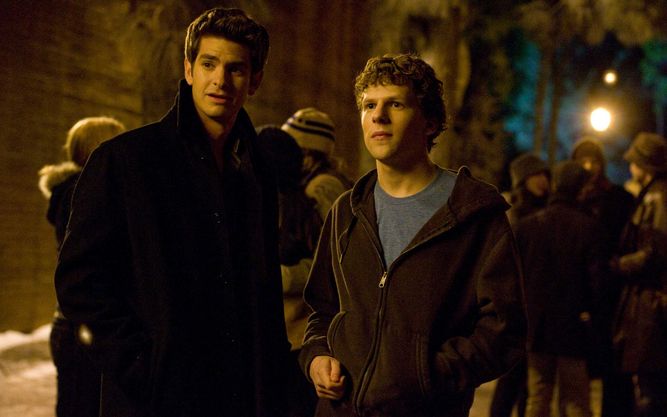
Despite all the awards and adulation and bloggers including it among their favorite movies, I honestly had little desire to see The Social Network and for one simple reason: I don’t use Facebook. I know that seems weird for a college guy in today’s hashtagging, selfie-loving world, but social networking has never been of interest to me; and while Mark Zuckerberg’s rise to millionaire is an American success story, I didn’t expect to be interested in a film about the creation of something I don’t use.

Leave it to Aaron Sorkin to prove me wrong. Some screenwriters just know how to write dialogue (Nora Ephron, for example), and then there are the few like Sorkin who write dialogue on steroids. His Oscar-winning screenplay probably boasts two or three times as many words as the typical Oscar nominee, and the consistently talented cast articulate it with the cadence of a machine gun, particularly Jesse Eisenberg as Zuckerberg.

Eisenberg’s version of the college-age billionaire is obviously so smart that he never even has to think before responding, though he’d surely have more friends if he did think, since his responses usually come with enough caustic banter to make Will Hunting blush. His capabilities with website creation are quickly made clear after losing his girlfriend turns into a drunken blog rant and then a sophisticated, network-crashing girl comparison site. Approached by the Winklevoss twins (both played by Armie Hammer) and Divya Narendra (Max Minghella) to develop a dating site for Harvard, Zuckerberg instead teams with his friend Eduardo Saverin (surprisingly excellent Andrew Garfield) to create The Facebook, the concept and extent of which evolves swiftly into what so many people now check one hundred times a day. Unfortunately, as Zuckerberg expands and gains the dubious collaboration of Napster founder Sean Parker (also surprisingly excellent Justin Timberlake), Saverin gets left behind both technologically and financially, and both he and the Winklevosses file separate lawsuits against Zuckerberg. If placed at the end, these legal proceedings would have dragged the film down, so instead the depositions are expertly sprinkled among flashbacks.

Winning Oscars for Best Adapted Screenplay, Best Score, and Best Film Editing, The Social Network boldly confirms the fact that nerds will inherit the earth, but even bolder is the fact that such a high-profile biopic was made about a 26-year-old (at the time) creator of a six-year-old website, which might have easily been a fading fad like Myspace. One might consider it an honor, but the film’s depiction of Zuckerberg could hardly be called flattering. While key, real-life events were used in the story, Zuckerberg himself has written much of the film off as fiction, which I find rather probable. He criticized the characters’ wild partying, for example, and I too believe that multi-billion-dollar corporations are most likely built on a bit more restraint and discipline, which aren’t as entertaining in a movie.

Despite the likely liberties taken by Sorkin, his treatment of Facebook itself is laudably balanced. On the one hand, he shows that it revolutionized how collegiate students and everyone else interact with one another. On the other, that very cultural revolution is sarcastically faulted for the shallow change in social life that has kept me away from Facebook in the first place. Likewise, the film’s Mark is a genius and a visionary deserving of praise, but a regrettable current of callousness often lurks beneath the admirable. While I have a better appreciation for it, I must admit that I won’t be joining Facebook any time soon.

Best line: (Zuckerberg) “I’m not a bad guy.”
(Marylin Delpy, a lawyer) “I know that. When there’s emotional testimony, I assume that 85% of it is exaggeration.”
(Zuckerberg) “And the other fifteen?”
(Delpy) “Perjury. Creation myths need a devil.”


Rank: List-Worthy


© 2016 S. G. Liput

384 Followers and Counting


Everest (2015)

22 Friday Apr 2016

Posted by sgliput in Movies, NaPoWriMo, Poetry, Reviews, Writing

≈ 3 Comments

Tags

Disaster, Drama, History


(Today’s NaPoWriMo prompt was inspired by Earth Day, which I incorporated as a mountain-shaped acrostic below.)


Everest:
As ladybugs climb,
Reaching toward the apex,
Toward the one place from which to fly,
Humans will strive for the summit, but do they know why?
Do we know why we cherish a challenge, perhaps our muscles to flex?
A conqueror’s motives are not so complex, and yet the worst danger or risk he expects is stoking his soul to the sky and arms him with courage to live or to die.
Your trials, O Nature, are hopelessly high, and yet mankind eagerly seeks to defy and, foolish or fearless, adventurers try and search for what you have next.
____________________

MPAA rating: PG-13

I haven’t seen many mountain-climbing movies, but the 1996 Everest disaster is such a fascinating example of human hubris gone wrong that it has warranted several books and films on the subject. My VC is well-versed on Jon Krakauer’s bestselling account Into Thin Air, and I somewhat remember the 1997 TV movie Into Thin Air: Death on Everest with Christopher McDonald. In light of more recent deadly incidents, like last year’s avalanche caused by the Nepal earthquake, the 1996 events seemed like a timely tragedy worth giving the big-screen, star-studded Hollywood treatment, and this is one example of the Hollywood treatment doing it right.

One of the shortcomings of the Into Thin Air movie and one of the causes of the deaths in the first place was the sheer number of climbers involved. The original film had so many characters whose faces were usually covered by necessary goggles or masks that I had trouble telling them apart. Everest fixes that problem by sacrificing some realism; I was much better able to distinguish between actors, but that was because they kept illogically removing their masks. My VC pointed out that impracticality, and considering the extreme cold endured by everyone, it became more noticeable yet still forgivable from a movie standpoint.

The presence of many famous actors didn’t detract the overall believability at all, from rising stars like Jason Clarke as expedition founder Rob Hall to better-known A-list actors like Jake Gyllenhaal as second team leader Scott Fischer or Keira Knightley as Hall’s pregnant wife, who gets the most emotional scenes. As for the climbers, we get to know the most important with some well-paced calm-before-the-storm introductions: Josh Brolin’s adventurous family man Beck Weathers; John Hawkes (Lost alert!) as desperate-to-summit Doug Hansen; Naoko Mori as Yasuko Namba, who has only Everest to complete her climbs of all Seven Summits; and a host of other amateurs and professionals (Sam Worthington, Martin Henderson). While the introductions aren’t thorough, it’s fair to say that everyone is worth liking and rooting for, and my ignorance of who survived and who didn’t made the eventual tragedy all the more potent.

In addition to the talented ensemble (who filmed on location only as high as base camp), the vision of Everest itself is immense and thrilling, with cinematography that easily could have earned an Oscar nomination. Sadly, disaster movies are no longer the award magnets of Irwin Allen’s day, and save for a lone SAG and Saturn award, Everest has been mostly snubbed. Even without the physical accolades, Everest deserves the positive reviews it has earned, and I rather wish I’d been able to experience it on the big screen. It is a sad story open to miracles that reminds us just how dangerous a sleeping giant can be.

Best line: (Doug Hansen) “I’m climbing Mount Everest… because I can… because to be able to climb that high and see that kind of beauty that nobody ever sees, it’d be a crime not to.”


Rank: List-Worthy


© 2016 S. G. Liput

383 Followers and Counting


Persepolis (2007)

16 Saturday Apr 2016

Posted by sgliput in Movies, NaPoWriMo, Poetry, Reviews, Writing

≈ 6 Comments

Tags

Animation, Drama, History


(Today’s NaPoWriMo prompt involved writing a poem based off of answers to an almanac questionnaire. In this case, question subjects like “Childhood dream,” “lover,” “hometown memory,” and “today’s news headline” brought to mind this animated drama.)


A culture builds a person
In a way they cannot hide.
By fine degrees, their memories
Instill a private pride.

I’m proud of where I come from,
And I love the U.S.A.,
But others feel an equal zeal
For countries far away.

I hear news full of chaos,
And my sense of pity grows,
For other nations have frustrations
Worse than Western woes.

Yet, being sympathetic,
I must not presume their shame:
Despite the vultures, other cultures
In the midst of flame
Have dignity and pride to be
Both different and the same.
________________

MPAA rating: PG-13

I’ve stated before that I love animation that can tackle mature themes without wallowing in mature content. This is why I’m often drawn to anime and why I admire 2007’s Persepolis, which lost the Best Animated Feature Oscar (barely but deservedly) to Pixar’s Ratatouille.

The Iranian Revolution isn’t the first topic I’d think of for a cartoon, but Iranian expatriate Marjane Satrapi translated her personal experiences first into a French comic/graphic novel and then into this feature film. She did so not only with insight and honesty but with the perfect reason for siding with animation over live-action: that animated characters are far more universal in appeal and connection, allowing audiences worldwide to relate to something that is not inherently “foreign.” She succeeded. Her childhood home in Tehran seems like any number of world cities, and her personal tastes in movies and music (Bruce Lee, Iron Maiden, etc.) remind us that pre-Revolution Iran wasn’t entirely different from the West. (I liked how the young Marji enjoyed ABBA until her friends guilted her into considering them uncool. My mom has mentioned that it was much the same with her in 1970s America.)

Thus, when the actual revolution takes place, bringing Islamic fundamentalists to power, the sudden forced changes to the culture are understandably jarring, as women are compelled to wear head scarves while alcohol and all things Western are banned. While my knowledge of the politics of the time is limited, I was intrigued by how Marjane’s opinions were formed by her parents and dissident uncle, who opposed the Shah but were also persecuted by the new government. The sequence of events reminded me of the Russian revolution in Doctor Zhivago, particularly when Marji’s mother comments, “Well, whatever the outcome is, it can’t be worse than the Shah.” The shortsightedness of revolutions is still an issue today and just one of the many thought-provoking facets of Persepolis.

Marjane’s rebellious spirit eventually forces her to move to Europe, where she grows into a wayward young woman. Her activities range from communing with thoughtless anarchists to unsuccessful love affairs, and while much of it is rather depressing, the storytelling manages to incorporate a smart mix of profundity (such as the wisdom of Marji’s grandmother, a sterling example of an honorable elder) and amusement (such as Marjane’s post-breakup rant against her ex, which resembles and predates a similar scene in (500) Days of Summer).

Satrapi has insisted her graphic novel should be called a comic book, and though it’s more mature than many animations, in several ways Persepolis is a cartoon. The black-and-white simplicity of the flashbacks (which is the majority of the film) is usually realistic, but sometimes reactions are exaggerated, dreams become surreal, or certain scenes are hyperbolized as only animation can. Other times, serious moments are reduced to silhouettes, like a deadly flight from police across rooftops.

While the ending is both fitting and disappointingly melancholy, what comes before is not without its shortcomings. The depiction of the Islamic government is clearly negative, but the overall political message remains muddled from varied character opinions and a dream sequence associating Karl Marx with God. Though not too profane, some of the language is also a tad harsh, and the PG-13 rating is deserved. (There’s also an odd preoccupation with Marjane’s grandmother’s breasts, which are discussed three separate times, perhaps because of a distinct memory she had.) Persepolis is a wholly unique animation, a coming-of-age tale that views a tumultuous time through the eyes of both a child and a young woman, whose subsequent real-life success makes it that much more praiseworthy.

Best line: (Marjane) “We were so eager for happiness, we forgot we weren’t free.”


Rank: List Runner-Up


© 2016 S. G. Liput

380 Followers and Counting


The 33 (2015)

14 Thursday Apr 2016

Posted by sgliput in Movies, NaPoWriMo, Poetry, Reviews, Writing

≈ 5 Comments

Tags

Disaster, Drama, History


(Today’s NaPoWriMo prompt was for a san san, in which three words or ideas are repeated three times each in a eight-line rhyme scheme of a-b-c-a-b-d-c-d. Since san san is Chinese for “three three,” I thought the perfect film for this was last year’s The 33 about the Chilean miners.)


The sun was swapped for stone, above our heads and in our hearts.
With patience, we awaited news from those who thought us dead.
We lived within our hollow grave, refusing to be still.
How many lack the patience that a hollow grave imparts,
No choice but to bemoan in hope the stone above our heads?
Anticipating sky again, we found our patience heaven-sent
And looked beyond the stone above our heads, as doomed men will.
Arising from a hollow grave is not without its precedent.
__________________

MPAA rating: PG-13

I’m sure most recall the rollercoaster of emotions that accompanied news of the Chilean miners who were trapped by a cave-in for 69 days in the San Jose mine. The international rescue effort and the strong faith of the miners turned the 2010 mining accident into one of the most inspirational true-life stories in years, and as soon as the last miner reached the surface, I knew it was only a matter of time before a movie dramatized the incident.

Honestly, I thought it would be much sooner than five years, but here we have the based-on-a-true-story film for which we’ve been waiting. I expected it to be great, but I’m content that it’s good. The filmmakers succeed in presenting a comprehensive account of what happened before, during, and after the accident, and it’s hard to fault their efforts. The beginning introduces the most notable of the thirty-three miners: Mario Sepúlveda (Antonio Banderas), who acted as the leader of the buried miners; Luis Urzúa (Lou Diamond Phillips), the danger-conscious foreman; Álex (Mario Casas), the family man with a baby on the way; Darío, who is estranged from his sister (Juliette Binoche); Yonni (Oscar Nunez), whose extramarital affair comes to a head during the crisis; and numerous others who aren’t given enough screen time to make an impression. It’s easy to confuse the characters at first, but time and some earnest character moments help to distinguish the most important.

Above ground, the drilling plans are spearheaded by both professionals (James Brolin; Gabriel Byrne, who I never would have considered for a Hispanic role) and politicians (Bob Gunton, also pretending to be Latino; and Brazilian actor Rodrigo Santoro, known to me as the much-maligned Paulo on Lost). After the search effort turns into a rescue effort, the details of the operation are prudently depicted through real-life news reports.

I suppose the worst thing I can say about The 33 is that it feels inconsistent. The actual accident is spectacular, if a bit hard to see in the dark, but then the emotions and tensions of the subsequent waiting and anticipating come in fits and starts depending on which miners are on-screen. One potentially powerful final meal strikingly captures the men’s hopes and fears, but the tone oddly drifts between heavy and light.

Despite the inconsistencies, The 33 triumphs where it matters most, that climactic rescue that had people around the world wiping tears from their eyes. The ending will come as no surprise to those who know the story, but the film manages to give its audience further understanding of how the miners and their families felt and represents the solidarity both below and aboveground. It may not be the Oscar-worthy powerhouse I feel it could have been, but the pre-credits depiction of all thirty-three real-life miners ends the film on the highest note possible.

Best line: (one of the miners, answering why he doesn’t hate an outcast) “Hate is for children.”


Rank: List Runner-Up


© 2016 S. G. Liput

380 Followers and Counting


Woman in Gold (2015)

31 Sunday Jan 2016

Posted by sgliput in Movies, Poetry, Reviews, Writing

≈ 1 Comment

Tags

Drama, History


I stand here and smile on the gallery wall,
Watching the patrons who stare and pass on,
And sometimes the curator comes in to call
To boast of my grace and my era long gone.

I’m used to the gaze of dispassionate eyes,
But I once adorned a more intimate wall
When I was a gift, not a national prize,
A visage of somebody few now recall.

Not many remember my former abode,
But my memory, like my smile, never dies,
Corrupt men and hatred marked that episode
That stole me away as mere rare merchandise.

Suppose me content with my grace and my smile
After what I have seen on my difficult road?
I won’t be content until we reconcile.
I wait for my family; to them I am owed.
______________

MPAA rating: PG-13


Woman in Gold may be the most underrated drama of 2015. Reviews were mixed, and its two award-worthy performances have been pretty much ignored by any of the awards, aside from a single SAG nomination for Helen Mirren. While everyone has their own personal grumble about the Academy’s choices, this one is mine. Woman in Gold deserves so much better.

The film’s greatest assets are its two appealing leads, played by Helen Mirren and Ryan Reynolds. Mirren is Maria Altman, an elegant grandmother who fled Nazi Germany as a young newlywed and now wishes to reclaim a painting she left behind, Gustave Klimt’s Portrait of Adele Bloch-Bauer I, otherwise known as The Woman in Gold. The problem is that, while Maria sees it as a fond portrait of her late aunt, the nation of Austria guards it as a national treasure, their own Mona Lisa. That’s where Reynolds’ Randy Schoenberg comes in, a less-than-successful lawyer whose familial connections trump the fact that he knows nothing of art restitution cases. Together, the old lady and the bookish attorney make an unlikely team against Austria and the injustice of the past.

Many films have touched upon the Nazis’ forced appropriation of great artwork, from 1964’s The Train to 2014’s The Monuments Men, but rarely do these films present the personal cost of those crimes. They weren’t just stealing valuables, but precious antiques and family heirlooms. Art isn’t exactly my favorite subject, and Woman in Gold could have come off as just some stuffy lady wanting back what’s hers; instead, flashbacks to Maria’s life in Vienna elucidate just how much these treasures meant to her, not merely because of their monetary value but because of their memory and affection that only she can fully understand. It’s personal, and the film translates that fact effectively.

Mirren is a brilliant Maria with her grandmotherly concerns and dry wit, but when the long road to restitution takes its toll, Reynolds’ Randy steps up to keep the crusade going. Randy lives in the shadow of his judge father and famous composer grandfather, and when pushed to look into Maria’s case, he decides to give it his all, right up to the overwhelming challenge of the Supreme Court. As the case moves forward, it’s clear that it’s personal for Randy too, and visits to Vienna reinforce the importance of his Jewish-German heritage.

Woman in Gold also features welcome smaller roles from Daniel Bruhl, Frances Farmer, and Jonathan Pryce and a witty, at times tense screenplay that bounces nicely between past and present. With all these positives, why then has the film been snubbed? Perhaps because the pacing lags at times or because it isn’t entirely historically accurate. Neither of these faults bothered me, and the historical deviations don’t seem to bother the real Randy Schoenberg, who was interviewed for the film’s bonus features. Woman in Gold turns a legal battle over art into a personal underdog story, and by the Titanic-style ending, my VC was in tears and I wasn’t far behind.

Best line: (ignorant court house employee) “I want to go to Austria sometime with my daughter. She loves kangaroos!”


Rank: List-Worthy


© 2016 S. G. Liput

361 Followers and Counting


The Miracle Worker (1962)

15 Sunday Nov 2015

Posted by sgliput in Movies, Poetry, Reviews, Writing

≈ 3 Comments

Tags

Drama, History, Triple A

Darkness in the light of day,
Silence in the loudest noise.
Close and also faraway,
Vacant at the gladdest joys,

Only feeling with the hand,
Needing, taking in the dark,
Slow to know or understand
And lacking means to try till hark!

A firmer hand arrives to guide,
A stronger arm, both cruel and kind,
To teach the words she’d been denied
And show them all love isn’t blind.
_________________

MPAA rating: the equivalent of G

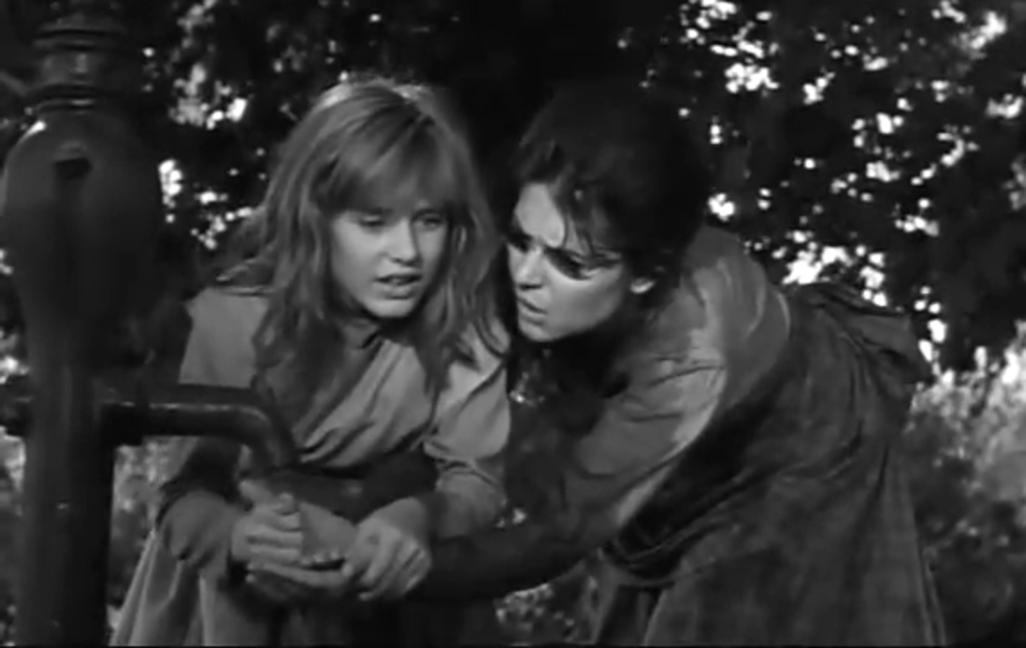
True life stories are often the most inspiring, and one of the most incredible is the life of Helen Keller. Born healthy but struck deaf and blind by a childhood infection, she grew up in total darkness, knowing the world solely through touch. She had no concept of light or love or even that objects had names, and yet she grew to be an accomplished author and lecturer (and apparently introduced the Akita dog to the U.S. Who knew?). As I read her autobiography The Story of My Life, her diction and facility of language make it hard to believe that she once had no understanding of it whatsoever. Her story is and has been a true inspiration for the handicapped, and The Miracle Worker brilliantly presents her difficult early years.

Both Patty Duke and Anne Bancroft won Oscars for their surprisingly physical roles, Duke as the young Keller and Bancroft as her tenacious teacher Anne Sullivan. The film very much reflects Keller’s memoirs, focusing solely on her tumultuous childhood and initial relationship with Sullivan. Duke acts convincingly detached as she gropes her way along, oblivious to the significance of what she touches yet petulant and violent when annoyed. She grabs food from others’ plates and locks people in rooms, while her parents cite her handicaps as a good reason to tolerate her behavior. Enter Ms. Sullivan. Her history with blindness gives her a special sympathy, yet her Irish temperament puts her at odds with Helen’s surliness and her parents’ enabling. Bancroft in particular deserved her Oscar; she exhibits the patience of Job as she reins Helen in, wrestles with her just to get her to hold a spoon, and deals with the uncertainty of teaching a seemingly unteachable pupil.

Boasting a 100% on Rotten Tomatoes, The Miracle Worker depicts quite the extraordinary relationship between a student who doesn’t know how to be taught and a teacher who sees potential no one else can. After an initially overacted introduction, everyone slips into perfectly natural roles from Helen’s antagonistic father (Victor Jory) to her concerned mother (Inga Swenson), all dwarfed by the two lead performances. When that “ah-ha” moment finally arrives with the hard-won breakthrough, the celebration feels genuine and earned and meant as only the beginning of Helen’s progress. It’s interesting to note that while Patty Duke won an Oscar playing Keller, she later won an Emmy playing Ms. Sullivan, opposite Little House on the Prairie’s Melissa Gilbert. Whenever an uninformed viewer wonders who that woman on the Alabama state quarter was, The Miracle Worker will give them a new appreciation for Helen Keller and the educator who opened the world to her.

Best line: (Anne) “It’s less trouble to feel sorry for her than it is to teach her anything better.”

Rank: List-Worthy

© 2015 S. G. Liput

344 Followers and Counting

Quiz Show (1994)

11 Sunday Oct 2015

Posted by sgliput in Movies, Poetry, Reviews, Writing

≈ 2 Comments

Tags

Drama, History

Can you be sure of where you stand
And how you’ll keep your footing when
A bit of guile gets out of hand,
And lies are needed once again?

They say the truth can set you free,
But when has someone crossed the line
Of giving up on honesty
Because to err is not divine?

When baby steps grow up too fast
And liars find them ill-advised,
They see the slope that cannot last
Began when first they compromised.
________________

Rating: PG-13 (solely for language)

For a year like 1994 that had acclaimed films like Forrest Gump, The Shawshank Redemption, and Pulp Fiction, it’s not surprising that a good but lesser film would be swept under the rug, so to speak. With so many good films that year, Quiz Show remained an afterthought, both during the awards season and for my own to-watch list, even if it was directed by Robert Redford. This really is a shame because this is a potent exploration of intellectual and personal honesty and might have performed much better in a less competitive year (1996 perhaps).

Quiz Show is based on the memoir of Richard Goodwin, an investigator for the Legislative Oversight Committee of the House of Representatives back in the 1950s. Rob Morrow plays Goodwin in the film, a lawyer who notices some peculiarities on a popular quiz show called Twenty One and follows a hunch to investigate. Apparent genius and champion Herb Stempel (John Turturro) is told to take a dive by the show’s producers (David Paymer and Hank Azaria) and loses on an easy question to allow the advent of Charles Van Doren (Ralph Fiennes). As likable Van Doren’s star rises, Stempel is ignored as he alleges corruption on the supposedly upstanding quiz show. As the investigation progresses, ethics are stretched, and new information comes to light that blurs the lines of right and wrong.

Thanks to excellent casting, Turturro and Fiennes really steal the show here. The missing teeth and, shall we say, homely appearance of the former ideally casts him as the ugly step-contestant, while the verbal grace and perfect hair of the latter offer a striking contrast to his predecessor. It leaves no doubt as to the reasoning of the showrunners. To them, Stempel should be the pitiful reject who can’t cope with losing, and Van Doren should be the shining example of virtue and erudition. In the hands of a lesser filmmaker, Stempel might have become the browbeaten underdog and Van Doren the haughty record holder. Yet while these characterizations are somewhat true, there are many more nuances and complex motivations behind them.

Van Doren, in particular, is depicted as a right decent chap, one who values honesty and intelligence but edges down a slippery slope. Fame can be quite the drug. Why else do so many people do such stupid stunts and post them on the internet? Why else would a successful college professor risk his career for a game show? One might take comfort in the “no one will ever know” mentality, but Van Doren seemed from the start as someone to respond with the “I would know” answer and refuse. Yet the web is woven. He revels in his newfound popularity but buckles under the weight of his own complicity, all while remaining entirely likable, both to us and to Mr. Goodwin. Though liberties are said to have been taken with the details, the ethical conflict rings true for this true story. After all, game shows are still watched as a matter of trust that they aren’t rigged. (I remember when Ken Jennings lost shockingly to a one-night wonder on Jeopardy! several years back. He claims that he simply didn’t know the final question, but I still have my doubts, though I tend to think he might have gotten tired of it all and “taken a dive” on his own without any behind-the-scenes intervention.)

Redford paints the moral dilemmas with a steady hand and, like some statements during the Congressional hearings near the end, offers sympathy when proper and reproof when needed. Quiz Show’s strength is that it is far from black and white. Like other films such as The Prestige or Rashomon, there is no clear-cut good guy to root for, just many victims and varying levels of blame. In the end, justice may be said to be done, but not perfectly. Corporate string-pulling proves too persuasive, but Quiz Show isn’t just about an official scandal or the innate duplicity of show business. It’s about honesty, whether tested, lost, or regained.

Best line: (Herb Stempel, offering rugalach to Goodwin) “Come on, they’re a Jewish delicacy. Before Toby eats it.” (Toby Stempel, his wife) “I’m retaining water, for your information.”   (Herb) “You and the Grand Coulee Dam.”

Rank: List-Worthy

© 2015 S. G. Liput

341 Followers and Counting

← Older posts
Newer posts →

Recent Posts

  • We Didn’t Start 2025 (Recap)
  • NaPoWriMo 2025 Recap (Finally)
  • Sonic the Hedgehog 3 (2024)
  • It Happened One Night (1934)
  • Spellbound (2024)

Recent Comments

associatesofshellymann's avatarassociatesofshellyma… on My Top Twelve La La La So…
Kit's avatarKit Nichols on Bonnie and Clyde (1967)
lifelessons's avatarlifelessons on Look Back (2024)
Carol Jackson's avatarCarol Jackson on The Thief of Bagdad (1940…
Stephen's avatarStephen on Love Story (1970)

Archives

  • January 2026
  • December 2025
  • May 2025
  • April 2025
  • March 2025
  • February 2025
  • January 2025
  • December 2024
  • May 2024
  • April 2024
  • March 2024
  • February 2024
  • January 2024
  • December 2023
  • November 2023
  • October 2023
  • September 2023
  • July 2023
  • June 2023
  • May 2023
  • April 2023
  • March 2023
  • February 2023
  • January 2023
  • December 2022
  • November 2022
  • October 2022
  • September 2022
  • August 2022
  • July 2022
  • June 2022
  • May 2022
  • April 2022
  • March 2022
  • February 2022
  • January 2022
  • December 2021
  • November 2021
  • October 2021
  • September 2021
  • August 2021
  • July 2021
  • June 2021
  • May 2021
  • April 2021
  • March 2021
  • February 2021
  • January 2021
  • December 2020
  • November 2020
  • October 2020
  • September 2020
  • August 2020
  • July 2020
  • June 2020
  • May 2020
  • April 2020
  • March 2020
  • February 2020
  • January 2020
  • December 2019
  • November 2019
  • October 2019
  • September 2019
  • August 2019
  • July 2019
  • June 2019
  • May 2019
  • April 2019
  • March 2019
  • February 2019
  • January 2019
  • December 2018
  • November 2018
  • October 2018
  • September 2018
  • August 2018
  • July 2018
  • June 2018
  • May 2018
  • April 2018
  • March 2018
  • February 2018
  • January 2018
  • December 2017
  • November 2017
  • October 2017
  • September 2017
  • August 2017
  • July 2017
  • June 2017
  • May 2017
  • April 2017
  • March 2017
  • February 2017
  • January 2017
  • December 2016
  • November 2016
  • October 2016
  • September 2016
  • August 2016
  • July 2016
  • June 2016
  • May 2016
  • April 2016
  • March 2016
  • February 2016
  • January 2016
  • December 2015
  • November 2015
  • October 2015
  • September 2015
  • August 2015
  • July 2015
  • June 2015
  • May 2015
  • April 2015
  • March 2015
  • February 2015
  • January 2015
  • December 2014
  • November 2014
  • October 2014
  • September 2014
  • August 2014
  • July 2014
  • June 2014
  • May 2014
  • April 2014
  • March 2014
  • February 2014
  • January 2014
  • December 2013

Categories

  • Blindspot
  • Blogathon
  • Christian
  • Movies
  • Music
  • NaPoWriMo
  • Poetry
  • Reviews
  • TV
  • Writing

Meta

  • Create account
  • Log in
  • Entries feed
  • Comments feed
  • WordPress.com

Recent Posts

  • We Didn’t Start 2025 (Recap)
  • NaPoWriMo 2025 Recap (Finally)
  • Sonic the Hedgehog 3 (2024)
  • It Happened One Night (1934)
  • Spellbound (2024)

Recent Comments

associatesofshellymann's avatarassociatesofshellyma… on My Top Twelve La La La So…
Kit's avatarKit Nichols on Bonnie and Clyde (1967)
lifelessons's avatarlifelessons on Look Back (2024)
Carol Jackson's avatarCarol Jackson on The Thief of Bagdad (1940…
Stephen's avatarStephen on Love Story (1970)

Archives

  • January 2026
  • December 2025
  • May 2025
  • April 2025
  • March 2025
  • February 2025
  • January 2025
  • December 2024
  • May 2024
  • April 2024
  • March 2024
  • February 2024
  • January 2024
  • December 2023
  • November 2023
  • October 2023
  • September 2023
  • July 2023
  • June 2023
  • May 2023
  • April 2023
  • March 2023
  • February 2023
  • January 2023
  • December 2022
  • November 2022
  • October 2022
  • September 2022
  • August 2022
  • July 2022
  • June 2022
  • May 2022
  • April 2022
  • March 2022
  • February 2022
  • January 2022
  • December 2021
  • November 2021
  • October 2021
  • September 2021
  • August 2021
  • July 2021
  • June 2021
  • May 2021
  • April 2021
  • March 2021
  • February 2021
  • January 2021
  • December 2020
  • November 2020
  • October 2020
  • September 2020
  • August 2020
  • July 2020
  • June 2020
  • May 2020
  • April 2020
  • March 2020
  • February 2020
  • January 2020
  • December 2019
  • November 2019
  • October 2019
  • September 2019
  • August 2019
  • July 2019
  • June 2019
  • May 2019
  • April 2019
  • March 2019
  • February 2019
  • January 2019
  • December 2018
  • November 2018
  • October 2018
  • September 2018
  • August 2018
  • July 2018
  • June 2018
  • May 2018
  • April 2018
  • March 2018
  • February 2018
  • January 2018
  • December 2017
  • November 2017
  • October 2017
  • September 2017
  • August 2017
  • July 2017
  • June 2017
  • May 2017
  • April 2017
  • March 2017
  • February 2017
  • January 2017
  • December 2016
  • November 2016
  • October 2016
  • September 2016
  • August 2016
  • July 2016
  • June 2016
  • May 2016
  • April 2016
  • March 2016
  • February 2016
  • January 2016
  • December 2015
  • November 2015
  • October 2015
  • September 2015
  • August 2015
  • July 2015
  • June 2015
  • May 2015
  • April 2015
  • March 2015
  • February 2015
  • January 2015
  • December 2014
  • November 2014
  • October 2014
  • September 2014
  • August 2014
  • July 2014
  • June 2014
  • May 2014
  • April 2014
  • March 2014
  • February 2014
  • January 2014
  • December 2013

Categories

  • Blindspot
  • Blogathon
  • Christian
  • Movies
  • Music
  • NaPoWriMo
  • Poetry
  • Reviews
  • TV
  • Writing

Meta

  • Create account
  • Log in
  • Entries feed
  • Comments feed
  • WordPress.com

Blog at WordPress.com.

  • Subscribe Subscribed
    • Rhyme and Reason
    • Join 814 other subscribers
    • Already have a WordPress.com account? Log in now.
    • Rhyme and Reason
    • Subscribe Subscribed
    • Sign up
    • Log in
    • Report this content
    • View site in Reader
    • Manage subscriptions
    • Collapse this bar