• Home
  • About Me
  • The List
  • THE LIST (2016 Update)
  • THE LIST (2017 Update)
  • THE LIST (2018 Update)
  • THE LIST (2019 Update)
  • THE LIST (2020 Update)
  • THE LIST (2021 Update)
  • THE LIST (2022 Update)
  • Top Twelves and More
  • The End Credits Song Hall of Fame

Rhyme and Reason

~ Poetry Meets Film Reviews

Rhyme and Reason

Tag Archives: Drama

Harvey (1950)

09 Sunday Jul 2017

Posted by sgliput in Movies, Poetry, Reviews, Writing

≈ Leave a comment

Tags

Comedy, Drama, Fantasy

Image result for harvey film

Imaginary friends are such
That we don’t miss them very much
And so forget the joy that comes
From pals we cannot see or touch.

The fanciful are easy to mock.
We question sanity and gawk,
But everyone needs someone else
With whom to drink and laugh and talk.

And what the “sane” perhaps don’t see
In what we call imaginary
Is something we too often miss
In our mundane reality.
__________________

MPAA rating: Not Rated (easily G)

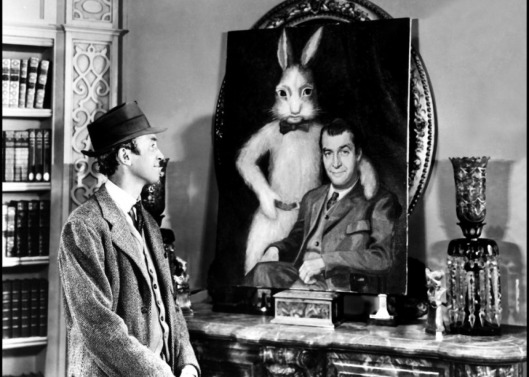
I watched Harvey for two main reasons: (1) It’s one of those universally liked classics that all fans of film should or feel like they should see, and (2) I love Jimmy Stewart, who earned an Oscar nomination for the kind of role that doesn’t initially seem worthy of an Oscar. As Elwood P. Dowd, he’s a genial, soft-spoken alcoholic happy to while away the hours visiting the bar and inviting strangers home for dinner. The trouble is that he’s utterly sincere in his friendship with a six-foot-plus invisible rabbit by the obvious name of Harvey.

Image result for harvey film

While I have been familiar with the basic concept of Harvey for years, I didn’t know what to expect from the actual storyline. My VC had seen it long ago and remembered it as vaguely weird, and that was largely my opinion through the first half, or the first two-thirds really. Dowd obliviously walks around introducing acquaintances to his large unseen pal, while his sister Veta (Oscar-winning Josephine Hull) and his niece (Victoria Horne) bemoan the damage this does to their social reputation and vow to lock him away in a sanitarium. There are plenty of comical misadventures for secondary characters that drive the plot, most of which Dowd remains heedless of, and I found myself more annoyed than amused that much of the humor relied on misunderstandings that could easily be solved by a simple turn of the head or a more careful choice of words.

Yet, the latter third of the film places Dowd’s potential “mental illness” into a wider context of fantasy vs. reality and dull normalcy vs. eccentric kindness. Whereas what came before was simply Dowd’s peculiar routine, which seemed deranged to the outside eye, Stewart gives him more depth with some simple but keenly heartfelt conversations that make the prospect of an invisible pooka more enviable than pitiable. While Hull’s busybody panic and Stewart’s sincerity make the most of a rather uninvolving beginning/middle, the end helped me see Harvey’s classic appeal. It will never be among my favorites, but, like Dowd himself, it had a gentle charm and was, above all, “pleasant.”

Best line: (Aunt Veta, to her niece) “Myrtle Mae, you have a lot to learn, and I hope you never learn it.”


Rank: Honorable Mention


© 2017 S.G. Liput
494 Followers and Counting


2017 Blindspot Pick #6: Saving Private Ryan (1998)

02 Sunday Jul 2017

Posted by sgliput in Blindspot, Movies, Poetry, Reviews, Writing

≈ 2 Comments

Tags

Action, Drama, History, War

Image result for saving private ryan

They ran up the hills and across hostile plains.
They learned from their drills and embarked on campaigns.
They slogged through the mud and up bullet-chewed shores.
They spilled others’ blood while they dropped by the scores.

These teachers and writers and miners supplied
Their service as fighters for duty or pride.
They risked life and limb, often lost one or both,
And faced dangers grim that weren’t part of the oath.

They left homes and holes to attack assumed foes.
They charged foolish goals they were told to oppose.
They braved likely death where the angels don’t tread
And gave their last breath with both courage and dread.

Some died on the field, and some died in the tent,
And some made survival their cause to repent.
And most dwell, years past their first sojourn to war,
In graveyards amassed for the ones they fought for.

They stormed into hell, not for heaven’s demand,
But blistered and fell for their nation to stand.
And though you and I fathom not their nightmares,
How deep our thanks lie for the gift that is theirs.
_____________________

MPAA rating: R

Of all my Blindspot Picks this year (I know this one for June is a couple days late), Saving Private Ryan was the one I was most nervous about watching. There’s a reason I hadn’t yet watched this widely acclaimed classic from Steven Spielberg, namely its reputation as one of the more graphic war movies, which as a rule, I usually try to avoid. Yet after enduring the harsh battle scenes of Hacksaw Ridge and still loving it, as well as the current patriotic timing between the D-Day anniversary (June 6) and July 4, now seemed like the right time to finally give Saving Private Ryan a chance. I’m glad I did.

Image result for saving private ryan

Most of what I’d heard of Saving Private Ryan centered on the first thirty minutes, the brutal re-creation of the Normandy invasion. Indeed it’s an impressively intense experience to sit through, even if it’s still only a fraction of what the soldiers involved actually had to endure, among them my own paternal grandfather. It also feels fiercely comprehensive in its depiction of the battlefield, following Tom Hanks’s Captain John Miller from the assault boats up the bullet-riddled beaches under constant enemy fire. The men’s reactions to the nightmarish setting range from terrified and dazed to angry and vengeful, particularly as the repeated attempts to save the wounded prove horrifically futile. There are no cuts away to generals talking or planning or anything to take the viewer out of the moment, and it’s epic and immersive. As for the notorious violence, it’s comparable to the battle scenes of Hacksaw Ridge, though perhaps a bit less constant in its bloodshed than the worst Hacksaw Ridge scenes.

Yet, even beyond the intense opening, the rest of the film has plenty of strengths as well, the strongest of which has to be Tom Hanks. Hanks has always been good in everything I’ve seen of his, and he gives an outstanding performance here, easily worthy of an Oscar, for which he was only nominated. As Captain Miller, he’s a competent leader willing to fulfill his duty, even when his superiors send him on a foolhardy mission into enemy territory to retrieve the titular Private Ryan (Matt Damon), whose loss of his three brothers in battle has earned him a sympathy ticket home. Yet Miller isn’t as tough as nails as he tries to act, sometimes amused at hearing his men guess at his mysterious past, sometimes letting his desperation and grief amidst all the violence show through. Hanks is the touchstone for the whole film, which is important when the rest of the men under him aren’t as distinguishable, at least at first. The film’s long runtime of 2 hours and 49 minutes helps the other men under him stand out a bit, such as Barry Pepper’s praying sniper or Edward Burns’ hothead who rebels at risking lives for the sake of one man. (Until the end credits, I really thought Burns was Ben Affleck for some reason.) Even if I couldn’t keep up with most of their names, all the actors do an excellent job, including Damon, Burns, Tom Sizemore, Giovanni Ribisi, and Vin Diesel. Speaking of characters, I was especially delighted to see a very young Nathan Fillion (Castle, Firefly) as a different Private Ryan and (major Lost alert!) Jeremy Davies as timid interpreter Upham, which is such a strong role for him that I’m surprised this film didn’t make him a more sought-after star.

Image result for saving private ryan

Along the cross-country search for Private James Francis Ryan are individual encounters that convey so much of the horror, callousness, and sacrifice. At one point, Miller’s men rummage through dog tags of the deceased, joking and bantering as if they’re playing cards, only to be reminded that they’re essentially sorting through men’s stolen lives. Later, Upham defends a German prisoner whom the others want to kill, only for his naively righteous motivations to be starkly challenged by the ruthlessness of war. (The way this subplot plays out is like the opposite of a similar aspect of the 2003 film Saints and Soldiers.)  And through it all is the question of whether Private Ryan is worth all the trouble of saving. Does offering Ryan’s mother a little comfort in her grief warrant putting other men’s mothers through the same? How can one man live up to the sacrifices made to rescue him?

Saving Private Ryan is undoubtedly one of Steven Spielberg’s greatest achievements, yet oddly enough, while the film runs through a range of emotions, one of the strongest for me was anger. Why? Because how on God’s blue marble did Shakespeare in Love beat this for Best Picture?!?!?! I mean, really, there is no contest as to which film is grander, better told, and all-around more significant. In my opinion, that has to be the worst Best Picture decision the Academy has ever made, worse even than the La La Land debacle from this past year. I’m sorry, but Saving Private Ryan is clearly the true Best Picture of 1998. At least, Spielberg won Best Director, alongside Oscars for Cinematography, Sound Mixing, Film Editing, and Sound Effects Editing.

Despite all this praise for Saving Private Ryan, I’m left divided on how exactly to rank it on my Top 365 List at the end of the year. As with Hacksaw Ridge, I loved the story, acting, script, patriotic message, and production values, but the violence is a big drawback for me, mainly in diminishing its watchability. While the violence is important for effectively re-creating the savagery of battle, I still feel that sprays of blood and severed limbs are unnecessarily gruesome tools in a filmmaker’s arsenal. At one point, someone is literally blown apart by a bomb they don’t throw away for some reason; I couldn’t tell who it was or why they didn’t chuck the explosive, making the scene unnecessary except for shock value. I just feel that this would have been a slightly more accessible film if it had been edited to avoid some of the gore; I know my aversion to violence puts me in the movie-watching minority, but there must be others who avoid films like this for the same reasons I did (like my VC, who still refuses to see it). Ultimately, though, its strengths far outweigh that personal negative, so I’ll have to figure out later where exactly on my list such a film deserves to be.
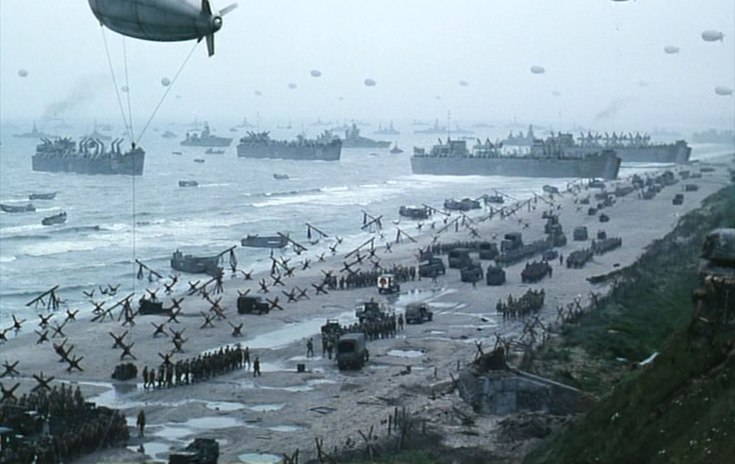
Image result for saving private ryan normandy

I have no hesitation in confirming that Saving Private Ryan really is among the best war films ever made. The cinematography and explosive battles augment its epic storytelling while never ignoring the human cost and casualties, and it captures the complicated mess of war, such as casting a disapproving eye at the vengeful cruelty done by Americans while reminding us that self-righteousness is rarely rewarded in battle. The strongest performances by Hanks and Davies should have earned them both Oscars. I can’t say I’d watch Saving Private Ryan often, due to its length and intensity, but few films are better suited for July 4 viewing.

Best line: (Captain Miller, to Private Reiben, who wants to kill a prisoner) “You want to leave? You want to go off and fight the war? All right. All right. I won’t stop you. I’ll even put in the paperwork. I just know that every man I kill, the farther away from home I feel.”


Rank: List-Worthy


© 2017 S.G. Liput
491 Followers and Counting
 

Educating Rita (1983)

28 Wednesday Jun 2017

Posted by sgliput in Movies, Poetry, Reviews, Writing

≈ 1 Comment

Tags

Comedy, Drama

Image result for educating rita film

“The brain was not born
To be wasted and worn,”
Said the student with scorn,
“In service of humbler bodily parts.
Instead, it should yearn
For the prospect to learn,
For there can be no higher cause than the arts.”

The worker meanwhile
Said, “Art has its style,
But brains are worthwhile
When used in more practical, down-to-earth ways.
The comfort of chums
Can raise even the slums
To far greater value than poets can phrase.”

Between the two sides,
Each content in their prides,
A woman decides
If worth is found in what one does or one knows.
Whatever her choice,
‘Tis a cause to rejoice,
For not all possess such dilemmas to pose.
___________________

MPAA rating: PG (definitely PG-13 these days, for language)

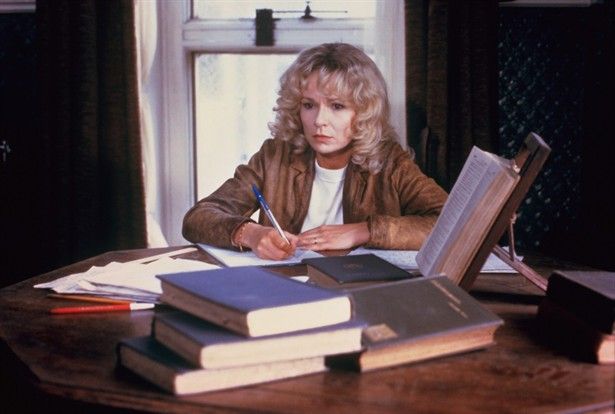
I’m currently working through college and have had a quality education throughout my life; in fact, it’s been such a constant presence that I know I’ve taken the textbooks and tests for granted, in sharp contrast to so many who haven’t had the opportunity of an education. Does the quality of one’s life depend on the quality of one’s schooling or how many 18th-century poets one can quote? Such is the kind of question asked in Educating Rita, an outstanding based-on-a-play character piece for Michael Caine and Julie Walters, both of whom were worthily nominated for Oscars.

Image result for educating rita film

Walters plays Susan, or Rita as she prefers, a plain-spoken, rather coarse hairdresser whose main dream is to expand her limited working-class knowledge through an Open University program and regular appointments with her alcoholic literature professor Frank Bryant (Caine). Disillusioned as he is with the pretensions of his academic habitat, Bryant is charmed by Rita’s enthusiasm and candidness. While Rita’s husband (Malcolm Douglas) sees little value in his wife’s scholarly pursuits and even actively opposes them when they interfere with his plans, Rita is determined to widen her narrow experience, even if her husband and Bryant himself don’t approve of how it may change her.

I loved how Educating Rita depicted different views of academia, specifically between Rita, who sees learning as a holy grail to lift her from her pedestrian life, and Bryant, who’s been so overexposed to the snobbish airs of the college system that his only escape is the bottle. Frank certainly understands the value of education and poetry, but he has no passion for it anymore, in contrast to his fresh-faced ingénue who gets excited over Macbeth and can answer essay questions with disarming simplicity.

At the same time, it’s an essential point that Rita sees firsthand the intellectual emptiness which isn’t limited to just Bryant, the result of placing artistic culture on such a pedestal that everyday life no longer seems to compare. It’s a stark reminder that artists and art lovers alike can revel in the heights of creativity and success and still find little reason for living (such as Sylvia Plath, Robin Williams, and many others). Interestingly, religion and faith never come up as a significant topic or supplement to scholarship, which I consider a sad reflection on the limitations of humanism.

Image result for educating rita film

While I very much enjoyed the often humorous interactions between Caine and Walters and the debate about the prominence of erudition in one’s life (and, of course, any film with poetry as a major element has my interest), I found the ending a bit wanting, content to affirm Rita’s choices with a satisfying but not quite happy conclusion. I’ve come to appreciate it more with thought, though, since its slight ambiguity upholds the real reason why Rita sought out her studies: not necessarily to change who she was but to educate her enough to allow her a greater choice in life, whether as a hairdresser or a scholar. In the midst of stressful research papers and half-confident tests, it’s easy to forget that the true meaning of education is that very ability to choose, to lift one’s experience high enough to see all the available options and pursue what we will. Happiness isn’t limited to the highbrow elite or the practical proletarian, but it’s perhaps clearer to find for one like Rita who can appreciate both.

Best line: (Denny, Rita’s husband) “In my family, a man has only to look at a woman, and she’s pregnant.”   (Rita) “That’s because you’re all so cockeyed.”


Rank: List Runner-Up (very close to List-Worthy)


© 2017 S.G. Liput
491 Followers and Counting
 

Sense and Sensibility (1995)

19 Monday Jun 2017

Posted by sgliput in Movies, Poetry, Reviews, Writing

≈ 4 Comments

Tags

Drama, Romance

Image result for sense and sensibility 1996

Sense is essential for keeping one grounded,
But too much can leave one a bit too well-rounded.
Sensibility’s fancies are quick to believe,
But too much can leave one a bit too naïve.
A good balanced blending of both can perchance
Improve one’s approach to both life and romance.
___________________

MPAA rating: PG

This is another review that could be considered a VC pick, since my VC has been expecting a review of Sense and Sensibility for a while, but this is also a personal resolve for me to finally review this movie before I forget about it. Yes, I’ve seen Sense and Sensibility twice before and could have reviewed it sooner if the details of its plot weren’t so quick to vacate my brain. It’s a shame really that I find it so forgettable because it truly is an excellent adaptation of Jane Austen’s first novel, thanks to the elegant but accessible Oscar-winning screenplay by Emma Thompson, who also stars as Elinor Dashwood.

Image result for sense and sensibility 1996

Elinor and her sister Marianne (fresh-faced Kate Winslet), along with their mother and younger sister, are brought low from wealth to relative poverty when their father’s inheritance all goes to their unsympathetic half-brother. While they make a home in the cottage of some annoyingly garrulous distant relatives, the Dashwood sisters face the hopes and crushing disappointments of 18th-century romance while employing their contrasting approaches to love, namely Elinor’s sense (realism) or Marianne’s sensibility (romanticism).

The entire production has the authenticity of a classic, from the sophisticated costumes to the rolling English countrysides to Ang Lee’s spare but graceful direction (his first English-language feature). Likewise, all the players fill their roles gracefully, especially Thompson and Winslet, who were both nominated for acting Oscars. Alan Rickman also outdoes himself as the thoroughly sympathetic Colonel Brandon, shedding his Hans Gruber-ness with the ease of a seasoned actor. Even Hugh Laurie makes a nice if brief impression as a grumpy husband whose irritability is a humorous contrast to the exuberance of his wife (Imelda Staunton). The only one who seems out of his element is Hugh Grant as Elinor’s semi-beloved Edward Ferrars. While the character is meant to be a bit wooden and “sedate,” Grant captures that stiffness so well that he seems a little too awkward at times.

Image result for sense and sensibility hugh grant

Despite this and even with a potentially ungainly number of characters to keep up with, Sense and Sensibility’s characters are what I most remembered, whereas what actually happens to them, while alternately sad, sweet, or surprisingly funny at the time, just doesn’t make much of an impression once the credits are done. I’m not sure why either, since I easily recognize it as a well-acted incarnation of Jane Austen sensibilities. True, Austen’s stories have never been among my favorites in style or substance, but a good movie is a good movie. Even if it doesn’t live long in the memory for me personally, Sense and Sensibility is still an admirable rendition of this Austen classic.

Best line: (Colonel Brandon, of Marianne) “She is wholly unspoilt.”
(Elinor) “Rather too unspoilt, in my view. The sooner she becomes acquainted with the ways of the world, the better.”
(Colonel Brandon) “I knew a lady very like your sister, the same impulsive sweetness of temper, who was forced into, as you put it, a better acquaintance with the world. The result was only ruination and despair. Do not desire it, Miss Dashwood.”


Rank: List Runner-Up


© 2017 S.G. Liput
491 Followers and Counting

VC Pick: The Big Chill (1983)

16 Friday Jun 2017

Posted by sgliput in Movies, Poetry, Reviews, Writing

≈ Leave a comment

Tags

Comedy, Drama, VC Pick

Image result for the big chill film

Death follows life follows death once again,
In a cycle we all must confront now and then.

The drama of death, though it separates souls,
Can bond those remaining, for closeness consoles.

And close are the mourning, their lives put on pause
To sing the dead’s praise and forget all his flaws.

To gather in grief, though a hard gift to give,
Reminds us that death can impel us to live.
____________________

MPAA rating: R

This review has been a long time coming, yet another of my VC’s favorites that I’ve been in no rush to revisit simply because my enthusiasm for it doesn’t come close to hers. According to her, The Big Chill ranks among her top 50 movies, and while it never approaches that kind of preference for me, I understand why she and many others consider it one of the best ensemble films ever made.

The Big Chill has two undeniable strengths that any movie would be proud to get right: a brilliant cast and a fantastic soundtrack. The story of seven former high school friends reuniting over the suicide of one of their own seems like a heavy setup, but there’s an abundance of humor and charm to accompany the mortality worries and mid-life crises. Everyone’s bound to have a favorite character, most likely the always appealing Kevin Kline or mustached Tom Berenger or even Jeff Goldblum as the kind of neurotic bloviator he plays so well. Glenn Close, JoBeth Williams, and William Hurt all have their endearing moments as well, some more low-key than others, as does Mary Kay Place, whose character sees the occasion as a chance to beat her biological clock and get pregnant by one of her old buddies. A younger Meg Tilly joins them too as the girlfriend of their dead friend Alex, played by Kevin Costner, even though any scenes with Costner recognizable were cut.

Image result for the big chill filmWhile I had trouble keeping up with everyone’s names (like the fact that there was a character named Meg but not played by Meg Tilly), the chemistry shared by everyone on screen was distinctly felt. Staying in the same house over the weekend and sharing each other’s grief only served to reawaken the natural connections they shared back in the good old days, and it’s no small feat that the actors themselves seemed to exemplify the same kind of relationships. Whether they’re goofing around in front of a video camera or engaging in surprisingly bitter arguments, they’re friends to the end, with an easy-going rapport that never feels contrived, buoyed by writer-director Lawrence Kasdan’s perceptive script and adlibbed moments from the talented cast. I especially liked a time lapse scene of the various characters waking up at different times and drifting into the kitchen throughout the early morning quiet, punctuated by a great punchline.

And then there’s the soundtrack, again ranking among the best out there. Serving as reminiscences of their glory days and sometimes oddly fitting complements to particular scenes, the likes of Marvin Gaye, Smokey Robinson, Three Dog Night, and The Temptations periodically liven the mood. The early funeral procession is especially memorable, accompanied by the Rolling Stones’ “You Can’t Always Get What You Want,” as is the classic kitchen scene with everyone dancing to “Ain’t Too Proud to Beg.”Image result for the big chill film dinner sceneWith all that in its favor, I can honestly say that I enjoyed most of The Big Chill, but the film’s resolutions started to lose me. By the end, the characters start pairing off in ways that try to skirt the issue of marital fidelity, and the solution to Mary Kay Place’s sperm hunt is both affectionately sweet and downright uncomfortable. It’s the kind of cinematic choice that easily engenders differing opinions on whether it’s right or wrong, but I can’t condone it personally. This conclusion and the intermittent profanity may cause The Big Chill to lose some of my esteem, but its talented ensemble of stars that were still rising at the time still make it worthwhile. Ensembles of this caliber are rare these days, and despite a few moral qualms with the plot, I see why my VC is so fond of this character-focused blend of nostalgic fun and drama.

Best line: (Michael, at Alex’s wake) “Amazing tradition. They throw a great party for you on the one day they know you can’t come.”

Rank: List Runner-Up

© 2017 S.G. Liput
490 Followers and Counting


Wonder Woman (2017)

08 Thursday Jun 2017

Posted by sgliput in Movies, Poetry, Reviews, Writing

≈ 15 Comments

Tags

Action, Drama, Fantasy, Superhero, Thriller, War

Image result for wonder woman 2017

I wonder what wonders the world has beheld:
More than seven, no doubt,
More than those learned about,
But must they be spectacles unparalleled,
Gloried feats unsurpassed,
Or more simply contrast?

A light among shadows, a gem among stones,
An unshakable stand
Against failure’s demand,
A rare certainty in a world of unknowns,
An encouraging word
That despair hasn’t heard,

A dream among cynics, a float in rough water,
Shooting stars overhead
When all hope was thought dead,
A lamb among wolves with no worry of slaughter—
The world’s wonders don’t last,
But the weak and steadfast
Can find hope in contrast.
_______________________

MPAA rating: PG-13

I honestly never thought I’d see a DC movie on its opening weekend, but a half-planned trip to the theater left Wonder Woman as the most convenient show time available, and the positive reviews I’d heard convinced my VC and me to give it a try. I had come to the conclusion that the DC Extended Universe (DCEU) is a lost cause, with Man of Steel, Batman v. Superman, and Suicide Squad being either unwieldy, joyless, or overblown. Yet here at last is Wonder Woman, helmed by Patty Jenkins, the first female director of a major superhero film, and DC finally gets a movie that can hold its own against Marvel.

I’ll admit I don’t know much about Wonder Woman from the comics and only ever saw her as a member of the animated Justice League on TV, as well as her animated origin film from 2009. The latest live-action movie begins much like its cartoon counterpart, with the Princess Diana (Gal Gadot) of the Amazons residing on the hidden island of Themyscira, training to be a great warrior, until the crash-landing of American pilot Steve Trevor (Chris Pine) awakens her sense of duty and interest in the outside world. Unlike the animated version set in the modern day, 2017’s Wonder Woman has the key difference of taking place during World War I, making its retro setting more than a little reminiscent of Captain America: The First Avenger. (Her origin apparently took place during World War II in the comics, so I guess the change was intended to avoid being too similar to Cap’s first outing.) There are plenty of parallels, from an evil German antagonist (Danny Huston) with a diabolical scientist (Elena Anaya) under him to a climactic sacrifice involving a death-carrying plane, but there’s enough originality here that the similarities never detract from the story.

Image result for wonder woman 2017

The best thing Wonder Woman has in its favor is Gal Gadot. Neither an overly familiar face nor a struggling newbie, she’s an effortlessly perfect fit for the role, her slight Israeli accent giving her an exotic touch while she nails the assertive and noble appeal of the character. She’s also attractive no matter what she does, whether in secretarial incognito or in the heat of battle. And speaking of battle, her first moment of truth fighting against the German army is spectacular, taking ownership of “No Man’s Land” with feats that Lynda Carter could only dream of. Alongside her, Chris Pine is his usual likable self, and while he can’t compare with Diana’s abilities, I liked that he was still an active and valiant match for her rather than a weakling to make her look better. Plus, in contrast to Batman and Superman of late, there’s actually some humor, perhaps not at Marvel’s levels, but it’s refreshing that DC seems to have learned something from the competition. (Suicide Squad may have had more jokes, but it’s a barely connected oddity as far as I’m concerned.)

As much as I enjoyed what is clearly DC’s best film to date, it’s not above a few nitpicks, such as stereotypical villains and one scene with some cynically feminist jabs as Steve and Diana awkwardly discuss sex and marriage. Most of the climactic battle has the same excessive bombast as the end of Batman v. Superman, which I guess is only a negative if you disliked it then. The strongest criticism for me is the muddy mythology that comes to a head toward the end. Wonder Woman has always drawn freely from Greek mythology, which works for the loose backstory at the beginning, and Diana understands Zeus to be man’s creator and Ares to be the corrupting god of war, roles that here distinctly echo the Christian God and devil. She’s convinced with apparent naiveté that Ares is controlling mankind to wage this Great War, and while her understanding is challenged and widened, it’s left in doubt by the end just how right she was and what that implies for history and religion in general.

Image result for wonder woman 2017

If you don’t think about that too hard, though, Wonder Woman absolutely fulfills its potential as the first superheroine blockbuster, and my VC quite enjoyed it as well, even without having seen the previous DC entries. (Coincidentally, the very day I saw it, I came home to find the old 1970s TV show with Lynda Carter on, and compared with that cheese, the film is a masterpiece.) Aside from Gadot herself, I most appreciated the fact that this is a genuinely heroic tale of a warrior discerning why she defends mankind. Not many superhero movies tackle that topic so directly, and especially considering how DC has loused up even the most iconic of heroes, Superman, Wonder Woman’s experiences of both the evil and the noble that man is capable of provide her with a persuasive reason for her defense of the world, beyond the idealistic zeal that she and Captain America had from the start. Her gallantry and girl-power status as a role model are a far cry from the broody skepticism of Batman v. Superman or the psychopathic half-villainy of Suicide Squad, and this “light among shadows” seems to indicate that there might actually be hope for the DCEU yet, though I undoubtedly still prefer Marvel. Wonder Woman may not quite be an unqualified success, but it’s a welcome success nonetheless.

Best line: (Hippolyta, as Diana leaves the island, echoing many parents, I’m sure) “You are my greatest love. Today, you are my greatest sorrow.”


Rank: List-Worthy


© 2017 S.G. Liput
488 Followers and Counting


Eddie the Eagle (2016)

05 Monday Jun 2017

Posted by sgliput in Movies, Poetry, Reviews, Writing

≈ 2 Comments

Tags

Biopic, Drama, History, Sports

Image result for eddie the eagle film

From way up here, my view is clear,
And all the world extends below.
They wait to see if this wannabe
Deserves this chance and vertigo.

Yet no one thought this soaring spot
Could be achieved by such as me.
They patronized and minimized
My every try and cut me free.

But not this time, this chance sublime,
Unmarred by how they’ve criticized;
I’m flying higher than critics desire
And won’t the scolders be surprised!

I don’t compare in skill or flair
With medalists, but I aspire.
That goal sincere has brought me here.
Now just to land, and I’ll retire.
___________________

MPAA rating: PG-13 (could almost be PG)

One of the most pleasant surprises from last year was how the story of an apparent goofball from the 1988 Winter Olympics exceeded its by-the-numbers genre to become one of the most uplifting films of the year. Inspirational sports dramas are a dime-a-dozen, but I wouldn’t hesitate to call Eddie the Eagle the best underdog story since the 1993 classic Rudy.

That comparison extends to the plucky protagonist whose dogged refusal to give up overshadows his relative lack of athletic ability. Eddie Edwards (Taron Egerton) has dreamed since childhood of going to the Olympics, despite the repeated failures of his clumsy practice runs. All the familiar ingredients are here: a father (Keith Allen) who thinks Eddie’s dreams are a waste of time, an authority figure (Tim McInnerny) who disparages Eddie and does all he can to block the irrepressible upstart,  an embittered coach (Hugh Jackman) who grudgingly agrees to mentor the young dreamer. It’s all so potentially cliché, and yet it’s all done so well, thanks in large part to the unironic exuberance of Egerton as Eddie himself.

Image result for eddie the eagle film

Eddie’s journey is a constant struggle that never seems to faze him, or at least doesn’t keep him down for long. In many ways, he glides along on unrealistic goals and loopholes, choosing to compete as an Olympic ski jumper when he discovers that Great Britain hasn’t had one since the 1920s. If it gets him to the Olympics, it doesn’t matter if he’s completely inexperienced. Yet it’s his unabashed spirit that earns some much-needed sympathy along his way and convinces disgraced former competitor Bronson Peary to coach and support him. Ordinarily, the coach would be the one encouraging his protégé, but Eddie needs no outside encouragement and instead lightens the drunken cynicism of his trainer.

It’s an important development toward the end that Eddie recognizes that his jubilation in the face of apparent failure can be seen as the antics of a fool and addresses those concerns head-on. Ultimately, as the film and a quote from the founder of the Olympics state, it doesn’t matter that Eddie’s best efforts still come up short, just as it didn’t matter that Rudy’s moment of truth was only a single touchdown: the very act of participating and doing one’s best is admirable, and it’s no wonder that Eddie’s tenacious joy and determination captured the hearts of spectators.

Image result for eddie the eagle film

It helps too that the film is designed to be as crowd-pleasing as possible, with a good deal of humor and a deliciously ‘80s soundtrack with well-placed song staples from the time, like Van Halen’s “Jump.” Egerton and Jackman imbue their familiar character types with likable personalities, Egerton lovably nerdy and Jackman ruggedly cool, and are easy to root for. By the film’s breath-holding climax (which surely looks ridiculous to those not in the moment), I was cheering alongside the characters with the biggest smile a movie has given me in some time. Plus, except for some brief sexual dialogue, the film is refreshingly family-friendly and free of profanity.

It’s true that the core story of Eddie the Eagle is far from original and ends on Eddie’s most positive moment with no mention of the fact that his next three attempts to reach the Olympics failed due to eligibility changes. Thus, its inspirational bias may seem contrived to some, but when a film is this uplifting and joyous, who cares? Eddie the Eagle takes its genre and flies high with it.

Best line: (quoting Pierre de Coubertin, the founder of the Olympics) “The most important thing is not the victory but the struggle.”


Rank: List-Worthy


© 2017 S.G. Liput
487 Followers and Counting


2017 Blindspot Pick #5: Blade Runner (1982)

28 Sunday May 2017

Posted by sgliput in Blindspot, Movies, Poetry, Reviews, Writing

≈ 4 Comments

Tags

Action, Drama, Sci-fi, Thriller

Image result for blade runner film

Darkly do the raindrops fall
Upon society’s withdrawal,
No innocence on which to land,
A wet and distant reprimand
On social rust and moral dusk and nobody who cares to feel.

Remember purer days of light?
They pale to darkness’ appetite,
For dark is omnipresent here
And only dreams escape the drear,
Mere memories that spark unease when we mistrust if they are real.
__________________

MPAA rating: R

There’s always bound to be movies out there that others hail as classics and you just don’t see the appeal. That’s Blade Runner for me. I picked it as one of my Blindspots this year because it’s been hailed as one of the greatest science fiction films of all time and its sequel Blade Runner 2049 is due out this October, returning Harrison Ford to one of his many iconic roles. Yet I found the story of Rick Deckard’s hunt for human-like replicants immensely lacking in both pacing and human interest, even as I recognized why it has become so well-respected.

Image result for blade runner film
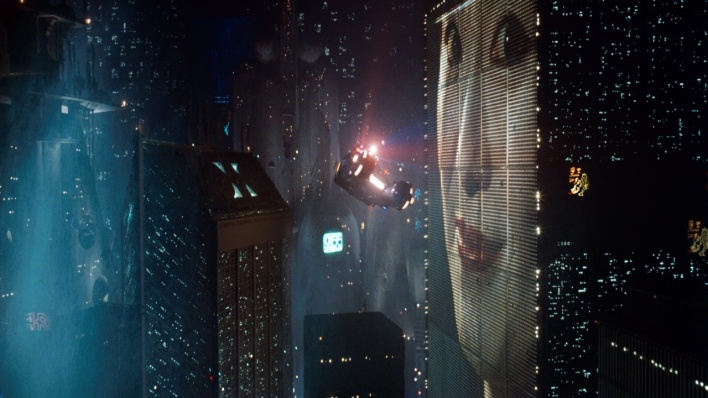
Based off a Philip K. Dick novel and directed by Ridley Scott following his hit with Alien, Blade Runner is often cited as a touchstone and forerunner for the cyberpunk and neo-noir genres, thanks to its grimy rain-soaked visuals of a future Los Angeles. With flying police cars traversing the neon-lit cityscape, I could clearly see this film’s influence on the likes of Minority Report, Ghost in the Shell, and The Matrix. Ghost in the Shell is perhaps the clearest borrower, also boasting a cerebral plot about man-made androids questioning their humanity, so there’s no denying Blade Runner’s impact on the style of much modern sci-fi. The non-digital effects hold up remarkably well, and the cinematography really heightens the bleak otherness of this particular dystopia.

If only this adeptly stylized world were worth spending time in. For all its technical finesse and shadowy cinematography, the strangeness of this future was a turn-off for me, with some of the surreal posturing of its characters reminding me of Dune from two years later. Whereas Dune was dragged down by a surplus of exposition, though, Blade Runner could have benefited from more, with far too many drawn-out scenes left in tedious silence. (I saw Ridley Scott’s Final Cut, but I understand the original theatrical version has a noir-style narration. Honestly, my curiosity about that difference is probably the only thing that would get me to watch Blade Runner again.) It’s a highly visual film, but the visuals weren’t enough to overcome a lackluster story.

Image result for blade runner film

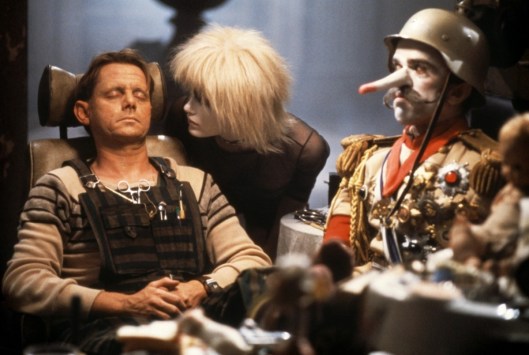
The actors are all decent for the most part, with Harrison Ford playing a good tenacious policeman but never making much of an impression. Likewise, Sean Young as the femme-fatale love interest fills her role in the noir plot, but there’s not much to her thinly written character or to anyone else’s for that matter. Rutger Hauer is perhaps the most memorable as the main villain, Roy Batty, a murderous replicant who seeks to lengthen the programmed four-year lifespan for himself and his fellow rogues (Brion James, Joanna Cassidy, Daryl Hannah). Yet we never get to know the replicants any more than the human characters, and their plight is only half-felt with any sympathy by the end. Batty’s final scenes are also bizarrely anticlimactic after he chases Deckard like Hannibal Lecter on crack.

I recognize a lot of potential depth to the story, with themes of what makes us human, the unreliability of memories, the moral questioning of doing one’s job, and the despair and anger toward the arrogance of a creator (which Scott also incorporated into Prometheus). Yet none of these themes are compelling or explored with any depth, and the intentional ambiguity of several scenes only heightened their underdeveloped potential. Blade Runner is a film such that I can see how critics could watch it repeatedly and wring profound merit from its narrative, but its reputation as a masterful classic is more merit than this slow story deserves, in my opinion.

Image result for blade runner film roy batty

Owing its R rating to only two scenes (one with nudity, one uncomfortably violent), Blade Runner was quite the disappointment, especially because I typically love science fiction. (I’m not alone too; my equally sci-fi-loving VC was bored and uninterested by the halfway point.) I just don’t understand how a style-over-substance film like this is labeled a masterpiece, when far more entertaining tales, like In Time or Surrogates, are written off as sci-fi hack jobs. The letdown has also spoiled much of my interest in the upcoming sequel, though I’m still curious to see Denis Villeneuve’s take on this world, after the intellectual emotion of last year’s Arrival. Blade Runner is a grittily surreal blending of future and noir, with admirable effects and cinematography and an unmistakable impact on science fiction to come, but it’s also proof that just because something shapes a genre doesn’t necessarily make it a masterpiece.

Best line: (Tyrell, Roy’s designer) “The light that burns twice as bright burns half as long, and you have burned so very, very brightly, Roy.”


Rank: Dishonorable Mention


© 2017 S.G. Liput
487 Followers and Counting


Version Variations: Pete’s Dragon (1977, 2016)

23 Tuesday May 2017

Posted by sgliput in Movies, Poetry, Reviews, Writing

≈ 3 Comments

Tags

Animation, Drama, Family, Fantasy, Musical, Version Variations

Image result for pete's dragon 1977

Image result for pete's dragon 2016

To some, a forest holds mere trees,
With empty air between,
While one who knows to notice sees
A firmament of green,
Of life and lives and rarities
That few have ever seen.

What wonderments may hide out there
I cannot dare to guess,
But those who speak of creatures rare,
Withdrawn from man’s progress,
Perhaps perceive that empty air
Cannot be magicless.
_________________

MPAA rating for 1977 version: G (maybe PG)
MPAA rating for 2016 version: PG

With Disney so dedicated now to translating its past canon of animated classics into live-action films, it’s rather disconcerting that their attempts thus far have been fan favorites, like Sleeping Beauty or Beauty and the Beast, but not the lesser entries in Disney’s catalog. While remakes of The Black Cauldron and The Sword in the Stone are supposedly in the works and would be welcome, Pete’s Dragon is the first recent remake that actually had a chance of surpassing the original simply because the original is fairly lame. Yet, even though a simple updating of the tale could have sufficed, writer-director David Lowery took the essentials of the first story and transformed them into something closer in spirit to E.T. than to their source, providing an example of improvement for future Disney remakes to follow.

Image result for pete's dragon 1977 helen reddy

Let’s take a look at the original, a film whose “classic” status is more reliant on its age than anything else. The first Pete’s Dragon sees young Pete and his sometimes invisible dragon Elliott escape from a wicked foster family and seek a home in the seaside town of Passamaquoddy, where kind lighthouse keepers (Mickey Rooney, Helen Reddy) take him in and sneaky snake-oil salesmen (Jim Dale, Red Buttons) plot to capture Elliott. It’s a family-friendly musical in the vein of Mary Poppins, Bedknobs and Broomsticks, and Chitty Chitty Bang Bang, the key difference being that it came out in 1977, a less innocent time when ultra-sincere stories like this began tasting too saccharine.

The silly musical numbers and childish wish fulfillment simply don’t work as well here, thanks to some dreadfully gee-whiz acting from young Sean Marshall as Pete. There’s a notable lack of Disney magic, perhaps due to a new generation of animators (including Don Bluth) taking the reins at the time, and some elements are downright unpleasant, like the abusive backwoods Gogans, headed by Shelley Winters, who want Pete as their personal slave. The songs range from forgettable to embarrassing, but Helen Reddy’s “Candle on the Water” is a beautiful exception and even earned an Oscar nomination.

Image result for pete's dragon 1977

I suppose I shouldn’t be too hard on the original Pete’s Dragon. If I’d seen it as a kid, maybe I’d consider it a classic, as I do Chitty Chitty Bang Bang. The merging of animation and live-action is actually done quite well, and there are some fun moments sprinkled throughout the tiresome ones, like Mickey Rooney’s panic over seeing Elliott or the visiting mountebank who can’t pronounce the name of the town he claims to love. It was also neat seeing Jim Backus of Gilligan’s Island appearing as the town’s mayor. By the overly heartwarming ending, I even was able to recognize why others might find this as charming as Elliott himself. Yet my adult sensibilities couldn’t let me overlook its glaring flaws and often laughable excesses, like the soap opera twist at the end that explains away a character’s year-long absence with amnesia. With these earnest family films, it’s a fine line between delightful and cloying, and Pete’s Dragon is one member of the Disney canon that could have certainly benefited from a remake done right.

Thankfully, almost forty years later, that remake arrived. I debated on whether to call this review a Cartoon Comparison or a Version Variation since the original’s dragon was animated and the latest Elliot was CGI, but since CGI is still animation, I opted for a Version Variation. (Did anyone else notice that the 1977 dragon was named Elliott with two t’s, while the more recent one was Elliot with one t?) Yes, in the 2016 version of Pete’s Dragon, there’s still a boy named Pete and a giant invisible green dragon, but that’s really all this film has in common with the original. Gone are the brutish hillbillies. Gone is Dr. Terminus, the greedy charlatan. Gone are the musical numbers and the silly tone. Whereas established fairy tale films are expected to follow the same beats as their predecessors, Pete’s Dragon took the bare minimum of inspiration from the 1977 movie and made something new yet affectionate out of it.

Image result for pete's dragon 2016 bryce dallas howard

Young Pete (Oakes Fegley) is still an orphan, but the beginning actually shows the loss of his parents and how his first encounter with Elliot saves him, after which the boy grows up as a wild child with his protective dragon friend in the remote woods of the Pacific Northwest. In place of Helen Reddy’s beer cask-skipping lighthouse keeper, Bryce Dallas Howard is pleasantly down-to-earth as Forest Ranger Grace Meacham, and her father (Robert Redford) still tells tall tales of spotting an enormous dragon out in the woods. When Pete is discovered and falls into Grace’s charge, the same familial bonds and adoptive hopes develop as in the first film, only done better and with more subtlety. In lieu of the covetous swindler who wants Elliott for elixir ingredients, the villain role goes to Karl Urban as Gavin, the brother of Grace’s lumberjack boyfriend. His desire to capture a fantastical creature isn’t the most original element, but he’s more like Peter Coyote’s man with the keys from E.T. than an outright villain, and a good moment toward the end reaffirms that he does care more for his family than about fame and fortune.

The latest Pete’s Dragon is perhaps a bit too slow in spots, but it’s an appealing contrast to the frantic comedy of most family fare these days. Unlike the 1977 film, all of the human performances are natural and endearing, and Elliot himself is masterfully brought to life in all his fluffy green dragon glory, behaving like a giant dog at times, which is perhaps different from the whistling original but not at all in a negative way. And as a huge Lindsey Stirling fan, I have to mention her lovely and wistful song “Something Wild” that easily makes my End Credits Song Hall of Fame and was my #4 song of last year.

Image result for pete's dragon 2016

Of all the live-action remakes Disney has created and planned, Pete’s Dragon seemed an unlikely contender, with a lackluster original with limited appeal. Yet even if it’s not the most entertaining entry, Pete’s Dragon may be the best live-action translation yet. While Cinderella and The Jungle Book did their sources justice, 2016’s Pete’s Dragon blows its predecessor out of the water, from the much more intimate change in tone to the uplifting final scene that offers a happy ending to Elliot as well as Pete. Notably distinct without the need to be edgy or revisionist, it’s a gentle remake that Disney would do well to learn from.

Best line from 1977 version:  (Merle Gogan) “Say, have you seen anything of a mean, fresh kid, about yea big? Answers to the name of Pete.”  (Hoagy) “Half of the kids here in this town answer to Pete. Other half don’t answer.”

Best line from 2016 version:  (Mr. Meacham) “There’s magic in the woods, if you know where to look for it.”


Rank for the 1977 version: Dishonorable Mention
Rank for the 2016 version: List Runner-Up


© 2017 S.G. Liput
484 Followers and Counting


VC Pick: Funny Lady (1975)

19 Friday May 2017

Posted by sgliput in Movies, Poetry, Reviews, Writing

≈ Leave a comment

Tags

Biopic, Comedy, Drama, Romance

Image result for funny lady film

It’s easy being funny
When you’re wallowing in money
With your sweet and faithful honey
Waiting lovingly at hand,
But when assets aren’t as runny
And the outlook’s less than sunny,
Not as much is fun or funny,
As the jokers understand.

Though life enjoys unveiling
Every foible, flaw, and failing,
Making efforts unavailing,
One’s good humor perseveres,
So while waiting, maybe wailing,
For a way to smoother sailing,
It’s important and unfailing
To keep laughing through the tears.
____________________

MPAA rating: PG (PG-13 is better due to language)

When I first saw Barbra Streisand’s Oscar-winning performance in Funny Girl, I wasn’t aware she had reprised the role of Fanny Brice in Funny Lady seven years later. It took my VC to suggest seeing this less prestigious follow-up, and honestly it proves that Hollywood’s fondness for unnecessary and unsatisfying sequels is nothing new.

Following the sad conclusion of Funny Girl, where Brice’s marriage to Nicky Arnstein (Omar Sharif) broke up amid financial tension and scandal, Funny Lady sees Brice solid in her stardom but struggling for work like everyone else due to the Great Depression. Enter James Caan as smooth-talking songwriter and showman Billy Rose, whose ego dwarfs Fanny’s diva mentality to the point that he advertises her as part of his new show without even asking her first. Annoyed but somehow charmed, she agrees, and their working relationship gradually turns to romance.

I can’t say that Streisand and Caan aren’t good in their roles, but they had hardly any chemistry, in sharp contrast to Sharif’s allure in the first film. Fanny’s songful suggestion that her second relationship is better thus feels hollow when their bond seems founded on the fact that they can simply yell at each other without either taking it personally.

Image result for funny lady film

I suppose Funny Girl’s tragic romance had more impact because it was preventable, torn apart by Nicky’s pride opposite Fanny’s success; here, Billy Rose’s huckster personality seemed inevitably fated for marital friction and infidelity, and it’s no surprise when things fall apart again. Worsening matters is Fanny’s confrontation with her first husband (Sharif returns), where she confesses to starry-eyed naiveté in the face of his selfishness. It may be true, but it’s not empowering as she intends it to be; instead, it’s sad that all of her romances were doomed from the start, robbing her of even the memory of a happy love life.

Aside from Streisand’s intermittent comedic skits, what makes Funny Lady watchable is the musical numbers, though there are far fewer show-stopping numbers than the first film, and none are as memorable as “People” or “Don’t Rain on My Parade.” In fact, it’s ironic that the best number goes not to Streisand, but to Ben Vereen as one of Fanny’s vaudeville cohorts, an exuberant rendition of “Clap Hands! Here Comes Charley!” that made me wish the rest of Vereen’s performance hadn’t been cut out before release. I’m actually rather surprised the film earned five Oscar nominations, including Cinematography, Score, and Original Song. If you enjoyed Funny Girl or are a fan of Streisand or Caan, Funny Lady may be worth your time, but don’t expect a feel-good classic.


Rank: Honorable Mention


© 2017 S.G. Liput
482 Followers and Counting


← Older posts
Newer posts →

Recent Posts

  • We Didn’t Start 2025 (Recap)
  • NaPoWriMo 2025 Recap (Finally)
  • Sonic the Hedgehog 3 (2024)
  • It Happened One Night (1934)
  • Spellbound (2024)

Recent Comments

associatesofshellymann's avatarassociatesofshellyma… on My Top Twelve La La La So…
Kit's avatarKit Nichols on Bonnie and Clyde (1967)
lifelessons's avatarlifelessons on Look Back (2024)
Carol Jackson's avatarCarol Jackson on The Thief of Bagdad (1940…
Stephen's avatarStephen on Love Story (1970)

Archives

  • January 2026
  • December 2025
  • May 2025
  • April 2025
  • March 2025
  • February 2025
  • January 2025
  • December 2024
  • May 2024
  • April 2024
  • March 2024
  • February 2024
  • January 2024
  • December 2023
  • November 2023
  • October 2023
  • September 2023
  • July 2023
  • June 2023
  • May 2023
  • April 2023
  • March 2023
  • February 2023
  • January 2023
  • December 2022
  • November 2022
  • October 2022
  • September 2022
  • August 2022
  • July 2022
  • June 2022
  • May 2022
  • April 2022
  • March 2022
  • February 2022
  • January 2022
  • December 2021
  • November 2021
  • October 2021
  • September 2021
  • August 2021
  • July 2021
  • June 2021
  • May 2021
  • April 2021
  • March 2021
  • February 2021
  • January 2021
  • December 2020
  • November 2020
  • October 2020
  • September 2020
  • August 2020
  • July 2020
  • June 2020
  • May 2020
  • April 2020
  • March 2020
  • February 2020
  • January 2020
  • December 2019
  • November 2019
  • October 2019
  • September 2019
  • August 2019
  • July 2019
  • June 2019
  • May 2019
  • April 2019
  • March 2019
  • February 2019
  • January 2019
  • December 2018
  • November 2018
  • October 2018
  • September 2018
  • August 2018
  • July 2018
  • June 2018
  • May 2018
  • April 2018
  • March 2018
  • February 2018
  • January 2018
  • December 2017
  • November 2017
  • October 2017
  • September 2017
  • August 2017
  • July 2017
  • June 2017
  • May 2017
  • April 2017
  • March 2017
  • February 2017
  • January 2017
  • December 2016
  • November 2016
  • October 2016
  • September 2016
  • August 2016
  • July 2016
  • June 2016
  • May 2016
  • April 2016
  • March 2016
  • February 2016
  • January 2016
  • December 2015
  • November 2015
  • October 2015
  • September 2015
  • August 2015
  • July 2015
  • June 2015
  • May 2015
  • April 2015
  • March 2015
  • February 2015
  • January 2015
  • December 2014
  • November 2014
  • October 2014
  • September 2014
  • August 2014
  • July 2014
  • June 2014
  • May 2014
  • April 2014
  • March 2014
  • February 2014
  • January 2014
  • December 2013

Categories

  • Blindspot
  • Blogathon
  • Christian
  • Movies
  • Music
  • NaPoWriMo
  • Poetry
  • Reviews
  • TV
  • Writing

Meta

  • Create account
  • Log in
  • Entries feed
  • Comments feed
  • WordPress.com

Recent Posts

  • We Didn’t Start 2025 (Recap)
  • NaPoWriMo 2025 Recap (Finally)
  • Sonic the Hedgehog 3 (2024)
  • It Happened One Night (1934)
  • Spellbound (2024)

Recent Comments

associatesofshellymann's avatarassociatesofshellyma… on My Top Twelve La La La So…
Kit's avatarKit Nichols on Bonnie and Clyde (1967)
lifelessons's avatarlifelessons on Look Back (2024)
Carol Jackson's avatarCarol Jackson on The Thief of Bagdad (1940…
Stephen's avatarStephen on Love Story (1970)

Archives

  • January 2026
  • December 2025
  • May 2025
  • April 2025
  • March 2025
  • February 2025
  • January 2025
  • December 2024
  • May 2024
  • April 2024
  • March 2024
  • February 2024
  • January 2024
  • December 2023
  • November 2023
  • October 2023
  • September 2023
  • July 2023
  • June 2023
  • May 2023
  • April 2023
  • March 2023
  • February 2023
  • January 2023
  • December 2022
  • November 2022
  • October 2022
  • September 2022
  • August 2022
  • July 2022
  • June 2022
  • May 2022
  • April 2022
  • March 2022
  • February 2022
  • January 2022
  • December 2021
  • November 2021
  • October 2021
  • September 2021
  • August 2021
  • July 2021
  • June 2021
  • May 2021
  • April 2021
  • March 2021
  • February 2021
  • January 2021
  • December 2020
  • November 2020
  • October 2020
  • September 2020
  • August 2020
  • July 2020
  • June 2020
  • May 2020
  • April 2020
  • March 2020
  • February 2020
  • January 2020
  • December 2019
  • November 2019
  • October 2019
  • September 2019
  • August 2019
  • July 2019
  • June 2019
  • May 2019
  • April 2019
  • March 2019
  • February 2019
  • January 2019
  • December 2018
  • November 2018
  • October 2018
  • September 2018
  • August 2018
  • July 2018
  • June 2018
  • May 2018
  • April 2018
  • March 2018
  • February 2018
  • January 2018
  • December 2017
  • November 2017
  • October 2017
  • September 2017
  • August 2017
  • July 2017
  • June 2017
  • May 2017
  • April 2017
  • March 2017
  • February 2017
  • January 2017
  • December 2016
  • November 2016
  • October 2016
  • September 2016
  • August 2016
  • July 2016
  • June 2016
  • May 2016
  • April 2016
  • March 2016
  • February 2016
  • January 2016
  • December 2015
  • November 2015
  • October 2015
  • September 2015
  • August 2015
  • July 2015
  • June 2015
  • May 2015
  • April 2015
  • March 2015
  • February 2015
  • January 2015
  • December 2014
  • November 2014
  • October 2014
  • September 2014
  • August 2014
  • July 2014
  • June 2014
  • May 2014
  • April 2014
  • March 2014
  • February 2014
  • January 2014
  • December 2013

Categories

  • Blindspot
  • Blogathon
  • Christian
  • Movies
  • Music
  • NaPoWriMo
  • Poetry
  • Reviews
  • TV
  • Writing

Meta

  • Create account
  • Log in
  • Entries feed
  • Comments feed
  • WordPress.com

Blog at WordPress.com.

  • Subscribe Subscribed
    • Rhyme and Reason
    • Join 814 other subscribers
    • Already have a WordPress.com account? Log in now.
    • Rhyme and Reason
    • Subscribe Subscribed
    • Sign up
    • Log in
    • Report this content
    • View site in Reader
    • Manage subscriptions
    • Collapse this bar