• Home
  • About Me
  • The List
  • THE LIST (2016 Update)
  • THE LIST (2017 Update)
  • THE LIST (2018 Update)
  • THE LIST (2019 Update)
  • THE LIST (2020 Update)
  • THE LIST (2021 Update)
  • THE LIST (2022 Update)
  • Top Twelves and More
  • The End Credits Song Hall of Fame

Rhyme and Reason

~ Poetry Meets Film Reviews

Rhyme and Reason

Tag Archives: Christmas

Serendipity (2001)

24 Sunday Dec 2017

Posted by sgliput in Movies, Poetry, Reviews, Writing

≈ 4 Comments

Tags

Christmas, Comedy, Romance

See the source image

The incidence of miracles is far too low these days.
Coincidence is cited now, when “accidents” amaze,
But when it seems that chance is too unlikely an excuse,
We start to dream of destiny and what it might produce.

Call it what you will, my friends: coincidence or fate,
Or more precisely, Providence that makes our courses straight.
Though some may call it all a crock, a universe of chance,
When once you glimpse the grand design, ‘tis more than happenstance.
____________________

MPAA rating: PG-13

Around Christmas, I tend to watch traditional movies I’ve seen a million times (It’s a Wonderful Life, Miracle on 34th Street, The Polar Express, etc.), so I wasn’t sure at first what would be best for the season. Then, I remembered that Serendipity begins and ends at Christmastime, making it a good fit for a Christmas Eve post. Somehow, I thought that most rom coms since the ‘90s just weren’t worth my time, but Serendipity surprised me as a wholly charming and enjoyable member of a genre that deserves a better reputation.

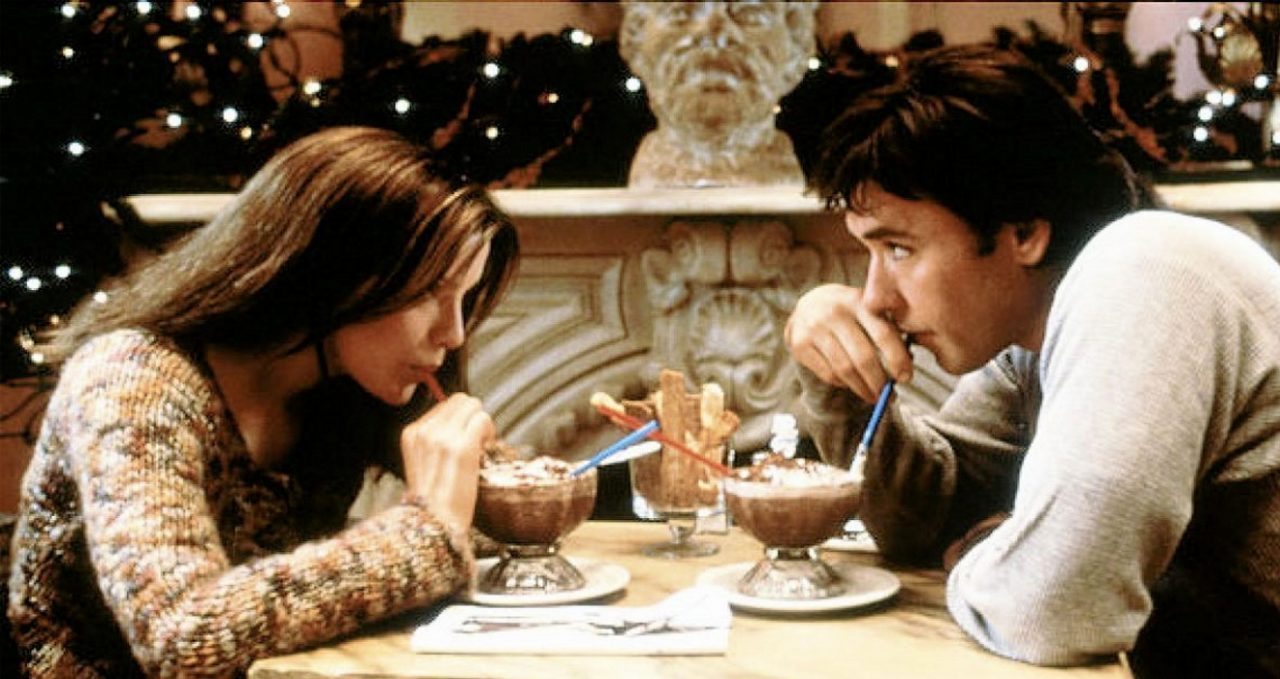
It begins with a classic meet-cute for Jonathan Trager (John Cusack) and Sara Thomas (Kate Beckinsale), both Christmas shoppers after a pair of gloves at Bloomingdale’s. Despite already having partners, there’s an instant connection as they have dessert together at a restaurant called Serendipity 3, and while Jonathan is quick to acknowledge it, Sara is more hesitant and unconvinced that they were “destined” to meet. Using a dollar bill, a book, and an elevator, she decides to test fate a bit too far, and the two potential lovebirds go their separate ways. Fast forward a few years, and both of their relationships have progressed to engagement. Yet, there’s also a gnawing sense of what-could-have-been, and they both decide to search out what might be destiny.

See the source image

No romantic comedy can be successful without two appealing leads, and Cusack and Beckinsale have marvelous chemistry together, that hard-to-define bond that simply either works or doesn’t. It definitely works here, and I could see how their short time together at the beginning could give them pause on whether this stranger might be “the one.” Beckinsale is lovely as always, though for some reason, even with his sweetly obsessive role in Say Anything, neither I nor my VC thought of Cusack as a romantic lead, yet he affably fills the kind of role that could have gone to Tom Hanks a few years earlier.

The dialogue may not be on the level of Nora Ephron’s, but there’s a good number of chuckles along the way as Jonathan and Kate go on a scavenger hunt for clues as to where their mystery lover might be. Eugene Levy puts in an amusingly offbeat side role, while Jeremy Piven and Molly Shannon are perfect companions in trying to keep the two star-crossed lovers relatively grounded. The themes of fate vs. coincidence are nicely laced throughout as well, sometimes for comedy (“Maybe the absence of signs is a sign!”) but also in more thoughtful ways, especially how the audience gets to see connections and near-misses that the characters don’t.

See the source image

I wasn’t sure exactly how much I liked Serendipity at first. One minorly major complaint was in how Jonathan and Sara’s other love interests are treated. Usually, this kind of movie shows that the initial relationship is doomed from the start, making the breakup inevitable, but while that is the case with Sara and her weird fluting boyfriend, Jonathan’s alternative girl is a little too viable a match, making me feel sorry for her by the end. I thought that might be a deal-breaker for me in deciding Serendipity’s ranking, but after seeing it a second time with my VC (who also enjoyed it), it’s a minor complaint in an otherwise satisfying romance. Predictable but very watchable, it falls a bit short of my absolute favorite rom coms, but I’ve come to value any movie that leaves me smiling by the end.

Best line: (Jonathan’s friend Dean) “If you want to improve, be content to be thought foolish and stupid.”


Ranking: List-Worthy


© 2017 S.G. Liput
522 Followers and Counting


A Merry Christmas to all and to all a good night!

The Disappearance of Haruhi Suzumiya (2010)

18 Monday Dec 2017

Posted by sgliput in Movies, Poetry, Reviews, TV, Writing

≈ Leave a comment

Tags

Animation, Anime, Christmas, Drama, Mystery, Sci-fi

See the source image

The world can vex,
Annoy, perplex,
Explicitly and in subtext,
Till one objects
“Life’s too complex!
Just pain in our collective necks.”

Yet when life’s skewed
And comes unglued
And changes unforeseen intrude,
One’s sour mood
And attitude
Can be renewed by gratitude.
___________________

MPAA rating: Not Rated (should be PG-13)

Setting aside the multitude of stand-alone anime films, like those from Studio Ghibli, there are just as many movies based on anime series, which tend to fall into certain categories. There are those that essentially provide a recap for the series, such as the first two films based on Puella Magi Madoka Magica. Then there are those that tie into a series but can stand apart and be enjoyed with or without prior knowledge of the franchise, such as Cowboy Bebop: The Movie. But more often than not, a film designed to follow up the events of a TV series relies on previous knowledge of said series, which is hard to get just right. Sometimes it’s difficult to capture the same magic the show had or the spin-off just falls flat; as much as I loved the time travel story of Steins;Gate, for example, its reasonably good film continuation didn’t feel necessary. (By the way, I highly recommend all these shows I’m namedropping.) Yet if any movie proves that it’s possible to revive a series and deepen everything that came before, it’s The Disappearance of Haruhi Suzumiya.

See the source image

For those who don’t know, The Melancholy of Haruhi Suzumiya is a 2006 anime adaptation of a light novel series, which quickly grew in popularity, and its title character is one of the more recognizable anime icons. The main character, though, is Kyon (in the middle above), a high school student who falls into the orbit of the lovely, pushy, and highly capricious Haruhi (with the headband), involuntarily becoming a member of her new fun-seeking club dubbed the SOS Brigade. The other three club members Haruhi recruits turn out to be less-than-normal students and inform Kyon that Haruhi has godlike powers to reshape reality, which she doesn’t and mustn’t know about. Thus, the 2-season series follows their everyday adventures with the robot-like alien observer Yuki Nagato (the girl with purple hair), the time-traveling pushover Mikuru Asahina (girl with orange hair), and the good-natured but mysterious esper/psychic and king of exposition Itsuki Koizumi (the boy on the far left).

All of that information is much easier to digest in the series, which is light-hearted and charming for the most part. Haruhi tends to be obnoxiously bossy, such as exploiting poor Miss Asahina for sex appeal, but her craziness is nicely contrasted by Kyon’s straight man, who always complains and offers some perfectly amusing deadpan commentary. It’s a series that periodically incorporates science fiction into its prosaic high school setting and can be both fantastically complex and aggressively mundane, such as one episode with a four-minute stretch of nothing but Nagato silently reading or the infamous Endless Eight, in which eight consecutive episodes replayed the same events because the characters were stuck in a time loop. (The show gets a lot of heat and accusations of laziness for the Endless Eight, but it’s actually pretty impressive that the animators found eight different ways to present the same events and redrew each one.)

See the source image

If you’re not sure if all this sounds worth watching, it is, and not just because there’s a murder mystery and a talking cat and a giant alien cricket. It’s not because Melancholy itself is particularly amazing or great, though it is pretty entertaining. It’s because the show allows you to fully enjoy The Disappearance of Haruhi Suzumiya, the 2010 movie that supposedly drew plot from season 2 and forced the showrunners to fill time with the Endless Eight. It’s quite a feat that the movie makes the show worth watching, rather than the other way around. I honestly can’t think of another series-based movie that can say the same.

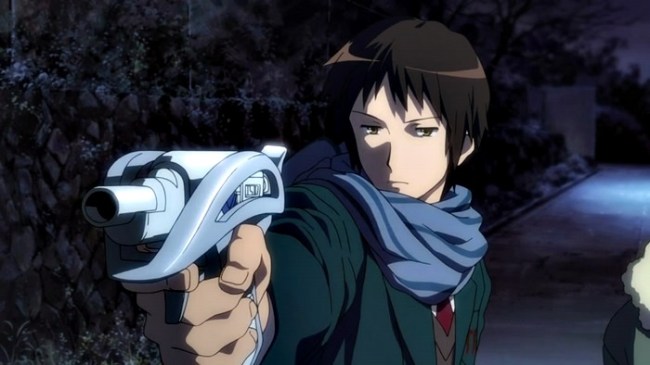
I’ve heard all kinds of praise for Disappearance, with fans naming it their favorite anime movie or claiming it ought to place in iMDB’s Top 250 (it’s currently #42 on iMDB’s animation list). And now that I’ve seen it, I can’t say I disagree. It’s an outstanding piece of animation that surpassed my expectations in every way. As the title indicates, Haruhi suddenly vanishes on December 18 (yes, I waited till today to post this review), the world apparently rewritten so that no one remembers her, except for Kyon, who is understandably perplexed at this inexplicable change. All the supernatural characters seem to be ordinary people now, and Kyon must figure out how to return the world to “normal” and perhaps even question which world is better.
See the source image

One of the more notable aspects of Disappearance is that it’s 163 minutes long, making it the second longest animated film of all time. It’s basically the equivalent of eight episodes of the series, yet despite its length, I was never bored. It’s hard to explain how unusual that is because the film is by no means action-packed. In contrast to the humor of the series, its tone is slow, serious, and melancholy. Unlike most anime films, there are no sweeping vistas or high-flying adventure; instead, it’s mostly winter cityscapes and interior scenes. How is it then that it held my attention from start to finish?

Well, aside from the fact that I’ve grown very fond of these characters, the plot manages to maintain interest in both the story and characters with some truly incredible pacing. Even with such a long runtime, there’s a lot of plot to cover, and the increased time allows characters’ motivations and the significance of their actions to sink in and add so much to their development. I don’t usually like to watch long movies, but this is one case where its length is carried largely by narrative and dialogue alone, and I’m glad nothing was cut, though I suppose Kyon’s awkward disorientation over his changed life could have been shortened.

See the source image

Whenever the pace threatens to lag, something significant is revealed and the moving orchestral score kicks in, making for some memorable scenes that feel like momentous turning points (the kind of scenes that would probably end an episode if this were broken up as part of the series). For example, the reappearance of one murderous character who should be dead is filled with the same looming menace as the coming of Jaws. In addition, despite the restraint compared with more fantastical anime, the animation is exceptional and quite detailed, with special attention paid to very expressive faces and the clouds of smoke that are breathed out in the cold Christmastime weather.

As much as I wish I could say to everyone “go watch this movie” with no strings attached, I must admit that the series is a prerequisite for understanding who everyone is. Even though seventeen minutes are spent establishing the status quo before Haruhi’s disappearance, almost every episode of the show is referenced at some point, which is great for those who’ve seen it, less so for those who haven’t. To cut some corners, I’d say you’d only really have to watch the first six episodes of season 1, the first episode of season 2, and the last entry in the Endless Eight. The rest aren’t as necessary, though you may not understand little things like Kyon trying to talk to a cat. I especially loved when time travel entered the equation of the film, and we got to revisit past scenes with a Back to the Future-style altered perspective, again something new viewers could just roll with but nostalgic viewers will understand better.

See the source image

Despite its potentially burdensome length, The Disappearance of Haruhi Suzumiya is a brilliant conclusion to a good series, transforming the show’s bright charm into subtle emotion and atmosphere. Hyperactive Haruhi herself can be irritating in large doses, so her absence for part of the film actually helps it and allows for some strong development for Kyon and especially Nagato, whose typically robotic face and voice finally get to reveal emotion in this alternate world. I also must point out, as others have before, that the English dub is one of the best out there. As the most significant voice actor, Crispin Freeman as Kyon provides some extensive and superb dialogue, such as an 8-minute soliloquy justifying a fateful decision, one which manages to engender both sympathy for him and regret for how it impacts another character. I’ve seen people refer to this speech as one of the greatest interior monologues of all time and with good reason, as it’s a key validation of his character.

I can usually tell how I feel about an animated film by whether I want to immediately watch it again after it’s over, and yes, all 163 minutes of Disappearance did just that. No, it’s not my new favorite anime film, but to those hesitant to watch a series just to see an overlong movie, I’ll just say you’re missing out.

See the source image

Best line: (Haruhi, to Kyon about Christmas) “You have to believe in a dream if you want to have one in the first place. If you don’t believe, even the dreams that can come true won’t.”


Rank: List-worthy


© 2017 S.G. Liput
519 Followers and Counting



VC Pick: The Christmas Card (2006)

24 Thursday Dec 2015

Posted by sgliput in Movies, Poetry, Reviews, Writing

≈ Leave a comment

Tags

Christmas, Drama, Family, Romance


You speak a word or you write a card,
And think perhaps that they have no effect,
The same clichés by triteness marred
That lead to an “Aww,” then most likely neglect.

But none can know where their kindness ends
And where a larger design can begin,
Where welcomed strangers grow into friends
And holiday spirit makes room at the inn.

You might send a hundred clichés someone’s way.
A heartfelt word may brighten more than their day.
____________________

MPAA rating: Not Rated (definitely G)


I’m sorry I’m getting into the Christmas spirit a little late this year. I thought about compiling a top Christmas movie list, but it would be the same old popular favorites for the most part (A Christmas Story, Home Alone, etc.). Instead, I decided to turn over the holiday reins to my VC, who is fond of this little Hallmark movie that I gave her as a Christmas gift a couple years back.

While it’s perfect for the holidays, The Christmas Card is far from the best Hallmark has to offer. It starts out in Afghanistan, where Sgt. Cody Cullen (John Newton) receives an encouraging Christmas card from a woman out west. When a comrade is killed in action and Cody visits his widow on leave, it turns out that she lives conveniently in the same town as the woman who sent him the card. That would be Faith Spelman (Alice Evans), who conveniently has the same tastes as he does and attends the same church he visits. Conveniently, she has a father (Ed Asner) who takes an instant liking to the handsome soldier and would like nothing more than to fix him up with his daughter. Then, of course, there’s her jealous fiancé and split affections and, well, you see where this is going. While the plot is wholly predictable romantic novel stuff, it’s still rather sweet and enjoyable, though that’s largely due to the scenery.

The Christmas Card always fills my VC with drooling envy, thanks to its setting. The Spelmans live in the quaint mountain town of Nevada City, California, a beautiful hamlet brimming with holiday spirit and warm small-town hospitality. Not only is it the kind of town that could lure my earthquake-phobic VC to California, but the Spelman’s home looks like an HGTV dream house, a palatial but cozy log cabin with a roaring fireplace and a Christmas tree that stands above the rafters. Just looking at this snug residence is enough to put us in the Christmas spirit, perhaps to wrap in a blanket and sip hot chocolate. While the environment keeps my VC’s attention, Alice Evans keeps mine, with her sweatered loveliness and charm holding the affections of two jealous men, though I’m surprised half the town isn’t after her. It’s also cool to recognize her as the younger Eloise Hawking on Lost.

The Christmas Card is nothing deep. John Newton is particularly wooden as the stoic veteran, and neither the acting nor the script is great, though Ed Asner did get an Emmy nomination for his role as the buoyant matchmaker father. While its technical merit is low, it nevertheless rings with Christmas warmth and generosity and brings attention to the soldiers who are away from their families during the holidays. There are better Christmas movies out there, but we keep coming back to The Christmas Card. Merry Christmas to all!

Best line: (Cody, upon meeting Faith’s father Luke) “It’s a real honor to meet you, sir.”   (Luke Spelman) “Honor? I guess you haven’t caught wind of my reputation.”


Rank: List Runner-Up


© 2015 S. G. Liput

352 Followers and Counting


#4: It’s a Wonderful Life (1946)

09 Monday Feb 2015

Posted by sgliput in Movies, Poetry, Reviews, Writing

≈ 3 Comments

Tags

Christmas, Classics, Drama, Family, Fantasy

George Bailey lives in Bedford Falls
But does not wish to stay.
“This crummy little town” just palls
Against lands far away.
 
His father barely keeps afloat
The ol’ Building and Loan,
Which causes George to miss his boat,
Or simply to postpone.
 
Young Mary Hatch has always had
A crush on George; the two
Soon hit it off, and Mary’s glad
That wishes do come true.
 
When George’s plans are shot once more
Because of the depression,
His business doesn’t close its door,
Through Mary’s intercession.
 
For years in little Bedford Falls,
George serves the friendly poor,
While stopping greedy Potter’s calls
To yield what George stands for.
 
But then one day, some carelessness
Misplaces needed cash,
And desperation’s stressful press
Tempts George to make a splash.
 
An angel staves off suicide,
And Clarence tries to warn
By giving George a glimpse untried
Of if he’d not been born.
 
This other world without George Bailey
Is dark and forlorn;
He sees the difference he made daily
Since he had been born.
 
He begs his life back, no more dull,
And finds to his delight
The life he sees is wonderful
And friends that aid his plight.
________________
 

My mom and I share my #1 film, but my dad’s personal favorite at least made it to my #4. My highest black-and-white film, It’s a Wonderful Life stands out as Frank Capra’s best film, sentimental in the best sense of the word, full of moments that inevitably bring my dad to tears. My mom loves it too, having first seen it after learning it was Roger Ebert’s favorite film back in the 80s. Though not successful upon release, it has grown in esteem over the years to become one of those perennial Christmas traditions, a reminder of all that can be good in this world.

In addition to a splendid screenplay, the casting is excellent. Jimmy Stewart is the ideal everyman, whether as a decent Joe Schmo in a world of dirty politics or a selfless son/brother/husband/father that changes his town in ways he never could have imagined. Here his acting talent is at its most diverse, evoking a wide range of deeply felt emotions, from disappointment to helpless despair to rebounding joy that tugs effortlessly on every viewer’s heartstrings. Other examples of exceptional casting include a glowing Donna Reed as Mary Bailey, Thomas Mitchell as forgetful Uncle Billy, child-like Henry Travers as guardian angel Clarence Odbody, and Lionel Barrymore as Mr. Potter, an utterly despicable villain in a town of otherwise pleasant folk.

Watching the film now, after so many prior viewings, it’s hard to believe that George Bailey could consider himself a failure, after saving a couple of lives and personally presiding over happy homecomings (most people don’t even do that). Yet the microscope of anxiety leads him to cruel panic, and a series of hardships, one after the other, plausibly drives him to consider suicide. While the film implies that guardian angels are deceased humans (which isn’t true), the intervention of Clarence is more charming and divinely sent than, say, the ghosts in A Christmas Carol. In trying to convince George of his own worth, the film serves as encouragement for its audience. Who hasn’t felt like a failure at some point in his/her life? Who hasn’t wondered if it was all for naught? Yet, like the tapestry argument about how focusing on one thread does not comprehend the full pattern, we never know how and how often our lives touch others’. By now, the interconnection of lives has become a well-worn lesson, from Liberty Mutual commercials to countless films, but It’s a Wonderful Life does it best, giving a full sense of just how essential one man can be to the happiness of an entire town.

My VC and I had a brief debate over whether the film could be considered a “meet-‘em-and-move-on” movie. I at first thought so because of the many people with whom George interacts throughout his life and the infinitely feel-good reunion of an ending. Yet she pointed out that, even if George doesn’t fully appreciate all his friends until the end, nobody really moves on. It all takes place in the same quiet little New York town, a place George at first views as a cage but, like nostalgic viewers, eventually comes to appreciate it as his home. (By the way, the entire town of Bedford Falls was one long outdoor set.) Thus, while It’s a Wonderful Life isn’t technically a “meet-‘em-and-move-on,” it does bear certain similarities, especially by the jubilant end. (Again by the way, as wonderful as it is for everyone in town to donate to George, it probably wasn’t enough to make up for the missing $8,000; it really all came down to his friendship with wealthy Sam Wainwright. Hee-haw!)

Though his films were often derided as “Capra-corn,” Frank Capra was certainly one of the great early Hollywood directors, simply choosing to focus on the good, the charming, and the uplifting rather than the more cynical stuff some critics prefer. His personal favorite of his films, It’s a Wonderful Life exemplifies simple, feel-good messages in an entertaining package sure to break and warm the heart.

Best line: (Clarence) “Strange, isn’t it? Each man’s life touches so many other lives. When he isn’t around, he leaves an awful hole, doesn’t he?”

 
Rank: 60 out of 60
 

© 2015 S. G. Liput

284 Followers and Counting

#11: The Princess Bride (1987)

27 Tuesday Jan 2015

Posted by sgliput in Movies, Poetry, Reviews, Writing

≈ 3 Comments

Tags

Christmas, Comedy, Drama, Family, Fantasy, Romance

Listen, dear viewers, and you shall be read
A story just like a sick child in bed,
About miracles, fencing, escapes, and true love,
Promises made and the efforts thereof
And a farm boy named Westley thought to be dead.
 
He said to his love that he would return
And not a thing could keep him away,
But Buttercup is upset to learn
That the Dread Pirate Roberts came to slay.
Burdened by grief, she catches the eye
Of Prince Humperdinck, a duplicitous guy.
Ere they are wed, she is caught by three
Colorful, talented killers-to-be,
Vizzini, Montoya, and Fezzik, who flee.
 
They are followed, though, by a man in black,
Coming to kidnap their prisoner back,
Facing the three of them, one by one,
Defeating each, and once he has won,
From Buttercup, Westley gets a smack.
The two through the Fire Swamp take their track
And fight when enormous rats attack.
Catching them, Prince Humperdinck won’t share
That he’s locked Westley in the Pit of Despair.
 
Meanwhile, Montoya and Fezzik unite,
Planning revenge for a family crime,
But they need Westley to plan it this time.
The two of them free him, though mostly dead,
Revive him with a miracle bite,
And before the wedding bells can chime,
Help him inside ere the couple can wed.
 
When he finds the man he’s been hunting for,
Montoya takes revenge at last,
And because true love is unsurpassed,
When Westley challenges pain galore,
Prince Humperdinck will not compete
Against a man death can’t defeat.
When Buttercup and the trio of men
Depart for safer hill and glen,
The two lovers kiss as never before.
You wouldn’t mind hearing the tale once more?
As you wish; I’ll come again.
______________________
 

The Princess Bride is one of the most perfect films around, not in any grand or profound way, but in its timeless, endlessly amusing creation of a modern fairy tale, based off the book by William Goldman, who also wrote the screenplay. I know I’m not alone in saying that this is a film I could watch any day of the week, while quoting much of the ingenious dialogue. It never ceases to entertain, and I think everyone involved in its production realized what a special film they produced.

The cast is a treasure trove of comedic talent, from Wallace Shawn as disdainful Vizzini to Andre the Giant as strong but gentle “land mass” Fezzik to Billy Crystal’s hilarious cameo as Miracle Max, who proves that chocolate does indeed have life-giving properties. Cary Elwes as Westley and Robin Wright as Buttercup (one of her first roles) are ideal starry-eyed lovers, the one gallant and dashingly British and the other beautiful, though rather helpless. The film is well-recognized for its abundance of potent quotables, and every character gets a memorable line, often several. Who can forget Mandy Patinkin as Inigo Montoya spouting his rehearsed threat to his father’s killer, or Wallace Shawn’s “Inconceivable,” said as only he can? Some droll moments are also given to the villains, Chris Sarandon as self-assured Prince Humperdinck (I wonder if his first name is Engelbert) and Christopher Guest as soft-spoken sadist Count Rugen. Even small roles like Mel Smith as the Albino and Peter Cook as the Impressive Clergyman get some Monte Python-style humor from their unexpected voices.

Though The Princess Bride parodies typical fairy tale tropes, it embraces them as well, like a more sincere version of a Mel Brooks comedy. Consider when Vizzini calls out “Behold, the Cliffs of Insanity!” followed by some overly dramatic music, yet the cliffs themselves do play a role in the tale, and their pretentious name doesn’t preclude real danger. The film’s depicted framework of a bedtime story, read by Peter Falk, lends the film a detached fascination, so that the audience can laugh while also becoming invested in the characters’ struggles. Quite a lot of work went into the filming as well, particularly the expert duel between Elwes and Patinkin, who did all but the somersaults themselves. Moments of whimsy alternate with moments of genuine passion to create a family film for all ages (though a single profanity from Fred Savage as the boy was unnecessary). The Oscar-nominated song “Storybook Love,” sung by Willy DeVille, is also worthy of a place in my End Credits Song Hall of Fame.

As I said, I can watch this film forever, but it was only recently that my attention was brought to a small but important detail. The Princess Bride is a Christmas movie! I didn’t believe it at first, but at the very beginning, there are lights and snow outside and a small lighted tree out in the hall, as well as a Santa hanging behind Peter Falk the whole time. I always assumed the book was a get-well-soon gift, but it’s a Christmas present. Now we all have one more reason to watch it, as if we needed another excuse. It’s got everything a good fairy tale needs and a great deal more besides.

Best lines (I wish I could just say the whole movie): (Vizzini, when Westley doesn’t fall from the Cliffs) “He didn’t fall? Inconceivable!”  (Inigo) “You keep using that word. I do not think it means what you think it means.”
 
(Inigo Montoya) “Hello. My name is Inigo Montoya. You killed my father. Prepare to die.”
 
(Miracle Max, when he lifts and drops Westley’s lifeless arm) “I’ve seen worse.”
 
(Westley, after knocking out the giant Fezzik) “I do not envy you the headache you will have when you awake. But for now, rest well and dream of large women.”
 
(Westley, after returning from almost-death) “Who are you? Are we enemies? Why am I on this wall? Where is Buttercup?”   (Inigo) “Let me explain. [pauses]  No, there is too much. Let me sum up.”
 
(Westley and the Grandfather) “As you wish.”
 
 
Rank: 60 out of 60
 

© 2015 S. G. Liput

283 Followers and Counting

#30: The Family Man (2000)

04 Sunday Jan 2015

Posted by sgliput in Movies, Poetry, Reviews, Writing

≈ 1 Comment

Tags

Christmas, Comedy, Drama, Fantasy, Romance

Remember, Kate, when we were at the airport years ago?
How stupidly I left you for what job and wealth could bring?
I grew to be a true success, a businessman, a pro,
And never would have thought that I was missing anything.
 
But then a glimpse was given me, and much to my chagrin,
I found my happy, wealthy life replaced with kids and you.
I saw ourselves together, as what would or might have been,
But hated the suburban life I barely never knew.
 
Yet as I started seeing past the lack of cash and clout,
I saw the truer joys that I had not perceived before.
I wasn’t getting anywhere with how I’d whine and pout,
So I embraced this other life, despite my being poor.
 
Although I tried improving it, the truth I didn’t see
Is we indeed were happy in our own suburban way.
That’s when the precious, fleeting glimpse was taken back from me,
And left me now regretful of that dim departing day.
 
Please reconsider life and love and all that we could be;
Don’t make the same mistake I did; but hear, believe, and stay.
____________________
 

Sorry for the week-long hiatus. A family hospitalization called me away, but I’m back to finish the list!

My family received The Family Man on DVD as an unwanted gift, and it was some time before we finally got around to seeing it. I’m glad we did. Whereas It’s a Wonderful Life presented a terrible alternate reality to encourage George Bailey, The Family Man hinges on another “what if” situation that causes Jack Campbell to realize the importance of marriage and family.

Nicolas Cage is at his best playing Jack as both confident businessman and sullen dad/husband, and most of the humor comes from his reactions to the sudden change forced upon him. Likewise, Tea Leoni is perfect as his could-be wife Kate; her performance spans the expansive range of spousal emotions, from insistent anger to glum disappointment, all surpassed by a familial give-and-take warmth. Don Cheadle also has a low-key role as “Cash Money,” the unexplained angel(?)/representative that gives Jack the glimpse. Also, (Lost alert) the Chinese guy in the convenience store early on is Ken Leung, known to Lost fans as ghost hunter Miles Straume.

It’s amazing that a film that depicts all the headaches of married suburban life turns out to be a tribute and endorsement of such, insisting that truer happiness can be found in a kid-harassed New Jersey home rather than an expensive but lonely apartment suite. Some critics didn’t consider the film an affirmation of middle-class suburban joy, pointing to Jack’s constant dissatisfaction with his situation, even near the end. Yes, his former/real life had its delights, which he understandably misses, yet it is just as he recognizes the preferred pleasure of this “glimpse” that it is taken from him.

That’s another sticking point for some viewers: Whereas George Bailey was shown his alternate reality to cheer him about his own accomplishments and worth, “Cash Money” plucks Jack from his ignorant bliss with a glimpse he neither wanted nor seemingly needed, only to return him to a comparatively dismal life made empty by his supernatural intervention. To be honest, I see how that view could turn people off, yet Cash Money’s motivations seem benevolent (a cross in the background implies he might be angelic), and his presence is ultimately just a plot device to initiate Jack’s change. Even if Jack thought he was happy, the reemergence of Kate reopened the door he closed thirteen years prior and made a better life possible if only he would jump on the opportunity; the glimpse was the catalyst. Such is how I see the film, and such is how I believe it was intended to be interpreted.

(Clear spoilers in this paragraph) I would have only changed one thing, the very end. While Jack’s final plea is wonderful, not unlike Billy Crystal’s in When Harry Met Sally…, the open-ended conclusion bears wistful potential rather than complete satisfaction. There was a 2010 remake with Kevin Sorbo and John Ratzenberger entitled What If…, which strengthened the Christian resonances in the story but was clearly borrowed material. The one improved point was the final scene, in which a home video the main character had seen earlier was recreated, indicating that the life and children he glimpsed did indeed become reality. Such a scene may have been overly clear for a sometimes ambiguous film like The Family Man, but it would have been more satisfying.

Excellent modern Christmas fare, The Family Man is also the best film from director Brett Ratner (whom I have never forgiven for ruining X-Men: The Last Stand, which coincidentally also featured Ken Leung). The Family Man is a celebration of the fulfillment found in family, and a bittersweet reminder of what could be lost down the path not taken.

Best line: (Jack, at the end) “I don’t know, maybe it was just all a dream. Maybe I went to bed one lonely night in December, and I imagined it all. But I swear, nothing has ever felt more real. And if you get on that plane right now, it’ll disappear forever. I know we could both go on with our lives and we’d both be fine, but I’ve seen what we could be like together. And I choose us.”

 
Rank: 58 out of 60
 

© 2015 S. G. Liput

275 Followers and Counting

#68: Home Alone (1990)

16 Sunday Nov 2014

Posted by sgliput in Movies, Poetry, Reviews, Writing

≈ Leave a comment

Tags

Christmas, Comedy, Family

The McCallister household is full
Of family; no moment is dull.
It’s Christmas; they’re stressed,
And young Kevin’s a pest
And makes one and all miserable.
 
He wishes they’d all go away,
And when they wake up the next day,
They rush to vacation
And, leaving the nation,
Find Kevin just happened to stay.
 
As Mom is consumed with concern
And does all she can to return,
Her son, home alone,
With no parents or phone,
Is thrilled with this fortunate turn.
 
While Kevin has fun and makes merry,
Two cat burglars named Marv and Harry
Are eyeing with guile
His rich domicile,
But Kevin is gleefully wary.
 
Right after the boy comes to terms
With a man who benignly confirms
The importance of kin,
Kevin leaves to begin
Preparing for two burglar worms.
 
With booby traps set everywhere,
He catches the pair unaware.
The bumbling knaves
And the vengeance each craves
Are no match for his every snare.
 
The McCallister home is defended.
And family rapport is commended.
Our kid’s reunited
With family delighted,
Though his fight with crooks isn’t ended.
________________
 

Home Alone was one of the most successful live-action comedies ever made, topping the box office for twelve weeks and making its combination of charm and torture a holiday staple. Written by John Hughes and directed by Mrs. Doubtfire’s Chris Columbus, the now-classic Christmas movie made young Macaulay Culkin a household name and (hopefully) prevented countless parents from neglecting to bring along their children on vacation.

The film doesn’t start off like the kind of film I would enjoy. Kevin and his relatives are realistically bratty, with little reason to like any of them. Once he is actually left alone, the plot improves dramatically. What kid hasn’t wanted the whole house to themselves and the freedom to do what they want when they want how they want? Yet Kevin turns out to be surprisingly responsible, in contrast to his inattentive mother (and father), who spends the rest of the film mostly making up for her lapse in judgment by displaying sympathetic, if pointless, worry for her abandoned child. Luckily, though, the blame isn’t all on her: Kevin is by no means an angel and his admittance of such allows him some proper remorse. His conversation with Old Man Marley (Roberts Blossom) in the church perfectly addresses both of their familial conflicts. (Incidentally, the scene begins with my VC’s favorite Christmas song, “O Holy Night,” and ends with mine, “Carol of the Bells.”)

Of course, much of the film’s credit should go to Daniel Stern and Joe Pesci as Marv and Harry, the two bumbling thieves who deserve a place amongst memorable comedic odd couples. Their persistence is matched only by their stupidity in walking into trap after trap set by the devious boy of the house. Pesci’s constant muttering of “Razzin, frazzin…” is hilarious (yes, he amuses me), while the spider scene proves Stern as one of the great male screamers of our time. Plus, for added comedy, Hughes brought along John Candy from Planes, Trains, and Automobiles for a small but humorous role as a kindhearted polka bum.

John Williams’ carol-infused score is also outstanding, and his own little noel, “Somewhere in My Memory,” deserves a spot in my End Credits Song Hall of Fame. Only the sweet closing scenes are actually set on Christmas, but the whole film illustrates the Christmas season, with films like It’s a Wonderful Life (in French!) and Miracle on 34th Street included for good measure. Also, it thankfully doesn’t shy away from the sacred aspects of Christmas, including a crèche scene, a church, and themes of forgiveness. All in all, Macaulay Culkin’s first major role was his best, yet another Christmas film that my family revisits year after year.

Best line: (Kate McCallister/Mom) “Tell me, have you ever gone on vacation and left your child home?”
(Polka king Gus, after a pause) “No, no. But I did leave one at a funeral parlor once. Yeah, it was—was terrible too. I was all distraught and everything, you know, the wife and I, and we left the little tyke there in the funeral parlor all day. All day. You know, we went back at night, when you know, we came to our senses, and there he was, apparently he was there alone all day with the corpse. Yeah, he was okay, you know, after six, seven weeks he came around and started talking again… But he’s okay. You know, they get over it; kids are resilient like that.”
(Kate) “Maybe we shouldn’t talk about this.”
 
Rank: 55 out of 60
 

© 2014 S. G. Liput

247 Followers and Counting

#74: A Christmas Story (1983)

10 Monday Nov 2014

Posted by sgliput in Movies, Poetry, Reviews, Writing

≈ Leave a comment

Tags

Christmas, Comedy, Family

‘Twas days before Christmas throughout the Midwest,
And young Ralphie Parker was clearly obsessed
With gaining the gift of a grandiose gun,
A Red Ryder air rifle second to none.
His teacher and Santa and Mom had no doubt
That, if he received it, he’d “shoot his eye out,”
But still he would dream of the glorious day
When he’d get the gun from the Christmas display.
 
As Ralphie’s friend Flick found his frozen tongue trapped,
As bullies tormented them till Ralphie snapped,
As Ovaltine ads disappointed the scamp,
As Mom and Dad fought over one gaudy lamp,
As imprudent words left him sampling soap,
He planned and held onto his undying hope:
The gun of his dreams. Though that Christmas had sighs,
He got and remembered both woes and his prize.
__________________
 

Sometimes, I find it difficult to imagine a time before certain films entered the pop culture stream; A Christmas Story is one of those films. Though set in an ambiguous ’30s-‘40s era in Indiana, it holds a ubiquitous nostalgia that even those whose childhoods were far-removed from that time and place can find plenty to which they can relate. In a way, Jean Shepherd’s novelized sketches of one hilarious Christmas seem to capture the very essence of childhood during the holidays.

Shepherd himself narrates the familiar vignettes with casual grandiloquence, while Peter Billingsley portrays his shrewd younger self. Ralphie is an engaging “everykid,” whose solecism and sporadic brattiness are easily forgiven, since after all, who wasn’t an occasional selfish rascal when growing up? Though Ralphie’s parents seem like tired stereotypes (the blustering, foul-mouthed patriarch and the dense, unassuming mother), they both are treated affectionately throughout, even in their parental judgments, and become more sympathetic as the film continues. They feel like real parents, not always getting along nor indulging their children as much as they might wish, but capable of unexpected kindness that sticks in a child’s memory just as strongly as pink bunny pajamas.

Every moment of this film is a paradigm of Christmas reminiscences, from Ralphie’s over-the-top fantasies to the oft-repeated assertion that BB guns can only end in ocular injury. Why A Christmas Story was coolly received upon its release, I’ll never know; perhaps nostalgia wasn’t “in” in 1983 or critics just couldn’t recognize an instant classic when they saw it. Regardless, it has risen to its due popularity over time and is typically repeated for the entirety of Christmas Day on TBS. Some Christmas movies focus on its true meaning, like The Nativity Story; some put the emphasis on wonder and vague holiday spirit, like The Polar Express; some just happen to be set at Christmastime, like Die Hard; and some are eternal portraits of yuletide Americana, the best of which is A Christmas Story.

Best line: (Ralphie’s narration, after he spills the F-dash-dash-dash word) “Over the years I got to be quite a connoisseur of soap. My personal preference was for Lux, but I found Palmolive had a nice, piquant after-dinner flavor – heady, but with just a touch of mellow smoothness. Life Buoy, on the other hand…” (young Ralphie) “YECCHH!”

VC’s best line (the more obvious): (Ralphie’s mom, his teacher, and Santa Claus) “You’ll shoot your eye out.”

 
Rank: 55 out of 60
 

© 2014 S. G. Liput

243 Followers and Counting

#80: Miracle on 34th Street (1947)

04 Tuesday Nov 2014

Posted by sgliput in Movies, Poetry, Reviews, Writing

≈ Leave a comment

Tags

Christmas, Classics, Drama, Family

At Macy’s Thanksgiving Day Parade,
Their Santa impostor is drunk,
And Miss Doris Walker must see that he’s played,
Although she thinks Santa is bunk.
 
When kindly Kris Kringle is begged to fill in,
He does such a wonderful job,
He’s made the store Santa, the best there has been,
And garners a juvenile mob.
 
He has the consumers’ best interest at heart,
An idea so radically new
That Macy’s and Gimbel’s incredibly start
A goodwill campaign overdue.
 
Miss Walker’s young daughter named Susan is told
By Mother to be realistic,
But Kris is so Santa-ish, jolly and old,
That she cannot stay pessimistic.
 
Yet Kris makes an enemy with enough clout
To claim an annoyed accusation,
Which puts Kris’s sanity quickly in doubt
Right after a brief altercation.
 
When Doris’s lawyer friend Fred defends Kris,
A court battle breaks out and quick,
And Fred Gailey’s planning to somehow prove this:
That Kris is the famous Saint Nick.
 
Though Doris is frustrated by Fred’s endeavor,
Both Susan and she still concede.
Their trust leads to proof, unexpected and clever,
By which Kris is upheld and freed.
 
His gifts warm the hearts of his numerous friends
After he is released Christmas Eve.
Fred, Doris, and Susan see all he intends
And really can’t help but believe.
____________________
 

One of the quintessential Christmas movies, Miracle on 34th Street is as pure and sentimental as holiday entertainment can get without becoming saccharine. Edmund Gwenn won a Best Supporting Actor Oscar for his portrayal of arguably the best on-screen Santa Claus, genial and honest, accommodating but willing to confront vice in the name of virtue. When younger, I was always told that the Santa at the end of Macy’s Thanksgiving Day Parade was the real Santa (as opposed to all his impersonating helpers out there in the malls and department stores and street corners), and this film cemented that belief.

Maureen O’Hara is both likable and frustratingly pragmatic as divorced mother Doris, whose growing relationship with the idealistic lawyer Fred Gailey (John Payne) is a cogent endorsement of the “lovely intangibles” that make life enjoyable. A young Natalie Wood gives a precocious performance as doubting Susan, who doesn’t know what to believe as the adults pull her in different intellectual directions.

Though there are some instances of Golden-Age-of-Hollywood overacting, its Oscar-winning screenplay succeeds at balancing humor, schmaltz, and intelligence. The courtroom scenes are particularly well-formulated, with an implausible claim being “proven” in a surprisingly persuasive way. Though we never see Kris Kringle in full Santa mode, delivering toys and such, he embodies and disseminates the goodwill, generosity, and “faith” of the secular side of Christmas. No remake can compare with the magic of the 1947 original (non-colorized, please).

Interestingly, despite its reputation as a holiday classic, the film was not advertised as a Christmas movie. Its trailers simply featured actors bestowing vague praise on some inspiring story called Miracle on 34th Street, and it was actually released in the United States in May. Even with its spring release, the film was recognized as a Christmas delight, one of those enduring bits of Americana that can be watched year after year.

Best line: (Fred) “Look, Doris, someday you’re going to find out that your way of facing this realistic world just doesn’t work. And when you do, don’t overlook those lovely intangibles. You’ll discover they’re the only things that are worthwhile.”
 
VC’s best line: (Mr. Shellhammer, on the phone with Doris) “Yes. Just a moment.  Mrs. Shellhammer wants to talk to you.  I made the martinis triple strength, and she feels wonderful!  Here, my pet.”
(Mrs. Shellhammer, on the couch and snockered, holding the phone upside down) “Thank you. Hello?  Hello?”
(Mr. Shellhammer, switching phone around but still upside down) “No, no, no, no. No, dear.”
(Mrs. Shellhammer, laughing) “Thank you, darling. [Loudly]  Hello?”
(Mr. Shellhammer, turning phone right-side up) “No, no, no, dear. There.”
(Mrs. Shellhammer) “Oh, darling. How silly of me. [Very loudly] Helloooo? [Laughs] Why, we’d love to have Santa Claus come and stay with us. Mm-hmm. I think it would be simp-ly charming!”
 
Rank: 54 out of 60
 

© 2014 S. G. Liput

239 Followers and Counting


#98: The Santa Clause (1994)

15 Wednesday Oct 2014

Posted by sgliput in Movies, Poetry, Reviews, Writing

≈ Leave a comment

Tags

Christmas, Comedy, Family, Fantasy

Scott Calvin says that Santa’s real
And gives the chronic Christmas spiel
When his son Charlie visits Scott.
Though Charlie has faith, Scott does not.
 
Their Christmas Eve is pitiful,
But Charlie’s still excitable.
He hears a noise upon the roof
And knows it’s many a reindeer hoof.
 
Scott’s yelling startles someone there,
Who falls before the dumbstruck pair.
At Charlie’s urging, Scott agrees
To wear the suit the man empties.
 
They find indeed a reindeer sleigh,
With which Scott flies, to his dismay,
Delivering the toys with scorn
To every house before the morn.
 
The reindeer taking full control,
They end up at the real North Pole,
Where child-like elves greet him because
Scott Calvin’s their new Santa Claus.
 
The Santa Clause (observe the E)
Makes Scott the big man rapidly.
Though he refuses to believe,
He can’t escape that Christmas Eve.
 
As Charlie tells both Mom and Neal
That Scott is Santa Claus for real,
Scott finds that he is gaining weight,
Perhaps from all the sweets he ate.
 
His beard is growing magically;
He’s Santa-fied for all to see,
And Laura comes to the conclusion
This is some harmful delusion.
 
She takes Charlie from his dad,
Who only wants to please the lad.
When Christmas Eve arrives once more,
Both Scott and Charlie flee and soar.
 
This puts Scott on the wanted list,
And he’s arrested in the midst
Of Christmas duties, though some elves
Release him, flying off themselves.
 
Returning Charlie to his mom,
Scott tries to keep the youngster calm.
As Laura’s disbelieving thaws,
Scott proves himself as Santa Claus
And flies away with all his toys
For all the world’s good girls and boys.
___________________
 

Certain films thoroughly capture and capitalize on a comedian’s unique voice; Bill Murray had Groundhog Day, Dudley Moore had Arthur, Steve Martin had The Jerk, and Tim Allen had The Santa Clause. Full of all the deprecatory wit of his hit TV series Home Improvement (which director John Pasquin had previously produced), Tim Allen is at his comedic best in this modern Christmas classic. It’s unfortunate that the humor seems to normalize Charlie’s dysfunctional broken family, but some later scenes showing the impact of a judge’s court order lends some reality to the pain of divorce and the nuclear family’s disintegration. The filmmakers couple this comedy and heart with some Christmas spirit that is at once revisionist and faithful, creating a film that remains as entertainingly original today as it was in 1994.

Tim Allen steals every scene, from his abortive turkey meltdown early on to his constant disparagement of Neal’s snazzy sweaters, which my VC actually admires. Allen’s fat suit for gradually transforming into St. Nick never looks fake, and if the likes of The Nutty Professor and Norbit can earn Best Makeup Oscar nominations, The Santa Clause certainly should have. Wendy Crewson of Air Force One and gentle-voiced Judge Reinhold of Beverly Hills Cop provide sympathetic foils for Allen’s drollery, and their disbelief and concern for Charlie’s well-being are entirely understandable. Indeed, though Allen releases a number of snide remarks, the film’s strength is its lack of negativity. No character possesses any ill will, and everything hinges on discovering belief rather than some good/evil conflict, much like The Polar Express.

Though the sequels featured a major Lost alert in casting Elizabeth Mitchell as Mrs. Claus, they fell short of the original Christmas favorite. With clever effects and a wondrous vision of the North Pole, The Santa Clause ranks among the best Santa movies, reinforcing everyone’s inner child.

Best line: (Scott, flying into the sunrise after his first night of toy deliveries) “Merry Christmas to all, and to all a good night! When I get home, I’m getting a CAT scan!”

 
Rank: 53 out of 60
 

© 2014 S. G. Liput

229 Followers and Counting


← Older posts
Newer posts →

Recent Posts

  • We Didn’t Start 2025 (Recap)
  • NaPoWriMo 2025 Recap (Finally)
  • Sonic the Hedgehog 3 (2024)
  • It Happened One Night (1934)
  • Spellbound (2024)

Recent Comments

associatesofshellymann's avatarassociatesofshellyma… on My Top Twelve La La La So…
Kit's avatarKit Nichols on Bonnie and Clyde (1967)
lifelessons's avatarlifelessons on Look Back (2024)
Carol Jackson's avatarCarol Jackson on The Thief of Bagdad (1940…
Stephen's avatarStephen on Love Story (1970)

Archives

  • January 2026
  • December 2025
  • May 2025
  • April 2025
  • March 2025
  • February 2025
  • January 2025
  • December 2024
  • May 2024
  • April 2024
  • March 2024
  • February 2024
  • January 2024
  • December 2023
  • November 2023
  • October 2023
  • September 2023
  • July 2023
  • June 2023
  • May 2023
  • April 2023
  • March 2023
  • February 2023
  • January 2023
  • December 2022
  • November 2022
  • October 2022
  • September 2022
  • August 2022
  • July 2022
  • June 2022
  • May 2022
  • April 2022
  • March 2022
  • February 2022
  • January 2022
  • December 2021
  • November 2021
  • October 2021
  • September 2021
  • August 2021
  • July 2021
  • June 2021
  • May 2021
  • April 2021
  • March 2021
  • February 2021
  • January 2021
  • December 2020
  • November 2020
  • October 2020
  • September 2020
  • August 2020
  • July 2020
  • June 2020
  • May 2020
  • April 2020
  • March 2020
  • February 2020
  • January 2020
  • December 2019
  • November 2019
  • October 2019
  • September 2019
  • August 2019
  • July 2019
  • June 2019
  • May 2019
  • April 2019
  • March 2019
  • February 2019
  • January 2019
  • December 2018
  • November 2018
  • October 2018
  • September 2018
  • August 2018
  • July 2018
  • June 2018
  • May 2018
  • April 2018
  • March 2018
  • February 2018
  • January 2018
  • December 2017
  • November 2017
  • October 2017
  • September 2017
  • August 2017
  • July 2017
  • June 2017
  • May 2017
  • April 2017
  • March 2017
  • February 2017
  • January 2017
  • December 2016
  • November 2016
  • October 2016
  • September 2016
  • August 2016
  • July 2016
  • June 2016
  • May 2016
  • April 2016
  • March 2016
  • February 2016
  • January 2016
  • December 2015
  • November 2015
  • October 2015
  • September 2015
  • August 2015
  • July 2015
  • June 2015
  • May 2015
  • April 2015
  • March 2015
  • February 2015
  • January 2015
  • December 2014
  • November 2014
  • October 2014
  • September 2014
  • August 2014
  • July 2014
  • June 2014
  • May 2014
  • April 2014
  • March 2014
  • February 2014
  • January 2014
  • December 2013

Categories

  • Blindspot
  • Blogathon
  • Christian
  • Movies
  • Music
  • NaPoWriMo
  • Poetry
  • Reviews
  • TV
  • Writing

Meta

  • Create account
  • Log in
  • Entries feed
  • Comments feed
  • WordPress.com

Recent Posts

  • We Didn’t Start 2025 (Recap)
  • NaPoWriMo 2025 Recap (Finally)
  • Sonic the Hedgehog 3 (2024)
  • It Happened One Night (1934)
  • Spellbound (2024)

Recent Comments

associatesofshellymann's avatarassociatesofshellyma… on My Top Twelve La La La So…
Kit's avatarKit Nichols on Bonnie and Clyde (1967)
lifelessons's avatarlifelessons on Look Back (2024)
Carol Jackson's avatarCarol Jackson on The Thief of Bagdad (1940…
Stephen's avatarStephen on Love Story (1970)

Archives

  • January 2026
  • December 2025
  • May 2025
  • April 2025
  • March 2025
  • February 2025
  • January 2025
  • December 2024
  • May 2024
  • April 2024
  • March 2024
  • February 2024
  • January 2024
  • December 2023
  • November 2023
  • October 2023
  • September 2023
  • July 2023
  • June 2023
  • May 2023
  • April 2023
  • March 2023
  • February 2023
  • January 2023
  • December 2022
  • November 2022
  • October 2022
  • September 2022
  • August 2022
  • July 2022
  • June 2022
  • May 2022
  • April 2022
  • March 2022
  • February 2022
  • January 2022
  • December 2021
  • November 2021
  • October 2021
  • September 2021
  • August 2021
  • July 2021
  • June 2021
  • May 2021
  • April 2021
  • March 2021
  • February 2021
  • January 2021
  • December 2020
  • November 2020
  • October 2020
  • September 2020
  • August 2020
  • July 2020
  • June 2020
  • May 2020
  • April 2020
  • March 2020
  • February 2020
  • January 2020
  • December 2019
  • November 2019
  • October 2019
  • September 2019
  • August 2019
  • July 2019
  • June 2019
  • May 2019
  • April 2019
  • March 2019
  • February 2019
  • January 2019
  • December 2018
  • November 2018
  • October 2018
  • September 2018
  • August 2018
  • July 2018
  • June 2018
  • May 2018
  • April 2018
  • March 2018
  • February 2018
  • January 2018
  • December 2017
  • November 2017
  • October 2017
  • September 2017
  • August 2017
  • July 2017
  • June 2017
  • May 2017
  • April 2017
  • March 2017
  • February 2017
  • January 2017
  • December 2016
  • November 2016
  • October 2016
  • September 2016
  • August 2016
  • July 2016
  • June 2016
  • May 2016
  • April 2016
  • March 2016
  • February 2016
  • January 2016
  • December 2015
  • November 2015
  • October 2015
  • September 2015
  • August 2015
  • July 2015
  • June 2015
  • May 2015
  • April 2015
  • March 2015
  • February 2015
  • January 2015
  • December 2014
  • November 2014
  • October 2014
  • September 2014
  • August 2014
  • July 2014
  • June 2014
  • May 2014
  • April 2014
  • March 2014
  • February 2014
  • January 2014
  • December 2013

Categories

  • Blindspot
  • Blogathon
  • Christian
  • Movies
  • Music
  • NaPoWriMo
  • Poetry
  • Reviews
  • TV
  • Writing

Meta

  • Create account
  • Log in
  • Entries feed
  • Comments feed
  • WordPress.com

Blog at WordPress.com.

Is this your new site? Log in to activate admin features and dismiss this message
Log In
  • Subscribe Subscribed
    • Rhyme and Reason
    • Join 814 other subscribers
    • Already have a WordPress.com account? Log in now.
    • Rhyme and Reason
    • Subscribe Subscribed
    • Sign up
    • Log in
    • Report this content
    • View site in Reader
    • Manage subscriptions
    • Collapse this bar