Balzac and the Little Chinese Seamstress (2002)

Tags

, ,

How provincial is the province where no one has heard the name
Of Dumas or Dostoyevsky or the books that earned them fame!
Why are some so sadly eager to commit the page to flame?

Do not heed the narrow tyrant quick to outlaw and condemn.
Read the words or listen close, and you may find a worthy gem,
But beware that written words have ravished many, changing them.
_______________

Rating: G (should be PG for light language and a few mature themes)

Language: Chinese and French w/ English subtitles

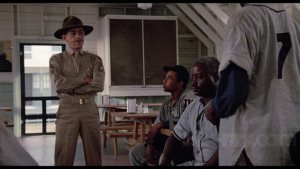
Born in China and now settled in France, director Dai Sijie obviously has deep ties to the story of Balzac and the Little Chinese Seamstress, which he adapted himself from his first novel of the same name. Set during China’s Communist Cultural Revolution, it follows his own personal experience of spending three years in a rural re-education camp from 1971 to 1974.

From the very start, the film’s tone is clear. While the village’s devoted Communist Chief promptly burns a cookbook for mentioning chicken because it is too bourgeois, the new arrivals Ma and Luo convince him to preserve Ma’s violin by insisting that Mozart wrote music with Chairman Mao in mind. Like the film overall, the scene is a little pitiful and a little funny, but it clinches the role that music and Western civilization play in helping the oppressed feel human again. Love can do the same thing, and when a tailor visits with his beautiful granddaughter, this “Little Seamstress” wins the hearts of both young men. She, like most of these country folk, is sadly ignorant, and they commit themselves to transform her with their “reactionary” Western ideas.

Based on the mention of re-education camps, I might have thought that this was some dark, murderous picture of persecution like The Killing Fields, but it’s not. In fact, there’s a notable lack of life-or-death danger here. With their forbidden books, the three friends are always in danger of being found out by the semi-vigilant Chief. As an authority figure, though, he’s less like a severe commandant and more like an inattentive parent, who barely notices when his charges sneak behind him with banned ideas and hidden abortions and fibs that prey on his ignorance.

At the same time, these work camps are rather effective, forcing many into a mindset of fear and submission. Yet the stories and concepts that Ma and Luo and the Seamstress keep and slowly spread to others also disseminate a starry-eyed freedom. Can you imagine such a beautiful, exotic name as Ursule Mirouet? Can you imagine a poor man becoming a wealthy count like Edmond Dantes? It’s ironic that, at a time when burning a bra was seen as liberating to women in the U.S., its introduction had an empowering effect on the Little Seamstress, leading to a bittersweet choice.

There’s a “Hitler Reacts” YouTube video (parodying a famous scene from Downfall), in which he decries Balzac’s ending and questions the point of the entire story. However, the film overall has that romantic quality of someone reminiscing, perhaps not of the best years of their life but the most memorable. Like all memories, they are swallowed by the floods of time but not forgotten.

Rank: List Runner-Up

© 2015 S. G. Liput

329 Followers and Counting

My Top 50 Movie Scores — Part 9

Tags

Nearing the end of the Top 50 countdown, we have now entered my top ten film scores, which has actually been a long time coming since I’ve only done five a week. This week, I’ve included some widely regarded classics and some personal favorites, several with a decidedly Celtic sound, themes I regard so highly that they’re basically interchangeable on the list. Only one week to go for the top 5. Enjoy!

_______________


#10: Titanic (1997), Oscar winner – James Horner

My original cryfest, Titanic is a marvelous film on nearly every level, but nowhere does it excel so masterfully as in the music department, thanks to the late great James Horner. His soothing Celtic strains play much more to the romance rather than the disaster, but there’s a deep sadness to it that fits the tragedy to a capital T.


#9: Forrest Gump (1994), Oscar nominee – Alan Silvestri

Yet another emotional journey with a memorable rock soundtrack as well, Forrest Gump had to have a fittingly poignant theme, and frequent Robert Zemeckis collaborator Alan Silvestri was just the man for the job. The first few notes alone bring back all the feels from one of my favorite films, starting with that drifting feather, while the ending makes me feel like I could run across the country. I don’t know if I should smile or cry. I think it’s both.


#8: Jurassic Park (1993), no nomination – John Williams

Putting the awe in awesome, Jurassic Park would be incomplete without John Williams’ exquisite themes. Again, the music conjures the immense glory of reborn dinosaurs, as well as the fascinating terror when they run amok. While I haven’t seen Jurassic World yet, I’m glad to hear that apparently Michael Giacchino has both honored and complemented Williams’ achievement.


#7: How to Train Your Dragon (2010), Oscar nominee – John Powell

The more I listen to this score, the more I absolutely LOVE it! I enjoy almost any kind of Celtic music, but this film amps it up beautifully to nail the tension, the fun, the wonder—pretty much everything one would expect from riding on a dragon. I could listen to this music forever. DreamWorks knew they had something great; they recently used the action theme for their 20th anniversary ads.


#6: The Chronicles of Narnia (2005, 2008), no nominations – Harry Gregson-Williams

From my list, it’s clear that I’m fond of epic and majestic film scores, and the music for the current trilogy of Narnia adaptations certainly fits that description. I’m only including the first two films here, though, since the third, Voyage of the Dawn Treader, had a different composer and was generally not quite as good. I probably admire Prince Caspian’s score most of all, since it builds on the first film’s themes and gets even more epic. Someone hurry up and make The Silver Chair already!


The Fault in Our Stars (2014)

Tags

,

They say that pain demands to be felt,
And we’re the ones to feel it,
The ones to bear the cards we’re dealt,
Unable to conceal it.

But pain is not the only one
Demanding our attention,
Although it blinds us like the sun
From others’ intervention.

Yet if we look beyond the pain
To love without regret,
We’ll see that neither is in vain
If love’s demands are met.
_____________________

Rating: PG-13 (for language, sexuality, and some heavy themes)

The first time I heard about The Fault in Our Stars was when a female coworker of mine gushed over how much she loved it and how much she cried and how much she loved crying at it. Thus, I thought it was merely some weepy chick flick. Then I heard all kinds of buzz about the movie adaptation and its talented young stars. Then my VC read the book and was wholly unimpressed, finding the character of Hazel Grace Lancaster so ill-tempered and somber as to be irritating.

Thus, I didn’t know what my opinion would be once I finally saw the blockbuster tearjerker of 2014, and I must say that it deserved its praise. Shailene Woodley is indeed melancholy as Hazel Grace, but with good reason: riddled with cancer since the age of thirteen, she has few joys in life. All the normal teenage pleasures of friends and such have yielded to chemotherapy sessions and constant fears about those who fear for her. Her morbidity is understandable and, as my VC pointed out, off-putting, but that only makes the subsequent romance more surprising and heart-winning.

As Augustus Waters, Ansel Elgort is the nicest guy imaginable, able to keep his spirits high with life-affirming metaphors and willing to part with everything from trophies to wishes for the sake of his friends. Like me and Pat from Silver Linings Playbook, he can’t abide unsatisfying endings, and he won’t accept that life is meaningless. He’s “kind of awesome” and almost too good to be true, but therein lies his appeal. My VC and I both love Elizabethtown, and I pointed out to her that Orlando Bloom’s character in that film also starts out depressed and obsessed with death (with only good looks being a reason for anyone to be attracted to him), yet he is captivated and encouraged by Kirsten Dunst’s Claire, who seems to consider his happiness her mission. Augustus is the same way. When Hazel desires further information about her favorite book (which happens to be about cancer), his efforts on her behalf are more than enough to win her heart.

Based on what I’ve written so far, this may seem like a happy, uplifting story that starts low but keeps on getting better, “a rollercoaster that only goes up,” but such is not the case. Like life itself, there are ups and downs and a tear for every smile. The film is sometimes shockingly abrupt in ungilding the lily, but even then it achieves a touching balance of bitterness and humor, of cynicism and sentiment.

That’s not to say that it is without fault. I didn’t care for how the lone Christian character is mocked as a sincere but inept “Kumbaya” advocate. It’s easy for cynicism to slough off the assurances of religion, but I for one can’t imagine finding meaning in suffering without faith (Christianity, in my case). As convinced as Hazel is from the start, I don’t believe in oblivion, and it’s a bit sad that even the most buoyant character can only say he believes in a heavenly “something.”

Even so, The Fault in Our Stars treads the line between the two viewpoints, Hazel’s sarcastic pessimism and Gus’s vague optimism, and retains a unique intelligence within its familiar romantic storyline, acknowledging that one deep love can be life-affirming. While it’s essentially this generation’s Love Story, The Fault in Our Stars engages both mind and heart far better than the usual tearjerker, though it can still jerk the tears with the best of them.

Best line: (Augustus, to the mother of his friend’s ex-girlfriend) “Hello, ma’am. Your daughter, she’s done a great injustice, so we’ve come here seeking revenge. You see, we may not look like much, but between the three of us, we have five legs, four eyes, and two and a half pairs of working lungs, but we also have two dozen eggs, so if I were you, I would go back inside.”

Rank: List-Worthy

© 2015 S. G. Liput

328 Followers and Counting
Genre Grandeur – Beetlejuice (1988) – Rhyme and Reason

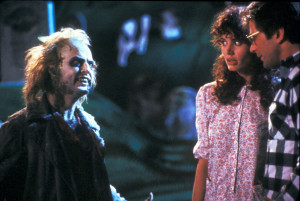
For this month’s Genre Grandeur of Dark Comedies, I picked Tim Burton’s paranormal comedy Beetlejuice. It’s a movie about dead people; what could be funnier?

movierob's avatarMovieRob

darkFor this month’s next review for Genre Grandeur – Dark Comedies, here’s a review of Beetlejuice (1988)  by SG of Rhyme and Reason

Thanks again to Reut of Sweet Archives. for choosing this month’s genre.

Next month’s Genre has been chosen by Steven of Past Present Future TV and Film  We will be reviewing our favorite B&W films prior to 1990. Please get me your submissions by the 25th of August by sending them to b&w@movierob.net  Try to think out of the box! Great choice Steven!

Let’s see what SG thought of this movie:

______________________________________

Geena Davis , Alec Baldwin , Michael Keaton Directed by Tim Burton Geena Davis , Alec Baldwin , Michael Keaton
Directed by
Tim Burton

Beetlejuice (1988)

I know you’ve been waiting; don’t head for the door.

You’re number nine trillion five million and four.

I hear that you died; well, that happens a lot.

Just handle death daily and try not to rot.

I’m sorry…

View original post 625 more words

VC Pick: Funny Farm (1988)

Tags

,

Well, come on up to Redbud;
We would love to have you here.
A life out in the country’s good
For those who persevere.

Just look at Andy Farmer,
Why, when he moved here at first,
He very nearly went insane
Before things got their worst.

If he can handle country life,
Then anybody can.
Just know that moves here rarely go
According to the plan.
_______________

Rating: PG (for some language and slapstick)
Another film beloved of my VC and liked by me, Funny Farm features Chevy Chase doing what Chevy Chase does best: getting in over his head. In this case, he’s Andy Farmer, a writer planning his first novel and wishing to get away from it all in the country with his wife Elizabeth (Madolyn Smith). With similarities to Baby Boom and Newhart, the film upholds the view that Vermont must be full of eccentrics, though in this case some are a bit more mean-spirited and vindictive.

While Andy and his wife desperately try to relax and squeeze enjoyment from small-town life, everything—literally everything—goes wrong. Furniture moving, fishing, gardening, placing a phone call, writing his ingenious novel, even getting mail—everything has unfortunate, humorous outcomes, the kind of mishaps that make you laugh even as you feel sorry for the poor saps being tormented. All these problems naturally take a toll on their marriage, particularly when Andy’s wife reads his masterpiece. One of the greatest fears of all authors is being told that their work stinks, and as much as Andy overreacts, I can say from personal experience that he’s at least somewhat believable. (I love how his wife complains that his manuscript has too many flashbacks, flash forwards, and even a flash sideways. He could have written Lost!) By the time they’ve had enough of Vermont, they’re ready to do anything to escape, and the plot they hatch with the entire town is hilarious.

I wouldn’t say Funny Farm is one of the greatest comedies, but it has its fair share of visual humor and crack-up moments, which get funnier as they pile onto each other. Some actually manage to be educational. For instance, if you move to Vermont, never buy an untrained dog. Never chop down road signs. Never write books inspired by real people and then kill them off. If you don’t know what a menu item is, ask first, especially for something as enigmatic as Lamb Fries. Never gild the lily. In fact, according to this and other movies, perhaps it would be best to just not move to Vermont at all, if you value your sanity.

Best line: (a young vandal, after cutting down an important traffic sign) “Think we should put this back?”   (another boy) “What are you, nuts? This sign is mint. There’s not a bullet hole in it!”

Rank: List Runner-Up

© 2015 S. G. Liput

328 Followers and Counting

Opinion Battles Round 7 Best Sports Movie

Take a look-see at everyone’s picks for Best Sports film at good ole Opinion Battles over at Movie Reviews 101. Quite a diverse selection (I ought to see more of these), but surprisingly I was the only one to pick a football movie, the inspirational Rudy. Pick your favorite!
(Thanks again, Darren, for letting me participate this week.)

Unknown's avatarMovie Reviews 101

Opinion Battles Round 7

Best Sports Movie

When it comes to Sports movies we have had nearly every sport put onto camera, we have had football to ping pong, ice staking to boxing and most include the typical underdog story but just what is the best film?

If you want to join the Opinion Battles our next round will be Best Remakes, email moviereviews101@yahoo.co.uk by 9th August 2015

Darren – Movie Reviews 101

Warrior (2011)wrrior

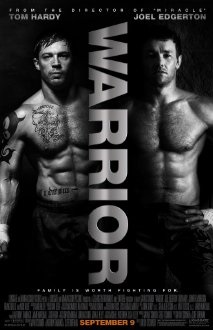
When it comes to fighting films I am normally turned away because I find boxing films rather boring, but when I sat down to watch this one I wasn’t really sure what to think. I couldn’t believe how intense this film was, I have never seen UFC before but the film managed to pull me into a world of sport I have no interest in. the fights come off realistic and the conflict between…

View original post 1,591 more words

My Top 50 Movie Scores — Part 8

Tags

Onward and upward with my Top 50 Film Scores! This week, there’s a mix of Oscar recognition (or lack thereof), but all of these have distinctive and memorable sounds that capture the heart and the imagination. Enjoy!

______________


#15: Out of Africa (1985), Oscar winner – John Barry

How could I not include this outstanding score from such an epically tragic film? Full of profound and painful feelings, the music evokes the sweeping African savannas and the swooning romance of Meryl Streep and Robert Redford. It inevitably breaks my VC into tears, though she’s noted that it reminds her of Barry’s later score for Dances with Wolves (which didn’t quite make the list). Along with E.T. and Star Wars, this is a rare choice that I actually agree with AFI’s top 25 film scores.


#14: Sherlock Holmes (2009), Oscar nominee – Hans Zimmer

As my favorite incarnation of Holmes (though Cumberbatch comes darn close), Robert Downey, Jr.’s take on the famous detective deserved some marvelous mystery music. In this case, the mixture of the tinny piano with whiny violins, plus an unconventional tempo, lend the story a unique and manic energy that echoes both its humor and its action. The sequel’s music is a bit more conventional/less unique, but it’s still excellent as a continuation of the original. Don’t you just feel like you’re in Victorian England; well, maybe just Guy Ritchie’s version of it?


#13: Robin Hood: Prince of Thieves (1991), no nomination – Michael Kamen

Epic, uplifting, heroic, magnificent—these are just some of the words I could use to describe Michael Kamen’s energizing score for Kevin Costner’s version of the Hood. Critics can say what they will about the film’s faults, but there’s no denying that this is great music. For a while, Disney even used the main theme for the intro montage of all of their DVDs, so even some who ignore the movie have surely heard its overture many times.


#12: The Piano (1993), no nomination – Michael Nyman

I haven’t actually seen The Piano, but my VC has (and does not recommend it). Yet beyond the Oscar-winning acting, one key part of the film refused to let go: the music. While most of the score is just good, one track in particular singlehandedly brought it to #12 on this list. “The Heart Asks Pleasure First” is one of the most beautiful things I’ve ever heard and ranks among my favorite pieces of music. I always feel this peaceful, floating sensation that lingers even after the melody stops. Goosebumps.


#11: Nausicaä of the Valley of the Wind (1984), no nomination – Joe Hisaishi

It’s not the most well-known of scores, but it should be. As John Williams is to Steven Spielberg, Joe Hisaishi is to Hayao Miyazaki. This pre-Studio-Ghibli dystopia features a score that instantly became a favorite upon my first viewing. A few parts have a weird techno vibe, but the bulk of the score is glorious and thrilling, laden with strings and choirs. The “la la la” section alone is sure to stick in your mind. In a good way.


Christmas in July Blogathon 2015: Hey, Arnold Holiday Special

At Drew’s Movie Reviews, everyone’s celebrating Christmas in July! I love a good Christmas movie, but I thought I’d review one of my favorite TV specials, a forgotten treat called “Arnold’s Christmas.” Just the thing to get into the holiday spirit!

Drew's avatarDrew's Movie Reviews

Next up in the Christmas in July Blogathon 2015, SG from Rhyme and Reason takes a look at a forgotten holiday special.  And here’s SG to tell us all about it!


Does anyone else remember Nickelodeon’s Hey, Arnold!? Nowadays, it only plays late at night for those desperate for some nostalgia, but it was a near-perfect animated kid’s show, a product of the ‘90s that focused on characters rather than gross-out humor and posed a relatable moral with every episode. Arnold was the titular football-headed kid, and his interactions with his friends, his grandparents, and pretty much everyone in town created everyday drama and humor that may be considered slow by today’s standards, but did wonders with character development. Arnold often helped others to overcome personal conflicts, like helping the bully Harold when he had a bar mitzvah or dealt with fat jokes, or assisting a friend with irrational phobias, or supporting a…

View original post 397 more words

Winter’s Tale (2014)

Tags

, ,

“What if the war between darkness and light
Decided if stars would fluoresce in the night?
What if a thief and a horse snowy white
Could save an enigma at destiny’s tasking?

“What if, when angels and demons do spar,
They fight for the miracles human souls are?
What if we die and become a new star?”
“Quite simply, we don’t, silly girl, so stop asking!”
________________

Akiva Goldsman has had a mixed career; he did win an Oscar for his screenplay for A Beautiful Mind, but that was after also writing Batman and Robin. His directorial debut Winter’s Tale plays to both his strengths and weaknesses, with a story that is sometimes fancifully rich but also stumbles in trying to sustain that richness.

Winter’s Tale is an unusual blend of real-world romance and parallel fantasy. On the human side, the story follows Peter Lake (Colin Farrell), a thief who falls in love with Beverly Penn (Jessica Brown Findlay). In 1916, she is dying of tuberculosis and has some odd opinions about the afterlife. On the fantastical side, a mobster named Pearly Soames (Russell Crowe) is really an undercover demon who wants Peter dead and is part of a covert “dark side” intent on preventing humans from fulfilling their inner miracles and becoming stars. Apparently in this story, Beverly’s beliefs are correct, though there’s no indication of how she learned about the whole romantic “star” mumbo jumbo, nor why this version of New York City has angels and demons but no sign of traditional religion, nor why it is ostensibly the real world but no one seems to have noticed flying horses or men who don’t age.

As the story progressed, I was unsure where it was going, though I was more confused than intrigued. Still, now that I understand the full picture, I believe Winter’s Tale is a worthwhile story that unfortunately loses its way. I admire its themes of hope and good triumphing over evil, as well as the message that our destiny is rarely what we expect. The period setting and intermittent effects are also well-crafted for the most part, and I found the acting quite good, especially Crowe as the snarling villain.

Yet it’s hard to ignore its weaknesses, particularly the gushingly romantic, sometimes poetic dialogue about stars and the universe, which stand in for heaven and God, respectively. In addition, one of my complaints about The Notebook was that Ryan Gosling is reduced to a lovesick recluse without his sweetheart and for far too long. Here, that weakness is extended for decades with no end in sight, a state that our hero accepts with little to no change.

Winter’s Tale has merit but not enough of it to make it a must-see, even for fantasy fans. Some aspects surprisingly work (such as Will Smith’s cameo as the devil), but others are just hard to believe (such as the flying horse who is really a dog who is really an angel. Huh?). I would see it again, but I wouldn’t seek it out.

Best line: (Beverly Penn, in an instance where her voiceover rings true) “But be warned: as we seek out the light, darkness gathers and the eternal contest between good and evil is not fought with great armies… but one life at a time.”

Rank: Honorable Mention

© 2015 S. G. Liput

328 Followers and Counting
My Top 50 Movie Scores — Part 7

Tags

We’ve now reached the top 20 entries in my movie music countdown, and I’ve finally started including some of the more beloved film scores. Silvestri and Williams dominate the next five, but there’s still room for one greatly underrated favorite of mine. Enjoy!

________________


#20: E.T. the Extra-Terrestrial (1982), Oscar winner – John Williams

That’s right; after last week’s Jane Eyre, that’s two John Williams scores in a row. No wonder he’s the most represented composer here. His magical score for E.T. added to the endearing delight of Steven Spielberg’s classic about a boy and his alien. Can’t you still see Elliott flying E.T. on his bike across the moon? Whimsical yet powerful, it gets the goosebumps going every time.


#19: Sinbad: Legend of the Seven Seas (2003), no nomination – Harry Gregson-Williams

Sinbad may be DreamWorks Animation’s most action-packed and overlooked work, but both the film and the score deserve to be remembered. The music ranges from the sultry song of the sirens to the impish mischief of Eris to the thrilling theme of Sinbad’s roguish misadventures. If not for Pirates of the Caribbean, this might have been the perfect pirate music. Oops, did I give something away?


#18: Cast Away (2000), no Oscar nomination – Alan Silvestri

Silvestri returns with a most impressive achievement. The majority of Cast Away has no music, in order to enhance the isolation of poor Chuck Noland, yet once he leaves his island home behind, the Grammy-winning music leaves an indelible impression. Utterly emotional, those plaintive strings make me want to cry every time. Wilson!


#17: Home Alone (1995), Oscar nominee – John Williams

A classic Christmas film deserves a classic Christmas soundtrack. The mischievous ditties recall Grieg’s ”Hall of the Mountain King,” while the twinkling theme “Somewhere in My Memory” always conjures the holiday season, no matter what time of year it is. John Williams strikes again!


#16: Back to the Future (1985), no nomination – Alan Silvestri

Time travel is never so much fun as with Marty McFly and Doc Brown, and Alan Silvestri’s accompanying score runs on excitement rather than plutonium. Again, the music immediately puts me in the movie during the best parts. Just listening to it, I feel like driving to 88 MPH.