The wave of the constant conductor’s baton
Arises and dips as each note’s liaison.
It nods to the strings
As the clarinet sings
And the audience clings
To the melody’s wings.
The music is steady and blind to the world,
Where battle is brutal and bullets are hurled.
The music will stay,
If the artists still play
And the hearers, like they,
Let war’s din fade away.
_____________________
MPAA rating: Might as well be PG
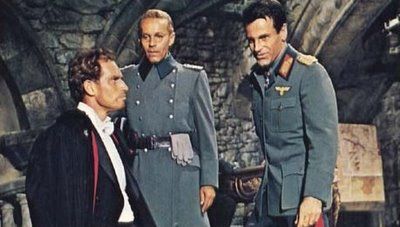
In the annals of semi-classic Hollywood, there are bound to be undiscovered gems, and I’m glad to say I found one, a World War II thriller worthy of being mentioned in the same breath as The Great Escape. Counterpoint begins on the front lines of the European theater, where a USO symphony orchestra plays for the troops only to have their performance cut short by the advancing German army. Quickly captured by the Nazis, the orchestra’s director Lionel Evans (Charlton Heston) demands they be released, but the Germans have orders to kill any and all prisoners. The only thing that saves them is the cultured admiration of the Nazi General Schiller (Maximilian Schell), who wants a concert and offers no guarantees of what is to follow it.
Heston and Schell make an outstanding pair of rivals, both self-absorbed and confident and used to getting their own way. Evans’ personality is summed up by an early line to his orchestra: “Each one of you will be responsible for your instruments, your music, and yourselves, in that order of importance.” Only two members of the seventy-member orchestra are actual characters (Leslie Nielsen, Kathryn Hays), but they and the rest know Evans’ ego all too well, and when he refuses to give in to General Schiller’s demands, they assume he’s satisfying his own opinions at their expense. Below the surface, however, he does care for his people and tries to stall the shooting squad that awaits them once the concert hall goes silent. Opposite Heston, Schell has a grinning, scheming charisma, looking perfectly at ease as he threatens his “guests”, like a precursor of Hans Landa in Inglourious Basterds. His treatment of an antique chair implies that he cares little for art, yet he’s a firm admirer of Evans and trades sharp-witted barbs with him to either convince or coerce him into submission. With one of his underlings clamoring for the prisoners’ blood, Schiller wants his concert before the war must resume.
I’m honestly surprised that Counterpoint isn’t a better-known film. The Nazis’ periodic acts of aggression keep the tension high, and close calls and narrow escapes are juxtaposed with the grandeur of the Los Angeles Philharmonic playing Tchaikovsky, Brahms, and Wagner. The climax even kept me guessing right up to the end. It’s not necessarily an award magnet that got spurned, but it’s an excellent and thoroughly underrated film that deserves far more recognition.
Best line: (Schiller) “To paraphrase Napoleon, morality is on the side of the heaviest artillery.” (Evans) “Whatever happened to Napoleon?”
Before you, a bridge rises out of the mist,
The near side your own side; the far, you resist.
On your side, so many are pleased to deride
The enemy wretches on their other side
And know in their hearts that their odious foe
Hates your side in equal amount, quid pro quo.
You fear them and jeer them and anyone near them
And anyone shy or unwilling to smear them,
And they do the same with no ending in sight
As hate begets hate and the threat of a fight.
You don’t really want one, and why would they too?
But they are untrustworthy, which they call you.
One day, though, you happen to meet one of “them,”
And though your first instinct’s perhaps to condemn
Like everyone else on the bridge’s two sides,
You doubt if it’s more than a bridge that divides.
Then, having suppressed your presumptive suspicion,
You look past the cover to read the edition.
Indeed, there’s a man behind labels and threats,
Not too unlike you, full of hopes and regrets.
You still disagree, thinking your side’s the best,
But men are more kindred than one might have guessed.
The bridge separates your two sides still suspect,
But now you await the day it may connect.
__________________
MPAA rating: PG-13
The first review I heard of Steven Spielberg’s Bridge of Spies was from a coworker who described it as “really boring but really good.” While the first part is arguable, I sincerely agree with the latter. Spielberg’s latest stab at significant historical drama may not be his most accessible, but it’s a solid addition to an already legendary filmography.
I’d wager that anyone other than a history buff probably has little more than name recognition when it comes to Gary Powers and the U-2 incident; I consider myself a semi-history buff, and I had no clue of the true story behind it, which began with the capture of Soviet spy Rudolf Abel (Oscar winner Mark Rylance). Since even criminals are given due process and no lawyer actually wants to defend an enemy spy, the powers that be task attorney James Donovan (ever-watchable Tom Hanks) with the duty of representing him in court. Donovan exhibits surprising commitment to the defense of his hated client, but it quickly becomes clear that Abel has already been convicted in the minds of both public and judge, making the prosecution nothing but a show trial.
I was reminded of how John Adams defended the British soldiers responsible for the Boston Massacre and somehow succeeded in acquitting most of them, proving the impartiality of American justice. However, such open-mindedness did not extend to the Cold War; not to say that Abel was innocent, but Donovan treats him with a laudable “innocent-until-proven-guilty” mentality and earns much hate for himself in doing so. Dirty looks on the train are one thing, but when cowardly haters take potshots through Donovan’s windows, we’re reminded that people’s respect for the law extends only as far as their own prejudices. (To be fair, I’ve read that such an incident never actually happened.) Of particular note is a scene that jumps back and forth between Donovan’s work and the secret deployment of Francis Gary Powers, the U-2 pilot shot down over enemy territory; the juxtaposition is subtle, but both men perform their duty for an unappreciative nation. The court battle could have made a good film by itself, but we see little of the legal proceedings as Donovan’s efforts are put into the larger context of international espionage, placing the attorney in the unfamiliar waters of prisoner exchanges and clandestine negotiations.
I can see how Bridge of Spies may not be a riveting experience for disinterested viewers, but I found the legal and political maneuvering consistently intriguing and not nearly as opaque as it could have been. Between the Coen brother’s intermittently witty script and Spielberg’s nuanced direction, the story flows naturally from one significant event to the next. I especially admired how certain scenes were foreshadowed or mirrored, whether for a sentimental payoff or for comparison, such as the contrast between the Soviets’ rough handling of Powers and the more civil treatment of Abel by the Americans. It may not be as exceptional a performance for Hanks compared with his more acclaimed roles, but I thought his principled character still deserved an Academy Award nomination. Rylance, who did win Best Supporting Actor, deserved praise for his drily sympathetic portrayal of Abel, but honestly I’m not sure that it would have warranted an Oscar in a more competitive year. In fact, I would have appreciated a little more interaction between Abel and Donovan, whose friendship is relegated mainly to the first half.
Despite these quibbles and the deliberate pacing, Bridge of Spies is quite close to a masterpiece. The historical basis and the focus on diplomacy and “spy stuff” through a personal lens distinguish their latest collaboration as one more success of which Hanks and Spielberg can be proud.
Best line: (Abel) “What’s the next move when you don’t know what the game is?”
(Best sung to AC/DC’s “It’s a Long Way to the Top (If You Wanna Rock ‘n’ Roll)”)
Knowing next to nothing,
Except for rock and roll
May well get you nothing
Resembling a goal.
Roll the rock,
Rock the roll,
If the music’s
In your soul.
Getting paid
For it, though—
It may be rare, but that’s the way to go.
It’s a grand gig worth a song,
Teaching what you know the best.
It’s a grand gig, just as long
As it’s legal and you’re dressed.
If you want to try and buck “the Man’s” control,
Takes passion to go make your own goal.
It’s a grand gig when you rock
To the rhythm of your soul.
________________
MPAA rating: PG-13
Don’t you love it when you expect very little from a movie and end up enjoying it far more than you thought possible? I found that the case with School of Rock, a comedy that many seem to consider a classic and yet I never have had any desire to see. I suppose it’s Jack Black that turned me away; I’ve always considered his comedy odd and lowbrow, akin to Adam Sandler’s, and yet what little I’ve seen of his, I’ve liked. He was good in Shallow Hal and The Muppets and the Kung Fu Panda movies, quite good in King Kong, and more charmingly low-key in The Holiday. I should really check out more of his movies, since both my VC and I thoroughly enjoyed School of Rock.
Black starts out as the kind of slobbish loser he seems to enjoy playing, a jobless rocker named Dewey Finn, who is kicked out of his own band after a pathetic concert. Living with his former bandmate Ned Schneebly (screenwriter Mike White) and Ned’s overbearing girlfriend (Sarah Silverman), Dewey’s life and career are going nowhere fast, and when Ned “demands” the rent he’d owed, there’s only one reasonable thing to do. Dewey impersonates Ned as a substitute teacher at an elite prep school, which strangely checks neither his references nor his ID. Faced with a class full of fourth-graders better educated than himself, Dewey trains them in his one area of expertise – classic rock – and prepares them to participate in a “Battle of the Bands” while trying to keep everything secret from their parents, Ned, and the uptight school principal Ms. Mullins (Joan Cusack).
The implausible setup alone is ripe with comedic opportunities, and the film rarely misses a beat. From Dewey’s rant against “the Man” to his students’ faking a blood disease, the dialogue finds the right balance between funny and believable. Aside from the general humor, though, School of Rock’s greatest appeal is to anyone who has ever banged their head to AC/DC or Fleetwood Mac or Led Zeppelin; not only are many classic rock songs played and sampled, but Black praises and explains them with such infectious gusto that both audience and class are won over, despite his quirky ineptitude.
Another plus is how Dewey manages to “touch” his students (figuratively): encouraging the shy boy who’s convinced himself he’s uncool, sympathizing with an overweight girl, showing some maturity by enforcing discipline with one kid who takes his reckless teaching to heart. There’s a bit of smart-mouthing by the kids, but both they and Dewey manage to grow while still remaining uniquely themselves. It was also nice to recognize young overachiever Summer as Miranda Cosgrove, who went on to play evil sister Megan on Drake and Josh. (I grew up with that show. I know she can sing, so it was odd that she pretended to be a poor singer here.) Even the final concert delivered on the expectations that had been growing throughout the movie, only making me wish that the performance could have been longer.
School of Rock is still popular today, spawning a Broadway play and a Nickelodeon TV series just this past year, and I now see why. Since she’s a bigger rock fan than I, my VC enjoyed it even more; she even started watching it again as soon as it was over. It’s not often that a film totally exceeds my expectations, but if you’ll forgive the pun, School of Rock rocks!
Best line: (Frankie) “Ms. Mullins, you’re “the Man.” (Ms. Mullins) “Thank you, Frankie!”
Movies and poetry are two of my favorite pastimes, and I always love it when they happen to overlap. Great poetry manages to conjure deep emotions, and when a film utilizes such poems, the combination can be quite powerful. I also just like the fact that these films expose regular moviegoers to some classic verse and make it more memorable. Thus, here are my top twelve uses of poetry in movies, with special placing for poems that are actually significant to the plot.
“In Flanders fields the poppies blow
Between the crosses, row on row,
That mark our place; and in the sky
The larks, still bravely singing, fly
Scarce heard amid the guns below.”
I remember memorizing this elegiac call-to-arms in my elementary English class, and Mr. Holland’s Opus uses it during a Vietnam War funeral to add an extra punch of emotion. It’s a small scene but from one of my favorite films ever.
“Do Not Go Gentle into That Good Night” by Dylan Thomas, from Interstellar (2014)
“Do not go gentle into that good night,
Old age should burn and rave at close of day;
Rage, rage against the dying of the light.”
While Dylan Thomas’s famous villanelle has been used in other films like Butterflies Are Free and Back to School, Christopher Nolan’s Interstellar perfectly plays out its message of resisting death. As the astronauts who are Earth’s last best hope of survival head for a wormhole, Michael Caine quotes part of the poem powerfully.
“The Panther” by Rainer Maria Rilke, from Awakenings (1990)
“His gaze, from staring through the bars,
Has grown so weary that it can take in nothing more.
For him, it is as though there were a thousand bars –
And behind the thousand bars, no world.”
In trying to reach and understand a hospital full of mysteriously catatonic patients, Dr. Sayer (Robin Williams) follows a clue from Leonard (Robert De Niro) to this poem. He visits a zoo and reads Rilke’s “The Panther,” drawing a tragic comparison between the caged animal and his patients trapped within their own bodies.
“Nothing Gold Can Stay” by Robert Frost, from The Outsiders (1983)
“Nature’s first green is gold,
Her hardest hue to hold.
Her early leaf’s a flower;
But only so an hour.”
After Johnny (Ralph Macchio) accidentally kills a rival gang member, he and Ponyboy Curtis (C. Thomas Howell) hide out in an abandoned church. During the days of waiting, they read Gone with the Wind, and in a sunset scene reminiscent of parts of Gone with the Wind, Ponyboy recites Robert Frost’s “Nothing Gold Can Stay,” a lament for the loss of beauty and innocence. “Stay gold, Ponyboy.”
“To an Athlete Dying Young” by A. E. Housman, from Out of Africa(1984)
“Now you will not swell the rout
Of lads that wore their honours out,
Runners whom renown outran
And the name died before the man.”
After moving to Africa and growing coffee and going on safari and falling in love with Denys (Robert Redford), Karen Blixen (Meryl Streep) loses what she held most dear and mourns by reading every other stanza of A. E. Housman’s plaintive poem at her lover’s funeral. Sad stuff.
“An Irish Airman Foresees His Death” by William Butler Yeats, from Memphis Belle(1990)
“I know that I shall meet my fate
Somewhere among the clouds above;
Those that I fight I do not hate,
Those that I guard I do not love;”
Too shy to read his own poems to his fellow airmen on the eve of their final bombing mission over Germany, Danny (Eric Stoltz) recites W. B. Yeats’s “An Irish Airman Foresees His Death” (again only part of it). The already eloquent poem becomes even more poignant in relation to the young men about to embark into danger.
“My Native Land” by Sir Walter Scott, from Groundhog Day (1993)
“The wretch, concentred all in self,
Living, shall forfeit fair renown,
And, doubly dying, shall go down
To the vile dust, from whence he sprung,
Unwept, unhonour’d, and unsung.”
Forget about Bill Murray’s fake quoting of 19th-century French poetry (and the Italian subtitles in the video); Andie McDowall delivers a great little poetic insult using Scott’s “My Native Land.” Of course, she takes it completely out of context; Scott meant that anyone unpatriotic is a “wretch,” but it applies to Phil too. The scene also stands out because this is another poem I memorized in school.
The warmongering poems of World War I, from Joyeux Noel (2005)
“To rid the map of every trace
Of Germany and of the Hun.
We must exterminate that race;
We must not leave a single one.”
What a way to begin a movie! For a film about a Christmas truce between German, French, and English troops in World War I, the first scene contrasts the later camaraderie with a taste of the disturbing hatred that nations fostered against their enemies, even in schoolchildren. I don’t know who exactly wrote the hateful words, but they certainly got their message across in all three languages.
“Bright star, would I were stedfast as thou art” by John Keats, from Bright Star (2009)
“No–yet still stedfast, still unchangeable,
Pillow’d upon my fair love’s ripening breast,
To feel for ever its soft fall and swell,
Awake for ever in a sweet unrest,
Still, still to hear her tender-taken breath,
And so live ever–or else swoon to death.”
Spoiler warning for anyone who doesn’t know what happened to John Keats. The tragic romance is one of the most touching genres, and Bright Star is a prime example. I could have gone with Shakespeare in Love since it includes some of Shakespeare sonnets, but I prefer Bright Star for a period romance, just as I prefer the romantic poetry of Keats over Shakespeare’s. Several of Keats’s poems are used here (such as “A thing of beauty is a joy forever”), but the final recitation scene of grief is the most poignant.
“Aedh Wishes for the Cloths of Heaven” by William Butler Yeats, from 84 Charing Cross Road (1987)
“I would spread the cloths under your feet:
But I, being poor, have only my dreams;
I have spread my dreams under your feet;
Tread softly because you tread on my dreams.”
Yeats strikes again! In this movie for literature lovers, a writer/reader (Anne Bancroft) and a bookstore manager (Anthony Hopkins) become trans-Atlantic pen pals over decades. Forget for a moment Sean Bean’s death with this poem in Equilibrium, because Hopkins’ quoting of these wistful lines is just one of the many charming literary moments of 84 Charing Cross Road, another of my favorite films.
“What good amid these, O me, O life?
Answer: That you are here,
That life exists and identity,
That the powerful play goes on,
And you may contribute a verse.”
From Tennyson’s “Ulysses” in the cave to Frost’s “The Road Not Taken” to Robert Herrick’s “To the Virgins, to Make Much of Time” to Shakespeare’s A Midsummer Night’s Dream, few films have the variety of poems that Peter Weir’s Dead Poets Society boasts. It likely introduced a generation to “Gather ye rosebuds, while ye may” and Walt Whitman’s “O Captain, My Captain,” though as famous as the latter is, it’s never actually recited in the movie. Still, poetry lovers can’t go wrong when a film has “Poet” in the title!
“Death, Be Not Proud” by John Donne, from Wit (2001)
“One short sleep past, we wake eternally,
And death shall be no more, Death, thou shalt die.”
As much as I love the poems in all these movies, only Wit actually changed my perception of a poem. Emma Thompson in one of her best roles plays a literature professor suffering from ovarian cancer, yet her devotion to metaphysical poetry remains strong. One distinct memory is of her own English professor explaining the spiritual significance of Donne’s “Death, Be Not Proud,” and though I memorized it too in school and still can recite it, I now add the comma so powerfully emphasized in the final line.
Runners-Up (though I’m sure I’ve missed some so feel free to comment on any others):
“The Charge of the Light Brigade” by Alfred, Lord Tennyson, from The Blind Side
“And did those feet in ancient time” by William Blake, sung as “Jerusalem” in Chariots of Fire
One last thing: It may not be a movie, but I have fond memories of watching The Waltons, especially the episode “The Air Mail Man,” in which John-Boy reads a poem to his mother for her birthday. She doesn’t completely understand “The Windhover” by Gerard Manley Hopkins (I don’t think I do either), but John-Boy’s interpretation is lovely and illustrates how poetry need not be fully comprehended to be appreciated.
The future looms before our eyes,
A tunnel to the next unknown.
It’s too well-traveled to surprise,
And yet we worry and postpone.
For some, the future is a wall,
A bricked-up tunnel, barred and firm.
A grim prognosis cancels all
And makes their fears of shorter term.
Small comfort ‘tis to pray and stay
With those whose lives too soon conclude,
But when our future’s underway,
Distress should yield to gratitude.
________________
MPAA rating: PG-13
Who would have thought that two young adult novels about friendship and teen cancer would be published within months of each other and both would get their own movies within three years? John Green’s The Fault in Our Stars is the more celebrated and, in my opinion, the better film, but Me and Earl and the Dying Girl does well finding its own messages and style that never feel like rip-offs of something else.
Any film set in high school is bound to have clichés, particularly the introduction to cliques and colorful characters, but this film freshens its more familiar aspects with some wildly inventive camera work. The camera zooms and flips and rushes through crowded rooms, and the drily comical narration caused my VC to compare it to the Coen brothers’ style in Raising Arizona. The eccentricities are many, as Greg (Thomas Mann) explains his school, his survival tactics, and his hobby of making ultra-low-budget parodies of classic movies (like The 400 Bros or Senior Citizen Kane) in collaboration with his friend/coworker Earl. When his mother literally nags him into submission, Greg agrees to befriend Rachel Kushner after she is diagnosed with leukemia and even tries to make a film for her benefit.
The first half of the movie has some great clever humor, such as the best hipster cat name ever, but also a good deal of casual crudity. Greg’s inherent awkwardness often manifests in crassness, Earl is impenetrably passive for the most part, and the film often feels like it’s trying too hard to sustain its quirkiness. With all the weirdness on show, Rachel is the most normal character by default; like me, she’s turned off by Greg at first but ultimately won over, and their friendship grows subtly over time, though without the romance of The Fault in Our Stars. As the title suggests, her condition worsens over time, and the film’s tone shifts into dramatic gear. After so much manipulation of the camera, one pivotal emotional scene settles in one perfect angle and is the more powerful for it.
Like Ruby Sparks, in which an off-kilter plot culminates in a perfect ending, Me and Earl and the Dying Girl ends on the right note. Does it matter that I don’t understand the movie that Greg makes for Rachel, which is as inscrutably avant-garde as some of the films he parodies? No, because like much of the “I don’t get it” art out there, it could mean anything or nothing, but it meant something to the right person at the right time. Films like this and The Fault in Our Stars can easily be seen as emotionally manipulative, but Me and Earl and the Dying Girl is at least honest about it, and as the final scenes reveal, there’s more subtlety to admire than first meets the eye.
Best line: (Earl, who after adding little to the story gets the line that inspired my poem, to Rachel) “It’s just crazy how patient you’ve been. You know, I know if it was me that had cancer, uh… I’d be upset and angry and trying to beat everybody’s a** half the time. So I’m just, I’m just amazed at how patient you’ve been. You, you make me feel blessed.”
A monster’s a monster, regardless of size.
‘Twould be an outrage to imply otherwise.
A villain’s a villain; of that, there’s no doubt.
Do we know all villains worth knowing about?
A murderer’s evil, without an exception,
And those who assisted his crime or deception
And those who stood by to let one such go free
Are all as blameworthy as he. Disagree?
But what if you stood there and let him go by,
In fear that a critic would be next to die?
‘Tis no less wrong, is it, to stifle your tongue,
But are you still evil like those you’re among?
While evil is evil, as most should agree,
A sinner can vary by deed and degree.
Discerning a villain is right and essential,
But so is the fact we all have the potential.
________________
MPAA rating: R (for descriptions of violence and a brief bedroom scene; could easily be PG-13 with the slightest editing)
I’ve only seen three German films (3½ if I count Joyeux Noel), but Labyrinth of Lies is easily the best. Germany’s unnominated submission to the Academy Awards intrigued me with the trailer alone, and the film delivered exactly what I hoped for, an investigative new look at the semi-known stories of Auschwitz and Germany’s response to it in the years after World War II.
It’s taken for granted nowadays that most people have heard of Auschwitz and the crimes perpetrated by the Nazis, but early in Labyrinth of Lies, journalist Thomas Gnielka (André Szymanski) asks several passersby if they’d ever heard of Auschwitz. Everyone answers “No.” The year is 1958, and within one generation, the atrocities of Nazi Germany had been nearly erased where they most needed to be remembered. Nuremberg tried the Nazi leadership, but the thousands of Nazi Party members didn’t just disappear; they blended back into the populace, never telling their children what they had done. While Jewish survivors tried to forget the horrors they endured, everyone else just ignored them.
Unjust is a mild descriptor for such a situation, and when injustice runs rampant, thankfully someone steps forward for what’s right. While he seems to be a composite of several real-life figures, that someone is Johann Radmann (Alexander Fehling), a lawyer who tends to see every crime as black or white, not even yielding to overlook a minor traffic violation. Young and ambitious, he too has no idea of the Nazis’ crimes, and when his eyes are opened, he makes it his duty to bring justice to the victims. With support from his boss Fritz Bauer (Gert Voss, who died before the film’s release), he seeks out buried records, reluctant witnesses, and slippery targets – a teacher, a businessman, a baker –, determined that their own country try them for war crimes. He eventually sets his sights on Auschwitz’s monstrous doctor Josef Mengele, who was not caught after the war and escaped into hiding. As Radmann, Fehling is outstanding and often reminded me of a less baby-faced Leonardo DiCaprio; though German, he has at least appeared in Inglourious Basterds and Homeland, but he’s such a good actor that I hope he appears in more English-language roles.
Radmann is a dogged crusader for truth, even to the point of obsession, and the more lies he uncovers, the more his faith in humanity is shattered. He looks at pictures of Mengele and comments at how normal he looks. How could he have done such nightmarish deeds? How could an entire country yield to such hate and cruelty? The deeper he digs, the more blame he finds for everyone. Aside from the victims, no one was entirely guiltless, but does that mean everyone was a monster? Does remembering the bad mean disregarding the good, or vice versa?
Labyrinth of Lies deals with its subject frankly but unobtrusively. Despite the R rating, little is seen of the actual concentration camp crimes, and I prefer that, to be honest. I am fully aware of how barbaric the Nazis were, but I don’t want to see it recreated onscreen. That’s why I haven’t yet been able to bring myself to watch Schindler’s List, even though I realize I’m perpetuating to some extent the mindset of many Germans in Labyrinth of Lies, not wanting to see evil for what it was. This film deals with the horrific facts in a believably restrained manner that still underscores how they must never be forgotten. It’s encouraging that such a film came out of Germany itself, indicating the nation’s resolve to remember. Labyrinth of Lies is in German, but even haters of subtitles should give this engrossing historical drama a chance. I’m glad I did.
Best line: (Bauer) “Why have you come back?” (Radmann) “Because the only response to Auschwitz is to do the right thing yourself.”
The thrills of poetry once felt
By readers of past centuries,
The psalms at which the faithful knelt,
The ballads by the masters dealt,
The words that made romantics melt
Are now but dusty elegies
That men ignore and children tease.
Yet in the texts we only read
When college credit is attached
Are hymns of prisoned passion freed
And rhythmic rhymes still fun indeed
And lessons we will never heed
If we decide to stay detached
From lyric surfaces unscratched.
From Flanders Fields to Innisfree,
From Reading Gaol to Paul Revere,
No world is wide as poetry.
When hip diversions are debris
And dust of the next century,
I trust that poems will persevere,
To still inspire, haunt, and cheer.
__________________
MPAA rating: PG
For a guy with a poetry/movie blog, it boggles my mind that I did not see this movie sooner. It has “poet” in the title! Its screenplay won an Oscar! It has Robin Williams in dramatic mode! What’s wrong with me? The only thing I had to go on was a comment from my VC, who recalled seeing five minutes of it and decided it was boring. It may have slow moments, but now I know better (and so does she).
Peter Weir’s Dead Poets Society takes place at the prestigious Welton Academy, where its founding principles of tradition, honor, discipline, and excellence are hailed early on by its headmaster (Norman Lloyd, or Dr. Auschlander from St. Elsewhere). A collection of teenage prep students quickly befriend each other in the dorms, and though I found it difficult to tell the boys apart at times, their characters are defined over time: the shy one (Ethan Hawke), the one with constant pressure from his strict father, the one with glasses, the tall one, the rebellious one, and the one with a crush on a girl at another school. Hawke, who plays Todd Anderson, has gone on to the most success, but all of the young actors excel. Despite its 1950s setting, I was reminded at times of another movie I ought to review, 1985’s The Breakfast Club; the relationships aren’t nearly as detailed or antagonistic, but moments of bonding strike a similar chord, especially when issues of parental and peer pressure come to the fore.
Of course, what these boys have that The Breakfast Club didn’t is a sympathetic teacher in John Keating (Williams), who remembers his own attendance at Welton well enough to understand his students better than the set-in-their-ways administrators. His unconventional methods take the students out of the classroom and challenge them to stand out, set their own pace, rip out fallacies, and “seize the day,” even encouraging them to re-form the titular Dead Poets Society. The club and the boys’ exploits carry the film well enough, but Williams becomes the star every time he’s on-screen. This, Good Will Hunting, and Awakenings just make me wish he’d done even more dramatic roles.
In following the story and its authoritarian critique to the bitter end, the film sadly doesn’t end on the most positive of notes. The final scene is inspiring and even more touching since Williams’ death, but the lives of the characters are left depressingly open. As much as I would have preferred a happier conclusion, Dead Poets Society is a testament to poetry, friendship, and the influence of a passionate teacher. It shines most in individual moments, like a brilliantly written vignette involving a desk set, and like Keating, dares us all to “live deep and suck out all the marrow of life,” to “contribute a verse” to the “powerful play” of life.
Best line: (Keating) “Boys, you must strive to find your own voice. Because the longer you wait to begin, the less likely you are to find it at all.”
What’s right,
Worth a fight
And the height of loyalty?
What’s wrong
Won’t last long
If right’s champions agree.
Surely all with decency
On seeking justice would agree,
And yet on how we seek and why
So many don’t see eye to eye.
Won, lost,
Wars have cost;
Lines are crossed and drawn once more.
Wrong, right,
And the fight
Never make a simple war.
________________
MPAA rating: PG-13
Marvel has at last reached its Phase 3, and despite being the thirteenth film in the Marvel Cinematic Universe, the reigning lords of summer blockbusters show no sign of stopping. In fact, Phase 3 might be the best era of the MCU, if Civil War is any indication. Captain America’s third film is a thrilling continuation of both the Bucky fiasco of The Winter Soldier and the Sokovian destruction of Age of Ultron, stressing the emotional damage that such disastrous circumstances can wreak on individuals and relationships.
Unlike other single-character-focused entries up to this point, Civil War doesn’t have just a few cameos from other MCU stars. It has nearly every Marvel hero introduced thus far — Cap (of course), Bucky, Iron Man, War Machine, Black Widow, Falcon, Hawkeye, Ant-Man, Vision, Scarlet Witch, and the newest additions of Black Panther (Chadwick Boseman) and a non-Sony Spider-Man (Tom Holland) — all being forced to choose between two equally defensible sides concerning how much freedom the Avengers should have to do their danger-prone duty. Even the notable absence of Thor and the Hulk is used to support the argument that ultra-powerful people should not be left unaccountable.
Most reviews of Civil War, including the initial reaction of my VC, have proclaimed it as the best Marvel movie yet. (I think the first Avengers edges it out, IMO.) However, I do know at least one naysayer, a DC fan, who considers the “Civil War” a mere petty squabble amid the big picture leading up to Infinity War. I’ll grant that much of the fighting between the heroes is not a life-and-death struggle, and it isn’t meant to be. For most of the film, the battles are meant for defense or damage control (not that they’re any less awesome), but the clash of ideologies is genuine. The seeds of it have been well-established, from the distrust of authority that The Winter Soldier instilled in Steve to the understandable guilt felt by Tony, who knows that, unlike most threats, Ultron really was his fault. Considering how much damage has been wrought by the MCU’s various baddies and heroes alike, it’s not surprising that the world’s governments would seek to reaffirm their authority. The other Avengers choose their sides based on loyalties or believable reasoning, with the exception of Hawkeye, who chooses Cap over his pal Black Widow for no other reason than to keep the fight six against six.
Considering how much ideological and character terrain is covered, it’s amazing how entertaining Civil War is. (The worst thing I can say about it is that the globe-hopping location titles are a little too HUGE.) Even if it seems odd now to introduce Spider-Man and Black Panther long before their respective stand-alone movies, both Boseman and Holland offer game interpretations of their characters that somehow manage to stand out among the crowd of heroes. Black Panther is the more mysterious of the two, reserved and stately outside his vibranium suit and vicious for revenge within it, while Holland as the youngest Spider-Man yet manages to top Andrew Garfield’s version with only a fraction of the screen time, even if his gee-whiz astonishment gets a little old. (I’m still partial to Tobey Maguire for now.) Despite their rushed introduction in Age of Ultron, Scarlet Witch and Vision also get some needed clarifying character moments. I was thrilled too to see Martin Freeman in a small governmental role, and I can’t wait to see if he’ll ever run into his Sherlock co-star as Dr. Strange. The semi-climactic battle between the twelve heroes at a German airport is really the crowning moment of the film and the franchise thus far and manages to surprise, poke fun, grieve, and impress with all the cleverness and enjoyment Marvel delivers so well. Casual viewers not up-to-date on the MCU may be lost at times, but for long-time fans like my VC and me, this is geek heaven. Stan Lee also gets one of his funniest cameo moments to date.
The advertisements for Civil War have urged audiences to “choose a side,” a choice which actually isn’t as clear-cut as the typical good-vs-evil battle. Tony has good reasons for his actions in trying to make amends for his mistakes, while Cap is trying to help his friend Bucky and remain unfettered by bureaucratic agendas. Considering his name is in the title, Cap seems like the obvious choice, and Bucky’s story is tragic enough to make him naturally sympathetic; but even the American hero can’t stop regrettable casualties. The costs of revenge become more real over time, and by the end, sympathies change back and forth until it’s hard to say where one’s allegiance lies. That’s what makes a brilliant conflict, the kind of built-up feud that can’t be done the same with one movie (ahem, Batman v Superman). It’s what sets Marvel and Civil War above the competition.
Best line: (Sharon Carter, speaking of Peggy Carter) “And she said, ‘Compromise where you can. Where you can’t, don’t. Even if everyone is telling you that something wrong is something right. Even if the whole world is telling you to move, it is your duty to plant yourself like a tree, look them in the eye, and say, “No, you move”.’”
Idealists are few, and unflinching ones rare.
Too many are loath to commit.
More often, agendas too secret to share
Give heroes good reason to quit.
Yet, sometimes a principled stalwart of right
Is wise to not trust quite so much,
So when the agendas collapse in a fight,
There’s something still solid to clutch.
___________________
MPAA rating: PG-13
Before I review Cap’s third awesome outing in Civil War, I thought I should cover the only major Marvel movie I haven’t reviewed yet. (I’ll get to Thor 2 eventually.) The First Avengerwas a pitch-perfect origin story for Captain America while The Avengers paired the patriotic hero with his super-powered team, but it was The Winter Soldier that brought the 1940s Steve Rogers into the modern world.
After adapting to his new century, Steve Rogers butts heads with Nick Fury (Samuel L. Jackson, who gets to do more in this movie than in most of his cameos), only to uncover a conspiracy within S.H.I.E.L.D. itself, going right up to its president Alexander Pierce (Robert Redford in rare villain mode). With help from Scarlett Johansson’s ever-resourceful Black Widow and new ally Sam Wilson/Falcon (Anthony Mackie), Cap faces off against the mysterious Winter Soldier and tries to contain the damage of the inevitable coup. Oh, and a gut-punch twist reminds everyone that no one but villains really die in these comic book movies.
Though The Winter Soldier has a reputation for being better than its predecessor, I do prefer the nostalgic action of The First Avenger more. Nevertheless, the second Cap film features one of the most significant plots of any Marvel film with some of the deepest ripples through the MCU. Not only is Nick Fury “killed” and HYDRA resurrected but S.H.I.E.L.D. is effectively toppled as well, and the film builds on the first film with its revelation of the Winter Soldier’s tragic identity (which I knew going in since it reflects the comics, but it was a genuine surprise for my VC). Being a fan of Marvel’s Agents of S.H.I.E.L.D., I find it amazing how the events of the film were incorporated into the TV show’s concurrent first season (such as the appearance of Agent Sitwell), and the entire second season continued to incorporate elements (like the face-changing mask) and dealt with the fallout and the need to rebuild S.H.I.E.L.D.
There’s really very little negative that I can say about The Winter Soldier. The action and special effects are as spectacular as Marvel’s best films, especially in the slightly numbing final battle. Every actor is on point, and it was an odd pleasure seeing Johansson’s confrontation with Redford, considering he gave her one of her first major roles when they co-starred in The Horse Whisperer. The only bad thing I can say about The Winter Soldier is that its overall product feels rather generic (car chases, fist fights, etc.) compared with Marvel’s more inventive or colorful adventures, like Guardians of the Galaxy or even The First Avenger. It’s nonetheless an essential installment of Marvel’s canon and a highly entertaining one at that.
Best line: (the end of Cap’s speech to S.H.I.E.L.D.) “I know I’m asking a lot, but the price of freedom is high. It always has been. And it’s a price I’m willing to pay. And if I’m the only one, then so be it. But I’m willing to bet I’m not.”
Michael Dorsey is a he,
But he pretends that he’s a she
To play a woman on TV,
So they don’t know that she’s a he
Because he does it secretly.
When, as a she, he finds a she
Who bonds with him as Dorothy,
He wishes he could tell Julie
That he’s a he and not a she,
But he’s a better she than he.
His role gains popularity,
So how can he admit that he
Is not indeed a mighty she
But really just a lying he?
Of course you know – hilariously!
__________________
MPAA rating: PG (probably PG-13 nowadays)
This post has been long in coming, since my VC has been urging me to review one of her favorite comedies while I’ve been in no rush. Tootsie is considered one of the great comedies of the ‘80s and of all time, ranking at #2 on AFI’s list of top 100 laughs. Whenever we watch it, my VC relates how hard she laughed the first time she saw it and how entertaining (and timely) it still is over three decades after its original release.
I acknowledge that Tootsie is quite a good film with a giggle-prone screenplay and a sensational performance from Dustin Hoffman, who embodies his soft-spoken but headstrong female alter ego with thorough commitment. Many scenes are hysterical, especially when all the misunderstandings pile up toward the end. Jessica Lange as Julie earned the film’s one Oscar win (out of ten nominations), but the best scenes and lines go to Michael’s friends, played by Teri Garr and Bill Murray.
Yet for all of its strengths, Tootsie just isn’t one of my favorites, and I can’t really put my finger on why. I suppose the main reason is that I don’t find crossdressing inherently funny. That AFI list I mentioned earlier placed crossdressing comedies in both its #2 and #1 spot (Some Like It Hot being #1), so clearly a man in women’s clothes just tickles many people’s funny bones. I find it amusing here and thankfully tasteful for the most part, but it does not a comedy masterpiece make, even if individual moments do rise into hilarity.
I don’t mean to sound negative. This is just one of many films that my VC loves and I merely like. Hoffman is the star attraction, but for a gender-bending comedy, I always go back to Robin Williams’ Mrs. Doubtfire, perhaps because I prefer the reasoning for his actions (wanting to be with his kids rather than just seeking a job). However, both have a good mix of laughs and drama aimed at a fine actor getting in touch with his feminine side.
Best line: Probably a tie between Bill Murray’s “You slut!” and “That is one nutty hospital.”