• Home
  • About Me
  • The List
  • THE LIST (2016 Update)
  • THE LIST (2017 Update)
  • THE LIST (2018 Update)
  • THE LIST (2019 Update)
  • THE LIST (2020 Update)
  • THE LIST (2021 Update)
  • THE LIST (2022 Update)
  • Top Twelves and More
  • The End Credits Song Hall of Fame

Rhyme and Reason

~ Poetry Meets Film Reviews

Rhyme and Reason

Category Archives: Reviews

Life, Animated (2016)

10 Monday Oct 2016

Posted by sgliput in Movies, Poetry, Reviews, Writing

≈ 3 Comments

Tags

Documentary


“Life as we know it” – a strange thing to say,
As if we all share every daily cliché,
As if you and I, in our habits and cares,
The views she retains and the burdens he bears,
All somehow add up to the same.

Life outside yours cannot fully be known;
Though we walk together, our paths are our own.
When other lives deviate, some may presume
Their paths are less worthy where tragedies loom,
And some may regard it a shame.

Life can have weakness without being weak.
Life can have sorrow without being bleak.
Support can be found where we least would suspect,
In plans that are clear only in retrospect,
In paths that are never the same.

Life in its innocence, life in its trials,
Life in its mirth and its merciless miles
Is something we each have the privilege to face,
Each life its own story and none a disgrace,
“Life as I know it,” by name.
_______________________

MPAA rating: PG

One genre that I’ve barely scratched the surface of is documentaries. I’ve always thought of them as interesting and informative, but lacking in entertainment value. Seriously, would you rather watch a Disney movie or a documentary? (I know; depends on which one, right?) Not to mention, I’m always suspect of many “true” stories if there seems to be an agenda behind them. The few documentaries I’ve seen have been quite good (In the Shadow of the Moon, The Drop Box), but they haven’t whet my appetite to seek out others of their kind. Life, Animated has.

I actually had a unique opportunity with this film. It was being shown at a local theater that usually shows second-run movies for $2, but they were showing Life, Animated for free, presented by a local autism organization complete with a Q & A with Ron Suskind, the father of the film’s subject. That subject is Owen Suskind, who seemed like a normal child until he stopped talking at the age of three and was diagnosed with regressive autism. After years of silence, he found his voice again through the inspiration of Disney’s animated films. Donning a hand puppet of Iago from Aladdin, his father discovered that Owen would converse with him through the puppet. Over time, they were able to share conversations with dialogue memorized from Disney films, and Owen even learned to read using the names in the credits.

Life, Animated features a pleasantly non-linear style, jumping between 23-year-old Owen in the present day as he learns to be more independent and flashbacks to young Owen, often told through semi-animated drawings. Owen himself is winsome and naïve, still somewhat of a child who has come a long way and has far yet to go. My earlier suspicion of documentaries being potentially manufactured doesn’t apply to him, since he is inherently earnest and open whether a camera is there or not. Ron called this sincerity a “compensatory strength” to offset Owen’s social weaknesses and mentioned that the cameraman called him one of the best subjects he’d filmed.

Interspersed with Owen and Ron’s narration are a multitude of film clips from Disney classics and even an unexpected cameo from some voice actors. Honestly, I can’t imagine any bigger compliment to Disney filmmakers than this movie, a tribute to how their work literally helped to change Owen’s life, which might explain why they allowed the use of their fiercely guarded films for a reasonable price. As much as we all love Disney movies, they are mere entertainment to most of us, while to Owen, they were a lens through which he could understand daily life. In a world that was suddenly hard to make sense of, he latched onto this “scripted constant” that provided accessible insights, which the film’s editors managed to translate to the screen. When Owen and his brother regret having to grow up, they reference the likes of Mowgli and Peter Pan. When Owen talks about enduring bullying in school, we see Quasimodo’s flogging in The Hunchback of Notre Dame. When Owen suffers his first taste of romantic pain, we remember Ariel’s despair over Eric in The Little Mermaid. During Owen’s first night on his own, he watches Bambi.

Image result for life, animated 2016

The film’s most fascinating visual touch is two extended animated sequences of a story Owen wrote called The Land of the Lost Sidekicks, brought to life by the French animation studio Mac Guff. In a swirling, painterly style, Owen imagines himself as the protector of various Disney side characters, battling despair and darkness. It’s simple yet profound, like so much of Owen’s story. Owen was encouraged that Life, Animated showed him to be, not a sidekick, but on a hero’s journey, and the struggles and joys he goes through depict him as a person, rather than a collection of tics as autism may seem at first glance. As Owen relates during a climactic speech, those with autism can latch onto any number of fixations, and Disney films allowed him to comprehend a constantly changing world. During the Q & A afterward, Ron confirmed autism’s similar patterns when he and a young man in the front row, much like Owen, shared a few back-and-forth lines of dialogue from The Lion King. (I was also interested to learn from Ron that Owen has branched out into live-action films and enjoys the Dark Knight trilogy as well.)

It may not be saying much, but Life, Animated is one of the best documentaries I’ve seen, and despite its independent status, I do hope it gets some notice for a Best Documentary nomination during Oscar season. Not only does it ennoble the Disney canon as “human sagas of struggle and triumph,” but it provides an endearing look at how they helped shape one boy’s inspiring development. Owen’s family is a constant encouragement for him, worrying and helping him however they can, and one question his parents asked was particularly resonant: “Who decides what a meaningful life is?” Ron said his wife and he asked it many times, but Owen finally answered it. “I do.”

Best line: (see above)


Rank: No documentary has made me reconsider my opinion of them like this one, but I still can’t help but put them in a different category from “regular” movies. Thus, any documentary reviews won’t be eligible for my List but will just use a simple Five Star system, and this one is definitely worth Five Stars!


© 2016 S. G. Liput
413 Followers and Counting


Pitch Perfect 2 (2015)

05 Wednesday Oct 2016

Posted by sgliput in Movies, Poetry, Reviews, Writing

≈ 2 Comments

Tags

Comedy, Musical

https://i0.wp.com/www.billboard.com/files/styles/promo_650/public/media/pitch-perfect-2-anna-kendrick-group-performance-billboard-650.jpg

(Again, best sung to “Cups”)

When competition leads to victory,
One slip can worsen failure’s sting.
To erase disgrace and reclaim the first place,
Out of many, your harmony must sing.

Sing along, sing along,
Perhaps a right can fix a wrong.
You’re gonna meet the future soon
And you will meet it still in tune,
If you sing now and then all your life long.
_____________________

MPAA rating: PG-13

Rarely has there been a sequel I so clearly enjoyed more than the original. Despite the fact that both Pitch Perfects were written by Kay Cannon, the screenwriter manages to overcome one of my main complaints about the first film –the lack of humor—with some greatly improved comedy.

The plot is essentially the same: a performance fiasco ruins the reputation of the Barden Bellas, which leads to training, a rivalry, tempers flaring, bonding, and a big musical face-off for which no one could possibly guess the outcome. Likewise, the characters haven’t changed much: Brittany Snow’s Chloe is now the obsessive Bella leader in place of Aubrey (who’s graduated but still gets some screen time), Hana Mae Lee’s Lilly still spouts bizarre non sequiturs, Ester Dean’s Cynthia-Rose still acts tough and gay, and Rebel Wilson’s “Fat Amy” is still her crude but fearless self. Yet when the stories and characters are so similar, the comedic differences shine all the brighter. I laughed more in the first twenty minutes of Pitch Perfect 2 than during the whole of the first film. Perhaps the characters simply grew on me with exposure, but they were all far more likable this time around. Some new characters were also welcome, such as Hailee Steinfeld as the amateur songwriter Emily and Chrissie Fit as a Latina constantly contrasting Chloe’s panicking with her own extreme Third World experiences. Again, the two a cappella commentators, played by Elizabeth Banks (who also directed this sequel) and John Michael Higgins, remain the most hilarious piece of the ensemble, especially when they throw political correctness out the window.

The one place that Pitch Perfect 2 may fall a bit short of the first is the music; the a cappella song-sampling is still full of catchy mixed beats from every era, but I was less familiar with the soundtrack as a whole (though I loved that the very first song was “Timber”). Even so, the sequel does try to outdo its predecessor, making the Bellas’ rivals a massive German collective who understand spectacle and turning the first film’s Riff-Off into a higher-stakes competition, even featuring the Green Bay Packers for some reason. Even if the main plot was identical, I did like the direction the subplots took. Aside from Fat Amy being paired with the man who threw a burrito at her in the first film, Beca had to realize that her experience with a cappella and mash-ups did not a music career make. Often hobbies we enjoy or even find success at don’t always translate into a practical vocation, and how Beca responded to that inconvenient truth felt like a real and worthwhile lesson for an otherwise silly movie.

Pitch Perfect 2 still isn’t quite the kind of film I gravitate toward, but it’s one I’d gladly see again. I wasn’t expecting much after the first film, but my low expectations allowed me to enjoy its sequel far more than I anticipated. With a third film on the way next year, I’m more optimistic for it now, and I hope they can conclude this trilogy in pitch perfect fashion.

Best line: (John, the commentator, during a Bellas performance) “An overweight girl dangling from the ceiling. Who hasn’t had that dream?”
(Gail) “Lots of us!”

Rank: List Runner-Up

© S.G. Liput 2016
413 Followers and Counting

Star Trek: Voyager Musical Highlights

25 Sunday Sep 2016

Posted by sgliput in Blogathon, Music, Reviews, TV, Writing

≈ 3 Comments

Tags

Lists

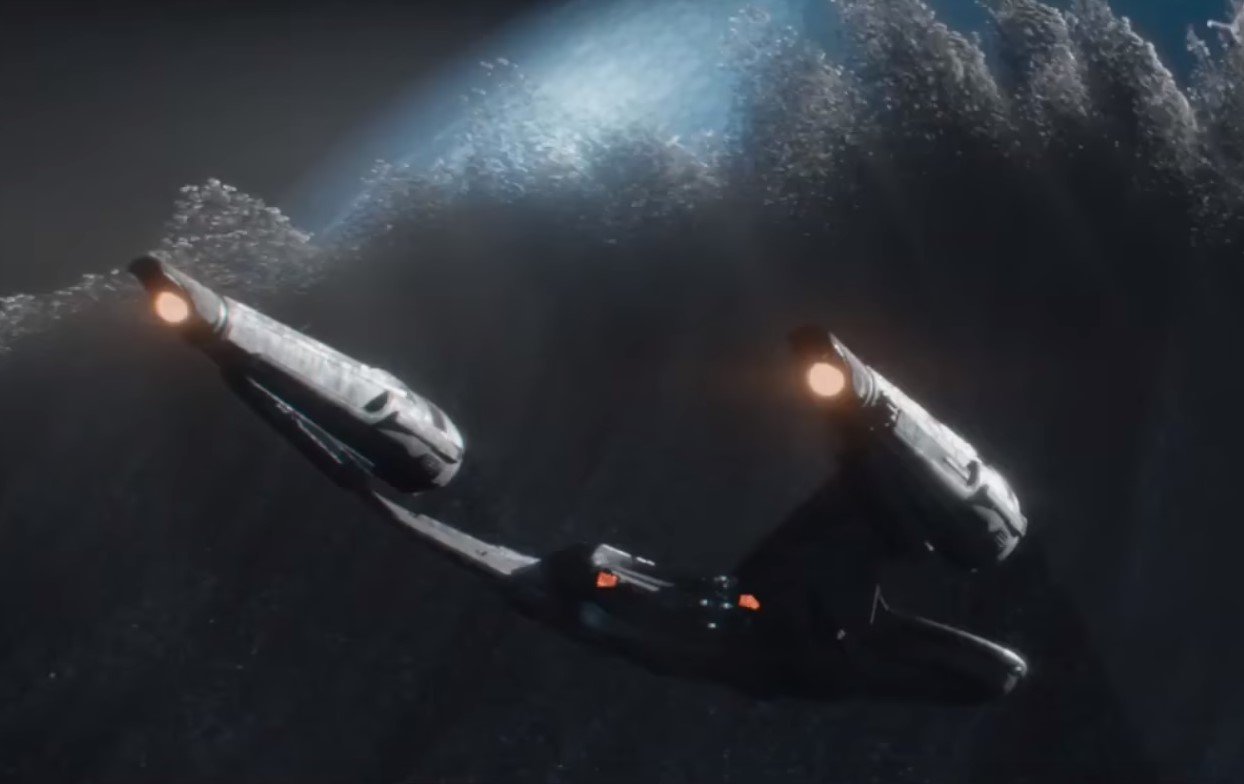
Image result for star trek voyager cast

This post is part of the Music of Star Trek Blogathon hosted by Film Music Central so check out the amazing music posts that others have already contributed. When I first heard about the blogathon, I wasn’t sure that there was much I could add to the discussion, since most people seemed to be focusing on the original Star Trek series, The Next Generation, and their movies. However, I decided to shine a spotlight on the musical moments in my favorite series in the franchise: Voyager.

For those who don’t know, Voyager is Star Trek‘s incarnation of the Odyssey. Two crews are hurled into the unexplored Delta Quadrant, 70,000 light-years from home: the Federation starship Voyager led by Captain Kathryn Janeway (Kate Mulgrew) and a Maquis ship of rebel freedom fighters, led by Chakotay (Robert Beltran). After their initial encounters with the native aliens leave them stranded, the two crews band together to make the long journey home. Like Next Gen, the somewhat stiff early episodes yield to better and better seasons, and it’s truly gratifying to see all the characters grow into a family. Many episodes rival the very best that Star Trek has to offer, but we’re not here to discuss every little thing I love about this series; let’s talk about the music.

One of the most obvious musical achievements is the opening theme song. While Next Gen recycled Jerry Goldsmith’s incredible score from Star Trek: The Motion Picture for its opening theme, Goldsmith provided an original theme for Voyager, which won an Emmy for Outstanding Individual Achievement in Main Title Theme Music. The soft trumpet and drums immediately set a mood of spacey grandeur, and the brass and strings mingle together as the essence of audible majesty, complemented by lofty shots of the title ship swooping through stellar phenomena. Between the music and the visuals, I firmly consider it the best opening of all the Trek series.

So, that’s the theme. What about the music in the series itself? All of it is excellent, but the most memorable new theme was introduced in the season 3 finale Scorpion, which was a turning point in the series and could be considered Voyager‘s “Best of Both Worlds.” The Voyager crew find themselves in the middle of the Borg’s losing war against an unbeatable super-race known as Species 8472. The music by Jay Chattaway is loaded with bombast, reminding the ear of the high stakes, and the seven forceful notes mix with the background music for a terrific small-screen action piece. You can hear it for yourselves here.

In addition to the instrumental scores, music played a special role in several episodes, particularly for the holographic Doctor (Robert Picardo), who developed a passion for opera. In addition, both Jeri Ryan as Seven of Nine and Tim Russ as Tuvok showed their singing chops on occasion, and Garrett Wang as Ensign Harry Kim periodically played the clarinet. Here are some of the most notable musical highlights:

  • In the season 2 episode “The Thaw,” Harry Kim and Tom Paris debate where Harry should practice his clarinet without disturbing his neighbor.
  • In the season 2 episode “Innocence,” Tuvok is stranded on a moon with three alien children and soothes them to sleep with a Vulcan “lullaby” of sorts called Falor’s Journey.
  • In the season 3 episode “Remember,” Janeway is telepathically taught to play an ethereal-sounding new instrument.
  • In the season 4 two-parter “The Killing Game,” a hunter race called the Hirogen brainwash the Voyager crew and make them take part in historical holographic violence. One holodeck is set in Nazi-occupied France, and Seven of Nine is a crooning serenader in a French bar.
  • In the season 5 premiere “Night,” Voyager travels through a vast area of starless space, and in his boredom, Harry performs his own concerto called “Echoes of the Void” while on the bridge.
  • In the season 5 episode “Counterpoint,” a paranoid, anti-telepath race repeatedly boards and searches Voyager, and its charismatic inspector flirts with Captain Janeway while blaring Mahler’s First Symphony during every inspection.
  • In the season 5 episode “Bride of Chaotica!,” the show indulges in the classic cheesiness of the old Flash-Gordon-style science fiction and the exaggerated score reflects the over-the-top histrionics.
  • In the season 5 episode “Someone to Watch over Me,” the Doctor tries to teach Seven of Nine social skills and seems to realize his attraction to her while they sing “You Are My Sunshine” together. During the poignant final scene, the Doctor also sings “Someone to Watch over Me,” alone.
  • In the season 6 premiere “Equinox Part II,” a reprogrammed evil Doctor performs surgery on Seven of Nine, sadistically making her sing “My Darling Clementine” with him.
  • In the season 6 episode “Barge of the Dead” (probably the worst episode of the series), we get to hear a traditional Klingon drinking song.
  • In the season 6 episode “Riddles,” Tuvok becomes mentally damaged, and Neelix plays him a Vulcan funeral dirge, as well as jazz, which Tuvok surprisingly enjoys.
  • In the season 6 episodes “Fair Haven” and “Spirit Folk,” the crew enjoy a holodeck program of a quaint Irish village, with accompanying Celtic background music.
  • In the season 6 episode “Virtuoso,” the Doctor becomes a celebrity when he introduces music to a race that has never heard it before. Lots of opera in this one.
  • In the season 7 episode “Homestead,” Neelix dances to some classic rock ‘n’ roll, and eventually Tuvok indulges him with a parting dance step.
  • The series finale “Endgame” also won Jay Chattaway an Emmy for Outstanding Music Composition For A Series. Here‘s a taste of the underscore from both the pilot and the final episode.


There you have it. Star Trek: Voyager excelled at utilizing music both in the score and the storylines, continuing the musical legacy of The Original Series and Next Gen. I leave you now with the funniest musical moment from the series in which the Doctor’s operatic daydreams take a comical turn in Season 6’s “Tinker, Tenor, Doctor, Spy.”

VC Pick: Shallow Hal (2001)

23 Friday Sep 2016

Posted by sgliput in Movies, Poetry, Reviews, Writing

≈ 2 Comments

Tags

Comedy, Romance, VC Pick

Image result for shallow hal film


When searching for the perfect mate,
We aim at the exterior.
With lesser looks, we hesitate
And seek a different him or her.

We never mean to judge them wrong,
For shouldn’t passion please the eye?
And yet how often do we long
For just the person we pass by?

We’ve heard it all, from school to camp,
Of books and covers, and ’tis true.
True love needs not perfection’s stamp
To be the perfect one for you.
______________________

MPAA rating: PG-13

I can never fully predict what kind of movies my VC will like. I wouldn’t have guessed that the Farrelly brothers’ Shallow Hal would be her kind of movie, yet, while it’s not among her favorites, it holds an odd appeal for her, perhaps because of star Jack Black. I do rather understand, though. For me, it’s a lot like 1987’s Mannequin, a film that I recognize as not very good or even funny, yet remains entertaining and milks its unique concept for all it’s worth.

After some bad deathbed advice from his father, Hal Larson (Black) grows up looking only on the outside, choosing his dates solely on their hotness. When the real-life Tony Robbins takes notice of his shallow ways, he gives Hal some positive-thinking hypnosis that causes him to recognize someone’s inner beauty in their outward appearance. Ergo, ugly people with hearts of gold look gorgeous while beautiful jerks look repulsive, though it apparently doesn’t affect people he’s already met. After some unwitting encounters with “attractive” girls, Hal meets Rosemary, who looks like the thin and lovely Gwyneth Paltrow we all know but is really morbidly obese. She finds his unbiased treatment of her refreshing, yet inevitable misunderstandings and the eventual truth threaten their unconventional bond.

What Shallow Hal could use the most is more humor. It’s one of the many comedies that settles for amusing with little chance at laughing out loud, and it confirms that Jack Black is hit-and-miss with his awkward brand of bumptiousness. Jason Alexander as Hal’s buddy is arguably even more shallow than Hal and earns a few chuckles with his unrealistic standards, but much of the humor consists of fat jokes aimed at Rosemary, along with Hal’s oblivious reactions that make her fall for him in the first place. It never verges into tasteless territory, but the comedy only hits its mark half the time.

Yet Shallow Hal has its moments, particularly when it leans toward the dramatic. Hal’s “gift” really does improve his perceptions and offers Rosemary a sorely needed self-esteem boost; as naturally attractive as she is, Paltrow expresses a self-deprecating diffidence both in and out of her fat-suit prosthetics. Hal’s rose-colored vision also provides some eye-opening revelations, a couple of which touchingly hit home.

I can see how Shallow Hal could be mildly controversial but not for the obvious reason. The fat jokes may bother some (though not my VC, who herself is “weight-challenged,” as she says), but as with the much maligned Soul Man, viewers need to look beyond the surface to see the film’s message, which is encouragingly respectful of the overweight and their sensitivities. On the other hand, the film’s message has its own negative. Hal’s “gift” seems to confirm the generality that kind people with great personalities are ugly and vice versa, and the attractive ones are probably nasty deep down. The truth is that personality has little to do with looks, but the film doesn’t go that far.

In Shallow Hal, it’s the humor that’s shallow and the themes that at least try to be deep. My VC does have a soft spot for it, likely due to the ending lesson to love regardless of appearances. Though it could have been much better, its caricatured heart is in the right place.

Best line: (Hal) “You know, there are a few times in a guy’s life – and I mean two or three, tops – when he comes to a crossroads, and he’s gotta decide. If he goes one way, he can keep doing what he’s been doing and be with any woman who’ll have him. And if he goes the other way, he gets to be with only one woman, maybe, maybe for the rest of his life. Now it seems that by taking the other road, he’s missing out on a lot. But the truth is, he gets much more in return. He gets to be happy.”


Rank: Honorable Mention


© 2016 S. G. Liput
411 Followers and Counting


High Plains Drifter (1973)

21 Wednesday Sep 2016

Posted by sgliput in Movies, Poetry, Reviews, Writing

≈ 3 Comments

Tags

Drama, Western

Image result for high plains drifter


Into town the stranger rode,
No history or name.
Revenge was due, a debt was owed,
And yet no other came.
All in town their worry showed
But covered up their shame,
Remembering the episode
For which they were to blame.
The still and sullen streets forebode
A secret, savage aim.
Into town the stranger rode,
And justice did the same.
________________

MPAA rating: R

For someone who loves movies, I do seem to have some glaring blind spots when it comes to expanding my repertoire. I’m a stranger to Tarantino and zombie films (though I don’t really care to be acquainted), and I’ve just recently begun exploring the most recent James Bond, Oliver Stone, and classic Hitchcock. One actor/director I know more by reputation than experience is Clint Eastwood. High Plains Drifter is actually the first western I’ve seen of his, and it confirmed why he is such a commanding screen presence.

Drawing from Eastwood’s experience with spaghetti westerns, High Plains Drifter also borrows certain elements from the likes of Seven Samurai and High Noon. Like Seven Samurai and its American remake The Magnificent Seven, the small desert town of Lago, named for the oddly located lake bordering it, lives in fear of the return of vengeful bandits and looks to a skilled stranger for salvation. Like High Noon, the film builds to the inevitable showdown between the lone defender and the encroaching enemy. A key question that sets High Plains Drifter apart, though, is “Is the town worth saving?” The townspeople in Seven Samurai and High Noon were prone to ingratitude and fear, but the settlers of Lago sit upon a cruel secret that takes much of the sympathy out of their plight.

Eastwood has played many a tough guy for the ages, not least of which is the nameless Stranger who rides into town without a word, backed by Dee Barton’s spookily atmospheric score. When the Stranger proves his grit and his aim by killing Lago’s supposed defenders, the sheriff begs him to protect them, promising him anything he wants in return. Despite his distaste for the town, the Stranger agrees and proceeds to take full advantage of the open-ended offer, ordering free drinks, the entire hotel to himself, and other unreasonable demands that seem meant to punish the town as a whole. The film walks a fine line between the Stranger’s abuse and how deserving the town may be of it, crossing the line on occasion when he freely rapes two women, who unrealistically don’t seem to mind too much after the fact. Except for that needless exploitation, Eastwood’s Stranger proves to be a compellingly mysterious anti-hero, whose intentions for the town itself remain uncertain right to the end. When asked what comes after the showdown, he defiantly replies, “Then you live with it.”

Far from Eastwood’s first rodeo, High Plains Drifter is a brazen western that questions the decency of frontier folk. Aside from Eastwood, Billy Curtis plays his closest ally, the diminutive Mordecai who has also felt the town’s malice, and Richard Bull appears as a shopkeeper, a year before he played the owner of Oleson’s Mercantile on Little House on the Prairie. I can’t say how High Plains Drifter compares with Eastwood’s other westerns (yet), but it’s a somewhat haunting entry in the western genre that gives a whole new meaning to “painting the town red.”

Best line: (the Stranger, after an overdue assault from his rape victim) “Wonder what took her so long to get mad?”


Rank: List Runner-Up


© 2016 S. G. Liput
411 Followers and Counting


Experimenter (2015)

18 Sunday Sep 2016

Posted by sgliput in Movies, Poetry, Reviews, Writing

≈ 2 Comments

Tags

Drama, History

Image result for experimenter film


Our human nature is a lake
Where most content themselves to take
A shallow view for comfort’s sake,
But few will dare the deep.
The poets plumb it with their verse,
And nihilists would make it worse
While sages study to reverse
Its ever-waning creep.

When someone dives and brings to light
A bit of psyche to indict
That questions what is wrong and right,
How often do we balk!
We point the finger, hide from view,
Insist that it cannot be true,
And say we’re wiser than the few
Who failed temptation’s knock.

To fear a truth and disregard
Depravities that perish hard
Will leave us only further marred
By lessons left unlearned.
The depths we’d rather not explore
Are those we most should not ignore,
For by the schemer who knows more
Is human nature turned.
________________

MPAA rating: PG-13 (for one lone obscenity and some subject matter, could even be PG)

I had never heard of the Milgram experiment before Experimenter, but its social impact is considerable. While hearing of the shock-based college study brought to mind Venkman’s similar parody at the beginning of Ghostbusters, the actual experiment touched upon serious questions ranging from the compliance of Nazi subordinates to social engineering and people’s natural reluctance to rebel against authority. It’s thought-provoking research, which inspired an equally provocative film.

While Experimenter is a scrutiny of Stanley Milgram himself as well as a restaging of his most famous work, it begins where his fame did: the shock experiment. As Milgram (Peter Sarsgaard) watches from behind a one-way mirror, his assistant brings in two volunteers, one to answer questions and receive electric shocks for wrong answers and one to administer the questions and shocks. The shock-ee is actually part of the ruse and re-creates sounds of pain from a closed room, while the shocker is urged to continue increasing the voltage no matter what. A majority of participants lacked the will to resist and yielded to pressure to deliver supposedly life-threatening shocks, simply because they were told to. Only 35% refused.

The orchestrated scenario forms the beginning of the film but is also intercut with Milgram’s life, including meeting his eventual wife (Winona Ryder). During all this, Sarsgaard speaks directly to the audience, discussing the experiment and his findings like a purveyor of mental provocation. Indeed, that’s how he sees himself and his job as a social psychologist; he’s merely presenting facts for academia and the public to discern as they will and is surprised at the controversy he attracts. More people seem critical of how he tricked his participants than of their actual responses. Later, Milgram tries to diversify his reputation with different social experiments, like confirming the “Six Degrees of Separation” principle that applies to more than just Kevin Bacon, but he’s always pulled back to his original shock experiment, both by colleagues and in the public eye.

Throughout the film are examples of how Milgram’s work was viewed. He’s forced to conduct followup interviews to test the emotional “damage” done to participants. Uninformed strangers complain about how he shocks people, not even understanding the details of the experiment. When Milgram informs his class that President Kennedy’s been shot, no one believes him, thinking it’s just a hoax to elicit a reaction. In addition, the filmmakers employ some curious creative choices, such as changing some backgrounds into stage-like painted backdrops. At certain points during Milgram’s fourth-wall-breaking narration, an elephant appears behind him, suggesting that he is always followed by “the elephant in the room.”

Sarsgaard does an outstandingly muted job in the role of Milgram, as does Ryder as his wife, though their marital struggles are a bit too generic to compare with the social questions presented. I was surprised at some of the minor supporting players: Jim Gaffigan ventures away from comedy as one of Milgram’s accomplices, while Dennis Haysbert plays Ossie Davis, who appeared with William Shatner in a 1976 TV movie about the Milgram experiment called The Tenth Level. Even the late Anton Yelchin appears in a barely noticeable role as an aide to the experiment.

Experimenter‘s deliberate pace doesn’t make it the most entertaining of biopics, but it’s a psychologically stimulating study that, like Milgram, asks difficult questions for the viewer to consider. As one of Milgram’s colleagues posits about atrocities, “The techniques change, the victims change, but it’s still a question. How do these things happen? How are they institutionalized?” The answers may be disturbing, but they are better off acknowledged than scorned. We as humans hate to think of what any one of us could be capable of under the worst conditions, but the worst parts of human nature are not all-inclusive. Thirty-five percent refused to continue the experiment. Would that include you?

Best line: (Milgram) “Human nature can be studied but not escaped, especially your own.”


Rank: List Runner-Up


© 2016 S. G. Liput
410 Followers and Counting

Cartoon Comparisons: Upside Down (2012) / Patema Inverted (2014)

15 Thursday Sep 2016

Posted by sgliput in Movies, Poetry, Reviews, Writing

≈ 2 Comments

Tags

Animation, Anime, Cartoon Comparisons, Drama, Romance, Sci-fi

Image result for upside down 2012 film

Image result for patema inverted


Right-side up is upside down
To those who smile when they frown,
To those who plunge whene’er they jump
Or rise when tripping on a bump
Or gobble down and up their meals
And sink a little in high heels,
To those who elevate a bit
If they lean over, kneel, or sit,
To those who set a precedent
When they descend on their ascent.
Up and down can be subjective.
‘Tis a matter of perspective.
____________________

MPAA rating for Upside Down: PG-13
MPAA rating for Patema Inverted: should be PG

For the next Cartoon Comparison, I’ve chosen two science fiction films with wildly imaginative concepts that happen to be suspiciously similar. Both the live-action Upside Down from Canada and the anime Patema Inverted from Japan feature the idea of opposite gravities: people walking on the ceilings, objects falling up, and the unlikelihood of two oppositely oriented young people overcoming the hatred of their politically hostile worlds. What differs is the way their worlds interact and the pseudo-scientific “explanation” for the curious gravitational situation.

Upside Down came first so if there was any copying being done, the live-action film can claim to be the original. Here, as explained by the narration of Adam (Jim Sturgess), two planets orbit each other so closely that there is essentially no sky. Looking up from either world, one simply sees the other planet’s surface, about as far away as a skyscraper, echoing perhaps the folding city street in Inception. One planet is considered Up Top, full of wealth and societal power, while the other is the economically exploited Down Below, though there’s no telling how they were named, considering the potential confusion of “up” and “down.” Luckily, the extraordinary visuals elevate the film’s none-too-subtle class struggle. Even if there were moments that I wasn’t sure what I was seeing at first, the remarkable effects were a marvel to the eye.

Image result for upside down 2012 film

As for the love story, Adam from Down Below happens to meet Eden (Kirsten Dunst) from Up Top, and they share remote romantic rendezvous in the mountains until the government breaks them apart. Years later, as Adam experiments with a practical anti-gravity serum, he seizes a chance to see Eden again at Transworld, the tower-like corporate bridge between the two worlds. The two leads certainly have chemistry, but due to a certain plot point, they don’t get to take much advantage of it, and Sturgess’s behavior can be awkward at times.

Yet Adam’s quest to reunite with Eden without being caught by the authorities leads to a good deal of inventiveness, such as his attempt to weigh himself “up” and pose as a citizen of Up Top. Unfortunately, logic gets in the way at times, including the film’s own invented gravitational rules. For instance, Adam never seems to have a problem with the blood flowing to his head when upside down. Wouldn’t that be both uncomfortable and a possible give-away to anyone who might notice? In addition, one of the planetary laws is that matter from opposite worlds eventually burns, but the time it takes for this to happen seems inconsistent. By film’s end, the conclusion is peculiarly rushed, offering a blanket resolution to crucial issues it couldn’t hope to address and doesn’t try. Upside Down is brilliant in concept, less so in execution, but the visuals alone are worth the watch.

Image result for upside down 2012 film adam and eden

Upside Down may have come first, but Patema Inverted utilizes the notion of inverse gravity far better, in my opinion. Perhaps the fantastical image of falling up is simply more credible in animation rather than live-action CGI, but it certainly captured the imagination of director Yasuhiro Yoshiura, who previously directed the compelling series-turned-movie Time of Eve. (I was impressed by both Patema and Time of Eve separately but didn’t realize till afterward that they shared the same director.)

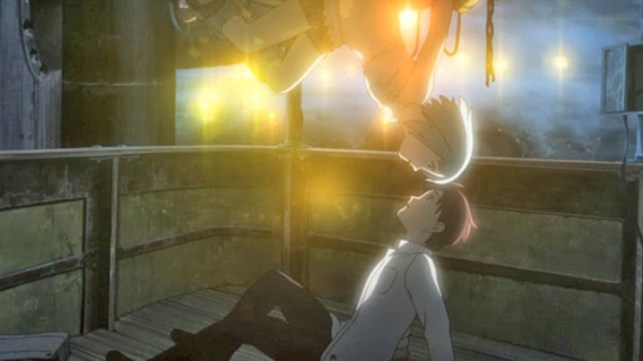
Instead of the up-front exposition of Upside Down, Patema Inverted takes its time to show and develop the gravitational anomalies as the characters discover them. Patema is a girl living in a City of Ember-like underground bunker and seems to be one of the few inhabitants to show an interest in the Forbidden Zone, where dust floats upward and “bat people” are rumored to lurk. After a close encounter, she finds herself dangling from a fence with the sky looming “below” her. Luckily, she is saved by the equally curious surface boy Age, who seems upside down to her. Age lives under a totalitarian dystopian government, whose leader is determined to root out the surviving inverts, who made their way underground after a catastrophic accident sent most of them falling into the sky years ago.

Image result for patema inverted

Upside Down basically lacked any sky; there was only so far someone could fall. Patema Inverted, however, makes the sky an imposing threat, a beautiful but dangerous abyss ready to swallow Patema without Age’s assistance. The animation is frequently dazzling, especially when the point of view shifts to contrast Age’s perspective with Patema’s. As Patema ventures into Age’s world and he ventures into hers, the distinction of up and down becomes fluid. The plot even takes some initially confusing twists that challenge the viewer’s perceptions and require some extra thought to fully comprehend. Some might be befuddled, but I found it fascinating. Plus, the musical score is enchanting and perfectly complements the film, including the gorgeous credits song “Patema Inverse,” which is sung in Esperanto and earns a place in the End Credits Song Hall of Fame. Between this and Time of Eve, I’m definitely hoping that Yoshiura continues to create such intriguing films.

I will admit that Patema Inverted seems to draw some inspiration from Upside Down. The cause of the inverted gravity differs (natural phenomenon vs. manmade disaster), but how the two gravities interact is the same: the lesser weight lightens the gravity of the other. This leads to the couples in both films holding on to each other to prevent the other from falling away, and being able to defy gravity by using each other’s weight. Writing about it doesn’t seem to do it justice, but it’s clever, cool, and undeniably similar in both films. As original as Patema Inverted is, I can’t help but wonder how much inspiration it drew from the earlier film. In addition, Patema is also rather slow in its gradual plot progression, and the villain is stereotypically bad for bad’s sake.

Image result for patema inverted


Despite these minor “down”-sides, Patema Inverted is easily the better film. Upside Down may have brought gravitational sci-fi to life first, but its conventional plot can’t compare with the thought-provoking vision of its animated counterpart.

Best line from Upside Down: (Adam) “Gravity, they say you can’t fight it. Well, I disagree. What if love was stronger than gravity?”

Best line from Patema Inverted: (Age, when holding onto Patema) “I get it! Your weight makes me light.”  (Patema) “Girls don’t like it when you talk like that!”


Rank for Upside Down: List Runner-Up
Rank for Patema Inverted: List-Worthy


© 2016 S. G. Liput
408 Followers and Counting

World Trade Center (2006)

11 Sunday Sep 2016

Posted by sgliput in Movies, Poetry, Reviews, Writing

≈ Leave a comment

Tags

Disaster, Drama, History

Image result for world trade center 2006 film


Do you recall the sirens?
The smoke-enveloped holes?
The billow blurred
And heavenward
Conveyed the victims’ souls.

Do you recall the terror
Of what was next to come,
The utter hell
As bodies fell
And minds and hearts went numb?

I didn’t watch the pictures
Ingrained on every brain.
I’ve seen them since
And felt the wince
That others bore with pain.

Like me, a generation
Has grown up towerless.
The shock and awe
That once was raw
We’ve had years to suppress.

One might regard us lucky,
The way we understand,
A distance free
From history
That many saw firsthand.

Although the blow is muted
For those younger than I,
We won’t let fade
The price once paid
By heroes when they die.
________________

MPAA rating: PG-13

Last year, I wanted to commemorate 9/11 by seeing the deeply effective United 93, and this year I did the same with World Trade Center, the slightly less acclaimed film from the same year. Based on the real-life experiences of Port Authority police officers John McLoughlin and Will Jimeno, who were buried under the rubble of Ground Zero, World Trade Center poignantly recreates the cavalcade of emotions of that infamous day.

From the first scenes, the film conjures the calm before the storm as everyday people perform their morning routines. Neither Jimeno (Michael Peña) nor his no-nonsense sergeant McLoughlin (Nicolas Cage) seems notable in their roles, yet when a plane flies into the North Tower of the World Trade Center, neither hesitates to venture into its lower levels. These early scenes highlight the uncertainty of the moment: conflicting reports of the severity of the damage, falling bodies, officers and civilians alike staring in shock at the smoking tower; and most of the scenes of the building seemed to be actual footage rather than a re-creation.

Despite the potent depiction of familiar events, most of the film is concerned with the aftermath, from McLoughlin and Jimeno struggling to stay alive beneath the debris to their worrying families. While a few scenes are confusing and the pacing becomes a bit paralyzed during their wait, the story still holds a relatable force in each family’s agonizing anticipation and the relieved cheer at any good news. Both Cage and Peña deliver excellent performances, as do Maria Bello and Maggie Gyllenhaal as their respective wives, and the ordeal is compelling enough that tears are probable by the end. (Also, Lost alert for William Mapother or “Ethan” as a Marine.)

World Trade Center is an admirable tribute to the first responders of 9/11, an impartial testimony thankfully free of the political messages for which its director, Oliver Stone, is known. I especially respect the religious overtones so often absent or limited in disaster movies; here, they extend to desperate prayers, God-led duties, and even a literal manifestation of Jesus. Even so, with its recognizable stars and anxieties common to most disaster films, it feels like a 9/11 movie, whereas United 93 felt like observing the actual events. Nonetheless, both are worthwhile commemorations of the courageous sacrifices made fifteen years ago.

Best line: (McLoughlin) “9/11 showed us what human beings are capable of. The evil, yeah, sure. But it also brought out the goodness we forgot could exist. People taking care of each other for no other reason than it was the right thing to do. It’s important for us to talk about that good, to remember. ‘Cause I saw a lot of it that day.”


Rank: List Runner-Up


© 2016 S. G. Liput
407 Followers and Counting

Finding Dory (2016)

07 Wednesday Sep 2016

Posted by sgliput in Movies, Poetry, Reviews, Writing

≈ Leave a comment

Tags

Animation, Comedy, Family, Pixar

Image result for finding dory


Not knowing where you’re headed
Or even where you’re from
Can lead you to frontiers remote
And thrills to keep yourself afloat
And friends you never thought you’d meet,
And yet you still feel incomplete.
You may seem empty-headed,
But none should think you dumb.

With memories returning
And hopes you can’t subdue,
You may pursue the past one day
In hopes that what you lost will stay.
The blanker slate is worry-free,
But most would fill it happily.
The answer to your yearning
Is waiting there for you.
_____________________

MPAA rating: PG

Of all the studios churning out unnecessary sequels to films widely considered untouchable, I trust Pixar the most. Finding Nemo is one of my most beloved films, animated or not, and when a sequel is announced for one of your favorites, I think most people are torn between excitement and fear of disappointment. I wanted Finding Dory to be good, but how could it compare to the original? Luckily, as they’ve proven in every case but Cars 2, Pixar isn’t content to drop the ball for sequels and managed to create a worthwhile story dedicated to everyone’s favorite forgetful fish.

From the very beginning, as the adorable short film Piper segues to an equally adorable baby Dory, Finding Dory cleverly builds a film based entirely on a single line from the first film: Dory’s brief mention of family and the quickly forgotten question “Where are they?” It seemed like a throwaway gag at the time, but Dory is no throwaway character. We see in repeated flashbacks how her parents (Diane Keaton and Eugene Levy) struggled to train and encourage her to overcome her short-term memory loss, and the separation that follows highlights what a disability it is. As hilarious as Dory’s antics are, I never really considered how vulnerable and directionless her condition made her. It’s no wonder that Marlin’s mission filled such a void in her life, and now it’s his and Nemo’s turn to help Dory find her own family, which happens to lead them to the Marine Life Institute in California.

One thing that should be said of Finding Dory is that Pixar has not limited themselves for believability. A gleeful absurdity runs through many parts and particularly during the hilarious climax, not unlike the off-the-wall creativity in Inside Out. But whereas that was inside a girl’s head, this is ostensibly the real world, and a greater suspension of disbelief is required as fish jump between every body of water in sight, big or small. Most examples can be easily overlooked, but it is odd that the first film made an epic quest out of the distance between the Great Barrier Reef and Sydney, while this one transports the characters from Australia to California within minutes. I guess the destination is more important than the journey in this case. Other questions abound, like “Do whale sharks really speak whale (when they are actual sharks, not whales)?” and “Does underwater echolocation really work outside the water too?” But if you just roll with the filmmakers’ indulgences, none of these should affect one’s enjoyment.

The animation is just as spectacular as the first film’s and greater in many cases, especially a first-person slide-away that heightens the trauma of the moment. Seeing the diversely populated exhibits at the institute reminded me of the wonder I always relished whenever I’d visit an aquarium as a kid. That was always my favorite kind of field trip, and Finding Dory reminded me how much I miss those visits, though I have an entirely new view of those innocent little touch pools. The voice cast is also superb, between the return of Ellen DeGeneres as Dory and Albert Brooks as Marlin, and the addition of a host of supporting players, from barking sea lions (Idris Elba and Dominic West) to the grumpy octopus Hank (Ed O’Neill), whose lithe acrobatics facilitate most of the out-of-water experiences. My VC can’t stand the sight of octopi, and while she has yet to see Finding Dory, I’m hoping Hank will alleviate her dislike a bit. I would have liked a little more backstory for him (Could the next movie be Finding Hank?), but he’s a welcome addition, especially on a visual level.

Image result for finding dory

In a way, Finding Dory is like a much improved version of what Cars 2 attempted: giving a popular side character the spotlight to have an adventure of their own and affirm their worth. But whereas Cars 2 had little to say about Mater other than “he’s a lovable idiot so love him,” Dory’s situation has far more depth and empathy. Essentially a fish version of Leonard from Memento without the benefit of tattoos, she’s a constantly rebooting blank slate whose desire to remember is both heartbreaking and warmly resolute. Even if I don’t quite agree with her assertion that “the best things happen by chance,” Dory remains as endearing and sincere a presence as ever.

I won’t try to pretend that Finding Dory is as good as its predecessor, but I’ve seen Finding Nemo countless times. I remember crowing with laughter at Dory speaking whale, yet when you know a film practically by heart, sometimes it loses something and you wish you could see it again for the first time. Above all, Finding Dory let me laugh-out-loud with these characters again and many new ones besides. For example, I never expected Pixar to pull off such a hilarious parody of a scene from Alien and the unrelated casting of Sigourney Weaver just made it better. Finding Dory filled in gaps I didn’t think needed answering and brought me somewhat of that same feeling I had watching the first film as a ten-year-old. If a sequel had to be made, I’m glad it was this one.

Best line: (Dory) “Sigourney Weaver is going to help us!”


Rank: List-Worthy (joining Finding Nemo)


© 2016 S. G. Liput
405 Followers and Counting


VC Pick: Silver Streak (1976)

04 Sunday Sep 2016

Posted by sgliput in Movies, Poetry, Reviews, Writing

≈ Leave a comment

Tags

Comedy, Thriller

Image result for silver streak film


Planes are too risky, and cars are too slow,
And don’t get me started on cruises and ships.
It seems that the safest conveyance for trips
Is travel by train; ‘tis the best way to go.

The scenery passes in hurtling flashes,
And movies have proven how romance can bloom.
But murderers too ride the train, I assume,
And safety is sometimes as rare as a crash is.

If you beware of endangered females
And manage to somehow remain on your train
Or if you fall off, to get on it again,
Then maybe your travels won’t go off the rails.
_____________________

MPAA rating: PG (should be PG-13 for innuendo and language)

In honor of the late Gene Wilder, I thought I’d review one of my VC’s favorite films of his. Murder on a train has certainly been seen before, like in 1974’s Murder on the Orient Express, but Silver Streak two years later milks the concept for sheer entertainment rather than mystery. Wilder plays George Caldwell, an editor in search of the boredom of riding a train, who meets his flirty room neighbor Hilly (Jill Clayburgh) and shares some garden-related pillow talk with her. And then a dead body appears outside the window. Talk about a mood killer.

Wilder isn’t quite as neurotic as his Leo Bloom in The Producers, but he’s likably nervous while he uncovers the conspiracy on board the Silver Streak, which connects L.A. and Chicago. There are shoot-outs and FBI agents and hidden evidence and a spear gun, and even if the plot gets a bit convoluted, the intrigue never falters.

The humor tends to stick with innuendo and mild amusement, that is, until Richard Pryor as the helpful criminal Grover joins the party. Silver Streak was the first partnership between Wilder and Pryor, and while I haven’t seen their other films together, they were no doubt striving to recreate the buddy chemistry on display here. There’s no real depth in their relationship, no moment of bonding, but they get along so well that it’s not needed. Their black-and-white appeal delivers some of the best moments, such as Wilder’s attempt at acting black to avoid the police.

The rest of the cast also get their memorable moments, including Ned Beatty, Scatman Crothers, Patrick McGoohan, Clifton James, Ray Walston, and Richard Kiel, playing a metal-toothed thug a year before he played Jaws in The Spy Who Loved Me. Perhaps the most memorable scene is the big unstoppable climax, which has been echoed in other train scenes like that in Hugo. While it’s not the best or funniest of Gene Wilder’s films (those would be Willy Wonka and Young Frankenstein for me), Silver Streak is an entertaining ride combining the American countryside, conspiratorial mystery, excellent casting, and a reminder of its star’s inimitable talent. RIP Gene Wilder.

Best line: (Grover) “I’m a thief!”


Rank: List Runner-Up


© 2016 S. G. Liput
404 Followers and Counting

← Older posts
Newer posts →

Recent Posts

  • We Didn’t Start 2025 (Recap)
  • NaPoWriMo 2025 Recap (Finally)
  • Sonic the Hedgehog 3 (2024)
  • It Happened One Night (1934)
  • Spellbound (2024)

Recent Comments

associatesofshellymann's avatarassociatesofshellyma… on My Top Twelve La La La So…
Kit's avatarKit Nichols on Bonnie and Clyde (1967)
lifelessons's avatarlifelessons on Look Back (2024)
Carol Jackson's avatarCarol Jackson on The Thief of Bagdad (1940…
Stephen's avatarStephen on Love Story (1970)

Archives

  • January 2026
  • December 2025
  • May 2025
  • April 2025
  • March 2025
  • February 2025
  • January 2025
  • December 2024
  • May 2024
  • April 2024
  • March 2024
  • February 2024
  • January 2024
  • December 2023
  • November 2023
  • October 2023
  • September 2023
  • July 2023
  • June 2023
  • May 2023
  • April 2023
  • March 2023
  • February 2023
  • January 2023
  • December 2022
  • November 2022
  • October 2022
  • September 2022
  • August 2022
  • July 2022
  • June 2022
  • May 2022
  • April 2022
  • March 2022
  • February 2022
  • January 2022
  • December 2021
  • November 2021
  • October 2021
  • September 2021
  • August 2021
  • July 2021
  • June 2021
  • May 2021
  • April 2021
  • March 2021
  • February 2021
  • January 2021
  • December 2020
  • November 2020
  • October 2020
  • September 2020
  • August 2020
  • July 2020
  • June 2020
  • May 2020
  • April 2020
  • March 2020
  • February 2020
  • January 2020
  • December 2019
  • November 2019
  • October 2019
  • September 2019
  • August 2019
  • July 2019
  • June 2019
  • May 2019
  • April 2019
  • March 2019
  • February 2019
  • January 2019
  • December 2018
  • November 2018
  • October 2018
  • September 2018
  • August 2018
  • July 2018
  • June 2018
  • May 2018
  • April 2018
  • March 2018
  • February 2018
  • January 2018
  • December 2017
  • November 2017
  • October 2017
  • September 2017
  • August 2017
  • July 2017
  • June 2017
  • May 2017
  • April 2017
  • March 2017
  • February 2017
  • January 2017
  • December 2016
  • November 2016
  • October 2016
  • September 2016
  • August 2016
  • July 2016
  • June 2016
  • May 2016
  • April 2016
  • March 2016
  • February 2016
  • January 2016
  • December 2015
  • November 2015
  • October 2015
  • September 2015
  • August 2015
  • July 2015
  • June 2015
  • May 2015
  • April 2015
  • March 2015
  • February 2015
  • January 2015
  • December 2014
  • November 2014
  • October 2014
  • September 2014
  • August 2014
  • July 2014
  • June 2014
  • May 2014
  • April 2014
  • March 2014
  • February 2014
  • January 2014
  • December 2013

Categories

  • Blindspot
  • Blogathon
  • Christian
  • Movies
  • Music
  • NaPoWriMo
  • Poetry
  • Reviews
  • TV
  • Writing

Meta

  • Create account
  • Log in
  • Entries feed
  • Comments feed
  • WordPress.com

Recent Posts

  • We Didn’t Start 2025 (Recap)
  • NaPoWriMo 2025 Recap (Finally)
  • Sonic the Hedgehog 3 (2024)
  • It Happened One Night (1934)
  • Spellbound (2024)

Recent Comments

associatesofshellymann's avatarassociatesofshellyma… on My Top Twelve La La La So…
Kit's avatarKit Nichols on Bonnie and Clyde (1967)
lifelessons's avatarlifelessons on Look Back (2024)
Carol Jackson's avatarCarol Jackson on The Thief of Bagdad (1940…
Stephen's avatarStephen on Love Story (1970)

Archives

  • January 2026
  • December 2025
  • May 2025
  • April 2025
  • March 2025
  • February 2025
  • January 2025
  • December 2024
  • May 2024
  • April 2024
  • March 2024
  • February 2024
  • January 2024
  • December 2023
  • November 2023
  • October 2023
  • September 2023
  • July 2023
  • June 2023
  • May 2023
  • April 2023
  • March 2023
  • February 2023
  • January 2023
  • December 2022
  • November 2022
  • October 2022
  • September 2022
  • August 2022
  • July 2022
  • June 2022
  • May 2022
  • April 2022
  • March 2022
  • February 2022
  • January 2022
  • December 2021
  • November 2021
  • October 2021
  • September 2021
  • August 2021
  • July 2021
  • June 2021
  • May 2021
  • April 2021
  • March 2021
  • February 2021
  • January 2021
  • December 2020
  • November 2020
  • October 2020
  • September 2020
  • August 2020
  • July 2020
  • June 2020
  • May 2020
  • April 2020
  • March 2020
  • February 2020
  • January 2020
  • December 2019
  • November 2019
  • October 2019
  • September 2019
  • August 2019
  • July 2019
  • June 2019
  • May 2019
  • April 2019
  • March 2019
  • February 2019
  • January 2019
  • December 2018
  • November 2018
  • October 2018
  • September 2018
  • August 2018
  • July 2018
  • June 2018
  • May 2018
  • April 2018
  • March 2018
  • February 2018
  • January 2018
  • December 2017
  • November 2017
  • October 2017
  • September 2017
  • August 2017
  • July 2017
  • June 2017
  • May 2017
  • April 2017
  • March 2017
  • February 2017
  • January 2017
  • December 2016
  • November 2016
  • October 2016
  • September 2016
  • August 2016
  • July 2016
  • June 2016
  • May 2016
  • April 2016
  • March 2016
  • February 2016
  • January 2016
  • December 2015
  • November 2015
  • October 2015
  • September 2015
  • August 2015
  • July 2015
  • June 2015
  • May 2015
  • April 2015
  • March 2015
  • February 2015
  • January 2015
  • December 2014
  • November 2014
  • October 2014
  • September 2014
  • August 2014
  • July 2014
  • June 2014
  • May 2014
  • April 2014
  • March 2014
  • February 2014
  • January 2014
  • December 2013

Categories

  • Blindspot
  • Blogathon
  • Christian
  • Movies
  • Music
  • NaPoWriMo
  • Poetry
  • Reviews
  • TV
  • Writing

Meta

  • Create account
  • Log in
  • Entries feed
  • Comments feed
  • WordPress.com

Blog at WordPress.com.

  • Subscribe Subscribed
    • Rhyme and Reason
    • Join 814 other subscribers
    • Already have a WordPress.com account? Log in now.
    • Rhyme and Reason
    • Subscribe Subscribed
    • Sign up
    • Log in
    • Report this content
    • View site in Reader
    • Manage subscriptions
    • Collapse this bar