• Home
  • About Me
  • The List
  • THE LIST (2016 Update)
  • THE LIST (2017 Update)
  • THE LIST (2018 Update)
  • THE LIST (2019 Update)
  • THE LIST (2020 Update)
  • THE LIST (2021 Update)
  • THE LIST (2022 Update)
  • Top Twelves and More
  • The End Credits Song Hall of Fame

Rhyme and Reason

~ Poetry Meets Film Reviews

Rhyme and Reason

Category Archives: Blindspot

2021 Blindspot #3: Office Space (1999)

03 Friday Sep 2021

Posted by sgliput in Blindspot, Movies, Poetry, Reviews, Writing

≈ Leave a comment

Tags

Comedy

See the source image

I once endured the office
And drove in every day.
I wore the expected buttoned shirt
And stared at screens till my eyeballs hurt,
Attended meetings that unveiled
They could have simply been emailed,
And in my cubicle I sat,
The lowest-ranking technocrat.

But now…
My home base is my office,
From bed to chair each day.
My eyes are still assailed by screens,
But that’s been true since my early teens.
I only dress my upper third,
And even that is rather blurred.
The meetings stayed, but I attend
From my back porch, a welcome trend.
A shame a virus was the cause,
But office work ain’t what it was.
_______________________

MPA rating:  R (for language and brief nudity)

What ever happened to that guy who wrote poems and movie reviews? Had a blog called Rhyme and Reason? Oh yeah, he earned his Bachelor’s degree and finally found time to write something new! That’s right; school is officially over, and while the next month still promises to be busy, I am at last freed of a major time sink investment and can get back to this blog, starting with my already delayed Blindspot series.
See the source image

I knew Office Space was a popular comedy from Mike Judge, but it wasn’t until the last couple years that it seemed relevant to me, since I had previously been in the restaurant/customer service world and had no experience with office life. In fact, getting a desk job in an office was a huge goal and a satisfying achievement when I finally transitioned to an IT career. Since I’ve had a taste of the office (pre-COVID at least), it seemed like the right time for a satire like Office Space.

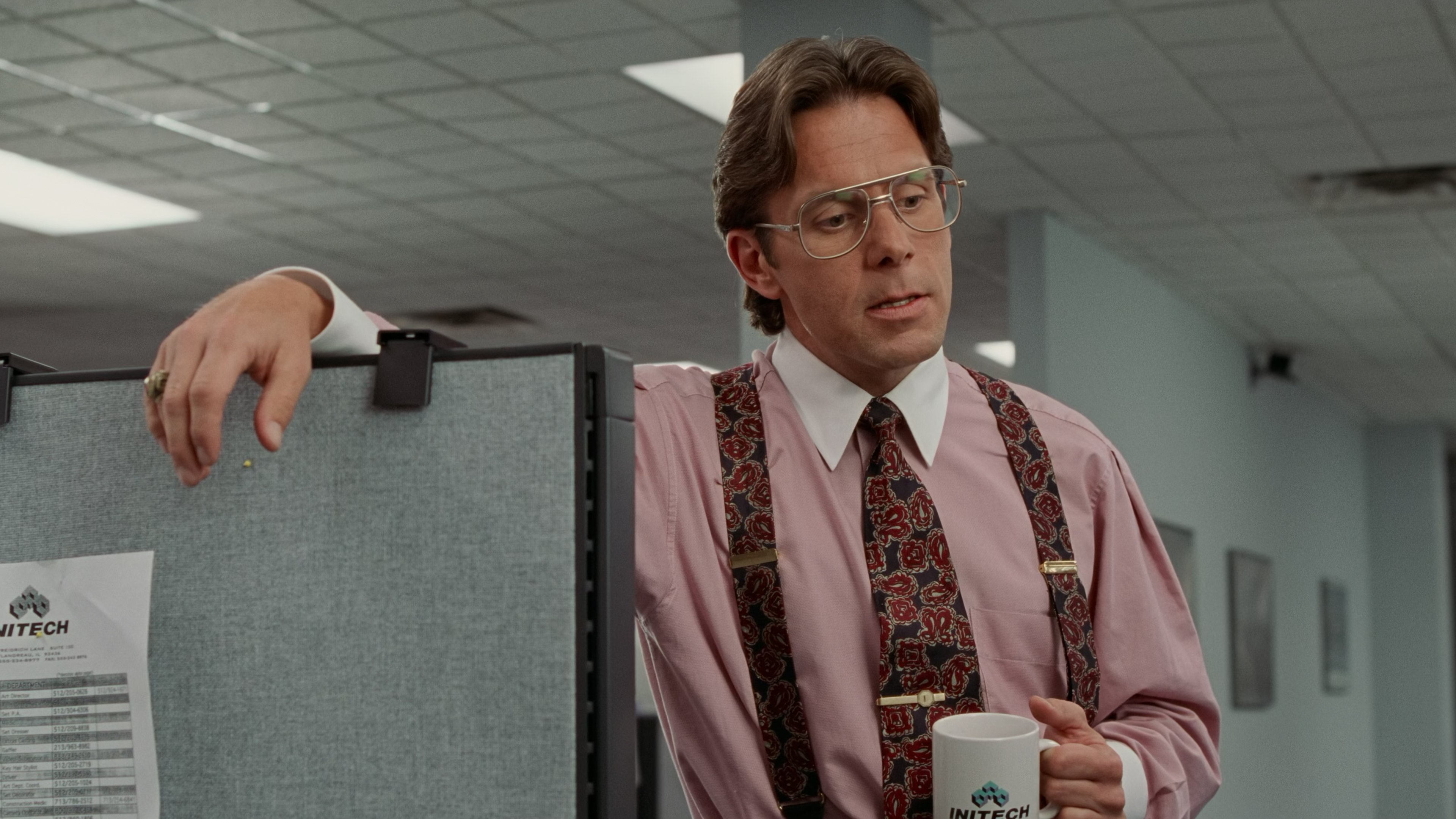
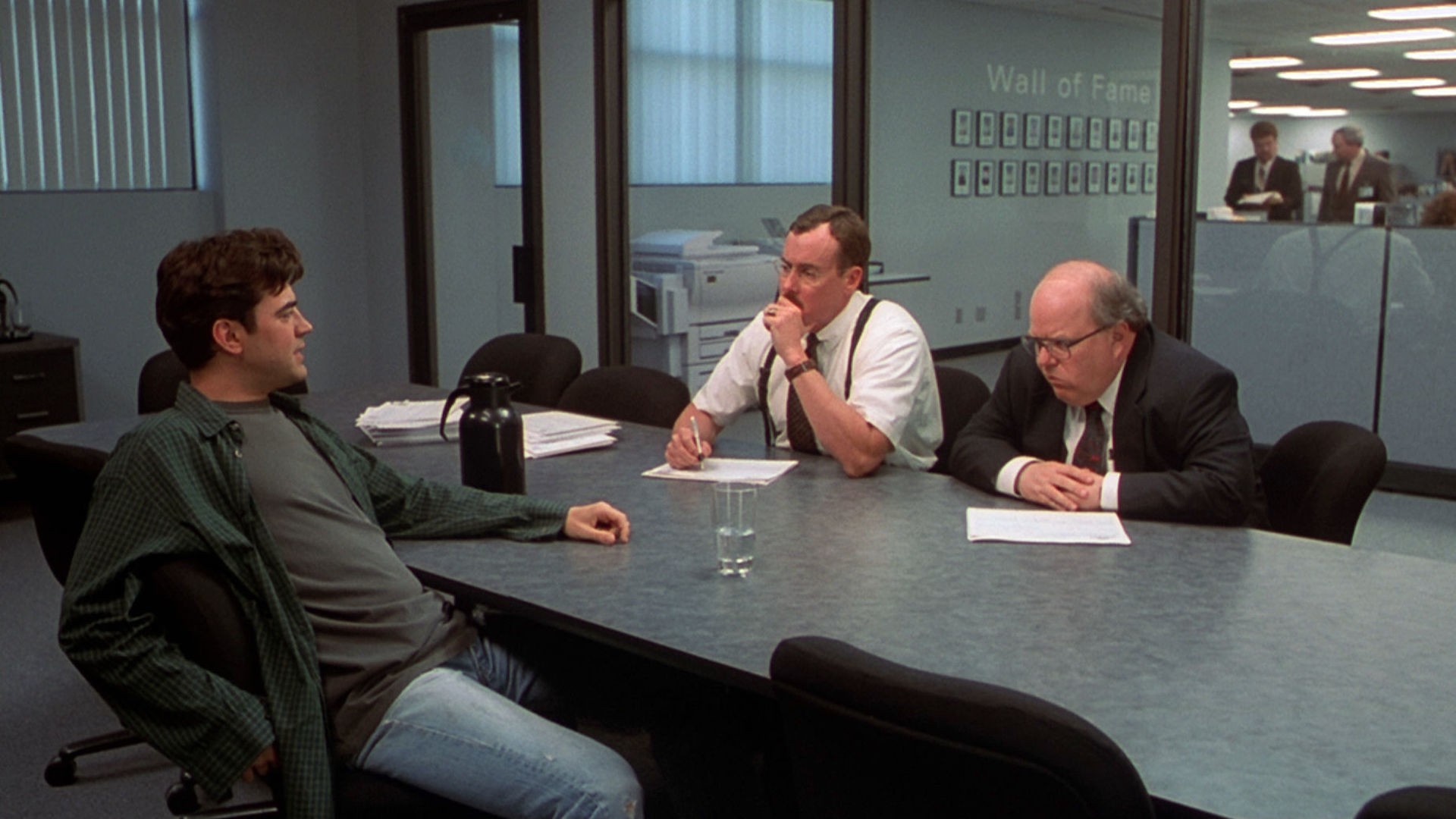
Ron Livingston plays Peter Gibbons, a programming pencil pusher working in the generic office complex of Initech, along with his comrades in monotony Michael (David Herman) and Samir (Ajay Naidu). Tired of being worried and frustrated, Peter agrees to an interrupted hypnosis session, and while the lasting impact of the hypnosis remains unclear, he finds himself unburdened by the demands of life and his manager Bill Lumbergh (Gary Cole). When Peter’s career ironically benefits from his newfound carefree attitude at the expense of his friends, they concoct a plan to get back at Initech, with trouble naturally ensuing.

Based on Judge’s Milton cartoon shorts and featuring Stephen Root as the mumbling side character Milton Waddams, Office Space is a comedy that finds its humor not in rapid-fire jokes but in magnifying everyday headaches to which its audience can relate. The chuckles come from recognition and a sort of shared sympathy. After all, who hasn’t worried about annual job evaluations or wanted to destroy an uncooperative printer? Ron Livingston’s Peter is an effective everyman doing the nonchalant acts of rebellion that most of us are too smart or worried to do ourselves, and though the film’s plot is rather meandering, its eventual payoff is cleverly satisfying for those most oppressed by “the system.”

See the source image

I probably could have related to Office Space already, since Peter’s love interest Joanna (Jennifer Aniston) works as a waitress, but there were certainly office-specific eccentricities sprinkled throughout the insightful script that I was able to recognize better now that I’ve worked in an office. I can’t help but think of this movie anytime one of my bosses says, “If you could do so-and-so, that’d be great.” At least it’s not in Lumbergh’s now-iconic monotone. That being said, I also feel quite lucky since I greatly enjoy my job, which is neither as dully repetitive nor as paperwork-heavy as Initech (plus no cubicles), so I suppose the film’s soul-crushing example of office doldrums could also be seen as an encouragement to recognize when your job isn’t that bad. (Maybe it is that bad, but I believe in looking on the bright side.) While I would have enjoyed Office Space even more without the semi-frequent profanity, I can see why it’s become a cult favorite and a touchstone for all those weary of office culture or suffering from “a case of the Mondays.”

Best line: (Peter, again offering an example for us to say our lives aren’t that bad) “So I was sitting in my cubicle today, and I realized, ever since I started working, every single day of my life has been worse than the day before it. So that means that every single day that you see me, that’s on the worst day of my life.”
(Dr. Swanson, the psychologist) “What about today? Is today the worst day of your life?”
(Peter) “Yeah.”
(Dr. Swanson) “Wow, that’s messed up.”

Rank:  List Runner-Up

© 2021 S.G. Liput
737 Followers and Counting
2021 Blindspot Pick #2: My Left Foot (1989)

03 Saturday Jul 2021

Posted by sgliput in Blindspot, Movies, Poetry, Reviews, Writing

≈ Leave a comment

Tags

Biopic, Drama

See the source image

We get what we’re born with,
No more and no less.
Curse the sky,
Moan and sigh,
Pound the cage and wonder why;
Still, when you are out of breath,
You’ll have what led to such distress.

Our handicaps vary,
In flesh and in mind.
Is it strange
That this range
Still can lead to lasting change?
The albatrosses each must carry
Mark the best of humankind.

Yet suffering will never
Inspire by default.
‘Tis the sight
Of the fight,
Proving we are not our plight.
The hardest roads, the fool’s endeavor
Are the wins to most exalt!
_________________________

MPA rating:  R (mainly for language)

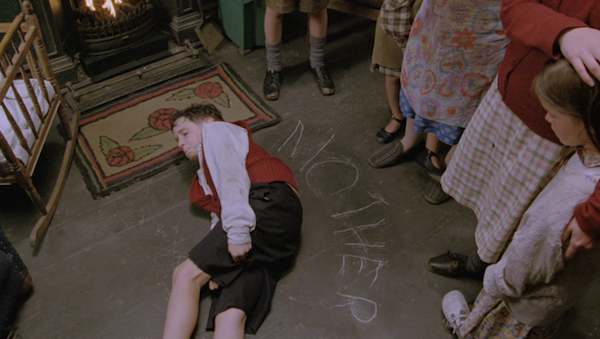
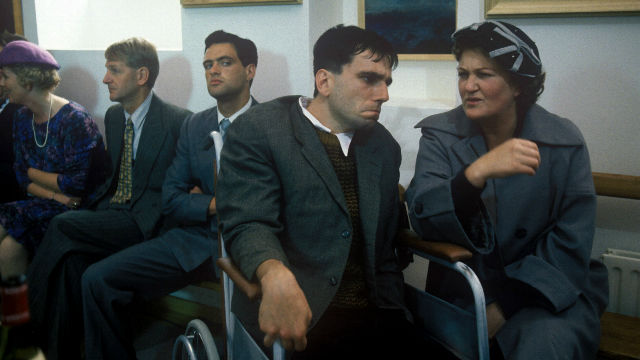
No, I haven’t forgotten about my Blindspots this year, and I plan to hurriedly catch up once school is done in September. In the meantime, I have still been able to see a few. I recall hearing my mom often speak positively about My Left Foot, but I never got around to seeing it for whatever reason. An acclaimed biopic, My Left Foot also heralded Best Actor winner Daniel Day-Lewis as one of the premier actors of his day, which other films have since confirmed.

See the source image

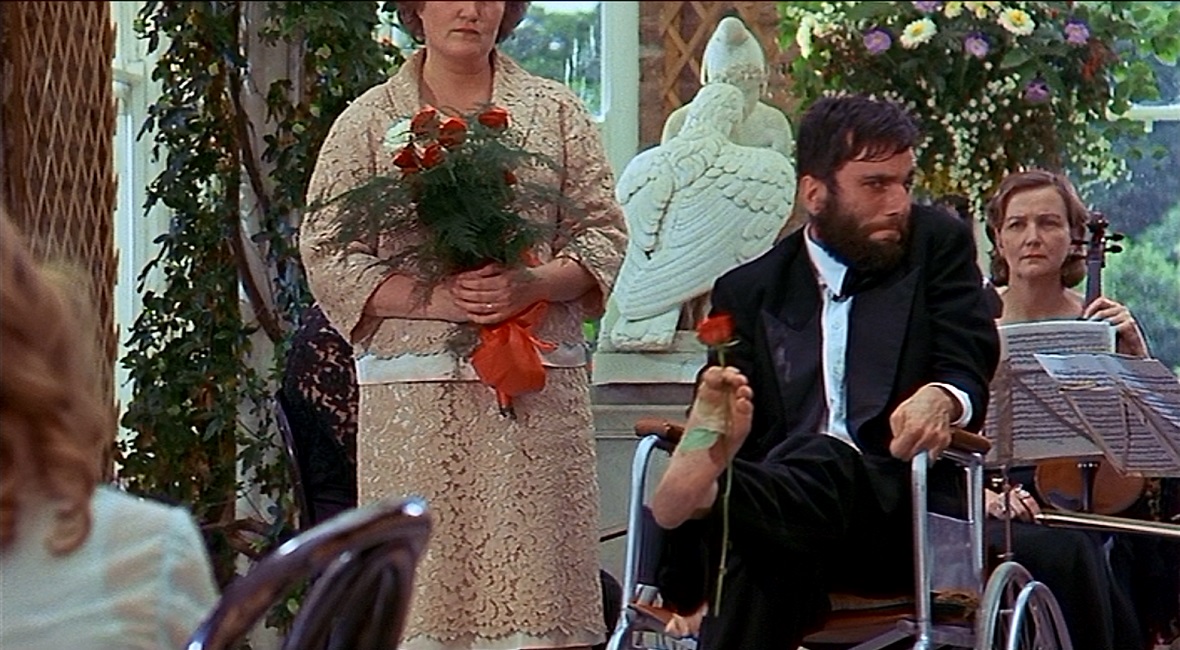
It’s become a bit of cliché for actors feigning disabilities to become awards magnets, with recent criticism increasing from many communities over such portrayals. In playing the real-life painter and writer Christy Brown, Day-Lewis rises above such complaints with the sheer commitment of bringing to life a man whose life was so much more than a victim of cerebral palsy. Born into a poor but plentiful Irish family, Christy is accommodated to the best of their ability, with particular love from his doting mother Bridget (Brenda Fricker) and grudging affection from his rowdy father Patrick (Ray McAnally, who died shortly after the film’s release).

While chronic conditions like Christie’s might have led to despair and debasement (a la The Elephant Man), it’s a warm-hearted joy to see how his siblings and friends treat him as one of their own. In the Browns’ cash-strapped world, a mere wheelchair is a thing to cherish, while a desire for a room of his own results in an inspiring family effort. In Christy’s struggles, there is still a constant feeling of otherness, leading to heartbreaking moments where Day-Lewis’s intensity transcends his limited movements. The actor’s lock-jawed dialogue can be hard to make out at times, but he perfectly embodies the emotional range of his subject, from his sardonic humor to his self-pitying grief to his earnest desire for happiness.

See the source image

As award-worthy as Day-Lewis was, I felt Brenda Fricker deserved her Best Supporting Actress Oscar just as much. Indeed, she ranks among the finest movie mothers, both with Day-Lewis and the equally excellent Hugh O’Conor as the young Christy. There has been some debate over whether Driving Miss Daisy deserved its Best Picture win in 1989, with My Left Foot held up as the best alternative. I’ll admit that was a very competitive year (Glory wasn’t even nominated) and I would be happy with My Left Foot winning, but I do have a soft spot for Driving Miss Daisy so I’m still glad it won. Even so, My Left Foot is a shining example of a biopic that finds a perfect convergence of inspiring true story, poignant script, and ideal casting.

Best line: (Mrs. Brown) “A broken body’s nothing compared to a broken heart.”

Rank:  List-Worthy

© 2021 S.G. Liput
736 Followers and Counting

2021 Blindspot Pick #1: Total Recall (1990)

27 Tuesday Apr 2021

Posted by sgliput in Blindspot, Movies, NaPoWriMo, Poetry, Reviews, Writing

≈ 1 Comment

Tags

Sci-fi, Thriller

See the source image

(It seems I’m too busy to consider midnight as a deadline, so I’ll simply take part in this home stretch of NaPoWriMo as I can. For Day 26, the prompt was to write a parody poem, so I decided to imitate “Paul Revere’s Ride,” one of my favorite poems and meters, and merge it with this movie’s plot.)

Listen, dear viewers, and you shall be played
The bewildering story of Douglas Quaid.
‘Twas some future date in Two Thousand Eight Four,
(This isn’t the remake that many abhor
But Verhoeven’s version that Ahnold portrayed).

He said to his wife, “It would awesome be
If you and I could go visit Mars.”
But because she responded with apathy,
He sought out the next best way to the stars.
No one would care if he were to deign
To have memories planted into his brain,
Maybe to match his curious dreams
Of mystery women and Martian extremes.
But life, he soon found, is not quite what it seems.

When he left Rekall, he recalled very little,
Yet he soon found he was right in the middle
Of murderous Martian Machiavels
And mutants revolting beneath glass shells,
Which most would agree were far too brittle.
Was all this real, or another dream?
Was Quaid a player, and for which team?
I would tell you more, but you must agree
That reviews are best when they’re spoiler-free.
____________________________________

MPA rating:  R (strong violence, language, and nudity)

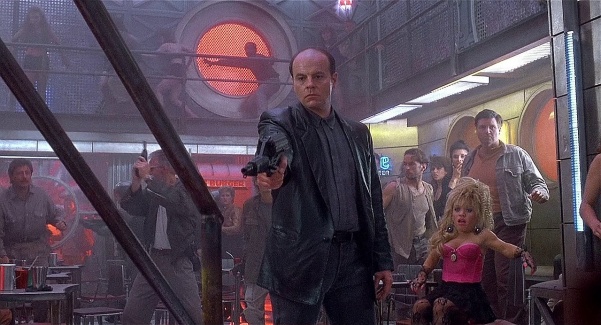
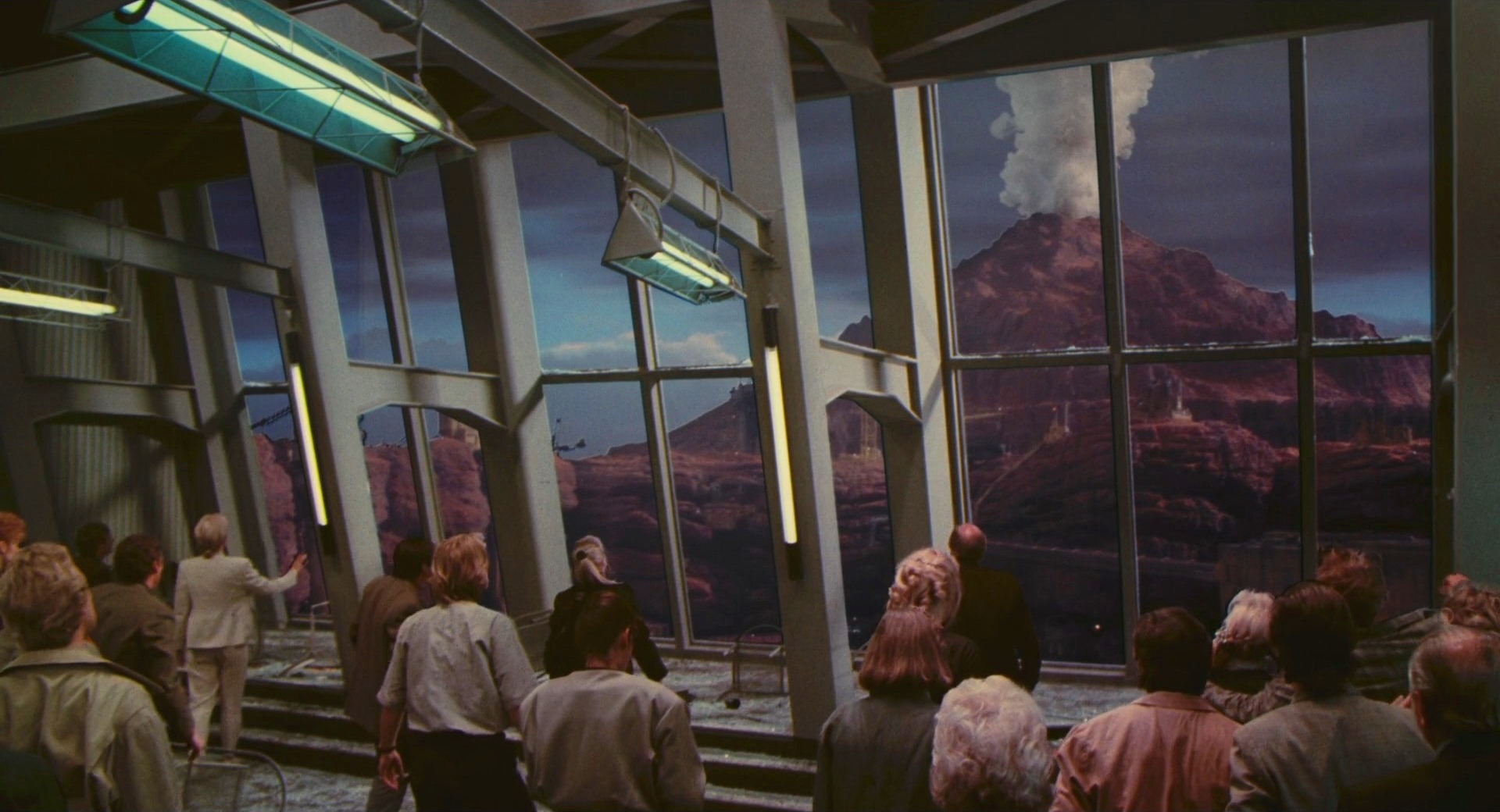
Like 2020, I’m finally getting started on my Blindspot list for the year in April, so I’ll have to double up a few times in the coming months to finish before the end of 2021. Kicking off the list is 1990’s Total Recall, a sci-fi mind-bender featuring Arnold Schwarzenegger at the height of his popularity, along with Rachel Ticotin, Sharon Stone, and Ronny Cox. It certainly represents a niche of its era that Hollywood is unlikely to resurrect successfully now that CGI is so prevalent: the hyper-violent, futuristic thriller with cheesy dialogue and effects that were amazing (and Oscar-winning) for the time and now have almost a quaint, unpolished roughness to them that somehow doesn’t detract from their quality. I’m thinking of movies like Outland, The Running Man, and director Paul Verhoeven’s own Robocop, and Total Recall is a prime example that I had somehow missed until now.

See the source image

My opinion of Total Recall is split. On the one hand, I love science fiction, and being based on a Philip K. Dick short story, the film is able to delve into a lot of fascinating subjects: questions about the nature of memories and reality, the dirty populism of a future Mars settlement, even the dependency of one’s identity on one’s memories. Plus, there are concepts that were clearly borrowed by later films, such as a red pill being offered to wake Quaid back to “reality,” not unlike The Matrix. Yet for all its impressive themes and gleefully convoluted plotline, ultra-violence has never been my cup of tea, and this movie definitely earns its R rating. Beyond the space brothels and headshots, it also gets very weird with its psychic mutants and whatnot, all of which I suppose should be no surprise considering the time period and Verhoeven’s involvement.

So Total Recall is a mixed bag for me, an unabashed sci-fi thrill ride that finds a balance between philosophizing and tearing bad guys’ arms off. It’s the kind of film I think is dragged down by its R-rated content even as I know that’s part of the appeal for its fans. I’m glad still to have watched it, even if I’d prefer to see it on a cut TV channel in the future. Take the grain and leave the chaff, as they say.

See the source image

Best line: (Kuato the mutant) “You are what you do. A man is defined by his actions, not his memory.”

Rank:  List Runner-Up

© 2021 S.G. Liput
728 Followers and Counting

My 2021 Blindspot Picks

31 Wednesday Mar 2021

Posted by sgliput in Blindspot, Movies

≈ Leave a comment

Tags

Lists

Why waste time? Hot off the heels of completing my 2020 Blindspots, it’s time to move on to a brand new list of twelve movies for 2021. Normally, I would have posted this at the beginning of the year and watched one a month, but I’m sure I can double up a few times before December, especially once I graduate.

As with past years, I attempted to select a varied collection of films I’ve been meaning to see, including a war classic, a Best Picture winner, an anime, a musical, a psychological horror, a sci-fi actioner, and a couple popular comedies. Here’s hoping that 2021’s Blindspot series will expose me to some new favorites!

And in alphabetical order, the movies are:

A Matter of Life and Death (1946)

See the source image

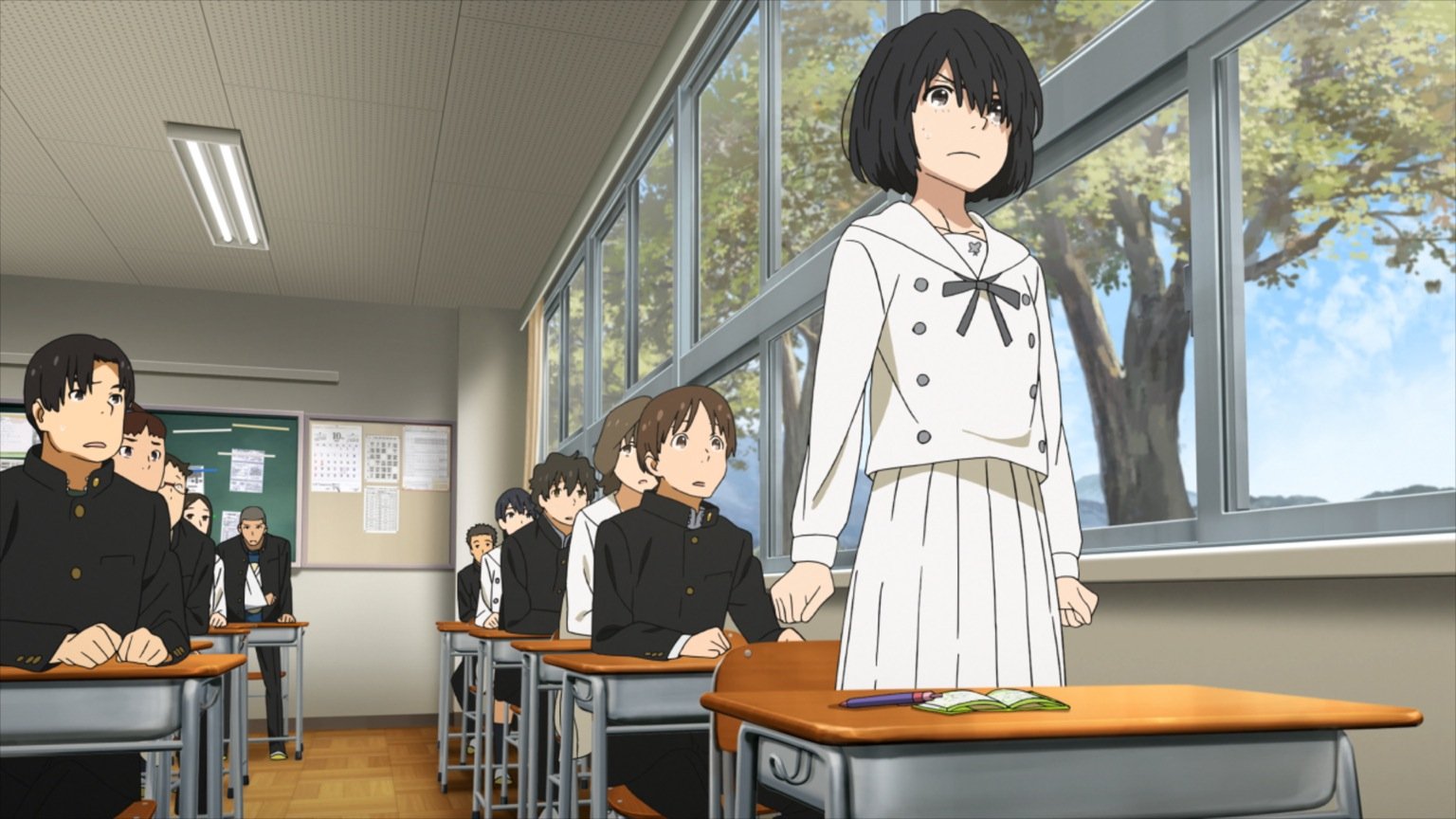
The Anthem of the Heart (2015)

See the source image

The Apartment (1960)

See the source image

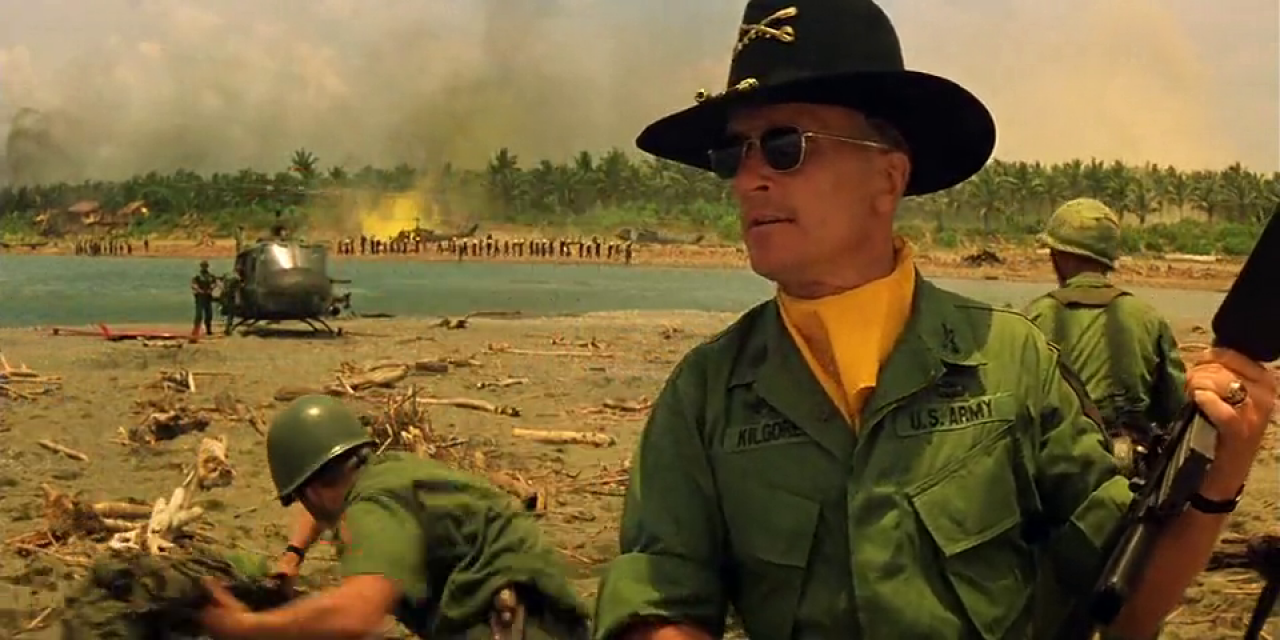
Apocalypse Now (1979)

See the source image

Coming to America (1988)

See the source image

Don’t Look Now (1973)

See the source image

My Left Foot (1989)

See the source image

Office Space (1999)

See the source image

Shin Godzilla (2016)

See the source image

Sunshine on Leith (2013)

See the source image

Total Recall (1990)

See the source image

The Village (2004)

See the source image

2020 Blindspot Pick #12: One Cut of the Dead (2017)

29 Monday Mar 2021

Posted by sgliput in Blindspot, Movies, Poetry, Reviews, Writing

≈ Leave a comment

Tags

Comedy, Foreign, Horror

See the source image

If actors in movies are merely fakes,
How do you manage to up the stakes?
How do you take the viewers’ slump
And get their blood to truly pump?
How do you take a film’s façade
And prove it’s more than just a fraud?

Reality! I’ve said it here;
It’s not enough to fake a tear,
To cry on cue, to feign a scream,
To cheapen what should be extreme.
I want a shark that really bites,
Real zombie hordes with appetites,
A true disaster caught on tape
From which the cast may not escape.

Alas, such things we can’t get at,
With contracts, laws, and things like that,
But if real danger should appear
Why not record the drama, fear,
Reality?! No thought for taste,
Let no disaster go to waste.
_______________________

MPA Rating:  Not Rated (probably R for bloody violence and F words in the subtitles, though there’s clear fakery to the gore)

At long last, I have reached the end of my 2020 Blindspot list, and once more I tap the trite but apt phrase “better late than never.” I didn’t intend to wrap up the list with this Japanese zombie film; it just happened to fall to last place, which only makes it even more surprising that it turned out to be my favorite of all the Blindspots from last year. In case there is doubt, I am typically averse to extreme violence in movies, so zombie flicks are far from my cup of tea. Yet I did love Train to Busan, and the 100% Rotten Tomatoes score for One Cut of the Dead gave me hope that this one might be something special. It is.

See the source image

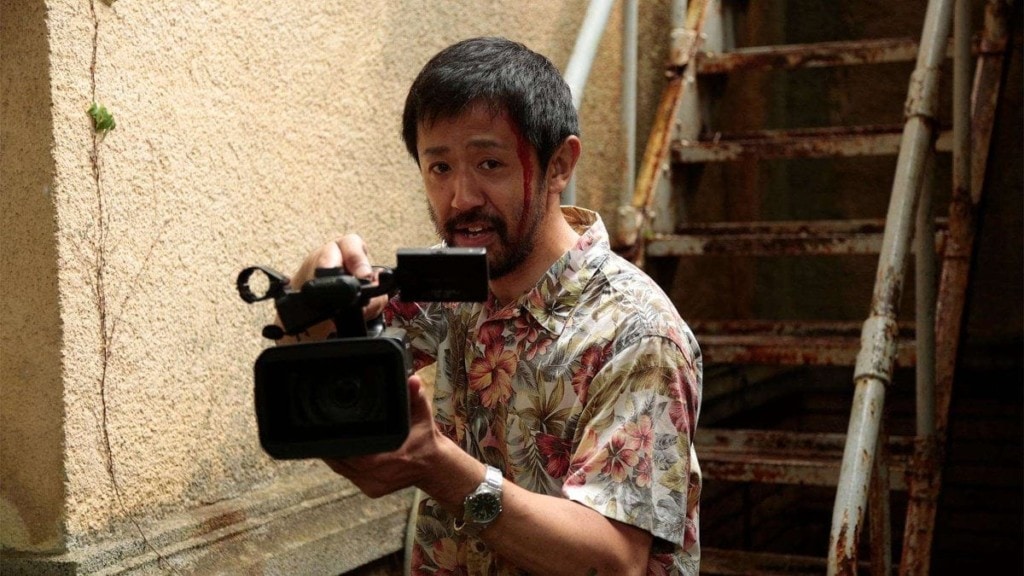
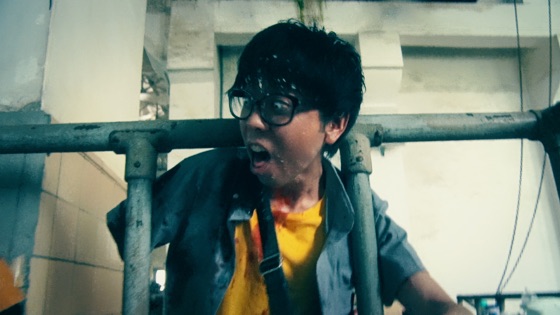
For starters, One Cut of the Dead is gleefully meta, being a film about the making of a film about people making a zombie film when real zombies appear. It is also the kind of film that is hard to talk about without giving too much away, but I’ll try to avoid spoilers. Director Higurashi (Takayuki Hamatsu) is trying to wring emotion out of his actors as they shoot an ultra-low-budget zombie flick in an abandoned factory. While the cast and crew grow weary of his demands, actual zombies suddenly appear, and he seizes the life-and-death situation to bring realism to his film, insisting on keeping the camera rolling as the undead move in.

That synopsis alone probably doesn’t seem particularly innovative, but let’s just say there’s more to it. The film’s most impressive achievement is that the first 37 minutes are all one long tracking shot with no cuts (a favorite technique of mine), following the characters from zombie chases to Higurashi’s sabotaging of their escape attempts. As impressive as this is, the film’s low-budget status is evident from the awkward pauses, stilted dialogue, and schlocky violence that largely stays off-screen, building into increasingly funny absurdity. Yet the rest of the movie adds so much more to the initial film within a film, providing context of what happened beforehand and what happened off-camera, making the proceedings even more hilarious, quirky, and (as strange as it may sound) heartwarming.

Modern comedies rarely hold a candle to the older classics, in my opinion, but I’ll admit that One Cut of the Dead had me grinning much more than I expected going in. What seems at first like a groan-worthy wannabe horror turns into a celebration of film and the enormous effort put into it, and I loved how even seemingly insignificant details were given amusing explanations as the story unfolded. Even the director’s name had me wondering if it was an oblique reference to the classic Higurashi horror series.

See the source image

As much as I enjoyed the film, I wasn’t quite sure if it warranted placement on my list; then I found that there was actually a follow-up sequel of sorts from last year called One Cut of the Dead: Remote Mission, in which the same cast made a short film from their homes during COVID lockdown. Just revisiting the characters and their quirks made me smile all over again and confirmed to me that One Cut of the Dead should be List-Worthy. As a comedy masquerading as horror, its inventive plot, endearing characters, and brilliant execution make it an instant classic in my book.

Best line: (Higurashi’s wife) “Pom!”  (You’ll get it when you see it.)

Rank:  List-Worthy

© 2021 S.G. Liput
719 Followers and Counting

2020 Blindspot Pick #11: Short Cuts (1993)

16 Tuesday Mar 2021

Posted by sgliput in Blindspot, Movies, Poetry, Reviews, Writing

≈ Leave a comment

Tags

Drama

See the source image

The patchwork quilt of others’ lives
That covers us and those we meet
Can swaddle us or smother us
Depending on the way we treat
The people in our sphere.

If those you knew or cared to love
Could see your thoughts, your worst mistake,
The way you act in panic’s vice,
I wonder what façade would break
And where you’d go from here.
_______________________

MPA rating: R (strong R for language and nudity)

Oh, look it’s March. Might be a good time to, I don’t know, finally get back to reviewing my Blindspots from last year! I can’t wait for school to be done later this year, but I’ll probably just shorten my reviews so the blog doesn’t go dead for another month.

Anyway, there are few things as disappointing as a movie you feel you ought to like but just don’t. Robert Altman’s Short Cuts is very much my style of movie. I love watching how individual lives intersect, how chance encounters can influence the bigger picture. It’s one of the many reasons I loved Lost and admire films like Ink, Cloud Atlas, and The Five People You Meet in Heaven. With some reservations, 2019’s Blindspot Twenty Bucks fulfilled the expectations I had for Short Cuts in 2020, which sadly failed to satisfy by enjoyment of cosmic connections this time around.

See the source image

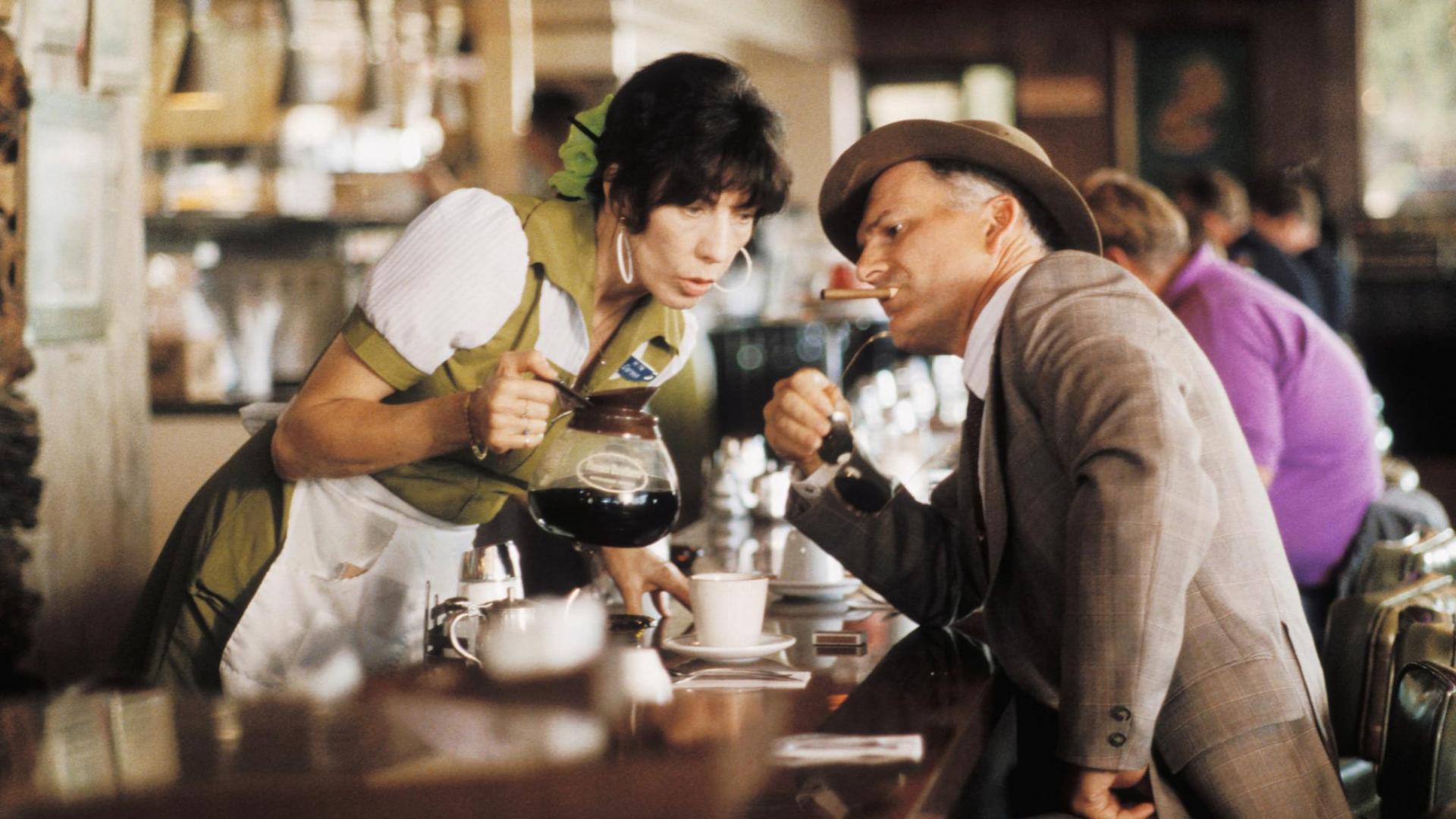
Ultimately, every film needs to have a story worth telling and characters worth watching, and no amount of admirable filmmaking or even a star-studded cast can fill that need. A lot happens in Short Cuts but also not nearly enough. Based on the short stories and poems of Raymond Carver, the story is an expansive snapshot of numerous lives throughout the Los Angeles area, played by a who’s who of recognizable ’90s faces. There’s Robert Downey, Jr., as a smarmy makeup artist, Lily Tomlin as an exasperated waitress, Andie MacDowell as a young mother, Matthew Modine as a doctor, Julianne Moore as his artistic wife, Frances McDormand as Peter Gallagher’s philandering wife, Tim Robbins as her cop lover, Jack Lemmon as Bruce Davison’s estranged father, and many more, including Tom Waits, Anne Archer, Lori Singer, Chris Penn, Jennifer Jason Leigh, Fred Ward, and Lili Taylor. In light of the passing of Alex Trebek (whom I still grieve, as a lifelong Jeopardy fan), I was also delighted to see him in a brief cameo.

It truly is an astounding cast, all of whom are wholly believable in their roles. It’s just a shame that most of them play crude, vindictive jerks with the morals of cats. In the world of this film, infidelity is more common than marriage, and empathy is rare, all of which carries enough realism to lower one’s opinion of society in general. Beyond this, Altman’s film seems queasily enamored of sex and female nudity, from Leigh’s graphic phone sex calls to an admittedly well-acted lovers’ quarrel which would have been less distracting had Julianne Moore been wearing more than just a top. Of the 22 main characters, I’d say there are only two that remain sympathetic throughout, meaning most of the 3-hour film focuses on the others, and I believe that several of the side stories could have been trimmed to reduce the excessive runtime.

See the source image

All that is not to say Short Cuts is without merit. I was actually impressed with how balanced the treatment of the characters was, switching between them often enough to give almost everyone in the expansive ensemble a memorable moment or two. Yet the jumping around between stories also doesn’t get overly confusing, and the artful direction weaves the stories together with subtle but identifiable connections, which is an impressive feat. However, the film ultimately falls into the “That’s It?” category, with the credits rolling before most of the intersecting storylines get even a semblance of closure. After over 3 hours with people I would not care to know personally, the bathetic conclusion settles for its status as a collage of experiences rather than offering any clear point. I realize everyday vignettes can be very compelling and endearing and don’t necessarily need an overarching purpose, but I suppose my distaste for much of the film’s content has soured my opinion of its storytelling as well. Unless the plot warrants ambiguity, I like my stories to have endings, not vague implications.

Rank: Dishonorable Mention

© 2021 S.G. Liput
717 Followers and Counting

2020 Blindspot Pick #10: Primer (2004)

18 Thursday Feb 2021

Posted by sgliput in Blindspot, Movies, Poetry, Reviews, Writing

≈ 6 Comments

Tags

Drama, Sci-fi

See the source image

Time is a string,
A straight line following
Every inch with the next,
And no one expects
That line to turn back
In its infinite track
Or be wrinkled or folded
Or otherwise molded
To anything but
A straight line, never cut,
For if that occurs,
Men are mere amateurs
In the Pandora’s boxes
Of time paradoxes,
And no one is certain
What’s under the curtain,
The dreadful reveal
Of sci-fi-made-real.
_________________________

Rating: PG-13 (though Netflix shows it as R, which is odd since there is nothing objectionable)

I suppose I never appreciated how much free time I possessed when I had just school or just work taking up the bulk of my day. Now that I have both, it seems like everything else has been sliding to a lower priority level, including this blog sadly. Nevertheless, I have not forgotten it! Speaking of time, it’s time now to check another entry from my Blindspot list, a film about time travel that has earned a reputation for being intractably complex. Indeed, Primer is the kind of movie, like last year’s Tenet, that doesn’t just benefit from but needs a diagram or outside explanation to fully grasp it, which makes it a hard sell for people who enjoy understanding what they watch.

Made on an extreme shoestring budget (about $7000), Primer is not your typical time travel flick; there are no flashes of lightning or fancy special effects to adorn its bare-bones tale of accidental scientific discovery. Its two main characters, Abe and Aaron, are a couple of moonlighting engineers who share resources with other small-time inventors; there’s no attempt at making them personable for the audience or even translating the scientific jargon that makes up much of the dialogue. A weight-reduction experiment somehow results in an unusual small-scale time loop, and the two inventors realize they’ve stumbled onto something big when its application for humans becomes clear.

See the source image

Many a time travel movie tries to pass itself off as “realistic,” even though the paradoxes involved with the ever-cool concept make it inherently not; Primer attempts this through its low-key, unglamorous style and how it injects actual science into the dialogue. I liked the idea of discovering time travel by accident, similar to the excellent anime/game Steins;Gate, and I was preparing my thinking cap as the characters figured out how to make it work. The concept of entering a box where time is reversed and exiting at a point in the past, keeping yourself isolated beforehand to avoid interacting with your double, made sense for the most part, and I started thinking, “This isn’t so complex.” And then the plot went off the deep end….

I have read the description and rewatched parts of the movie to try to wrap my head around the story, and I can honestly say that I believe I understand most of it (which is more than I can say for Tenet), but not without a good amount of mental effort. I don’t mind films that make you think, but I find it a bit annoying when a film throws a wrench in the plot and doesn’t even care to give the audience a shred of time to decipher its meaning. There’s a running narration, but the language used seems intentionally vague, and certain plot points are dropped without any explanation whatsoever. And this was on purpose, according to Shane Carruth, who served as director, actor (as Aaron), composer, writer, and editor, a true auteur like Jamin Winans. Carruth wanted this sense of bewilderment to stress the confusion of time travel for the characters, and he succeeded, though whether that is a good thing is debatable.

See the source image

Primer is a puzzle-box movie if ever there was one. The puzzle is the reason for its existence, with things like character development or eye-catching visuals pushed to the background. I enjoyed that moment of “eureka, I think I get it,” which only happened after the credits rolled a second time, but the intentional opacity of the plot certainly doesn’t equate to entertainment value. Whether the appeal of the former outweighs the latter is entirely subjective and dependent on each person’s capacity for wondering what the heck is going on. I would agree that Primer is a required watch for anyone seeking a comprehensive view of time travel in cinema, but I don’t consider it a positive that the main reason to see it again is to gain a semblance of understanding as to what you just saw.

Best line: (Aaron, to Abe) “Man, are you hungry? I haven’t eaten since later this afternoon.”

Rank:  Dishonorable Mention (That seems harsh, but I doubt I’ll watch it again.)

© 2021 S.G. Liput
716 Followers and Counting
2020 Blindspot Pick #9: Make Way for Tomorrow (1937)

02 Tuesday Feb 2021

Posted by sgliput in Blindspot, Movies, Poetry, Reviews, Writing

≈ 3 Comments

Tags

Drama, Triple A

See the source image

“Honor thy father and mother.”
How simple and subtle a rule!
Our methods may vary
And end up contrary
To what we expected in school.

Our strained obligations
To past generations
Are wholesome but no longer cool.

Our lives take priority
Over seniority
Lest we be labeled a fool.

Good children are rarest
Where they be embarrassed
By wrinkles, dementia, and drool.

A list of excuses
Can equal abuses,
And lack of concern can be cruel.
_______________________

MPA rating:  Approved (easy G, though likely not of interest to kids)

Continuing with my 2020 Blindspots has still been subject to delays, but I’ll finish them one way or another, even if it means keeping my reviews short. It’s time now for the oldest entry on the list, 1937’s Make Way for Tomorrow, which seems to have earned the distinction of being a desperately sad drama long before more modern tearjerkers stained viewers’ cheeks and made this unsung classic fade from cinematic memory. Boasting a 100% score on Rotten Tomatoes yet failing to earn a single Oscar nomination, it’s one of those films that leaves you surprised that it’s not more well-known.

See the source image

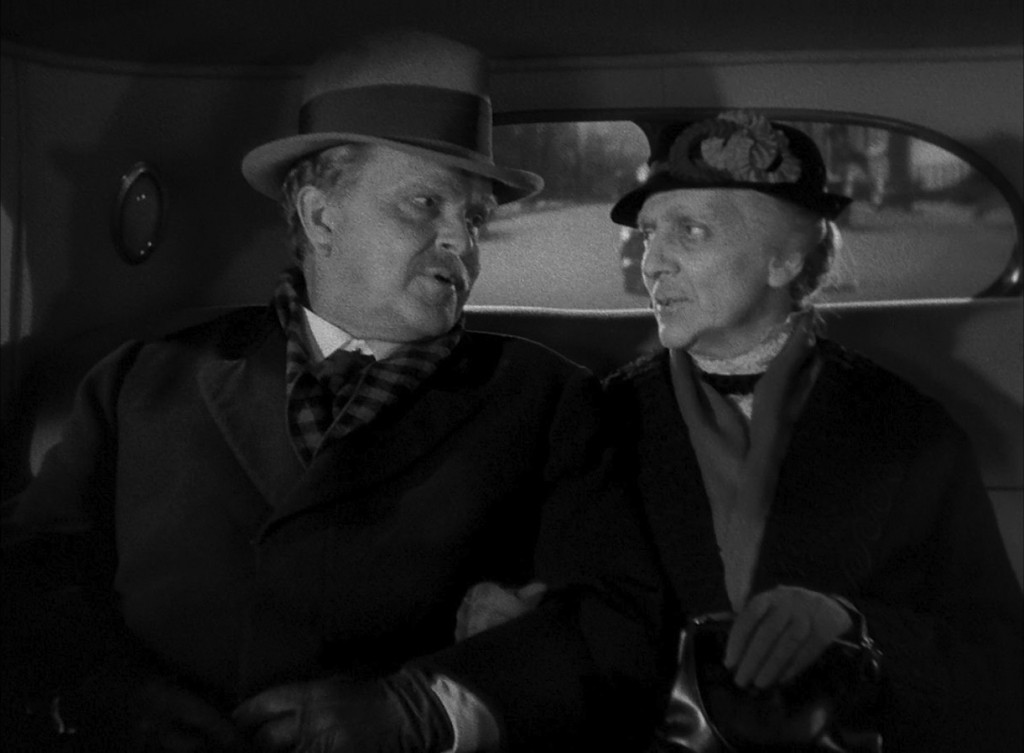
Make Way for Tomorrow qualifies as what I call a Triple A movie, one that is All About the Acting. The performances are nuanced and subtle, a far cry from the histrionics associated with old Hollywood, with stars Victor Moore and Beulah Bondi in top form. The pair, both significantly aged up with makeup made seamless by the black-and-white format, play the elderly Bark and Lucy Cooper, who are forced out of their home by the bank and must rely on the goodwill of their five grown children to board them. No one can take both parents, so they must live apart; as they wear on the nerves of the kids and their families, everyone wishes in vain for some better arrangement.

Based on a play that was based on a novel, the script of Make Way for Tomorrow is notable for its realism and pervasive sense of empathy. It’s the kind of situation that many families have no doubt had to endure, and you can’t entirely blame anyone for their frustration with it. One daughter (Elisabeth Risdon) who takes in Pa Cooper seems needlessly harsh and impatient, but Pa Cooper also acts opinionated and stubborn as he misses his wife. We can all say how we would act in such a situation, but I expect most people would find they have less patience than they think they do.

See the source image

Ma Cooper’s motherly idiosyncrasies in the home of her son George (Thomas Mitchell) brought to mind the more humorous aggravation from Doris Roberts’ Marie on Everybody Loves Raymond, and it’s a testament to the authenticity of the characters that such universal circumstances can inspire both comedy and drama. Bondi as Ma Cooper is the real heart of the film, and her last selfless scene with her son is a punch to the heartstrings. (It’s interesting to note that she plays Thomas Mitchell’s mother here, while she would play his sister nine years later in It’s a Wonderful Life.) By the end, I’ll admit the film does seem longer than its relatively short 91-minute runtime, but Moore and Bondi fill their few scenes together with the comfortable chemistry of a couple whose love has persisted through decades, which only makes the pitiable situation sadder. The director, Leo McCarey, actually won the Best Director Academy Award that year for The Awful Truth but said on stage that he thought they “gave it to [him] for the wrong picture”; I haven’t seen The Awful Truth myself, but I tend to think he was right.

Best line: (Lucy Cooper, quoting a poem, the source of which I’m still unsure but it deserves a place on my Poems in Movies list)

A man and a maid stood hand in hand
Bound by a tiny wedding band.
Before them lay the uncertain years
That promised joy and maybe tears.
“Is she afraid?” thought the man of the maid.

“Darling,” he said in a tender voice,
“Tell me. Do you regret your choice?
We know not where the road may wind,
Or what strange byways we may find.
Are you afraid?” said the man to the maid.

She raised her eyes and spoke at last.
“My dear,” she said, “the die is cast.
The vows have been spoken. The rice has been thrown.
Into the future we’ll travel alone.
With you,” said the maid, “I’m not afraid.”

Rank:  List Runner-Up

© 2021 S.G. Liput
714 Followers and Counting
2020 Blindspot Pick #8: The Grand Budapest Hotel (2014)

18 Monday Jan 2021

Posted by sgliput in Blindspot, Movies, Poetry, Reviews, Writing

≈ Leave a comment

Tags

Comedy, Drama

See the source image

It’s really a shame that mankind at its worst
Is seen more conspicuously than its best,
Like children who cry getting tended and cursed
By those who decide children all are a pest,
While one quiet child can’t hope to reverse
The hostile impressions ingrained by the rest.

There still are some saints that can shine over sin,
Their kindnesses somehow worth more in our eyes.
But how can we drown out the negative din
If so few are willing to re-humanize?
It doesn’t much matter who’ll lose and who’ll win
If basic civility meets its demise.
________________________

MPA rating:  R (for profanity, a couple violent scenes, and a few explicit paintings)

“Better late than never” will be my catchphrase for the next several weeks, since school and life in general have put me so far behind my desired posting schedule. Heck, I’m only ¾ of the way through last year’s Blindspots. But here at last I am continuing the list with Wes Anderson’s most decorated film, the ornately madcap farce The Grand Budapest Hotel.

See the source image

I’m still not sure what my opinion of Wes Anderson is in general. I’ve seen Rushmore, Isle of Dogs, and Fantastic Mr. Fox before, and I can’t say I loved or hated any of them. I enjoy his eccentric and fastidious production design to a certain extent but mainly as unique oddities, admiring his work from the outside but never feeling drawn in by the world of the story. The Grand Budapest Hotel probably comes the closest to achieving that, thanks to the well-drawn characters and how Anderson’s ever-present drollery gives way to pathos by the end. It’s an odd set-up, the plot being portrayed as a reading of a recollection of a conversation of a memory, jumping back in time with each story layer, but the way it breeds a sense of bygone nostalgia is rather remarkable.

Although this movie mainly won Oscars in non-acting categories (Best Production Design, Score, Costume Design, Makeup), one area in which Anderson’s films excel is casting. The Grand Budapest Hotel is chock full of recognizable stars, sometimes as mere cameos, including frequent collaborators like Jeff Goldblum, Bill Murray, Edward Norton, Jason Schwartzman, Owen Wilson, and Willem Dafoe. Foremost in the cast is Ralph Fiennes as the titular hotel’s esteemed concierge Monsieur Gustave H., and his portrayal of the demanding dandy is surprisingly layered as he takes under his wing the hotel’s new lobby boy Zero (Tony Revolori, a.k.a. Flash Thompson in the MCU Spider-Man films). Revolori gives a marvelous debut performance opposite Fiennes, and their relationship grows sweeter and more poignant with time. What at first seems like an alpine comedy of manners takes turns morphing into a murder mystery, a prison break film, and a black comedy, somehow surviving these tonal shifts due to Anderson’s unmistakable stamp of ownership.

See the source image

At times it felt as if Wes Anderson the auteur was tossing in elements he had always wanted to film, such as the extended jailbreak sequence, which goes on too long but seemed like it was fun to implement. At another point, there’s an artfully shot scene of a man being stalked through dark interiors which felt directly inspired by Hitchcock. I do wish that Anderson had excised some of the more mature elements, since they seemed contrary to the film’s overall old-world charm and refreshing eloquence of speech. Yet there is much to enjoy and commend about The Grand Budapest Hotel, from the expansive ensemble to the picturesque locations and cleverly articulate script to Gustave’s gospel of refined gentility and moments of unexpected humor that warrant a chuckle if not a laugh out loud. As with the director’s style in general, the fragmented narrative may not be to everyone’s taste, but I would say The Grand Budapest Hotel is Wes Anderson at his best.

Best line: (Mr. Moustafa, of Gustave H.) “There are still faint glimmers of civilization left in this barbaric slaughterhouse that was once known as humanity… He was one of them. What more is there to say?”

Rank:  List Runner-Up

© 2021 S.G. Liput
711 Followers and Counting
2020 Blindspot Pick #7: Heathers (1989)

31 Thursday Dec 2020

Posted by sgliput in Blindspot, Movies, Poetry, Reviews, Writing

≈ Leave a comment

Tags

Comedy, Drama, Thriller

See the source image

The more I see in movies
Of a high school student’s woes,
The tricks and cliques and politics,
The mockery of clothes,
The favoritism, criticism,
Narcissism, hedonism,
Overwhelming pessimism
All the films have shown…
I feel more blessed for all the pros
Of being schooled at home.
_____________________

MPA rating:  R (for frequent profanity and occasional violence)

Well, it looks like my Blindspot list for 2020 didn’t go as expected, along with almost everything else about 2020. I may have only gotten to #7 out of the initial 12 Blindspots, but I’ll do my best to knock out the last few ASAP before getting to a new list for 2021. Still, I wanted to get one more Blindspot pick out of the way this year, which has also been the most accessible one all year. (It’s on YouTube in its entirety.) I’ve been hesitant to watch Heathers, though; I’ve listened to and greatly enjoyed the soundtrack to Heathers: The Musical, and I just wasn’t sure if the original film would measure up to my expectations, minus the show tunes. I’d say it did meet them, but I can’t help but have mixed feelings.

See the source image

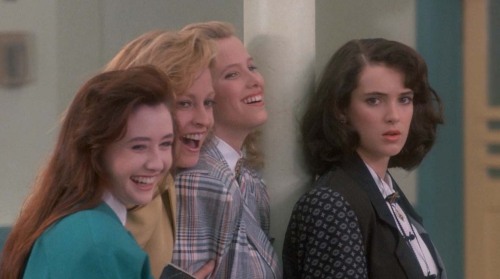
Heathers follows Veronica Sawyer (Winona Ryder), a half-willing member of the feared/admired high school clique known as the Heathers: Heather McNamara (Lisanne Falk), Heather Duke (Shannon Doherty), and the queen of mean-girl stereotypes Heather Chandler (Kim Walker). Bristling under the thumb of Heather Chandler, Veronica grows close to classmate J.D. (Christian Slater), whose ideas of retaliating against the popular kids become more and more psychotic. Repressed teens may often wish their bullies were dead, as Veronica does, but J.D. is willing to grant such wishes.

Being familiar with the musical meant that very little about the plot of Heathers surprised me, though certain characters were combined and events shuffled around as needed for the stage adaptation. I was mainly surprised that the film already began with Veronica as a member of the Heathers, whereas the musical takes a little more time portraying her initiation. However, where both versions excel is black comedy, which is a very touchy genre for me. I can appreciate something like Beetlejuice, which also starred Winona Ryder and Glenn Shadix the previous year, but such films can also just come off as mean-spirited or in bad taste, which I don’t find entertaining. While I knew going in that it’s not exactly High School Musical, Heathers threatens to be in the latter category with its frequent profanity and making light of teenage suicide and homosexuality. Yet the film has some surprising depth to its satire and manages to weave some insightful themes into its droll plot: the stress of not liking your own friends, the eagerness with which the powerless can exploit newfound influence, the sensationalism that dark subjects impart in those with good intentions and no solution, and the difference that empathy or its absence can have on someone. Oh, and of course the signs that your boyfriend might be a psychopath.

See the source image

One ingredient I can say I liked was Winona Ryder, on whom I have something of a celebrity crush. She perfectly originates the sarcastic frustration of Veronica and evokes a sense of growth as she seeks to atone for the evil influence of Heather Chandler and J.D. Slater is also an effective bad boy doing his best Jack Nicholson impression, and the rest of the cast excel at their high school clichés, though it’s disturbing that two cast members later died in ways that the film foreshadowed. Another aspect worth commendation is that unique confidence of style that certain ‘80s films had, regardless of director, as if they knew they would become iconic eventually. Ferris Bueller’s Day Off and Say Anything come to mind, and Heathers likewise feels like the kind of film that knew exactly what it wanted to be, which is rare for high school movies these days that often just try to imitate what came before. Maybe my exposure to the musical accentuated that, as I recognized the origins of songs like “Big Fun” and “Our Love Is God.” So, although my feelings remain mixed on content, I largely enjoyed Heathers as a paragon of dark high school humor, mainly because its ultimate goal is empathy, something that we could use a lot more of nowadays.

Best line: (Veronica) “All we want is to be treated like human beings, not to be experimented on like guinea pigs or patronized like bunny rabbits.”
(Veronica’s dad) “I don’t patronize bunny rabbits.”
(Veronica’s mom) “Treated like human beings? Is that what you said, little Miss Voice-of-a-Generation? Just how do you think adults act with other adults? You think it’s all just a game of doubles tennis? When teenagers complain that they want to be treated like human beings, it’s usually because they are being treated like human beings.”

Rank:  List Runner-Up

© 2020 S.G. Liput
708 Followers and Counting

Happy New Year, everybody!

← Older posts
Newer posts →

Recent Posts

  • We Didn’t Start 2025 (Recap)
  • NaPoWriMo 2025 Recap (Finally)
  • Sonic the Hedgehog 3 (2024)
  • It Happened One Night (1934)
  • Spellbound (2024)

Recent Comments

associatesofshellymann's avatarassociatesofshellyma… on My Top Twelve La La La So…
Kit's avatarKit Nichols on Bonnie and Clyde (1967)
lifelessons's avatarlifelessons on Look Back (2024)
Carol Jackson's avatarCarol Jackson on The Thief of Bagdad (1940…
Stephen's avatarStephen on Love Story (1970)

Archives

  • January 2026
  • December 2025
  • May 2025
  • April 2025
  • March 2025
  • February 2025
  • January 2025
  • December 2024
  • May 2024
  • April 2024
  • March 2024
  • February 2024
  • January 2024
  • December 2023
  • November 2023
  • October 2023
  • September 2023
  • July 2023
  • June 2023
  • May 2023
  • April 2023
  • March 2023
  • February 2023
  • January 2023
  • December 2022
  • November 2022
  • October 2022
  • September 2022
  • August 2022
  • July 2022
  • June 2022
  • May 2022
  • April 2022
  • March 2022
  • February 2022
  • January 2022
  • December 2021
  • November 2021
  • October 2021
  • September 2021
  • August 2021
  • July 2021
  • June 2021
  • May 2021
  • April 2021
  • March 2021
  • February 2021
  • January 2021
  • December 2020
  • November 2020
  • October 2020
  • September 2020
  • August 2020
  • July 2020
  • June 2020
  • May 2020
  • April 2020
  • March 2020
  • February 2020
  • January 2020
  • December 2019
  • November 2019
  • October 2019
  • September 2019
  • August 2019
  • July 2019
  • June 2019
  • May 2019
  • April 2019
  • March 2019
  • February 2019
  • January 2019
  • December 2018
  • November 2018
  • October 2018
  • September 2018
  • August 2018
  • July 2018
  • June 2018
  • May 2018
  • April 2018
  • March 2018
  • February 2018
  • January 2018
  • December 2017
  • November 2017
  • October 2017
  • September 2017
  • August 2017
  • July 2017
  • June 2017
  • May 2017
  • April 2017
  • March 2017
  • February 2017
  • January 2017
  • December 2016
  • November 2016
  • October 2016
  • September 2016
  • August 2016
  • July 2016
  • June 2016
  • May 2016
  • April 2016
  • March 2016
  • February 2016
  • January 2016
  • December 2015
  • November 2015
  • October 2015
  • September 2015
  • August 2015
  • July 2015
  • June 2015
  • May 2015
  • April 2015
  • March 2015
  • February 2015
  • January 2015
  • December 2014
  • November 2014
  • October 2014
  • September 2014
  • August 2014
  • July 2014
  • June 2014
  • May 2014
  • April 2014
  • March 2014
  • February 2014
  • January 2014
  • December 2013

Categories

  • Blindspot
  • Blogathon
  • Christian
  • Movies
  • Music
  • NaPoWriMo
  • Poetry
  • Reviews
  • TV
  • Writing

Meta

  • Create account
  • Log in
  • Entries feed
  • Comments feed
  • WordPress.com

Recent Posts

  • We Didn’t Start 2025 (Recap)
  • NaPoWriMo 2025 Recap (Finally)
  • Sonic the Hedgehog 3 (2024)
  • It Happened One Night (1934)
  • Spellbound (2024)

Recent Comments

associatesofshellymann's avatarassociatesofshellyma… on My Top Twelve La La La So…
Kit's avatarKit Nichols on Bonnie and Clyde (1967)
lifelessons's avatarlifelessons on Look Back (2024)
Carol Jackson's avatarCarol Jackson on The Thief of Bagdad (1940…
Stephen's avatarStephen on Love Story (1970)

Archives

  • January 2026
  • December 2025
  • May 2025
  • April 2025
  • March 2025
  • February 2025
  • January 2025
  • December 2024
  • May 2024
  • April 2024
  • March 2024
  • February 2024
  • January 2024
  • December 2023
  • November 2023
  • October 2023
  • September 2023
  • July 2023
  • June 2023
  • May 2023
  • April 2023
  • March 2023
  • February 2023
  • January 2023
  • December 2022
  • November 2022
  • October 2022
  • September 2022
  • August 2022
  • July 2022
  • June 2022
  • May 2022
  • April 2022
  • March 2022
  • February 2022
  • January 2022
  • December 2021
  • November 2021
  • October 2021
  • September 2021
  • August 2021
  • July 2021
  • June 2021
  • May 2021
  • April 2021
  • March 2021
  • February 2021
  • January 2021
  • December 2020
  • November 2020
  • October 2020
  • September 2020
  • August 2020
  • July 2020
  • June 2020
  • May 2020
  • April 2020
  • March 2020
  • February 2020
  • January 2020
  • December 2019
  • November 2019
  • October 2019
  • September 2019
  • August 2019
  • July 2019
  • June 2019
  • May 2019
  • April 2019
  • March 2019
  • February 2019
  • January 2019
  • December 2018
  • November 2018
  • October 2018
  • September 2018
  • August 2018
  • July 2018
  • June 2018
  • May 2018
  • April 2018
  • March 2018
  • February 2018
  • January 2018
  • December 2017
  • November 2017
  • October 2017
  • September 2017
  • August 2017
  • July 2017
  • June 2017
  • May 2017
  • April 2017
  • March 2017
  • February 2017
  • January 2017
  • December 2016
  • November 2016
  • October 2016
  • September 2016
  • August 2016
  • July 2016
  • June 2016
  • May 2016
  • April 2016
  • March 2016
  • February 2016
  • January 2016
  • December 2015
  • November 2015
  • October 2015
  • September 2015
  • August 2015
  • July 2015
  • June 2015
  • May 2015
  • April 2015
  • March 2015
  • February 2015
  • January 2015
  • December 2014
  • November 2014
  • October 2014
  • September 2014
  • August 2014
  • July 2014
  • June 2014
  • May 2014
  • April 2014
  • March 2014
  • February 2014
  • January 2014
  • December 2013

Categories

  • Blindspot
  • Blogathon
  • Christian
  • Movies
  • Music
  • NaPoWriMo
  • Poetry
  • Reviews
  • TV
  • Writing

Meta

  • Create account
  • Log in
  • Entries feed
  • Comments feed
  • WordPress.com

Blog at WordPress.com.

Is this your new site? Log in to activate admin features and dismiss this message
Log In
  • Subscribe Subscribed
    • Rhyme and Reason
    • Join 814 other subscribers
    • Already have a WordPress.com account? Log in now.
    • Rhyme and Reason
    • Subscribe Subscribed
    • Sign up
    • Log in
    • Report this content
    • View site in Reader
    • Manage subscriptions
    • Collapse this bar