• Home
  • About Me
  • The List
  • THE LIST (2016 Update)
  • THE LIST (2017 Update)
  • THE LIST (2018 Update)
  • THE LIST (2019 Update)
  • THE LIST (2020 Update)
  • THE LIST (2021 Update)
  • THE LIST (2022 Update)
  • Top Twelves and More
  • The End Credits Song Hall of Fame

Rhyme and Reason

~ Poetry Meets Film Reviews

Rhyme and Reason

Monthly Archives: April 2015

Cross Creek (1983)

22 Wednesday Apr 2015

Posted by sgliput in Movies, NaPoWriMo, Poetry, Reviews, Writing

≈ 2 Comments

Tags

Drama, Romance


Cities are a dying breed,
Though those who live in them know not.
They’re full of people, noise, and need,
Yet lack the treasures man forgot,
The joys of wind and sprouting seed
And peace of mind that can’t be bought.
 
Here in Cross Creek, my writing wakes,
Surrounded by the Spanish moss,
By sylvan streams that link the lakes
And tiny boats to get across.
I moved here for the silence’ sakes;
The lack of clamor is no loss.
 
My neighbors are a different folk;
Like me, they tend to stay apart,
To work beneath the ancient oak
And never reckon to depart.
We hear the frogs in chorus croak
And know the creatures’ songs by heart.
 
Cities are a dying breed,
Though some say nature will go first.
Yet renters ever will secede
To find the home for which they thirst.
Cross Creek and peace will thrive indeed
When all the cities have dispersed.
__________________
 

(In honor of Earth Day, today’s NaPoWriMo prompt, and Marjorie Kinnan Rawlings’ distaste for cities, the poem today is a pastoral, focusing on nature and a bucolic setting, of which Cross Creek has no shortage.)

Cross Creek could be considered a VC Pick, since she loves this film dearly, but I’ve come to enjoy it nearly as much. It should have made my original list, but I couldn’t remember it well enough at the time. Based on the memoir of Marjorie Kinnan Rawlings, it stars Mary Steenburgen as the strong-willed but reclusive author who in 1928 bought a dilapidated house and orange grove in the Florida boondocks. Having lived in central Florida myself, I recognize the film as a tribute to the Florida “cracker” lifestyle, the rural frontiersmen who made a home out of the balmy wilderness. (I even remember taking field trips to Cracker Country, a living history museum that promotes knowledge of their early culture.) Rawlings comes to Cross Creek in search of silence to write but finds inspiration and love (with Peter Coyote!) in this unexpectedly homey landscape.

Watching the film again, it reminded me of another film about a famous divorced female writer who moves to a steamy countryside, falls in love with one of the first people she meets there, grows a tropical crop, bonds with the natives, and finds the inspiration for her best-known work, that film being 1985’s Out of Africa. Yet Cross Creek was released two years earlier and is less epic and more folksy than the later film. Instead of being a remake of Rawlings’ The Yearling, it offers a different yet recognizable sideplot involving the relationship of a child (a girl instead of the boy in the book) and a fawn (one of the most adorable things on four legs).

Made with the assistance of Rawlings’ husband Norton Baskin (who has a cameo toward the beginning), Cross Creek is charming and cozy, peaceful but tragic, and very well-acted. Rip Torn as Rawlings’ backwoods neighbor and Alfre Woodard as her devoted maid both received Oscar nominations, as did the costume design and the score (which is also slightly reminiscent of Out of Africa). Despite these honors, it’s a film that seems to have been forgotten for the most part, which is a shame. It’s most pertinent message for me as a writer is to write what you know, what you’re passionate about, rather than what is simply popular. Despite some awkward scenes and a conclusion that could have been strengthened by some added information, Cross Creek is a river well worth traveling down.

Best line: (Marjorie Rawlings, after a drunken night) “That is just the way I am. I go along quietly for a while and then out of the clear blue sky, I don’t know what happens to me, I just pick up a gun, and I shoot whatever makes me angry. I’m so afraid one day it just might be a person.”

 
Rank: List-Worthy
 

© 2015 S. G. Liput

297 Followers and Counting

Rebecca (1940)

21 Tuesday Apr 2015

Posted by sgliput in Movies, NaPoWriMo, Poetry, Reviews, Writing

≈ 2 Comments

Tags

Drama, Hitchcock, Romance


Rebecca is dead, but her room is the same.
The servants still miss her and whisper her name.
Her husband is grieving, and tries to move on,
But Mrs. de Winter is not fully gone.
 
Her secrets remain, as do Mr. de Winter’s,
Secrets that torture him daily like splinters.
His new wife is innocent, nervous, and shy;
She shouldn’t learn them, nor understand why.
 
But secrets have habits of being found out,
Casting suspicion and panic and doubt.
Rebecca is dead, Mrs. Danvers knows well,
And yet Manderley is still under her spell.
________________
 

After seeing Hitchcock’s last great film based off a Daphne du Maurier story (The Birds), I thought I’d see his first great American film based off a Daphne du Maurier story, Rebecca. A Gothic tale with distinct similarities to Jane Eyre, Rebecca won the 1940 Academy Award for Best Picture and was indeed far better than a certain disliked competitor (ahem, The Philadelphia Story.)

Laurence Olivier is both dashing and brusque as Maxim de Winter, a widower haunted by the loss of his first wife Rebecca. When he runs into the lovely Joan Fontaine, her naiveté and complete contrast to Rebecca attract him, and a somewhat comedic whirlwind romance makes the unnamed heroine the second Mrs. de Winter. When they return to de Winter’s sprawling estate of Manderley, his new bride begins to feel more and more uncomfortable as semi-famous villain Mrs. Danvers psychologically torments her with unfortunate comparisons. By the end, the narrative takes some unexpected twists that either improve or destroy certain characters.

In contrast to many old Gothic films (like Merle Oberon’s laughable scenes in 1939’s Wuthering Heights), Rebecca avoids old-fashioned histrionics and provides some genuinely great performances from Olivier, Fontaine, and Dame Judith Anderson as Mrs. Danvers, the black-clothed matron with an unhealthy fascination with her late employer. (My VC became frustrated with Fontaine’s constant timidity, but I thought it was handled well, considering her age and limited experience. Her apprehensions are much like a child’s, like when she accidentally breaks a statue and hides it, only to feel and look foolish when the truth comes out.) The film transitions thrice, first from an unexpected romance to a dark psychological mystery and then to a whodunit in which the audience actually hopes the investigation is unsuccessful. That’s no mean feat, and Hitchcock’s direction creates just the right aura of intrigue, meant to fascinate and frighten both the protagonist and the audience. While it owes much to past classics of the genre and the ending is a bit abrupt, Rebecca promised that America could expect some great things from Alfred Hitchcock.

Best line: (Mrs. Van Hopper, the heroine’s employer) “Most girls would give their eyes for the chance to see Monte [Carlo]!”   (Maxim de Winter) “Wouldn’t that rather defeat the purpose?”

 
Rank: List Runner-Up
 

© 2015 S. G. Liput

297 Followers and Counting

The Truman Show (1998)

20 Monday Apr 2015

Posted by sgliput in Movies, NaPoWriMo, Poetry, Reviews, Writing

≈ 2 Comments

Tags

Comedy, Drama, Sci-fi


Did you ever feel that you were being watched,
That someone saw each time you won or botched?
No one’s watching; don’t despair
(At least as far as I’m aware),
Yet Truman Burbank’s on TV,
Living life for all to see,
Quite contented in his dome,
Which he doesn’t know is home.
 
He has fans around the world who watch him daily
As he greets Seahaven every morning gaily.
No reality show’s greater,
Thanks to Christoff, its creator.
Due to Christoff’s shrewd promotion,
Truman’s frightened of the ocean,
So he never leaves his isle,
Though he’s tempted for a while.
 
Truman’s been content with blinders since his youth,
But he starts to have an inkling of the truth.
From a star that might be fake
To a radio mistake
To endorsements from his wife,
Things revolve around his life,
Such that he begins to wonder
What conspiracy he’s under.
 
He attempts to leave his quaint, idyllic course
But is urged to linger, even if by force.
When at last he gets away,
Sailing off across the bay,
Christoff tries to be his guide
From the unknown world outside.
Truman doesn’t want ideal;
He would rather have what’s real.
________________
 

(I had fully intended for The Truman Show to be part of my original list, and I even wrote the review last year. Yet, in looking over my archives, I found that I apparently never posted it. I don’t know how I could have missed it, but it’s time to correct that oversight. Better late than never, right?)

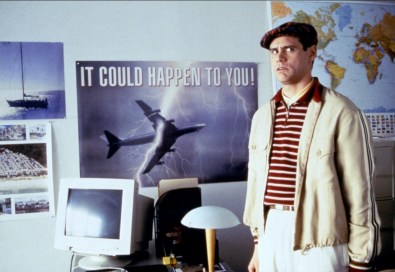
Who would have thought from films like Ace Ventura: Pet Detective, The Mask, and Dumb and Dumber that Jim Carrey could muster such a subtle, earnest performance? The Truman Show is without a doubt his finest film. I want to call it one of the most original stories of the last twenty years, but a little research revealed that it did have some forerunners, particularly a similar 1989 Twilight Zone episode entitled “Special Service.” While that episode had some perceptive themes, such as how some people are famous just because they’re on television (Snooki, Housewives, etc.), the movie improved on those themes, creating a film that both entertains and challenges our sense of paranoia and privacy. It’s also funny and pleasantly intelligent, shrewdly depicting certain rules of Truman’s world before they’re even fully explained.

Jim Carrey gets a chance to intermittently employ his trademark goofy grin and mannerisms, but he proves he can handle weightier material as he slowly discovers all is not right in his world. One of his best scenes occurs when his suspicions are first aroused, and accompanied by a mood-setting score, he wordlessly changes up his routine just to witness what will happen. Oscar nominee Ed Harris as show creator Christoff isn’t wholly unlikable as the overlord of Truman’s life, and his few scenes make it clear that he does care for Truman in a twisted way and believes that this charade is somehow in his subject’s best interest. Of the other actors, Noah Emmerich offers the most convincing deception, effortlessly earning Truman’s trust while giving little indication that he’s just an actor.

As a Christian, I might have taken issue with The Truman Show’s symbolic renunciation of its God stand-in, except that Christoff is just a stand-in. He’s a pretender, believing himself benevolent while using Truman for ratings and engaging often ridiculously obvious methods to keep him from discovering the truth. It’s a thought-provoking notion that all of our situations are pre-ordained and many groups have latched onto such concepts, but I believe God allows the multitude of human beings on this planet to choose their actions. Though He knows what will happen, He doesn’t interfere in the ways Christoff does but lets us choose, sometimes to our detriment. In addition, there’s no sacrifice on Christoff’s part, no desire for a real relationship, as God desires. While the filmmakers most likely intended Truman’s rejection of Christoff to mirror a rejection of Christ, Christoff’s actions are ultimately not God-like enough to warrant the comparison, unless you count watching from the sky. The film does challenge one’s view of God but not in an insulting or dogmatic way. I choose to perceive it as a critique, not of God, but of authoritarian frauds, posers, and maybe even governmental control freaks.

The Truman Show continues to be insightful and socially relevant in our fake reality-obsessed world and stands as Jim Carrey’s most Oscar-worthy performance. It continues to have an influence on modern films like Bolt and The Hunger Games and reinstated fears of surveillance to a post-1984 world. If only Jim Carrey would seek out more roles like this….

Best line: (Truman, as a kid in school) “I’d like to be an explorer, like the great Magellan.”  (his teacher, trying to convince him to not want to leave) “Oh, you’re too late. There’s really nothing left to explore.”

 
Rank: List-Worthy (should have been #100)
 

© 2015 S. G. Liput

296 Followers and Counting

The Ultimate Life (2013)

19 Sunday Apr 2015

Posted by sgliput in Movies, NaPoWriMo, Poetry, Reviews, Writing

≈ 2 Comments

Tags

Drama, Family


A man is sadly at his least wise
When he prefers work above his own loveliest prize.
 
Wisdom can spring from pain or the past;
How you and I choose is our generation’s contrast.
 
Journals and annals have much to tell:
Listen and look to find in them what lessons may dwell.
 
Dreams are perhaps best when advertised:
Speaking them may render them more potent when realized.
 
Regret grows when foolish sleepers wake;
Contentment grows from dodging someone else’s mistake.
___________________
 

(Today’s NaPoWriMo prompt is for a landay, a 22-syllable couplet that exists as an oral poetic form among women in Afghanistan. Above, I strung several together to be taken individually or together as lessons drawn from the film.)

I’ve always loved the 2006 film The Ultimate Gift, a clean-cut drama that plays like a high-quality Hallmark film but won me over with its moral wake-up call and some fine performances from Abigail Breslin and James Garner. I had heard it had been given a television sequel, but just now got around to seeing it. Directed by Michael Landon, Jr., The Ultimate Life is a less-publicized tale of the continuing struggles of Jason Stevens, the reformed playboy who was given twelve gifts from his dead grandfather Red Stevens (Garner), which changed his world view, won him a girlfriend, and prepared him to take over Red’s billion-dollar corporation. It picks up where the first left off, proving that his spoiled relatives wouldn’t so easily accept his sudden turnaround and happy ending, yet it doesn’t take long for his story to be supplanted by an extended flashback involving Red’s youth and rise to fame and fortune.

I’ll come right out and say it: this film is not nearly as good as the original, but it’s not all bad either. Drew Fuller has been replaced as Jason Stevens by Logan Bartholomew and Garner is absent save for a single recording, but at least most of the actors from the first film return, including Bill Cobbs, Lee Meriwether, and Ali Hillis as Drew’s sweetheart Alexia. Sadly, the chemistry between Jason and Alexia is lost for the most part by the recasting, and their early tension is awkward and unconvincing. The film thankfully doesn’t dwell on Drew’s still misplaced priorities, for Red’s faithful lawyer friend Hamilton supplies him with Red’s personal journal, which will undoubtedly hold whatever lesson Jason needs to learn.

The story of young Red’s endeavors to become a billionaire ranges from corny to inspiring, but the film’s greatest enjoyment comes from recognition of known characters’ younger selves and the depiction of events only mentioned in The Ultimate Gift. There’s romance and labor, success and obsession, and the film does show how a man as seemingly wise as Red Stevens could have such rotten ungrateful offspring. (Basically, when a tree isn’t tended and grows crooked, it’s hard to straighten it after the fact.)

Unfortunately, The Ultimate Life falters toward the end of Red’s story. His loss of priorities leads him to make a self-serving choice, which is never really admonished, and after doing something kind and noble, he suddenly realizes the error of his ways and comes up with his famous twelve gifts seemingly out of nowhere. The film should have been more explicit about what inspired this list. It suggests the interesting forerunner of a golden list (a morning habit of listing ten things for which to be grateful), but that’s ten items, not twelve, and any comparison is never made clear.

Ultimately (hee hee), it’s a worthy companion piece for The Ultimate Gift but a far cry from the original’s power and appeal. It extols family and hard work and offers a generic but sweet confession of love that may tug someone’s heartstrings (like my dad’s). Whereas the first was slightly higher than usual Hallmark fare, The Ultimate Life fits comfortably into that less-than-favored mold.

Best line: (young Hamilton) “Your family is your legacy.”

 
Rank: Honorable Mention
 

© 2015 S. G. Liput

295 Followers and Counting

The Way Back (2010)

18 Saturday Apr 2015

Posted by sgliput in Movies, NaPoWriMo, Poetry, Reviews, Writing

≈ 1 Comment

Tags

Drama, History


Deep in Siberia, prison of nature,
Brig of the barbarous Soviet ship,
Men were convinced there could be no escapers;
No one could hope to survive such a trip.
 
Janusz, a Pole locked away by betrayal,
Hoped and gave hope when it nearly was dead.
Rushing from Russians through snow-glutted gale,
Seven escaped from the Gulag and fled.
 
Journeying south through the frost and the firs,
Through hunger and fears that they may not arrive,
Ever they traveled with personal spurs,
Keeping the world-weary rovers alive.
 
Onward and onward, from hills unto lakes,
Lakes unto hills unto plains unto sand,
Onward through nature’s unbearable aches,
Onward they walked over merciless land.
 
Husband and artist, accountant and priest,
Father and criminal—all carried on.
Though they were free, some were further released
To journey no farther until the last dawn.
 
Sojourning south through the sting of the sun,
Through thirst and through fears that they may not arrive,
Ever they traveled till travels were done,
Clinging to that which keeps all men alive.
________________
 

(On this eighteenth of April, in honor of “Paul Revere’s Ride,” one of my favorite poems, the NaPoWriMo prompt was for a poem about an urgent, epic journey. This quest certainly qualifies.)

Not to be confused with the 2013 coming-of-age film The Way, Way Back, The Way Back is the very definition of an epic, “based-on-a-true-story” journey, drawing its inspiration from Slawomir Rawicz’s 1956 memoir The Long Walk. While the truth of the story has been questioned over the years, several similar stories exist, and though the film also takes some artistic liberties, its authenticity concerning the Soviet Gulag was well-researched. The Way Back has even been called the first Hollywood film to tackle a tale of the Communist Gulags.

Regardless of its source material’s accuracy, The Way Back is a moving and well-acted tribute to what is indeed a very long walk, 4000 miles from Siberia to India, through hostile terrains of all kinds. Like past hits (Witness, The Truman Show), director Peter Weir brings an eye for detail and beauty, particularly in the sweeping landscapes the characters traverse. While the cinematography alone is enough to recommend the film, the acting is equally outstanding. Several lesser-known actors from Eastern Europe are joined by Jim Sturgess, Colin Farrell, Ed Harris, Mark Strong and Saoirse Ronan, giving varied performances that never falter in their emotional resonance. Though the film’s lone Oscar nomination was for Best Makeup (lost to The Wolfman), it was an underrated spurn for the Academy to omit any directing or acting nominations, especially for Sturgess and Harris.

While The Way Back features much suffering and heartache, it’s a thankfully restrained portrait of an awe-inspiring escape to freedom, one which stands on its own with limited references to jailbreak predecessors like The Great Escape (one escapee is somewhat blind, but that’s about it). My only qualm about the film is that it took some effort to understand the Eastern European accents, mainly Colin Farrell’s; it’s a prime example of a film best seen with subtitles too, just as an added reference.

While the film could have ended with a simple arrival in India, its poignancy takes a dramatic surge as one long walk becomes an even longer walk, its length adding to its tear-jerking potential. While its positive reviews were halfhearted for the most part, I consider The Way Back to rank among Weir’s finest films and proof that he is still an expert director.

Best line: (Mr. Smith) “In the camps, some saw death as freedom.”   (Janusz) “Then why didn’t you just kill yourself?”   (Mr. Smith) “Survival was a kind of protest. Being alive was my punishment.”

  
Rank: List-Worthy
 

© 2015 S. G. Liput

295 Followers and Counting

Bottom-Dweller: X-Men: The Last Stand (2006)

17 Friday Apr 2015

Posted by sgliput in Movies, NaPoWriMo, Poetry, Reviews, Writing

≈ 1 Comment

Tags

Action, Bottom-Dweller, Drama, Sci-fi, Superhero


X-Men United? Well, not all that much.
There’s six or so heroes, and Rogue who can’t touch.
The rest of the mutants unfortunately
Line up with Magneto or stay absentee.
 
A cure for mutations has been synthesized,
And soon its great risk is sensationalized.
Meanwhile, Jean Grey has returned from the grave
To murder the friends that she perished to save.
 
As evil Magneto initiates war,
The X-Men fight back, as they’ve all done before.
For those wishing for Bryan Singer on hand,
This thankfully isn’t the X-Men’s last stand.
___________________
 

When it comes to movies, I’m fairly easy-going. Even in films that others tear apart, I tend to see the positives and end up liking them to some extent (Spider-Man 3, Indiana Jones and the Kingdom of the Crystal Skull). Yet there are a select few movies that I honestly despise, six special films that carry my cinematic slur of “bottom-dweller.” Not all of these are bombs; some were even critically lauded. Yet they all have something in common. They disappointed me deeply, and no film exemplifies this fault like X-Men: The Last Stand, a film that seemed at the time like a franchise killer.

Having seen it again, I believe it had the potential to be a worthy follow-up to the truly great sequel X2. The plotline involving a mutant cure poses a divisive “what-if” development that offers both hope and fear, and the characters’ reactions to it are believable for the most part. Except for some scenes with Angel’s wings, the special effects are top-notch, particularly Magneto’s hijacking of the Golden Gate Bridge. (I remember once seeing this movie the same day as Monsters vs. Aliens and noticing that both featured the same bridge’s destruction.) Had The Last Stand focused solely on the “cure” plot thread, it may not have gone so wrong, but its greatest mistake is the maddeningly disappointing adaptation of the famous “Dark Phoenix Saga” from the comics. (Spoilers ahead.)

Perhaps the Honest Trailer (a satirical YouTube video series) for the X-Men trilogy summed it up in stating that, after Brett Ratner’s taking over for original X-Men director Bryan Singer, we get to watch him “kill off your favorite characters, leave out your favorite characters, and depower your favorite characters.” The worst aspect of the film is its treatment, or rather mistreatment, of these characters. X2 ended with Jean Grey’s heroic sacrifice to save her teammates from certain death, and it offered a bittersweet conclusion that left room for more. Putting aside all the action of The Last Stand, this film essentially resurrects her, only for her to disintegrate her lover Cyclops, her mentor Professor X, and a whole lot of other people until she is finally taken down by Wolverine. Not only does this diverge from the comic source material, but it makes for an entirely unsatisfying superhero film, one in which major character deaths are given no nobility and the few hints at future film prospects are woefully deficient, considering the damage already done to the franchise.

Other complaints could range from the overstuffed, underdeveloped host of new characters (including [Lost alert] Ken Leung as a punk with retractable quills) to the underwhelming face-off between Iceman and Pyro to the continuity-clashing prologue in which Charles can walk and he and Magneto are still on good terms (First Class pretty much ignored this film). Plus, even if Magneto is the villain, he always seemed to have a misguided yet understandable reason for his villainy, but his abandonment of Mystique after she saved him makes him unnecessarily shallow and selfish. Despite the welcome additions of Kelsey Grammer and Ellen Page as Beast and Shadowcat, respectively, every single character was given short shrift and deserved so much better.

After this film, most subsequent X-Men films had to hearken back to the origins of its most popular characters since this film left little to work with, yet this movie certainly wasn’t a worthy conclusion to the original characters’ story. Ultimately, it took the return of Bryan Singer with X-Men: Days of Future Past to clean up the mess left by The Last Stand and give us the happy ending this bottom-dweller never could.

Best line: (Storm’s eulogy, one of the few genuinely poignant moments) “We live in an age of darkness: a world full of fear, hate, and intolerance. But in every age, there are those who fight against it. Charles Xavier was born into a world divided, a world he tried to heal… a mission he never saw accomplished. It seems it’s the destiny of great men to see their goals unfulfilled. Charles was more than a leader, more than a teacher. He was a friend. When we were afraid, he gave us strength. When we were alone, he gave us a family. He may be gone, but his teachings live on through us, his students. Wherever we may go, we must carry on his vision, and that is a vision of a world united.”

 
Rank: Bottom-Dweller
 

© 2015 S. G. Liput

295 Followers and Counting

Taking Chance (2009)

16 Thursday Apr 2015

Posted by sgliput in Movies, NaPoWriMo, Poetry, Reviews, Writing

≈ 3 Comments

Tags

Drama, Meet 'em and Move on


To soldiers we send to the other side
In pain and grief and bodies still—
Esteem is the least we can provide.
 
When enemies suddenly surfaced to kill,
Due honor was given to young Private Chance
In pain and grief and bodies still.
 
His body and others would no more advance.
Homeward he went with Marine Michael Strobl;
Due honor was given to young Private Chance.
 
Everywhere everyone noticed the noble,
Mournful delivery, precious cargo.
Homeward he went with Marine Michael Strobl.
 
No greater debt does society owe
To those who return in a flag-buried box,
Mournful delivery, precious cargo.
 
We mustn’t ignore those who bear our worst shocks.
To soldiers we send to the other side,
To those who return in a flag-buried box,
Esteem is the least we can provide.
_______________
 

(For the sixteenth day of NaPoWriMo, the optional prompt is for a terzanelle, a hybrid poetry form involving repeated lines.)

While war films aren’t my favorite genre, I have always had the greatest respect for the military and all who risk and devote their lives to keeping their nation safe. While countless other films have depicted the heroism of soldiers in every war, no film captures the honor and deference they deserve like Taking Chance. A big thank-you to MovieRob for introducing me to this short but meaningful HBO film, which stands as the most moving testament to fallen heroes I’ve seen.

Kevin Bacon won an Emmy for his portrayal of Lieutenant Colonel Michael Strobl, the real-life Marine who escorted the body of PFC Chance Phelps from Delaware to Wyoming, during the Iraq War. He’s a desk-bound family man who loves his wife and kids but feels inner regret when he compares his courage to that of the slain soldiers who pass through Dover. As simple as it might seem to escort a body, every character and every frame of Taking Chance are fully aware that this is no ordinary body. It is the body of a hero, a man cut down in the prime of life while fighting for his country. I had no idea that bringing home a dead serviceman was such a diligent and careful process, one which treats their sacrifice with the utmost reverence. As we were watching, my VC commented that she hopes every soldier is indeed given this kind of respect, for they so deserve it.

Once the cross-country flight begins, the film becomes a “meet-‘em-and-move-on,” that favorite sub-genre of mine which follows a character as he encounters various people on his journey. In this case, those people are ordinary Americans who recognize the significance of Strobl’s mission and treat it with empathy, kindness, astonishment, and solemnity. These people have varying relationships to the military, whether as soldiers themselves or friends or family of servicemen, and by the time Strobl’s mission is complete, he can honestly pass on to Chance’s family the sincere grief of a nation. Just as Strobl didn’t know Chance Phelps in life, many of us may not possess a personal connection with those who have died defending us. Yet Taking Chance is an emotional reminder that, regardless of political views or wartime objections, we all owe our soldiers a profound honor, one which they may not always feel in life but thankfully receive in death.

Best line: (Lt. Colonel Strobl) “If I’m not over there, what am I? Those guys, guys like Chance… they’re Marines.”   (Charlie Fitts, who knew Chance) “And you think you’re not? Want to be with your family every night—you think you have to justify that? You’d better stop right there, sir. You’ve brought Chance home. You’re his witness now. Without a witness, they just disappear.”

 
 Rank: Top 100-Worthy
 

© 2015 S. G. Liput

294 Followers and Counting

The Three Musketeers (2011)

15 Wednesday Apr 2015

Posted by sgliput in Movies, NaPoWriMo, Poetry, Reviews, Writing

≈ 1 Comment

Tags

Action, Drama


Brave Athos and Porthos and Aramis three
Fell victim to fraud that they could not foresee.
These fine musketeers were the heroes of France
But now are in need of a grand second chance.
 
When reckless D’Artagnan arrives with his sword
And makes first impressions that garner reward,
The Cardinal Richelieu plots and conspires
To trigger a war with a helper he hires.
 
It’s up to D’Artagnan and those musketeers
To launch the great quest of their noble careers.
For king, queen, and country, and also romance,
They’ll sail for adventure to rescue all France.
____________________
 

The latest Hollywood big-screen adaptation of Alexandre Dumas’s classic swashbuckling tale of intrigue feels undoubtedly like a copycat film, the kind that tries to come off as daring and original when all it does is borrow heavily from other better films. From the very beginning, when the titular musketeers are introduced in action, they are each drawn in a sketchbook style identical to that of Guy Ritchie’s Sherlock Holmes. In addition, they are not merely expert swordsmen but rather the 17th century version of the Avengers, with anachronistic gadgets and endless tricks up their sleeves, that is until someone else with bigger sleeves tricks them, namely Milady de Winter (Milla Jovovich, whom director and husband Paul W. S. Anderson brought along from the Resident Evil franchise to play the same kind of kick-butt superwoman).

Once we’re introduced to young D’Artagnan (Percy Jackson‘s Logan Lerman), the film more or less follows the course of the novel, as he challenges and eventually teams with the famed musketeers (Luke Evans as Aramis, Ray Stevenson as Porthos, and Matthew Macfadyen as Athos) in order to save the honor of France’s queen, battling the Duke of Buckingham (a campy Orlando Bloom), Cardinal Richelieu (Christoph Waltz), and Richelieu’s Captain Rochefort (Mads Mikkelson in another one-eyed role). Aside from the romantic struggle of Athos (and Macfadyen’s voice which my VC loves), the characters were mere placeholders. The filmmakers clearly tried for some development, such as with foppish Louis XIII’s re-courtship of his queen, but none of it carried any meaningful depth.

Throughout the film, I was reminded of National Treasure, The Dark Knight, Entrapment, The Golden Compass, and so on and so forth. The most glaring embellishment to Dumas’s tale is the airships, enormous balloon vessels supposedly designed by the visionary Leonardo da Vinci yet so anachronistic as to turn the story almost into science fiction. The battle between two such ships in the finale seems ripped straight from Pirates of the Caribbean, with a subsequent over-the-top swordfight on top of Notre Dame. It’s entertaining, but it felt as if the filmmakers were just throwing ideas at the story, saying, “Surely, this will be cool!” The film is not without merit: its production design, costumes, visual effects, ornate sets, and decent acting make for an enjoyable ride, but with so many influences so obviously borrowed, it fails to leave any lasting impression, making the heavily implied sequel highly unlikely. It’s popcorn entertainment of the disposable kind.

Best line: (Athos, as D’Artagnan is torn between duty and love) “I’ve made a lot of sacrifices. Made a lot of hard choices. For honor, for King, for country. Do you know what I’ve learned, boy? Hard choices and sacrifices do not keep you warm at night, and life is too damn short and too damn long to go through without someone at your side. Don’t end up like me. Choose the woman. Fight for love, D’Artagnan. France will take care of itself.”

 
Rank: Honorable Mention
 

© 2015 S. G. Liput

294 Followers and Counting

The Lovely Bones (2009)

14 Tuesday Apr 2015

Posted by sgliput in Movies, NaPoWriMo, Poetry, Reviews, Writing

≈ 1 Comment

Tags

Drama, Thriller


(Today’s NaPoWriMo prompt is for a dialogue poem. In this case, I borrowed a page from The Book Thief and allowed Susie Salmon a conversation with Death.)
 
 
“Your name is Salmon, like the fish.
First name: Susie. Do you wish
That we had met on better terms
Before I made you food of worms?”
 
“You came upon me unannounced.
Within his den that monster pounced,
Delivering me to your door,
That I should wander home no more.”
 
“You were so young and so naïve,
And he so eager to deceive.
Before you knew it, you were here,
The latest girl to disappear.”
 
“This place is beautiful, and yet
I cannot help but feel regret
For all the joys I’d yet to find
And all the souls I left behind.”
 
“You still may watch the world now gone,
But like your friends, you will move on.
I’ll meet them all in proper time
And bring them to this realm sublime.”
________________
 

The Lovely Bones is Peter Jackson’s other film, the one he directed between his passion project of King Kong and his return to Middle-Earth with The Hobbit trilogy. Based on the bestseller by Alice Sebold, this supernatural drama is both deeply emotional and deeply flawed, a film that tries to balance beauty and evil and manages to cancel both out.

I enjoyed Saoirse Ronan in City of Ember and her ingenuous skill carries over to The Lovely Bones, in which she portrays Susie Salmon, a perfectly happy 14-year-old girl in 1973 who falls victim to an uncomfortably leery neighbor George Harvey, played with unsettling guile by Stanley Tucci. She hopes to be a wildlife photographer; she has a mutual crush on a fellow student from England; and she has her whole life ahead of her. Or rather, had, since she succumbs to the very stranger danger that kids are always warned about nowadays. The rest of the film follows her family as they deal with their loss, particularly her heartbroken parents (Mark Wahlberg and Rachel Weisz), even as Susie explores her personal heaven and watches those she left behind through a fantastical lens.

The film as a whole reminded me of The Five People You Meet in Heaven (they both feature Michael Imperioli) mixed with the serial killer story from the 1983 miniseries Chiefs, yet falling short of either. Everything about Harvey is disturbing (though thankfully not graphic), from his methodical planning of the crime to his efficient hiding of it, similar to Keith Carradine’s role as a murderer in Chiefs, and it’s no wonder Tucci received a Best Supporting Actor nomination. As the story continues, the audience’s desire for justice grows as well, or revenge in Susie’s case. The anticipation grows as both another murder and his comeuppance approach, and when the climax arrives, the height of tension strangely coincides with the height of romance, a reincarnate second chance which ultimately supplants the more concrete drama. At the moment when we think the killer will be caught in the act, Susie lets him go, for rather selfish reasons, in my opinion, since he clearly plans to continue his death spree. By the time he gets some form of just desserts, it feels random and tacked on, despite some foreshadowing, with little apparent closure for those he wronged. By the end, everyone just gets over it, and there’s even the suggestion that things are better for Susie’s loss. Certainly, growth from tragedy is healthy and necessary, but it’s a stretch to consider everyone the better for it.

In addition, the scenes of Susie traversing the ethereal “in-between” are certainly lovely, with a vibrancy of color and fluidity of landscape that suggests an eternal dream, yet they ultimately serve little purpose except to indulge in giant special effects. There’s surely an artistic, symbolic reason for crumbling gazebos and shattered ships in bottles, essentially to offer a more visually impactful perspective to what is happening on earth, but the deep-seated grief from the talented cast carries more than enough poignancy, making the effects redundant and excessive.

While the film’s heaven is basically devoid of God, the kind of happy, watered-down, self-made afterlife Hollywood prefers, it is not without beauty. The best example of the attempted duality of repugnance and hope involves Harvey’s other victims, listed and shown in chilling succession yet revisited in “heaven” as a morbid but happy sisterhood. This is the film’s high point, and it sadly goes downhill from there. While it tries earnestly to lighten the mood with existential hope and Susan Sarandon’s comic relief, the film cannot escape the fact that it is a sad story, well-told but unsatisfying.

Best line: (Susie) “There was one thing my murderer didn’t understand; he didn’t understand how much a father could love his child.”

 
Rank: Honorable Mention (though on the lower end)
 

© 2015 S. G. Liput

294 Followers and Counting

The Birds (1963)

13 Monday Apr 2015

Posted by sgliput in Movies, NaPoWriMo, Poetry, Reviews, Writing

≈ 1 Comment

Tags

Drama, Hitchcock, Horror, Thriller


We are watchers on the wires;
We are tenants of the skies;
Symbols of when man aspires;
Keepers of the flinching eyes;
Witnesses of every creature,
Evil, good, and in between,
Whether as a nimbus reacher
Or a prisoner to preen.
 
We are victims cursed by weakness,
Kept by cage or mortal mesh;
Though you know us by our meekness,
We will feast upon your flesh.
We are biders of the ages;
We are conquerors in wait.
When our wingéd warring rages,
You will comprehend too late.
_______________
 

(Today’s NaPoWriMo prompt was for a riddle poem, one that doesn’t reveal its subject, unless you count the title.)

I had never seen The Birds before and was curious about the film often considered to be Hitchcock’s last masterpiece. While many old suspense/horror films are sapped of their power by the passage of time, this one manages to retain most of its efficacy. Despite its potentially silly concept, the visual effects and Hitchcock’s direction manage to milk the tension and plausibly transform birds into a lethal nightmare, mainly due to their sheer numbers.

As the film begins, it follows the only mildly interesting courtship games of wealthy Melanie Daniels (Tippi Hedren) and Mitch Brenner (Rod Taylor), and as she goes to improbable lengths to deliver a couple of lovebirds, my VC and I were waiting impatiently for some kind of bird-related havoc to happen. Of course, it does come and progresses gradually, from a single gull to a flock to a shocking discovery at a neighbor’s house (by a younger Jessica Tandy). Once the actual avian carnage begins, the film becomes vastly more entertaining. This transition from romantic comedy to terror was intentional, since Hitchcock wished to prey on his audience’s anticipation as they wondered when the attacks would start. While the gambit works for the most part, I can’t help but feel that Hitchcock was given a pass for a tactic that wouldn’t fly (pardon the pun) with someone of lesser prestige. Many films since have fused comedy and horror, but to shift from an unfunny comedy with no horror to a horror with no comedy would normally be criticized nowadays as being unbalanced or jarring.

Just as 1960’s Psycho established the slasher genre, The Birds actually foreshadowed two other horror sub-genres. Its depiction of nature rising up against humanity would be rehashed with various other animals over the years in lesser imitators (Frogs, Bats, Slugs). Likewise, the climax, in which the Brenners and Melanie barricade themselves within their home and defend against the swarming enemy, prefigured countless other such trapped room invasions throughout the horror genre (Night of the Living Dead, Aliens, The Mist, etc.). When the lights go out during the birds’ attack, I halfway expected someone to say, “They cut the power.” “What do you mean ‘They cut the power?’ How could they cut the power, man? They’re animals!” Unfortunately, The Birds also features the usual victim stupidity common in horror films, like sitting outside for a smoke after birds have attacked or inexplicably stepping into a room that clearly is full of birds and then losing the ability to open a door.

While one could speculate about the presence of caged birds being a possible impetus for the attacks, there is no explanation for the birds’ behavior. Perhaps Hitchcock felt any clarification would detract from the film by adding in some cheesy exposition, like radioactive something-or-other, a favorite device in B-movies. My VC would have preferred something of that sort, as well as a less sudden, ambiguous ending, which offered little closure for the characters. While some of the effects are dated and the beginning could have been improved, The Birds is still a film deserving of its classic reputation, one which succeeded in making even the mere flapping of wings an opportunity for dread.

Best line: (a naysaying ornithologist) “I have never known birds of different species to flock together. The very concept is unimaginable. Why, if that happened, we wouldn’t stand a chance! How could we possibly hope to fight them?”

 
Rank: List Runner-Up
 

© 2015 S. G. Liput

292 Followers and Counting

← Older posts
Newer posts →

Recent Posts

  • We Didn’t Start 2025 (Recap)
  • NaPoWriMo 2025 Recap (Finally)
  • Sonic the Hedgehog 3 (2024)
  • It Happened One Night (1934)
  • Spellbound (2024)

Recent Comments

associatesofshellymann's avatarassociatesofshellyma… on My Top Twelve La La La So…
Kit's avatarKit Nichols on Bonnie and Clyde (1967)
lifelessons's avatarlifelessons on Look Back (2024)
Carol Jackson's avatarCarol Jackson on The Thief of Bagdad (1940…
Stephen's avatarStephen on Love Story (1970)

Archives

  • January 2026
  • December 2025
  • May 2025
  • April 2025
  • March 2025
  • February 2025
  • January 2025
  • December 2024
  • May 2024
  • April 2024
  • March 2024
  • February 2024
  • January 2024
  • December 2023
  • November 2023
  • October 2023
  • September 2023
  • July 2023
  • June 2023
  • May 2023
  • April 2023
  • March 2023
  • February 2023
  • January 2023
  • December 2022
  • November 2022
  • October 2022
  • September 2022
  • August 2022
  • July 2022
  • June 2022
  • May 2022
  • April 2022
  • March 2022
  • February 2022
  • January 2022
  • December 2021
  • November 2021
  • October 2021
  • September 2021
  • August 2021
  • July 2021
  • June 2021
  • May 2021
  • April 2021
  • March 2021
  • February 2021
  • January 2021
  • December 2020
  • November 2020
  • October 2020
  • September 2020
  • August 2020
  • July 2020
  • June 2020
  • May 2020
  • April 2020
  • March 2020
  • February 2020
  • January 2020
  • December 2019
  • November 2019
  • October 2019
  • September 2019
  • August 2019
  • July 2019
  • June 2019
  • May 2019
  • April 2019
  • March 2019
  • February 2019
  • January 2019
  • December 2018
  • November 2018
  • October 2018
  • September 2018
  • August 2018
  • July 2018
  • June 2018
  • May 2018
  • April 2018
  • March 2018
  • February 2018
  • January 2018
  • December 2017
  • November 2017
  • October 2017
  • September 2017
  • August 2017
  • July 2017
  • June 2017
  • May 2017
  • April 2017
  • March 2017
  • February 2017
  • January 2017
  • December 2016
  • November 2016
  • October 2016
  • September 2016
  • August 2016
  • July 2016
  • June 2016
  • May 2016
  • April 2016
  • March 2016
  • February 2016
  • January 2016
  • December 2015
  • November 2015
  • October 2015
  • September 2015
  • August 2015
  • July 2015
  • June 2015
  • May 2015
  • April 2015
  • March 2015
  • February 2015
  • January 2015
  • December 2014
  • November 2014
  • October 2014
  • September 2014
  • August 2014
  • July 2014
  • June 2014
  • May 2014
  • April 2014
  • March 2014
  • February 2014
  • January 2014
  • December 2013

Categories

  • Blindspot
  • Blogathon
  • Christian
  • Movies
  • Music
  • NaPoWriMo
  • Poetry
  • Reviews
  • TV
  • Writing

Meta

  • Create account
  • Log in
  • Entries feed
  • Comments feed
  • WordPress.com

Recent Posts

  • We Didn’t Start 2025 (Recap)
  • NaPoWriMo 2025 Recap (Finally)
  • Sonic the Hedgehog 3 (2024)
  • It Happened One Night (1934)
  • Spellbound (2024)

Recent Comments

associatesofshellymann's avatarassociatesofshellyma… on My Top Twelve La La La So…
Kit's avatarKit Nichols on Bonnie and Clyde (1967)
lifelessons's avatarlifelessons on Look Back (2024)
Carol Jackson's avatarCarol Jackson on The Thief of Bagdad (1940…
Stephen's avatarStephen on Love Story (1970)

Archives

  • January 2026
  • December 2025
  • May 2025
  • April 2025
  • March 2025
  • February 2025
  • January 2025
  • December 2024
  • May 2024
  • April 2024
  • March 2024
  • February 2024
  • January 2024
  • December 2023
  • November 2023
  • October 2023
  • September 2023
  • July 2023
  • June 2023
  • May 2023
  • April 2023
  • March 2023
  • February 2023
  • January 2023
  • December 2022
  • November 2022
  • October 2022
  • September 2022
  • August 2022
  • July 2022
  • June 2022
  • May 2022
  • April 2022
  • March 2022
  • February 2022
  • January 2022
  • December 2021
  • November 2021
  • October 2021
  • September 2021
  • August 2021
  • July 2021
  • June 2021
  • May 2021
  • April 2021
  • March 2021
  • February 2021
  • January 2021
  • December 2020
  • November 2020
  • October 2020
  • September 2020
  • August 2020
  • July 2020
  • June 2020
  • May 2020
  • April 2020
  • March 2020
  • February 2020
  • January 2020
  • December 2019
  • November 2019
  • October 2019
  • September 2019
  • August 2019
  • July 2019
  • June 2019
  • May 2019
  • April 2019
  • March 2019
  • February 2019
  • January 2019
  • December 2018
  • November 2018
  • October 2018
  • September 2018
  • August 2018
  • July 2018
  • June 2018
  • May 2018
  • April 2018
  • March 2018
  • February 2018
  • January 2018
  • December 2017
  • November 2017
  • October 2017
  • September 2017
  • August 2017
  • July 2017
  • June 2017
  • May 2017
  • April 2017
  • March 2017
  • February 2017
  • January 2017
  • December 2016
  • November 2016
  • October 2016
  • September 2016
  • August 2016
  • July 2016
  • June 2016
  • May 2016
  • April 2016
  • March 2016
  • February 2016
  • January 2016
  • December 2015
  • November 2015
  • October 2015
  • September 2015
  • August 2015
  • July 2015
  • June 2015
  • May 2015
  • April 2015
  • March 2015
  • February 2015
  • January 2015
  • December 2014
  • November 2014
  • October 2014
  • September 2014
  • August 2014
  • July 2014
  • June 2014
  • May 2014
  • April 2014
  • March 2014
  • February 2014
  • January 2014
  • December 2013

Categories

  • Blindspot
  • Blogathon
  • Christian
  • Movies
  • Music
  • NaPoWriMo
  • Poetry
  • Reviews
  • TV
  • Writing

Meta

  • Create account
  • Log in
  • Entries feed
  • Comments feed
  • WordPress.com

Blog at WordPress.com.

Is this your new site? Log in to activate admin features and dismiss this message
Log In
  • Subscribe Subscribed
    • Rhyme and Reason
    • Join 814 other subscribers
    • Already have a WordPress.com account? Log in now.
    • Rhyme and Reason
    • Subscribe Subscribed
    • Sign up
    • Log in
    • Report this content
    • View site in Reader
    • Manage subscriptions
    • Collapse this bar