• Home
  • About Me
  • The List
  • THE LIST (2016 Update)
  • THE LIST (2017 Update)
  • THE LIST (2018 Update)
  • THE LIST (2019 Update)
  • THE LIST (2020 Update)
  • THE LIST (2021 Update)
  • THE LIST (2022 Update)
  • Top Twelves and More
  • The End Credits Song Hall of Fame

Rhyme and Reason

~ Poetry Meets Film Reviews

Rhyme and Reason

Tag Archives: War

Wonder Woman (2017)

08 Thursday Jun 2017

Posted by sgliput in Movies, Poetry, Reviews, Writing

≈ 15 Comments

Tags

Action, Drama, Fantasy, Superhero, Thriller, War

Image result for wonder woman 2017

I wonder what wonders the world has beheld:
More than seven, no doubt,
More than those learned about,
But must they be spectacles unparalleled,
Gloried feats unsurpassed,
Or more simply contrast?

A light among shadows, a gem among stones,
An unshakable stand
Against failure’s demand,
A rare certainty in a world of unknowns,
An encouraging word
That despair hasn’t heard,

A dream among cynics, a float in rough water,
Shooting stars overhead
When all hope was thought dead,
A lamb among wolves with no worry of slaughter—
The world’s wonders don’t last,
But the weak and steadfast
Can find hope in contrast.
_______________________

MPAA rating: PG-13

I honestly never thought I’d see a DC movie on its opening weekend, but a half-planned trip to the theater left Wonder Woman as the most convenient show time available, and the positive reviews I’d heard convinced my VC and me to give it a try. I had come to the conclusion that the DC Extended Universe (DCEU) is a lost cause, with Man of Steel, Batman v. Superman, and Suicide Squad being either unwieldy, joyless, or overblown. Yet here at last is Wonder Woman, helmed by Patty Jenkins, the first female director of a major superhero film, and DC finally gets a movie that can hold its own against Marvel.

I’ll admit I don’t know much about Wonder Woman from the comics and only ever saw her as a member of the animated Justice League on TV, as well as her animated origin film from 2009. The latest live-action movie begins much like its cartoon counterpart, with the Princess Diana (Gal Gadot) of the Amazons residing on the hidden island of Themyscira, training to be a great warrior, until the crash-landing of American pilot Steve Trevor (Chris Pine) awakens her sense of duty and interest in the outside world. Unlike the animated version set in the modern day, 2017’s Wonder Woman has the key difference of taking place during World War I, making its retro setting more than a little reminiscent of Captain America: The First Avenger. (Her origin apparently took place during World War II in the comics, so I guess the change was intended to avoid being too similar to Cap’s first outing.) There are plenty of parallels, from an evil German antagonist (Danny Huston) with a diabolical scientist (Elena Anaya) under him to a climactic sacrifice involving a death-carrying plane, but there’s enough originality here that the similarities never detract from the story.

Image result for wonder woman 2017

The best thing Wonder Woman has in its favor is Gal Gadot. Neither an overly familiar face nor a struggling newbie, she’s an effortlessly perfect fit for the role, her slight Israeli accent giving her an exotic touch while she nails the assertive and noble appeal of the character. She’s also attractive no matter what she does, whether in secretarial incognito or in the heat of battle. And speaking of battle, her first moment of truth fighting against the German army is spectacular, taking ownership of “No Man’s Land” with feats that Lynda Carter could only dream of. Alongside her, Chris Pine is his usual likable self, and while he can’t compare with Diana’s abilities, I liked that he was still an active and valiant match for her rather than a weakling to make her look better. Plus, in contrast to Batman and Superman of late, there’s actually some humor, perhaps not at Marvel’s levels, but it’s refreshing that DC seems to have learned something from the competition. (Suicide Squad may have had more jokes, but it’s a barely connected oddity as far as I’m concerned.)

As much as I enjoyed what is clearly DC’s best film to date, it’s not above a few nitpicks, such as stereotypical villains and one scene with some cynically feminist jabs as Steve and Diana awkwardly discuss sex and marriage. Most of the climactic battle has the same excessive bombast as the end of Batman v. Superman, which I guess is only a negative if you disliked it then. The strongest criticism for me is the muddy mythology that comes to a head toward the end. Wonder Woman has always drawn freely from Greek mythology, which works for the loose backstory at the beginning, and Diana understands Zeus to be man’s creator and Ares to be the corrupting god of war, roles that here distinctly echo the Christian God and devil. She’s convinced with apparent naiveté that Ares is controlling mankind to wage this Great War, and while her understanding is challenged and widened, it’s left in doubt by the end just how right she was and what that implies for history and religion in general.

Image result for wonder woman 2017

If you don’t think about that too hard, though, Wonder Woman absolutely fulfills its potential as the first superheroine blockbuster, and my VC quite enjoyed it as well, even without having seen the previous DC entries. (Coincidentally, the very day I saw it, I came home to find the old 1970s TV show with Lynda Carter on, and compared with that cheese, the film is a masterpiece.) Aside from Gadot herself, I most appreciated the fact that this is a genuinely heroic tale of a warrior discerning why she defends mankind. Not many superhero movies tackle that topic so directly, and especially considering how DC has loused up even the most iconic of heroes, Superman, Wonder Woman’s experiences of both the evil and the noble that man is capable of provide her with a persuasive reason for her defense of the world, beyond the idealistic zeal that she and Captain America had from the start. Her gallantry and girl-power status as a role model are a far cry from the broody skepticism of Batman v. Superman or the psychopathic half-villainy of Suicide Squad, and this “light among shadows” seems to indicate that there might actually be hope for the DCEU yet, though I undoubtedly still prefer Marvel. Wonder Woman may not quite be an unqualified success, but it’s a welcome success nonetheless.

Best line: (Hippolyta, as Diana leaves the island, echoing many parents, I’m sure) “You are my greatest love. Today, you are my greatest sorrow.”


Rank: List-Worthy


© 2017 S.G. Liput
488 Followers and Counting


Empire of the Sun (1987)

15 Saturday Apr 2017

Posted by sgliput in Movies, NaPoWriMo, Poetry, Reviews, Writing

≈ 2 Comments

Tags

Drama, History, War

Image result for empire of the sun film

(Today’s NaPoWriMo prompt was for a poem about the middle of something, so I applied that theme to another film about sudden and distressing circumstances.)


The peace we always took for granted vanishes, no warning paid,
And thoughts and fears and new frontiers take precedence as comforts fade.
This change of fortunes must be fleeting, say the victims who pretend.

Keep the faith, a little longer, don’t give up, our angels cheer;
Those who dare say, “Halfway there,” but that just means to persevere,
For how are we to know the middle when we cannot see the end?

Some are born to dream in darkness; some are born to bear its weight;
Some are born, it seems, to mourn with equal chance to hope or hate.
They all survive on how they face experiences no one should.

The start of hardship can unsettle, and its end can overwhelm,
What one endures between assures the rest of us who’s at the helm.
The middle of a tragedy reveals the evil and the good.
__________________

MPAA rating: PG (should be PG-13)

Empire of the Sun has never had the same reputation as Steven Spielberg’s other films. No one I know quotes famous lines or references famous scenes from it, but even Spielberg’s less prominent films confirm him as a consummate filmmaker, whether he’s directing fun actioners or serious historical narratives like this one. Little attention is usually paid to China during World War II, much less the foreigners living there at the time, but Empire of the Sun takes inspiration from J.G. Ballard’s semi-autobiographical novel, tracing one British boy’s survival story through the hardships of war.

Image result for empire of the sun film

While the cinematography, score, and direction are awe-inspiring in their epic scope, this film belongs to Christian Bale, whose first major performance as the teenage Jamie Graham has to rank among the finest child actor performances ever. He runs the full gamut of emotions, from his spoiled brat ways as a well-to-do schoolboy in Shanghai to his ever more desperate attempts at clinging to normalcy in the wake of being separated from his parents and forced to survive in an uncaring land. He nails the euphoria and admiration of a boy obsessed with the glory of war planes (“Cadillac of the sky!”), as well as the shock and sorrow of witnessing the loss of everything he held dear. A lesser performance couldn’t have supported such a long movie, but Bale distinguished himself early as a strong and versatile performer.

The always great John Malkovich also pops up intermittently as Basie, an American whose experience and leadership cause Jamie to latch onto him as an anchor amidst the chaos, even if he doesn’t recognize Basie’s repeated selfishness. Joe Pantoliano, Nigel Havers, and Miranda Richardson also do good work in supporting roles along Jamie’s journey, and apparently Ben Stiller was in it too, though I don’t remember seeing him.

Spielberg provides sharp contrast between Jamie’s privileged upbringing and the native squalor surrounding it—an early scene has a convoy of Britishers headed to a costume party besieged by the destitute masses—and the fall from status of Jamie and his fellow moneyed class is hard-felt as they are soon reduced to fighting over a potato or else starving to death. Jamie, or Jim as Basie calls him, displays surprising adaptability in the face of all the desperation, but the casualties of war eventually overcome him in tragic fashion, claiming his innocence as one of their number. In many ways, it reminded me of Grave of the Fireflies from the following year by putting a struggling boy through a wartime hell no child should have to endure.

Image result for empire of the sun film

Empire of the Sun is an epic with a pitying eye on the civilian cost of war and boasts a singular star performance to deliver both the hope and the heartbreak of its story. Its 2½-hour length is a bit of a bear at times, accentuating the duration of Jamie’s trials but testing the audience’s patience as well. It’s really the only fault I can point to to justify it not being List-Worthy, and it’s hard to believe it wasn’t nominated for Best Picture or Director that year. It’s not as watchable as most of Spielberg’s filmography, but it’s one of his grander, more illustrious works.

Best line: (Basie, in the Japanese internment camp) “It’s at the beginning and end of war that we have to watch out. In between, it’s like a country club.”


Rank: List Runner-Up


2017 S.G. Liput
470 Followers and Counting


Hacksaw Ridge (2016)

19 Sunday Mar 2017

Posted by sgliput in Movies, Poetry, Reviews, Writing

≈ 8 Comments

Tags

Drama, Thriller, War

Image result for hacksaw ridge film

Though shots ring out both far and near,
And men engage in hate and fear,
I will not.
I’ll do my duty, honorbound,
But for my faith, I’ll stand my ground,
As I ought.

Though every man insist that I
Should join their wish that others die,
I cannot.
And when war’s done, my heart’s belief
Will hold more worth and bear less grief
Than they thought.
___________________

MPAA rating: R (solely for violence)

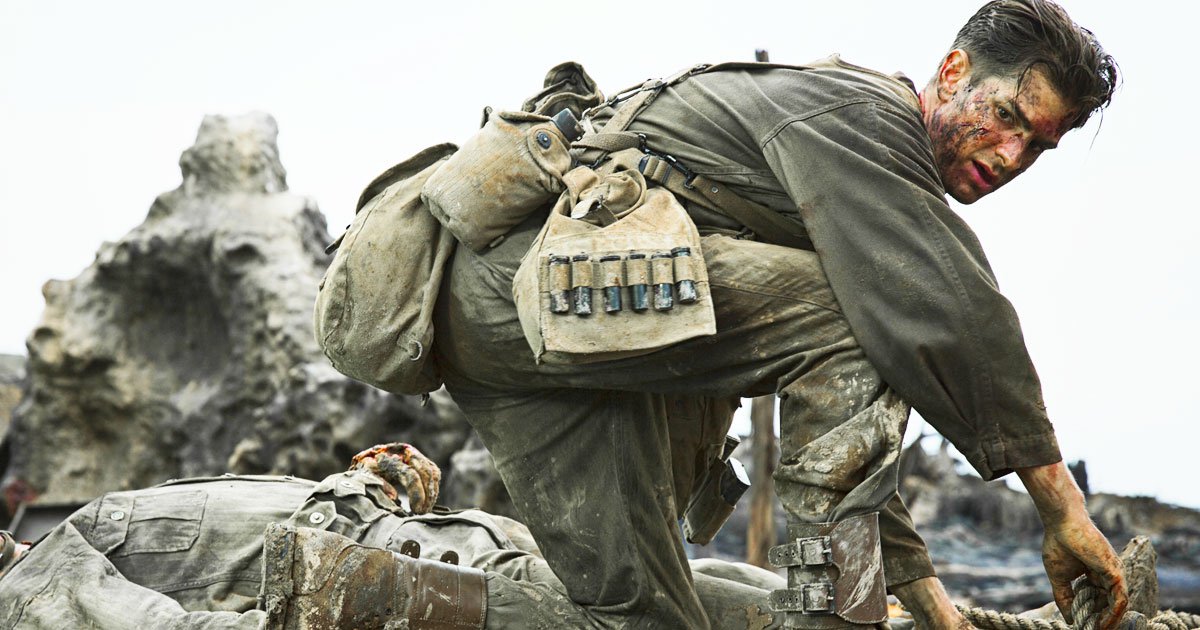
Perhaps appropriately considering its subject matter, Hacksaw Ridge caused me a bit of a crisis of conscience. I don’t typically watch extremely violent movies, which is why I’ve avoided films like Braveheart and anything Tarantino, and I was very hesitant to see Hacksaw Ridge after hearing of the intensity of its battle sequences. My VC, who is of the same mind, urged me not to, but there were enough positive elements inherent in the story of conscientious objector and war hero Desmond Doss that I decided to risk it. That actually made Hacksaw Ridge the first R-rated film I’d seen in the theater, and by the end, I was glad I did.

Image result for hacksaw ridge film

Mel Gibson may have shot his reputation in the foot years ago, but his talent as a filmmaker is undeniable, and it’s surprising and inspiring that he’s been somewhat forgiven by Hollywood, based on the number of Oscar nominations and wins Hacksaw Ridge received. His latest film has a lot in common with The Passion of the Christ; both carry deep religious meaning for Christians especially and also indulge in some gut-wrenching bloodshed that mark them as clearly not for everyone. It took me a while to work up the nerve for Passion of the Christ, but now I watch it every Good Friday; Hacksaw Ridge, likewise, requires a strong stomach in parts, but the overall story makes it worth it.

Andrew Garfield hardly seemed like an obvious choice for the potential Oscar-magnet role of Doss, but he was a massive surprise; he’s no longer that second-rate Spider-Man. As Desmond, he’s folksy but determined, earnest but firm, kind but tenacious, a man who wants to help others at any cost to himself, in short a true hero. Other casting examples were also less-than-obvious choices, such as Vince Vaughn as Desmond’s drill sergeant with a deadpan sense of humor or Hugo Weaving as his war-haunted father. Everyone involved does a phenomenal job, particularly Weaving, and even if the collection of fellow soldiers Desmond meets in boot camp don’t all register at first viewing, the quality of the acting never lapses.

The film is basically broken into two parts: the first half sees Desmond enlist as a medic and deal with the consequences and persecution from his refusal to carry a gun, while the second focuses on the decisive battle at Hacksaw Ridge and proves this supposed coward as anything but. I’ve seen some reviews criticize the beginning as preachy and heavy-handed, but I feel that one’s opinion of Desmond and his father waxing eloquent about freedom of religion and the Constitution depends on how dearly one holds such conservative values. I found it refreshing for a mainstream film to extol the First Amendment and the right of someone to serve his country as his faith allows. Desmond may be a Seventh Day Adventist with views that not every Christian holds, but his right to uphold his own principles is the same.

Image result for hacksaw ridge film

Even those rolling their eyes at the first half have praised the second for its realistic war scenes, and they are indeed intense and visceral. The explosions are constant, the body count is high, the headshots are many, and I may have spent most of those scenes with my eyes off to the side, watching in my peripheral vision. With superb editing, Gibson certainly nails the visualization of war as hell, but I don’t quite agree with those who say that it’s not gratuitous if it’s realistic; the gruesome double headshot that kicks off the carnage is a prime example. I still insist that films like Gettysburg and most of Glory are proof that war scenes don’t have to be gory to be effective, but the hell Desmond endures does make his courage in the face of it even more incredible. The violence may be an extreme, but at least here it serves as a counterpoint and contrast to the main character’s grace and perseverance, not unlike Passion of the Christ. I will say that, now that I’ve seen this, I do feel a bit less anxious about seeing Saving Private Ryan as a Blindspot pick later this year.

Though the worst moments of battle were extreme, it luckily wasn’t constant. It’s when the shooting stops that Desmond’s role as a medic and hero kicks in. As he recovers the wounded of Hacksaw Ridge and prays to save just “one more,” the tension never lets up, and Desmond demonstrates the valor and backbone his fellow soldiers assumed he lacked. I loved how the one time he does touch a gun, it’s for a wholly practical purpose in one of the most exciting scenes.

Image result for hacksaw ridge film

There’s little doubt in my mind that Hacksaw Ridge is one of the best war films I’ve seen, made even better by concluding with interviews with the real Desmond Doss. Some may consider it cheesy but appreciate the war scenes, while I tolerated the bloody battles and embraced everything else. Gibson seems to excel at making religious themes accessible, and what some call preachy, I call laudable. Even if some scenes are hard to watch, few films can match the selfless courage on display in Hacksaw Ridge.

Best line: (Desmond) “It isn’t right that other men should fight and die, that I would just be sitting at home safe. I need to serve. I got the energy and the passion to serve as a medic, right in the middle with the other guys. No less danger, just… while everybody else is taking life, I’m going to be saving it. With the world so set on tearing itself apart, it doesn’t seem like such a bad thing to me to wanna put a little bit of it back together.”
 

Rank: List-Worthy

2017 S.G. Liput
454 Followers and Counting


The Hobbit: The Battle of the Five Armies (2014)

19 Monday Dec 2016

Posted by sgliput in Movies, Poetry, Reviews, Writing

≈ 2 Comments

Tags

Action, Drama, Fantasy, War

Image result for the hobbit the battle of five armies


It seems so very long ago
The journey started with “hello,”
And then despite my disapproving,
Ever onward we were moving
Through the high and through the low,
Through lands I never dreamed I’d go.

And now at last, it’s with a sigh,
I whisper out a strained goodbye.
Despite the pain I had in store,
I’m glad I stepped out my front door.
From comfort’s hearth to dragon’s den,
I’ll treasure there and back again.
___________________

MPAA rating: PG-13

I reviewed the first two Hobbit films long ago as part of my original year-long movie countdown in 2014, when the third installment wasn’t even released yet, and despite my grouping the trilogy together on my list, it’s odd that I haven’t gotten around to reviewing The Battle of the Five Armies until now. Perhaps it’s because this third chapter of Peter Jackson’s prequel trilogy to The Lord of the Rings is most clearly the weakest of the bunch, the main problem being the preponderance of apocryphal embellishments found nowhere in Tolkien’s children’s novel.

It certainly can’t be accused of false advertising: it’s called The Battle of the Five Armies, and that’s exactly what you get—a huge, Middle-earth epic battle between dwarves, elves, the men of Laketown, orcs, and eventually eagles. If all I want out of a movie is sword slashing galore and spectacular set pieces, The Battle of the Five Armies delivers, especially reminding us just how awesome Legolas is. But in stretching out what is only a few pages in The Hobbit book, it falls short of the higher aspirations of The Lord of the Rings, each part of which deserved its near three-hour runtime. What with the painfully forced comic relief of Alfrid (Ryan Gage) and the unsatisfying love triangle of she-elf Tauriel (Evangeline Lilly of Lost) and he-dwarf Kili (Aidan Turner), it’s obvious that Jackson’s trying to string out this bloated third of a story in a less than successful manner. It’s not bad; it’s just forced at times. And don’t get me started on those were-worms! What is this, Dune?

Image result for the hobbit the battle of five armies bilbo

Yet Middle-earth is never without its joys. Jackson does manage to improve certain scenes from the book, most notably the death of the dragon Smaug, and the themes of greed and loyalty started in An Unexpected Journey are fulfilled in Thorin’s obsession with protecting his newly won hoard. As it was from the start, the casting is (mostly) impeccable, whether it be Martin Freeman as the younger Bilbo Baggins, Luke Evans as heroic Bard the Bowman, or returning familiar faces like Ian McKellen and Hugo Weaving. And by the end, it does feel like a worthwhile journey has been taken, especially with the end credits that recall those of The Return of the King, backed by Billy Boyd’s magnificent “The Last Goodbye.” (See my End Credits Song Hall of Fame.) The Hobbit trilogy is undoubtedly less than The Lord of the Rings, but it is unfortunate that the last one received only a single Oscar nomination for Sound Editing. Surely it could have competed in Makeup, Visual Effects, and Best Song, but the series’ general inferiority made that unlikely. Even so, Jackson’s achievement should not be overlooked; he completed two consecutive epic trilogies, a feat that is clearly harder than it seems if James Cameron’s troubles with the Avatar sequels are any indication.

I still can’t help but feel that an opportunity was missed in making The Hobbit a trilogy rather than a two-parter. Early on, I thought it was perhaps to humanize the thirteen dwarfs so that each character wasn’t just one of the thirteen, and while Jackson was more successful with some than others, most of the dwarves still seemed interchangeable, even for me, a hardcore Middle-earth fan. It’s a shame that Jackson couldn’t leave us Middle-earth lovers with more than a CGI free-for-all and a wistful farewell, but any visit to the land of hobbits, dragons, wizards, and rings is still one worth taking.

Best line: (Thorin) “If more people valued home above gold… this world would be a merrier place…”


Rank: List-Worthy (mainly due to the previous two and my own fondness for the franchise)


© 2016 S.G. Liput
437 Followers and Counting


The Man Who Never Was (1956)

18 Friday Nov 2016

Posted by sgliput in Movies, Poetry, Reviews, Writing

≈ 4 Comments

Tags

Classics, History, War

Image result for the man who never was


I dreamed a man deprived of soul
Had drifted to the shore.
He waited, though I did not know
What he was waiting for.

At last, a passerby took note,
And, soon borne by a crowd,
The body seemed within my dream
To be uniquely proud.

The passive face had made its way
From sea to land to grave,
And none could tell this empty shell
Had come more lives to save.

I wouldn’t know myself, except,
I saw his soul, which wore
A knowing glance, pleased with the chance
To be worth waiting for.
______________________

MPAA rating: G

Hollywood loves to find those fascinating true-life stories, especially if they involve war, Nazis, and spies, and The Man Who Never Was proves that was the case even back in the 1950s. Based off a novel written by Ewen Montagu, who headed the World War II operation that occurred only thirteen years before the film’s release, The Man Who Never Was details the British plan to convince the Axis Powers that the Allies would invade Greece rather than Sicily, a plan that involved an anonymous dead body and fake intelligence reports.

After a half-serious suggestion from his assistant (Robert Flemyng), Navy Lieutenant Commander Ewen Montagu (Clifton Webb) ponders how to possibly divert German forces from Sicily, where the Allies will invade within months. He decides that the enemy could be misled by a dead body found with false documents but only if the ruse is convincing enough. It seems like a straightforward plan and one that had actually been used in the past, but the film presents this Operation Mincemeat as quite a tricky challenge, as Montagu and his team ensure that every detail is thoroughly persuasive in crafting the persona of “Major William Martin.” Nothing is taken for granted, from the signatures of real generals endorsing the fake letters to the everyday contents of the man’s pockets, which must appear to reflect Martin’s habits and even his love life. And of course, there’s the sticky task of cajoling the family of the recently deceased to release his body for an unspecified undertaking for the greater good.

Image result for the man who never was 1956

In many ways, I doubt The Man Who Never Was could have been made nowadays, at least in its original form. The military strategies are never dull, but there’s no wow factor that would make this a blockbuster. It fascinates with its procedural shrewdness and attention to detail. Even when the mostly true story embellishes with a Nazi spy (Stephen Boyd, three years before playing Messala in Ben-Hur) sent to London to verify Martin’s identity, his tactics are subtle, and the climax is a rare example of the best course of action being no action at all. As Montagu says with a well-placed poem quote from Milton, “They also serve who only stand and wait.”

The only element that keeps this film from being List-Worthy in my opinion is Gloria Grahame, who plays the lover of a real soldier while doubling as William Martin’s fake fiancée. In a film where every other performance is kept earnest and believable, Grahame’s emotional histrionics feel out of place, even if they do play a role in the plot. Plus, her face seemed strangely shiny in all of her scenes, though that’s a personal quibble on my part.

As realistic spy stories go, The Man Who Never Was is an understated gem, with a well-deserved 100% on Rotten Tomatoes. While it appears several details fall short of historical accuracy, it’s a thoughtful and well-acted procedural sure to please those in search of neglected tales from World War II.

Best line: (Admiral Cross, after hearing the plan) “It’s the most outrageous, disgusting, preposterous, not to say barbaric idea I’ve ever heard, but work out full details and get back to me in the morning!”   (Montagu) “Thank you, sir!”


Rank: List Runner-Up


© 2016 S.G. Liput
422 Followers and Counting


For Greater Glory (Cristiada) (2012)

24 Friday Jun 2016

Posted by sgliput in Blogathon, Christian, Movies, Music, Poetry, Reviews, Writing

≈ 4 Comments

Tags

Drama, History, War

Image result for for greater glory film
If your freedoms were taken, your rights undermined,
To worship, to write, or to speak your own mind?

Would you flee?
Would you fight?
Would you stay out of sight?
Would you trigger a war?
Would you pray less or more?
Would you just play along,
With no thought to the wrong,
And in fear knowing well
That one word could bring hell?

Would you plot and resist?
Would you cease and desist?
Would your final resort
Be but silent support?
Would you bear the blood spilt
And accept your own guilt?
Would you think yourself smarter
As traitor or martyr?

Now ask what must happen, what action or vision,
To weigh on your conscience and change your decision?
___________________

MPAA rating: R (for scenes of war and torture, could be PG-13)

This is my contribution to the Remembering James Horner Blogathon over at Film Music Central, where the music of the late great film composer is being celebrated. I’d wanted to see For Greater Glory for years now, and this gave me the perfect opportunity, while illustrating how Horner was equally at home scoring small-budget historical dramas as well as multi-million-dollar blockbusters.

I’ve been waiting for that moment when Christian filmmaking manages to keep up with Hollywood, because despite the inspirational appeal of movies like Fireproof and Miracles from Heaven, Christian films always tend to lack the polish of their secular counterparts. Thankfully, For Greater Glory has that polish, boasting cinematography, editing, and a name-recognized cast worthy of Hollywood while telling a story at once faithful, gritty, and timely.

Most people have probably never heard of the Cristero War, a Mexican revolt from 1926 to 1929 caused by the viciously anti-Catholic policies of President Plutarco Elías Calles (played by Rubén Blades). Because of the history of devout Catholicism that seems synonymous with Latin America, it came as a surprise to me that anti-religious positions were written into the Mexican constitution, and when Calles began enforcing them by deporting foreign priests and killing priests and parishioners alike, the people rose up against him with the battle cry of “Viva Christo Rey!” It’s a struggle largely forgotten but comprehensively recounted through the experiences of various freedom fighters: famed general Enrique Gorostieta (Andy Garcia), lone wolf Victoriano Ramirez (Oscar Isaac), priest-turned-general Father Vega (Santiago Cabrera), peace-seeking lawyer Anacleto Flores (Eduardo Verástegui), and pious youngster José Sánchez del Río (Mauricio Kuri).

The entire cast deliver excellent performances, from Garcia’s conflicted attitude toward defending a religion he doesn’t share to a brief but impactful role for Peter O’Toole. Garcia as General Gorostieta is the most intriguing, an atheist like Calles who nonetheless staunchly believes in religious freedom; his calls of “Viva Christo Rey” encourage the troops as they become perhaps more heartfelt, reminding me that impartial atheists can do wonders with spiritual material. (For example, Amazing Grace was directed by Michael Apted.) The sporadic action is also tense and visceral (though more worth a PG-13 than an R), with ambushes, battles, and an especially cool one-against-fourteen shoot-out with Oscar Isaac. As for Horner’s score, it’s not among his most memorable soundtracks but one which masterfully complements every scene, rousing during the war scenes and suitably intense in the most emotional moments.

Image result for for greater glory film hanging


Despite the epic scope that the film mostly achieves, it’s rather slow-paced overall, and one might have trouble telling the various characters apart at first. What makes For Greater Glory worthwhile, though, is its commitment to telling a story that has been swept under the rug of history, an injustice explained by the fact that history is told by the winning side. As the film progresses, it becomes clear that this is more tragedy than triumph, and sacrifices toward the end bring to mind death scenes in The Passion of the Christ and Butch Cassidy and the Sundance Kid. Even if none of the characters are deeply explored, the historical notes before the end credits give them the depth of reality as we learn that many have since been beatified or canonized as saints.

With ever-growing distress over religious freedom in America and throughout the world, it’s important to see where religious intolerance can lead. Again, it’s hard to imagine that, in the country of Our Lady of Guadalupe, Christians were hanged from telephone poles less than a century ago, like crosses along the ancient Appian Way. Some have considered the film to be one-sided in its blessing of the rebels who committed some glossed-over atrocities of their own, but the heroics and devotion on display are still worthy of admiration, remembrance, and prayers that such abuses may never happen again.

Best line: (Calles, speaking of Gorostieta) “Filio Diaz used to say, ‘A dog with a bone in his mouth doesn’t bark and doesn’t bite.’ In politics, everything has a price. Go find his.”


Rank: List Runner-Up


© 2016 S. G. Liput
389 Followers and Counting

Image result for for greater glory film hanging


Counterpoint (1967)

09 Thursday Jun 2016

Posted by sgliput in Movies, Poetry, Reviews, Writing

≈ 2 Comments

Tags

Classics, Drama, Thriller, War


The wave of the constant conductor’s baton
Arises and dips as each note’s liaison.
It nods to the strings
As the clarinet sings
And the audience clings
To the melody’s wings.

The music is steady and blind to the world,
Where battle is brutal and bullets are hurled.
The music will stay,
If the artists still play
And the hearers, like they,
Let war’s din fade away.
_____________________

MPAA rating: Might as well be PG

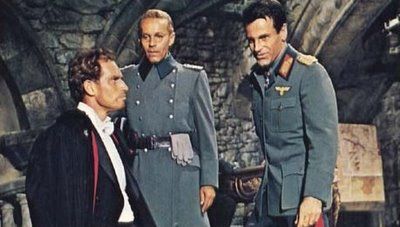
In the annals of semi-classic Hollywood, there are bound to be undiscovered gems, and I’m glad to say I found one, a World War II thriller worthy of being mentioned in the same breath as The Great Escape. Counterpoint begins on the front lines of the European theater, where a USO symphony orchestra plays for the troops only to have their performance cut short by the advancing German army. Quickly captured by the Nazis, the orchestra’s director Lionel Evans (Charlton Heston) demands they be released, but the Germans have orders to kill any and all prisoners. The only thing that saves them is the cultured admiration of the Nazi General Schiller (Maximilian Schell), who wants a concert and offers no guarantees of what is to follow it.

Heston and Schell make an outstanding pair of rivals, both self-absorbed and confident and used to getting their own way. Evans’ personality is summed up by an early line to his orchestra: “Each one of you will be responsible for your instruments, your music, and yourselves, in that order of importance.” Only two members of the seventy-member orchestra are actual characters (Leslie Nielsen, Kathryn Hays), but they and the rest know Evans’ ego all too well, and when he refuses to give in to General Schiller’s demands, they assume he’s satisfying his own opinions at their expense. Below the surface, however, he does care for his people and tries to stall the shooting squad that awaits them once the concert hall goes silent. Opposite Heston, Schell has a grinning, scheming charisma, looking perfectly at ease as he threatens his “guests”, like a precursor of Hans Landa in Inglourious Basterds. His treatment of an antique chair implies that he cares little for art, yet he’s a firm admirer of Evans and trades sharp-witted barbs with him to either convince or coerce him into submission. With one of his underlings clamoring for the prisoners’ blood, Schiller wants his concert before the war must resume.

I’m honestly surprised that Counterpoint isn’t a better-known film. The Nazis’ periodic acts of aggression keep the tension high, and close calls and narrow escapes are juxtaposed with the grandeur of the Los Angeles Philharmonic playing Tchaikovsky, Brahms, and Wagner. The climax even kept me guessing right up to the end. It’s not necessarily an award magnet that got spurned, but it’s an excellent and thoroughly underrated film that deserves far more recognition.

Best line: (Schiller) “To paraphrase Napoleon, morality is on the side of the heaviest artillery.”   (Evans) “Whatever happened to Napoleon?”


Rank: List-Worthy


© 2016 S. G. Liput
386 Followers and Counting


#1: The Lord of the Rings Trilogy (2001, 2002, 2003)

20 Friday Feb 2015

Posted by sgliput in Movies, Poetry, Reviews, Writing

≈ 3 Comments

Tags

Action, Drama, Fantasy, Meet 'em and Move on, War

(Major spoilers ahead)
 
Three films to rule them all,
Three films to top them,
Three films to contests call
And effortlessly stop them.
 
In ages long past, there were forged mighty rings,
And one was the greatest, to rule over kings.
‘Twas forged by the Dark Lord, one Sauron by name,
Who barely was beaten when men and elves came.
Isildur, however, retained the One Ring,
Which went on to spend centuries poisoning
The mind of poor Gollum, obsessed with his prize,
Until it was picked up by one of small size.
This hobbit named Bilbo returned to the Shire
And kept the Ring, growing in secret desire.
 
On Bilbo’s birthday, he intends to depart,
Although nephew Frodo is close to his heart.
The wizard Gandalf bids the hobbit farewell
But, wishing old Bilbo’s temptation to quell,
Insists that the Ring stay behind at Bag End,
For Frodo to keep safe, if not comprehend.
When Gandalf discerns that the Ring is the One,
He sends Frodo off since the hunt has begun.
With friends Samwise Gamgee and Pippin and Merry,
The hobbit seeks Bree on a life-saving ferry,
For nine fallen kings known as Ringwraiths now ride
To claim Frodo’s ring, knowing he cannot hide.
 
As Gandalf must deal with the sudden betrayal
Of white wizard Saruman, Frodo’s travail
Is still far from over, but he is defended
By Strider (or Aragorn), who’s well-descended.
When Frodo is wounded by one of the Nine,
The elf maiden Arwen assists him in time.
In Rivendell, Frodo finds rest with his friends,
Until a new journey Elrond recommends.
With Aragorn, Gandalf, Sam, Pippin, and Merry,
Plus Boromir, Legolas, and Gimli hairy,
Frodo heads to Mordor to end the Ring’s power,
As Sauron looks on from Barad-dûr’s tower.
 
When one mountain blocks them with avalanche thunder,
The Fellowship hesitantly passes under.
Through Moria’s mines and dark dangers galore
They dare, since they cannot turn back anymore.
A battle and balrog claim Gandalf, alas!
The others get out since the foe cannot pass.
Then on to Lothlórien they make their way,
Where Lady Galadriel lets the group stay.
A vision lets Frodo know what he must do,
And soon they depart down the river anew.
 
The wiles of the Ring come to tempt Boromir,
Who menaces Frodo when no one is near.
When Saruman’s fierce Uruk-hai then attack,
The men, elf, and dwarf prove that courage none lack.
Yet Boromir falls to his comrades’ dismay,
And Merry and Pippin are taken away.
As Aragorn, Legolas, Gimli, all three,
Go after the hobbits in captivity,
Both Frodo and Sam head to Mordor alone
To finish the quest in the wilds unknown.
__________________
 
As Frodo and Sam wander on with their quest,
The creature called Gollum proves more than a pest.
They catch and convince him to act as their guide;
Though Gollum assists, Sam is quick to deride.
Through labyrinths of stone and a haunted marshland,
The trio continue with threats close at hand.
They find Mordor’s entrance, the dreaded Black Gate,
Much too well-defended to now infiltrate,
So Gollum (or Sméagol as he was once known)
Suggests a dark way through a tunnel of stone.
As Frodo starts trusting him, Gollum must face
An identity crisis, one half to erase.
While traveling further through Gondor’s frontier,
They’re captured by Boromir’s kin, Faramir.
 
Meanwhile, the elf and the dwarf and the man
Are chasing the Uruks as fast as they can.
In Rohan, the creatures are slaughtered that night
By banished Rohirrim while making their flight.
While Merry and Pippin take shelter with Ents,
The shepherds of trees who ignore world events,
The others find Gandalf, alive, clad in white,
And join him to set Rohan’s monarchy right.
King Théoden sags under Saruman’s sway,
But Gandalf will not let the rogue wizard stay.
With Théoden now in his right mind once more,
He does as was done with past dangers before,
Vacating the city through mountain paths steep
And biding behind the great walls of Helm’s Deep.
 
As Saruman’s army arrives seeking blood,
The men and elves battle the sword-wielding flood.
While Merry and Pippin are sad and upset
By ponderous Ents still unmoved by the threat,
King Théoden, Aragorn, and all the rest
Defend for their lives from the Uruks, hard-pressed.
For when the foe blasts through impregnable walls,
Despair enters in as their brave defense falls.
 
While Frodo and Sam are held captive by men,
Who mishandle Sméagol, made bitter again,
The Ring allures Faramir’s inner desire
To prove himself to his unpleasable sire.
In Osgiliath, as the Nazgûl attack,
A change of heart shows strength that many men lack.
 
King Théoden rallies his warriors then
To ride out proclaiming the valor of men,
And Gandalf arrives with Rohirrim in tow
To charge with the sun and thus finish the foe.
As Helm’s Deep is won, the Ents see for themselves
That Saruman’s crimes harm not just men and elves.
They storm Isengard with a most righteous rage,
And ancients prevail in their last war to wage.
The good and the free have thus won battles twain,
But darkness will strengthen before it must wane.
The hope of all Middle-earth rests in a pair
Of hobbits whom Gollum intends to ensnare.
_________________
 
While Frodo and Sam follow Gollum, whose past
Reveals the corruption the Ring can work fast,
The rest of the Fellowship soon reunite
To celebrate triumph in their recent fight.
Yet Pippin is tempted to study a sphere,
A dangerous seeing stone called Palantir,
Which gives them a glimpse into Sauron’s next plan,
To crush Minas Tirith, the threat posed by Man.
 
When Gandalf takes Pippin to outrun the foe
And warn Gondor’s capital of coming woe,
The steward of Gondor, the Lord Denethor,
The father of Boromir, knows of the war.
He’s losing his mind and deplores Faramir
In mourning his brother, both cruel and severe.
Insisting his son display loyalty vain,
He sends him to fight where he’ll surely be slain.
Though Faramir sadly submits to his will,
The wizard Gandalf has a plan to fulfill
And sends word to Rohan to come to their aid,
Through beacon fires magnificently displayed.
 
While Merry’s preparing to fight for the peace,
Assisted by Éowyn, Théoden’s niece,
Both Frodo and Sam have a difficult time
In mounting stone stairs Sméagol says they must climb.
His influence turns Frodo’s mind against Sam,
Who’s forced to turn back by a Sméagol-y scam.
Within a dark tunnel of webbing and murk,
A monstrous spider called Shelob does lurk;
Though Gollum had hoped she would earn him the Ring,
His master escapes and sends him plummeting.
As Frodo continues, the spider surprises
Till Samwise the brave takes her down a few sizes.
 
When Elrond reforges a sword legendary
For Aragorn ever to wield and to carry,
The Grey Company leaves King Théoden’s side
To seek the assistance of traitors who died.
To grand Minas Tirith, Rohan’s armies ride
To aid the beleaguered of Gondor inside.
While Denethor’s sanity cracks from the strain
Of Faramir’s loss, though he isn’t yet slain,
The men and the wizard defend the White City
From hideous hordes that refuse to show pity.
When Théoden’s forces arrive with the sun,
The battle’s tide turns, though it isn’t yet won.
When great oliphaunts join this most epic fray,
It takes a ghost army to carry the day.
 
As Gandalf saves Faramir from Denethor,
Sam rescues poor Frodo from orcs of Mordor.
With much heroism and losses endured,
The victors, to keep Frodo’s mission obscured,
March on to the Black Gate, diverting the gaze
Of Sauron’s great eye, ever watching ablaze.
Through barren wastelands, Sam and Frodo proceed,
Weighed down by the Ring from which all must be freed.
Though Gollum attacks, Frodo reaches Mount Doom
But falls to temptation that tends to consume;
It’s not until Gollum, for his Precious’ sake,
Bites off Frodo’s finger, a deadly mistake,
That Sauron’s One Ring in the fire is cast
And evil is unmade and vanquished at last.
 
It looks like the end for the two hobbits spent,
But Gandalf retrieves the small heroes he sent.
In Rivendell, Frodo is thrilled to once more
Embrace his old Fellowship left long before.
In Minas Tirith, grateful free peoples bow down,
And Aragorn humbly accepts Gondor’s crown.
Though years of peace follow, for Frodo it seems
The scars of his quest are still haunting his dreams.
When elves take their leave of mankind’s Middle-earth,
They give final passage to heroes of worth.
As Bilbo and Gandalf depart from these shores,
It’s Frodo’s time too, and the journey restores.
Farewell to his friends, ever faithful and true;
Farewell for a time until all is made new.
_________________
 

This is it, the top of my list and, in my opinion, the greatest trilogy ever made. I know that is a tall claim, but no other film series matches the emotional power, memorable characterization, and epic scope of Peter Jackson’s original cinematic tour de force. Before their release, I had never read the books or had any exposure to J.R.R. Tolkien’s classic magnum opus, so these films came as a total surprise to my family and me; what we expected to be “just another movie” turned out to be something truly magnificent.

The Fellowship of the Ring has been acclaimed as the greatest fantasy film of all time; even with the detractions of literary purists, the film certainly succeeds in crafting a wholly convincing Middle-earth and capturing the spirit of its diverse inhabitants: the curly-haired tranquility of Hobbiton; the Stygian menace of the Nazgûl; the luminous nobility of the elves; and the repulsive terror of orcs, balrogs, and the Kraken’s second cousin. The hobbits especially are among the series’ most endearing creations, bucolic folk fond of peace, pubs, and pipes but capable of unexpected heroism.

Fellowship is more episodic than the other two films, as the travelers grow in number and pass from city to wilderness to caves to forest to river, yet amid all the walking, we get to know these characters more deeply than one would expect: hesitant Frodo, faithful Sam, the comic relief duo of Merry and Pippin, sapient Gandalf, conflicted lover Aragorn, awesome Legolas, untossable dwarf Gimli, corruptible Boromir, and so on. The film also features my favorite sequence of the entire trilogy, the tense and visually stunning journey through Moria, full of colossal architecture, subtle wisdom, fearsome creatures, and a climactic sacrifice. The showdown with the troll and the Khazad-dûm collapse were the turning point that convinced me of the immensity of this story, and Frodo’s world-weary gaze once they escape confirmed its emotional punch. By the end of the film, I’m always eager for more.

Being bookended by even greater films, The Two Towers is understandably the least of the trilogy, but it nonetheless includes some essential additions to an already exceptional cast. While the sudden introduction of Rohan’s horsemasters (with similar names like Éowyn, Éomer, Théoden, Théodred, etc.) might be confusing for the uninitiated, they add another texture to this captivating land. Though the flesh-and-blood characters are engaging enough, the special effects team outdid themselves with two brilliantly rendered eccentrics. Andy Serkis’s motion-capture performance as Gollum/Sméagol is among the film’s highlights, his raspy voice and spindling physicality perfectly capturing the creature’s tragic state and inner turmoil. Likewise, Treebeard’s lumbering presence is as convincing a living tree as one can imagine, and the deep, protracted voice of John Rhys-Davies (doubling as Gimli) fits him to a tree…I mean, tee. Again, there is no shortage of riveting action sequences, including a skirmish between riders of horses and wargs, the prodigious siege of Helm’s Deep which surpasses any other depiction of medieval warfare, and my second favorite battle sequence of all, the attack of the Ents on Isengard. The latter two battles converge in the climax for a truly epic conclusion, even as Sam delivers a heartfelt speech setting the noble yet very human stakes.

My VC was especially eager for The Return of the King and, not being familiar with the books, was constantly terrified for the beloved characters, especially Frodo. She was pretty much in tears for the entire latter half of the film, from concern and happiness and from the sheer epic scale of the images before her. While it didn’t have quite the same effect on me, I wholeheartedly agree that this third film is the greatest ever made, as the culmination of the trilogy and a monumental depiction of the triumph of good over evil. Along with Titanic and Ben-Hur, it won the most Oscars ever, eleven total, and holds the record for the greatest Oscar sweep since it won everything for which it was nominated; it’s also the only fantasy film to win Best Picture and deservedly so. After journeying through two already admired films with these characters, the emotions are in high gear, devastated grief at Faramir’s sacrifice and Frodo’s rejection of Sam, heartache at Théoden’s final moments and Shelob’s stabbing of Frodo, bittersweet joy at the quest’s success and Frodo’s relieved parting glance. Like the previous two films, there are moments of unbridled awesomeness worthy of sudden cheering, like Legolas and Éomer’s single-handedly taking down enormous oliphaunts, Éowyn’s feat of female empowerment, or Aragorn’s employing an undead ace up his sleeve. The two greatest sequences are the lighting of the beacons, a perfect combination of jaw-dropping New Zealand scenery and Howard Shore’s legendary score, which is my VC’s favorite part of the whole trilogy, and the battle of the Pelennor Fields, particularly Théoden’s charge; the looks of fear on the orcs’ faces are what I imagine will be seen when the Lord returns and evil is finally stamped out. Though the multiple endings have drawn some criticism and even mockery, none of them are needless, and all serve as most satisfying closure, perhaps just with a bit too much fading in and out. Every time the credits start to roll, I feel that I’ve watched something magnificent.

Since I first saw The Lord of the Rings trilogy, my family and I have become fast fans, buying enough merchandise to probably finance one of The Hobbit films. We’ve purchased the original books, guide books, books about the films, a documentary about the films, calendars, CDs of the score, action figure playsets, and both the original films and the extended edition box set. The extended edition is now our preferred version, contributing nearly two hours of fascinating additions that complement rather than detract from the original. It’s become a tradition for my family to watch all three films in a row, usually around Christmas, as an annual reminder of how much we love this story.

While I typically shy away from violent films, and The Lord of the Rings does contain plenty of hacking and even decapitations, the battle scenes still show considerable restraint for the most part, especially for a director known for gory horror movies; plus, the film’s fantasy setting precludes any instances of profanity or foul language, which isn’t even missed. Instead, the language carries a memorable nobility foreign to modern-set films, such as the monologues of encouragement from Gandalf or from various warriors before battle (“Ride for ruin and the world’s ending!”; “It is not this day!”) The music is also particularly marvelous, and Fellowship’s “May It Be” by Enya and The Return of the King’s “Into the West,” performed by Annie Lennox, easily make my End Credits Song Hall of Fame. (“Gollum’s Song” at the end of The Two Towers isn’t quite in the same league.) In addition, it occurred to me that one more reason I enjoy the films is that Frodo’s journey at least could be considered a “meet-‘em-and-move-on” story, since he encounters several others on his quest and is ultimately reunited with many of them. By the way, (Lost alert) I must mention Dominic Monaghan, who plays Merry as well as troubled rocker Charlie on my favorite TV show and who turned out to be a major draw for me to check out Lost, which started the year after The Return of the King was released.

(On a side note, I do want to explain my wholehearted embracing of this franchise in contrast with my dislike of the Harry Potter series. While both feature magic, however fantastical, Tolkien’s tales do not employ magic as a focus and ongoing interest for his characters, and they are set in an untouchable fantasy realm as opposed to a setting and time recognizably similar to our own. In some ways, it’s a fine line, but one that Rowling’s stories cross enough to warrant caution, to my mind. My opinions match those further expanded in this long article by film critic Steven Greydanus: http://www.decentfilms.com/articles/magic.)

The Lord of the Rings will forever stand as a landmark of cinema, especially impressive coming from an only mildly esteemed horror director like Peter Jackson, who certainly earned a name for himself. No other film can match the blend of utterly beautiful scenery, memorable music, realistic effects of every kind, Oscar-winning makeup, detailed armor and weaponry, brilliant ensemble acting, impressive artistry, unparalleled thrills, heart-wrenching pathos, and tear-worthy gratification. Some films rival or even surpass certain such aspects, but not all of them. All the awards won by the third film were undoubtedly meant for the trilogy as a whole, for no other director has shot a trilogy back to back like Jackson did, an achievement he repeated with The Hobbit and one that I don’t think is appreciated enough. George Lucas took three years between each of the Star Wars films, and James Cameron recently had to postpone his planned Avatar sequel trilogy because of the massive effort involved in shooting back-to-back films. It’s obviously harder than it seems. The Hobbit trilogy may not measure up to Jackson’s original achievement, but nothing really could. They are untouchable, masterpieces of fantasy to match their literary counterparts, despite certain alterations.

This film list of mine has been a long road, but its end is one worth revisiting again and again. I’m glad to be with you, Samwise Gamgee, here at the end of this list.

Best lines from The Fellowship of the Ring: (Gandalf, catching Sam after talking with Frodo) “Confound it all, Samwise Gamgee. Have you been eavesdropping?”
(Sam) “I ain’t been droppin’ no eaves, sir, honest. I was just cutting the grass under the window there, if you’ll follow me.”
(Gandalf) “A little late for trimming the verge, don’t you think?”
(Sam) “I heard raised voices.”
(Gandalf) “What did you hear? Speak.”
(Sam) “N-nothing important. That is, I heard a good deal about a ring, and a Dark Lord, and something about the end of the world, but… please, Mr. Gandalf, sir, don’t hurt me. Don’t turn me into anything… unnatural.”    and
 
(Frodo) “I wish the Ring had never come to me. I wish none of this had happened.”   (Gandalf) “So do all who live to see such times, but that is not for them to decide. All we have to decide is what to do with the time that is given to us. There are other forces at work in this world, Frodo, besides the will of evil. Bilbo was meant to find the Ring. In which case, you were also meant to have it. And that is an encouraging thought.”
 
Best lines from The Two Towers: (Treebeard) “I always like going south. Somehow, it feels like going downhill.”    and
 
(Sam) “Those were the stories that stayed with you, that meant something, even if you were too small to understand why. But I think, Mr. Frodo, I do understand. I know now. Folk in those stories had lots of chances of turning back, only they didn’t. They kept going. Because they were holding on to something.”   (Frodo) “What are we holding onto, Sam?”   (Sam) “That there’s some good in this world, Mr. Frodo… and it’s worth fighting for.”
 
Best lines from The Return of the King: (Gimli, after Legolas’s oliphaunt takedown) “That still only counts as one!”    and
 
(Frodo, after the success of their quest) “I’m glad to be with you, Samwise Gamgee, here at the end of all things.”
 
 
Rank: 60 out of 60
 

© 2015 S. G. Liput

286 Followers and Counting
#19: War Horse (2011)

19 Monday Jan 2015

Posted by sgliput in Movies, Poetry, Reviews, Writing

≈ 2 Comments

Tags

Drama, Meet 'em and Move on, War

A Devon-born horse with four white socks and star
Is bought at an auction by Ted Narracott.
The drunkard, discouraged by how their lives are,
Lets Albert, his son, give the horse his best shot.
 
His training of Joey allows him to plow
And buck expectations of them and their field,
But when the War starts, there’s a greater need now
For money, and horses for England to wield.
 
Assigned to the cavalry, Joey is passed
From Britain to Germany following fights.
Two brothers persuaded by promises past
In fleeing to safety surrender their rights.
 
An elderly Frenchman and his young granddaughter
Are next to take in this miraculous horse.
They try to protect him from bondage and slaughter,
But callous war comes to reclaim him by force.
 
Through marches and trenches, he tries to survive;
Through wire and fences, he ventures to flee,
But only when care and compassion arrive
Do rivals join forces to set Joey free.
 
By chance or by fate or by Providence’ will,
The unlikely promise that young Albert swore
Is kept when the both of them reunite still,
Two tired, admired survivors of war.
__________________
 

In vying for Oscars and popularity, most films nowadays constantly experiment to make themselves new. As well-done as they may be, many award-winners are becoming more dependent on gimmicks, whether it be a retro silent picture, a coming-of-age tale shot over twelve years, a drama meant to appear as one continuous take, or a musical that does away with pre-recorded tracks. Few films return to the pure, old-fashioned filmmaking of Hollywood’s Golden Age as wondrously as Steven Spielberg’s 2010 masterpiece War Horse, a return to a time when epic journeys could indulge in straightforward schmaltz and emotion without being called “sentimental,” as if that were a bad thing.

Paulie already proved that “meet ‘em and move on” films could feature an animal protagonist, but unlike that film or Spirit: Stallion of the Cimarron or the Michael Morpurgo book on which War Horse is based, the animal involved is not anthropomorphized to provide narration. He acts as a character but also a sounding board for those he meets along his odyssey. In doing so, he experiences the many angles of World War I depicted throughout the story: the confident bravery of the war’s beginning, the early losses, the fears and misgivings on both sides, the heartbreaking cost forced upon innocent civilians, the devolution of battlefields into ravaged wastelands, and the unexpected kindnesses displayed throughout.

As a war film, it manages to show multiple perspectives and never demonizes one group or the other. As with every war, there are sympathetic angels and hard-nosed warriors on both sides. A scene of cooperation between a British and German soldier acts as a microcosm of the previously reviewed Christmas film Joyeux Noël, uniting them over shared humanity and sympathy for an injured innocent. One way in which the film recalls the war features of yesteryear is in its realistic but sanitized depiction of battle; despite much loss of life and some intense sequences, there’s no blood and no unnecessary brutality. I applaud Spielberg for that.

My VC doesn’t believe War Horse should be this high on my list (she’s not partial to any film with a suffering animal), but for me, War Horse is the most recent film to find a special place in my heart. Certain movies like this, Heart and Souls, and Whisper of the Heart just retain an unusual personal fondness that can’t be fully explained. The opening might be a little slow, but it highlights the formation of a life-leading friendship that compels the viewer to follow this special horse, and certain elements are made more relevant and poignant as the film progresses. In addition, the breath-taking cinematography and scenery of Devon, England, are more than enough to hold one’s attention, especially when combined with yet another moving score from John Williams. The actors are all excellent as well, from newcomer Jeremy Irvine as Albert, a heartfelt and consistently admirable lad whether in the turnip field or battlefield, to a number of recognizable English thespians, including Tom Hiddleston (Loki), Eddie Marsan (Inspector Lestrade), and Benedict Cumberbatch (Smaug, Sherlock, Khan, etc.).

War Horse indeed feels like classical filmmaking, like that of John Ford mixed with Lassie, but updated with Spielberg’s artistic touch and more natural acting. Shots of the Devon sunset carry a painterly beauty, while a scene of an execution is evocatively hidden by a turning windmill. The Artist may have been more lauded for its innovative take on classic Hollywood, but I consider War Horse the best film of 2011.

Best line: (Rose Narracott to her husband Ted, after he fears his failures will alienate her) “I might hate you more, but I’ll never love you less.”

 
Rank: 59 out of 60
 

© 2015 S. G. Liput

282 Followers and Counting

#57: Glory (1989)

27 Thursday Nov 2014

Posted by sgliput in Movies, Poetry, Reviews, Writing

≈ 1 Comment

Tags

Drama, History, War

The Civil War was raging, and good Captain Robert Shaw
Wrote letters to his mother of the army that he saw.
Hurt and honored as a hero, he returned to Boston north
And was named the newest colonel of the Negro 54th.
 
He struggled with his station as a leader of recruits,
An officer of men who did not share his privileged roots.
He trained his infantry with all the harshness he felt right,
And, earning insult and respect, he taught them how to fight.
 
Nobody truly thought a colored regiment would see
The bloody badge of battle so their comrades could be free,
But Shaw and all his men insisted they should have their chance
To prove their love of freedom and their merit to advance.
 
When they at last met combat, Shaw then volunteered to lead
A charge against Fort Wagner, which they could not supersede.
The bravery, the glory of these honored soldiers strong
Ensured that color would not keep our country split for long.
__________________
 

Glory is a war movie that is not only thrilling and tragic but truly glorious. As hellish as battle is, there is a stirring admiration for those risking their lives for the sake of freedom, defense, patriotism, and duty. James Horner’s orchestral score with choral high points possesses a poignancy that captures the elusive “glory” of war itself and beautifies scenes like the final battle with an uplifting paean of majesty. (Strangely, the score wasn’t even nominated for an Oscar, though Horner’s other one that year for Field of Dreams was. Also, I noticed that one section of music sounded quite similar to Horner’s score of The Pagemaster five years later.)

In addition to the prestigious score, the cast is brilliant. Matthew Broderick sheds his Ferris Bueller persona for the role of Captain Shaw, a man caught under the weight of his own responsibility, forced to balance past friendships with expected protocol. Cary Elwes also turns in a serious performance as his friend Major Forbes, who urges him not go too far in his military rigidity. The black soldiers are diverse characters who are neither idealized nor derided. Andre Braugher as Shaw’s unprepared friend Thomas and Jihmi Kennedy as crack-shot Private Sharts provide the human weakness and improvement seen in other “boot camp” movies, while Denzel Washington won an Oscar for his potent portrayal of bitter Private Trip. The infamous “N word” is used frequently throughout the film, and though white characters say it too, Trip is the worst offender, prompting a brilliant reproach from Sergeant Major Rawlins (Morgan Freeman) that indicts not only the sayer of the word but the behavior that can prompt its use.

The period costumes and credible battle reenactments lend the film great realism, as do the repeated voiceovers of the real Shaw’s letters to home. This authenticity complements the film’s balanced storytelling, shifting between the viewpoints of white and black characters with great delicacy. It also points out historical details that many forget, such as the fact that slavery was also present in the Union (in the border states) and that prejudice and atrocities were not limited to the Confederates. Yet neither are whites demonized; even when Shaw is harsh to his recruits, he is attempting to prepare them seriously as few other commanders would and exhibits a keen sympathy despite his distance.

The battle scenes are fierce but not excessive, except for a shocking head shot five minutes in. Though the 54th Infantry’s sacrifice threatens to end the film on an overly depressing note, the intense battle at Fort Wagner (complete with Horner’s score and “bombs bursting in air”) is surprisingly inspiring, and the final scene speaks to the equality of death and what lies beyond. Glory depicts an early and lesser-known high point in African-American history. On this Thanksgiving Day, it seems appropriate to honor those who died to salvage a nation worthy thanking God for. (By the way, I was surprised that the film’s first day of training occurred on November 27, 1862, 152 years ago today.)

Best line: (Shaw, writing to his mother) “We fight for men and women whose poetry is not yet written but which will presently be as enviable and as renowned as any.”

 
Rank: 57 out of 60
 

© 2014 S. G. Liput

259 Followers and Counting

← Older posts
Newer posts →

Recent Posts

  • We Didn’t Start 2025 (Recap)
  • NaPoWriMo 2025 Recap (Finally)
  • Sonic the Hedgehog 3 (2024)
  • It Happened One Night (1934)
  • Spellbound (2024)

Recent Comments

associatesofshellymann's avatarassociatesofshellyma… on My Top Twelve La La La So…
Kit's avatarKit Nichols on Bonnie and Clyde (1967)
lifelessons's avatarlifelessons on Look Back (2024)
Carol Jackson's avatarCarol Jackson on The Thief of Bagdad (1940…
Stephen's avatarStephen on Love Story (1970)

Archives

  • January 2026
  • December 2025
  • May 2025
  • April 2025
  • March 2025
  • February 2025
  • January 2025
  • December 2024
  • May 2024
  • April 2024
  • March 2024
  • February 2024
  • January 2024
  • December 2023
  • November 2023
  • October 2023
  • September 2023
  • July 2023
  • June 2023
  • May 2023
  • April 2023
  • March 2023
  • February 2023
  • January 2023
  • December 2022
  • November 2022
  • October 2022
  • September 2022
  • August 2022
  • July 2022
  • June 2022
  • May 2022
  • April 2022
  • March 2022
  • February 2022
  • January 2022
  • December 2021
  • November 2021
  • October 2021
  • September 2021
  • August 2021
  • July 2021
  • June 2021
  • May 2021
  • April 2021
  • March 2021
  • February 2021
  • January 2021
  • December 2020
  • November 2020
  • October 2020
  • September 2020
  • August 2020
  • July 2020
  • June 2020
  • May 2020
  • April 2020
  • March 2020
  • February 2020
  • January 2020
  • December 2019
  • November 2019
  • October 2019
  • September 2019
  • August 2019
  • July 2019
  • June 2019
  • May 2019
  • April 2019
  • March 2019
  • February 2019
  • January 2019
  • December 2018
  • November 2018
  • October 2018
  • September 2018
  • August 2018
  • July 2018
  • June 2018
  • May 2018
  • April 2018
  • March 2018
  • February 2018
  • January 2018
  • December 2017
  • November 2017
  • October 2017
  • September 2017
  • August 2017
  • July 2017
  • June 2017
  • May 2017
  • April 2017
  • March 2017
  • February 2017
  • January 2017
  • December 2016
  • November 2016
  • October 2016
  • September 2016
  • August 2016
  • July 2016
  • June 2016
  • May 2016
  • April 2016
  • March 2016
  • February 2016
  • January 2016
  • December 2015
  • November 2015
  • October 2015
  • September 2015
  • August 2015
  • July 2015
  • June 2015
  • May 2015
  • April 2015
  • March 2015
  • February 2015
  • January 2015
  • December 2014
  • November 2014
  • October 2014
  • September 2014
  • August 2014
  • July 2014
  • June 2014
  • May 2014
  • April 2014
  • March 2014
  • February 2014
  • January 2014
  • December 2013

Categories

  • Blindspot
  • Blogathon
  • Christian
  • Movies
  • Music
  • NaPoWriMo
  • Poetry
  • Reviews
  • TV
  • Writing

Meta

  • Create account
  • Log in
  • Entries feed
  • Comments feed
  • WordPress.com

Recent Posts

  • We Didn’t Start 2025 (Recap)
  • NaPoWriMo 2025 Recap (Finally)
  • Sonic the Hedgehog 3 (2024)
  • It Happened One Night (1934)
  • Spellbound (2024)

Recent Comments

associatesofshellymann's avatarassociatesofshellyma… on My Top Twelve La La La So…
Kit's avatarKit Nichols on Bonnie and Clyde (1967)
lifelessons's avatarlifelessons on Look Back (2024)
Carol Jackson's avatarCarol Jackson on The Thief of Bagdad (1940…
Stephen's avatarStephen on Love Story (1970)

Archives

  • January 2026
  • December 2025
  • May 2025
  • April 2025
  • March 2025
  • February 2025
  • January 2025
  • December 2024
  • May 2024
  • April 2024
  • March 2024
  • February 2024
  • January 2024
  • December 2023
  • November 2023
  • October 2023
  • September 2023
  • July 2023
  • June 2023
  • May 2023
  • April 2023
  • March 2023
  • February 2023
  • January 2023
  • December 2022
  • November 2022
  • October 2022
  • September 2022
  • August 2022
  • July 2022
  • June 2022
  • May 2022
  • April 2022
  • March 2022
  • February 2022
  • January 2022
  • December 2021
  • November 2021
  • October 2021
  • September 2021
  • August 2021
  • July 2021
  • June 2021
  • May 2021
  • April 2021
  • March 2021
  • February 2021
  • January 2021
  • December 2020
  • November 2020
  • October 2020
  • September 2020
  • August 2020
  • July 2020
  • June 2020
  • May 2020
  • April 2020
  • March 2020
  • February 2020
  • January 2020
  • December 2019
  • November 2019
  • October 2019
  • September 2019
  • August 2019
  • July 2019
  • June 2019
  • May 2019
  • April 2019
  • March 2019
  • February 2019
  • January 2019
  • December 2018
  • November 2018
  • October 2018
  • September 2018
  • August 2018
  • July 2018
  • June 2018
  • May 2018
  • April 2018
  • March 2018
  • February 2018
  • January 2018
  • December 2017
  • November 2017
  • October 2017
  • September 2017
  • August 2017
  • July 2017
  • June 2017
  • May 2017
  • April 2017
  • March 2017
  • February 2017
  • January 2017
  • December 2016
  • November 2016
  • October 2016
  • September 2016
  • August 2016
  • July 2016
  • June 2016
  • May 2016
  • April 2016
  • March 2016
  • February 2016
  • January 2016
  • December 2015
  • November 2015
  • October 2015
  • September 2015
  • August 2015
  • July 2015
  • June 2015
  • May 2015
  • April 2015
  • March 2015
  • February 2015
  • January 2015
  • December 2014
  • November 2014
  • October 2014
  • September 2014
  • August 2014
  • July 2014
  • June 2014
  • May 2014
  • April 2014
  • March 2014
  • February 2014
  • January 2014
  • December 2013

Categories

  • Blindspot
  • Blogathon
  • Christian
  • Movies
  • Music
  • NaPoWriMo
  • Poetry
  • Reviews
  • TV
  • Writing

Meta

  • Create account
  • Log in
  • Entries feed
  • Comments feed
  • WordPress.com

Blog at WordPress.com.

Is this your new site? Log in to activate admin features and dismiss this message
Log In
  • Subscribe Subscribed
    • Rhyme and Reason
    • Join 814 other subscribers
    • Already have a WordPress.com account? Log in now.
    • Rhyme and Reason
    • Subscribe Subscribed
    • Sign up
    • Log in
    • Report this content
    • View site in Reader
    • Manage subscriptions
    • Collapse this bar