• Home
  • About Me
  • The List
  • THE LIST (2016 Update)
  • THE LIST (2017 Update)
  • THE LIST (2018 Update)
  • THE LIST (2019 Update)
  • THE LIST (2020 Update)
  • THE LIST (2021 Update)
  • THE LIST (2022 Update)
  • Top Twelves and More
  • The End Credits Song Hall of Fame

Rhyme and Reason

~ Poetry Meets Film Reviews

Rhyme and Reason

Tag Archives: Triple A

The Effect of Gamma Rays on Man-in-the-Moon Marigolds (1972)

11 Tuesday Apr 2017

Posted by sgliput in Movies, NaPoWriMo, Poetry, Reviews, Writing

≈ Leave a comment

Tags

Drama, Triple A

Image result for the effect of gamma rays on marigolds film

(Today’s NaPoWriMo prompt was for an African-American sonnet variant called a Bop, with a particular line arrangement and repetition. Mine focuses on the themes of hope and despair found in a very strangely titled film.)


I fear life was always regret for the sad misanthropes:
A flurry of chances, a cavalcade of open doors,
A sunrise of rapt opportunities youth had distilled,
Until an incurious world put an end to their hopes,
Disbanded the chances and slammed likely doors by the scores
And made them to watch the sun set on a day unfulfilled.

For life, pain and all, is a terrible thing to resent.

They laugh, or belittle if laughter is too much to ask,
At promising youths with their sunrises yet to unveil.
They fancy they know, because they were not up to the task,
That all of mankind has the similar fortune to fail.
Perhaps it’s a comfort to slander the world as a whole,
Reminding themselves they’re but some of its victimized brood,
But how they do rage at success that was always their goal,
Reminded that all do not share their embittering mood.

For life, pain and all, is a terrible thing to resent.

A crack in the concrete will leave the slab broken enough,
But when a seed forces its shoot through the cleft to the sun,
The stone may object to the flower that rose from its pain.
But stones will be stones, their priorities wretched and rough;
The flower, however, can see from the vantage it’s won
A world so much brighter than any the stone could attain.

For life, pain and all, is a terrible thing to resent.
____________________

MPAA rating: PG (for occasional profanity)

Yes, that is the actual name of this movie. And no, it’s not some cheesy B-movie, but rather a layered look at a dysfunctional family, an extremely bitter mother (Joanne Woodward), her older daughter Ruth (Roberta Wallach, daughter of Eli Wallach), and the younger Matilda (Nell Potts). The title even makes surprising sense, deriving from the meaningful science project Matilda performs throughout the film, but it’s still quite a mouthful.

Based on a Pulitzer Prize-winning play, Marigolds was the third film directed by Paul Newman, who cast his wife Woodward and their daughter (Nell Potts) opposite each other. Newman himself actually said that he considered this to be his wife’s best performance, and I can see why. The role of Beatrice Hunsdorfer is not one to enjoy as much as endure. As a widow and single mother beset by poverty she can’t escape, she’s intensely resentful toward everyone and everything and isn’t afraid to complain at every opportunity, even calling in to a radio show to complain when no one else is around to hear her. She’s a sour and broken woman with every reaction being the worst possible kind, and even her attempts at being pleasant or comforting come off as obnoxious and insincere.

Image result for the effect of gamma rays on marigolds film rabbit

As prominent as she is in the story, it’s not so much about Beatrice as much as what kind of children such a person can raise. Ruth is spiteful and petulant, not unlike her mother, while young Matilda is quiet and intelligent, caught in the middle of an unhappy family atmosphere. While the acting is tremendous throughout, except maybe for a few of Woodward’s more strained moments, Nell Potts is the one worth connecting with, a compelling eye of sympathy in the middle of a storm of indignation. What she goes through is liable to break your heart, especially with how she responds to it.

The Effect of Gamma Rays on Man-in-the-Moon Marigolds may have one of those “what-were-they-thinking” titles, but there’s something profound to be gleaned from how its noxious mother-daughter relationship shapes Ruth and Matilda in different ways. Woodward plays a wholly unlikable character but still a complex one, a mother who can show concern for her daughter’s wellbeing while letting her own insecurities wreck that goal. The realism and not-entirely-tragic message make this film more than just an eccentric title.

Best line: (Beatrice, to Matilda) “Science, huh? Well, you tell Mr. Goodman there’s a lot of work to be done around here, so he’d better not count on you spending your days with half-life. Tell him if he wants to find out about half-life, he can come and ask me; I’m the original half-life. I’ve got one daughter with half a mind, the other who’s half a test tube, a house half-full of rabbit crap and half a corpse. That’s a half-life, all right.”


Rank: Honorable Mention


© 2017 S.G. Liput
466 Followers and Counting


Fences (2016)

12 Sunday Mar 2017

Posted by sgliput in Movies, Poetry, Reviews, Writing

≈ 2 Comments

Tags

Drama, Triple A

Image result for fences film


The role of a father’s not easy to fill;
The best of intentions can leave a bad taste,
And efforts that some might consider a waste
Can trouble their progeny still.

A father can favor or ruin a child,
Although they may try to resist.
A fine line exists between slaps on the wrist
And a rift to stay unreconciled.

Though not every father will coddle or kiss,
They impact the lives they create.
A father may foster affection or hate
But later is easy to miss.
_________________

MPAA rating: PG-13

Movies have so many different elements to catch one’s attention—the score, the direction, the locations—that the acting can sometimes be an afterthought, important but not the be-all-end-all for a success. When it comes to a play, with its limited sets and reliance on dialogue, the acting is everything, and the same applies for films based on a play, at least those that remain faithful to the source material. Fences is a Triple A movie if ever I saw one (that’s All About the Acting for those who don’t know) and features some of the best acting performances I’ve ever seen, especially the slam-dunk pairing of Denzel Washington and Viola Davis, reprising their roles from the Broadway revival.

Washington is both the director and star, playing Troy Maxson, a garbage collector who is easygoing while chewing the fat with his friend Bono (Stephen Henderson, who also appeared in Manchester By the Sea, by the way) but has a stubborn, controlling streak when it comes to his sons, whether it be the dissatisfaction with older son Lyons and his unrealistic musical aspirations or the hard-hearted opinion that young Cory has no chance at professional football. Viola Davis is his long-suffering wife Rose who balances Troy’s harder edges with sympathy and straightens him out when necessary. Both Washington and Davis give intense and incredibly nuanced performances, as does Jovan Adepo as Cory, and their interactions carry affection at first but also a high capacity for tension and verbal fireworks. While I was disappointed that Washington lost Best Actor, it’s about time Viola Davis won a well-deserved Oscar, considering she’s stood out even in small roles for years. It’s also the same role for which she won a Tony in 2010, and she’s now the only black actor to have an Emmy, Tony, and Oscar for acting categories.

Image result for fences film

While I’m not very familiar with playwright August Wilson’s Pittsburgh Cycle, a series of ten plays about African-American families throughout the 20th century, Fences isn’t my first exposure to his work. The Hallmark movie The Piano Lesson had a similar dialogue-driven narrative and style, but while that focused on matters of heritage and had a strangely supernatural ending, Fences is wholly realistic and tackles themes of fatherhood and responsibility with some truly complex characters. Troy, in particular, is both imperfect and admirable in his staunch adherence to personal responsibility; one of his first exchanges with Cory (the main one seen in all the trailers) sums him up perfectly, extolling his devotion to duty but putting that tough love ahead of anything like a caring familial relationship. When he admits to a reputation-shattering mistake on his part, he owns up to it but tries to defend his actions all the same, submitting to his responsibility with cold impartiality but not quite recognizing his own selfishness. He’s a proud man and a bitter one, thanks to racial prejudice and his own half-admitted past foibles that put his treatment of his sons in context.

Fences is a character study of flawed fatherhood, the kind that can mess up one’s childhood while shaping the person one becomes, for better or worse. Like its characters, it’s not perfect: the introduction of Troy’s mentally damaged brother (Mykelti Williamson) doesn’t flow as well as the rest, and I’m not sure it has the rewatch value of other play adaptations I love, such as Driving Miss Daisy. For the first half-hour, as Troy delivers folksy soliloquies that establish who he is, I wasn’t sold, but the emotional turns that follow confirm Fences as one of the great films of the year.

Image result for fences film viola davis

I never thought the whole #OscarsSoWhite controversy of the last two years was that egregious, but it might have seemed that the Academy overcompensated with the number of black nominees in 2016. Yet, with films like Fences, Hidden Figures, and Moonlight, it’s encouraging that these movies with and about African Americans are genuinely deserving rather than some token nominations to fill a societal quota. With its confined setting and focus on dialogue, Fences honors its roots as a play, and the exceptional acting distinguishes it as a first-class adaptation.

Best line: (Rose, to Cory about his father) “You can’t be nobody but who you are, Cory. That shadow wasn’t nothing but you growing into yourself. You either got to grow into it or cut it down to fit you. But that’s all you got to make life with. That’s all you got to measure yourself against that world out there. Your daddy wanted you to be everything he wasn’t…and at the same time he tried to make you into everything he was. I don’t know if he was right or wrong, but I do know he meant to do more good than he meant to do harm.”

Rank: List Runner-Up

2017 S.G. Liput
453 Followers and Counting

Sophie’s Choice (1982)

23 Sunday Oct 2016

Posted by sgliput in Movies, Poetry, Reviews

≈ 3 Comments

Tags

Drama, Triple A

Image result for sophie's choice


Choices, choices, none rejoices
When they’ve no choice but to choose.
How can anyone decide when
Every option sees them lose?

The mind will race, the conscience brace
For all the doubts of if and why
You chose the lesser of two evils
Or the road less traveled by.

Choices, choices, haunted voices,
More ashamed than they’ll admit.
The deepest burden of a choice is
Learning how to live with it.
______________________

MPAA rating: R (mainly for language)

I’m that strange sort of guy who doesn’t seem to care about spoilers. Of course, that only increases the value of twists or plot developments I didn’t see coming, but typically I have few qualms about reading up on a movie before seeing it. Thus, I was rather surprised that, as famous as Sophie’s Choice is, I didn’t really know what the titular choice was. I suspected it during the film, but watching it play out was no less gut-wrenching, thanks more than anything to an incredible performance by Meryl Streep.

Based on William Styron’s novel, Sophie’s Choice is what I call a Triple A movie, one that is All About the Acting, and I would encourage anyone who thinks of Streep as an overrated actress to see Sophie’s Choice and be reminded of her in her prime. She isn’t the narrator, though; that honor goes to a young Peter MacNicol as aspiring author Stingo, who moves into a New York boardinghouse, only to witness a furious break-up between Polish immigrant Sophie (Streep) and her lover Nathan (Kevin Kline). Before long, though, his neighbors make up and warmly welcome Stingo into their friendship, as well as their personal problems.

MacNicol is a rather dull protagonist, whose main role is as a framing device to learn about Sophie and Nathan. Kline, on the other hand, in his first film role, is almost as astonishing as Streep, even if he gets the bulk of the foul language. His extremes of eloquent camaraderie and profound hatred are electric and so intense that I was not surprised by the eventual explanation for his behavior. How he was not nominated for an Oscar that year, I will never know, especially when Charles Durning was for The Best Little Whorehouse in Texas! Come on, there’s no comparison! Even so, this movie is Streep’s forever, from her meticulously assumed Polish accent to her heart-breaking flashbacks where she speaks both Polish and German; it’s no wonder her performance is considered one for the ages.

While the two central performances in Sophie’s Choice are exceptional, it’s not a film I’d watch often, and it’s not simply because of the crushing sorrow involved. Depressing films can be some of the most powerful, like Grave of the Fireflies or The Elephant Man, and I love those films. Yet Sophie’s Choice falls into another category that leaves a certain profound emptiness. When an ending feels more like a waste than a misfortune, it’s harder to admire. I’m glad I saw Sophie’s Choice, a film that always brings my VC to tears and did this time as well, but it will be some time before I revisit its upsetting story.

Best line: (Sophie, to Stingo) “The truth does not make it easier to understand, you know. I mean, you think that you find out the truth about me, and then you’ll understand me. And then you would forgive me for all those… for all my lies.”


Rank: List Runner-Up


© 2016 S.G. Liput
414 Followers and Counting


Dominick and Eugene (1988)

12 Friday Feb 2016

Posted by sgliput in Movies, Poetry, Reviews, Writing

≈ 2 Comments

Tags

Drama, Triple A


Bless all brothers near and far,
The sensitive and callous ones,
The playmates prone to jealousy
Yet somehow fond of family,
The boys who tease and rib and spar
Yet love their parents’ other sons.

Maybe brothers don’t realize
The privilege that I never had,
A friend you maybe did not want,
A buddy quicker to confront,
Yet one whose love your name implies,
Who shares more than a mom and dad.
______________


MPAA rating: PG-13


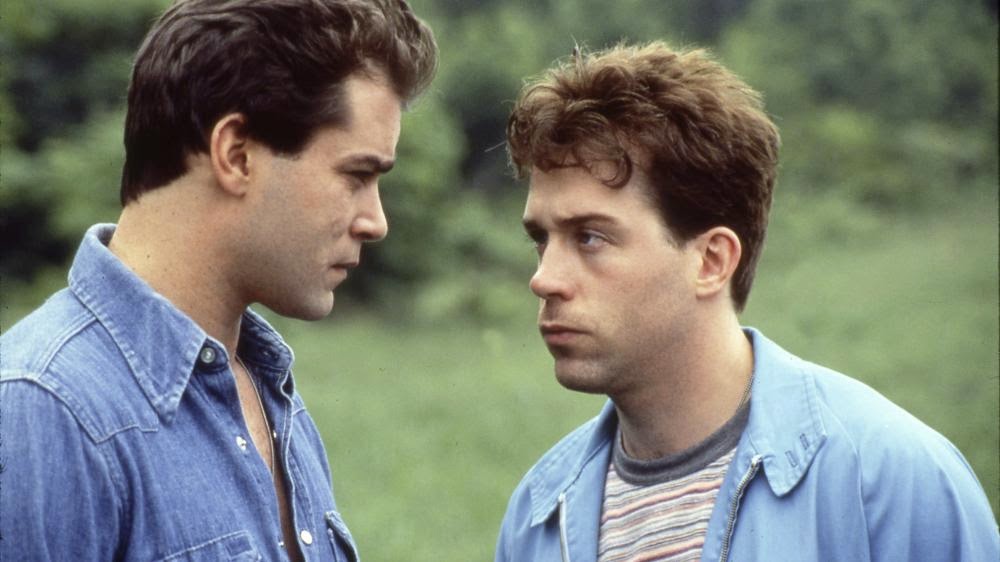
I recently found a local movie channel that shows more obscure films, and checking out one such sleeper just for the heck of it, I discovered this underrated drama. Dominick and Eugene seems like a prime award magnet. It features a nuanced fraternal relationship, a superb performance from an Oscar nominee (Tom Hulce), strong supporting roles for Ray Liotta and Jamie Lee Curtis, and a 100% rating on Rotten Tomatoes. Yet I’d never heard of it, and the most it received in 1988 was a Golden Globe nom for Hulce before fading away into the sea of forgotten ‘80s movies. Maybe its title was too generic, but this is a shame.

The titular duo are twins living together in Pittsburgh. Liotta is Eugene, a doctor-to-be who tries to start a relationship with a colleague (Curtis) and further his career while dealing with his mentally challenged brother. Hulce as Dominick is the star here. He is child-like, earnest, and hopelessly gullible, often falling for the tricks or suggestions of his coworker Larry and the local hoodlums, and when an idea gets in his head, he doesn’t let it go easily. Despite his disability, though, Nicky is the breadwinner, and his job as a garbage man serves to fund his brother’s education. Eugene is both protective of and frustrated by his brother, for reasons not clear at first, and life, love, and tragedy get in the way of their close relationship.

Dominick and Eugene could have drawn comparisons to the other drama about brotherly bonds and mental illness from that same year Rain Man, which did earn Best Picture and Best Actor Oscars and had far more advertising and better known stars. Hulce can’t quite compare with Dustin Hoffman’s role there (few can), but his fragile and earnest performance surely deserved more attention. One scene in particular stood out to me, as the camera centers on Hulce’s first-person view and reaction to a shocking act and a personal realization. The relationship between the two brothers is both strained yet unbreakable and more believable than in Rain Man, helping Dominick and Eugene to succeed as a subtle and touching affirmation of family ties.

Best line: (Dominick, who is a Christian but discouraged, looking at a crucifix) “If I was God, I wouldn’t let that happen to my boy.”


Rank: List-Worthy (tied with Rain Man)


© 2016 S. G. Liput

361 Followers and Counting


The Miracle Worker (1962)

15 Sunday Nov 2015

Posted by sgliput in Movies, Poetry, Reviews, Writing

≈ 3 Comments

Tags

Drama, History, Triple A

Darkness in the light of day,
Silence in the loudest noise.
Close and also faraway,
Vacant at the gladdest joys,

Only feeling with the hand,
Needing, taking in the dark,
Slow to know or understand
And lacking means to try till hark!

A firmer hand arrives to guide,
A stronger arm, both cruel and kind,
To teach the words she’d been denied
And show them all love isn’t blind.
_________________

MPAA rating: the equivalent of G

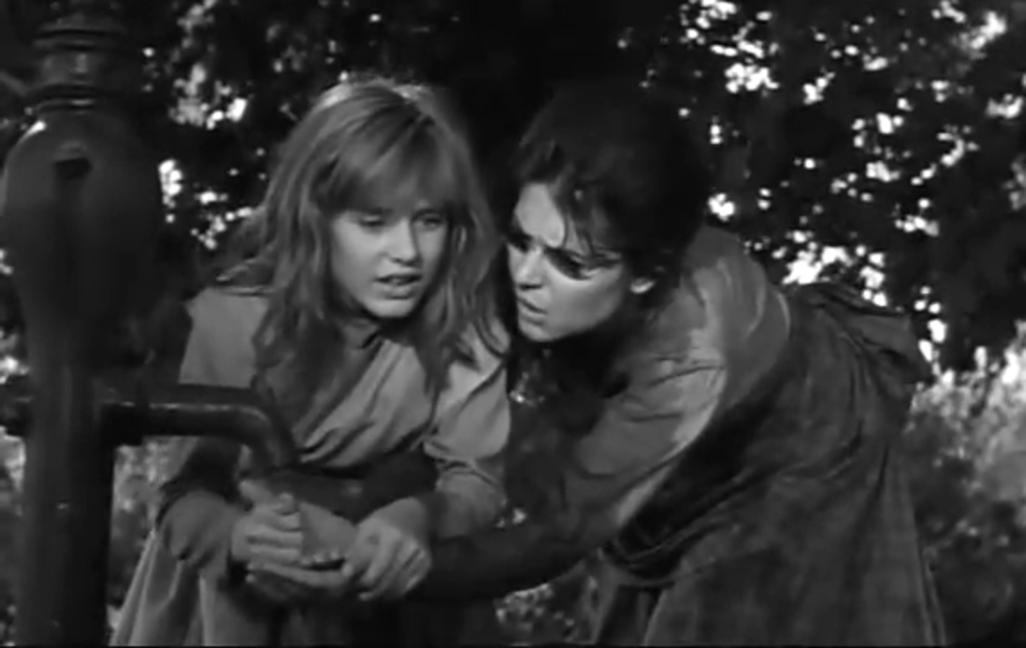
True life stories are often the most inspiring, and one of the most incredible is the life of Helen Keller. Born healthy but struck deaf and blind by a childhood infection, she grew up in total darkness, knowing the world solely through touch. She had no concept of light or love or even that objects had names, and yet she grew to be an accomplished author and lecturer (and apparently introduced the Akita dog to the U.S. Who knew?). As I read her autobiography The Story of My Life, her diction and facility of language make it hard to believe that she once had no understanding of it whatsoever. Her story is and has been a true inspiration for the handicapped, and The Miracle Worker brilliantly presents her difficult early years.

Both Patty Duke and Anne Bancroft won Oscars for their surprisingly physical roles, Duke as the young Keller and Bancroft as her tenacious teacher Anne Sullivan. The film very much reflects Keller’s memoirs, focusing solely on her tumultuous childhood and initial relationship with Sullivan. Duke acts convincingly detached as she gropes her way along, oblivious to the significance of what she touches yet petulant and violent when annoyed. She grabs food from others’ plates and locks people in rooms, while her parents cite her handicaps as a good reason to tolerate her behavior. Enter Ms. Sullivan. Her history with blindness gives her a special sympathy, yet her Irish temperament puts her at odds with Helen’s surliness and her parents’ enabling. Bancroft in particular deserved her Oscar; she exhibits the patience of Job as she reins Helen in, wrestles with her just to get her to hold a spoon, and deals with the uncertainty of teaching a seemingly unteachable pupil.

Boasting a 100% on Rotten Tomatoes, The Miracle Worker depicts quite the extraordinary relationship between a student who doesn’t know how to be taught and a teacher who sees potential no one else can. After an initially overacted introduction, everyone slips into perfectly natural roles from Helen’s antagonistic father (Victor Jory) to her concerned mother (Inga Swenson), all dwarfed by the two lead performances. When that “ah-ha” moment finally arrives with the hard-won breakthrough, the celebration feels genuine and earned and meant as only the beginning of Helen’s progress. It’s interesting to note that while Patty Duke won an Oscar playing Keller, she later won an Emmy playing Ms. Sullivan, opposite Little House on the Prairie’s Melissa Gilbert. Whenever an uninformed viewer wonders who that woman on the Alabama state quarter was, The Miracle Worker will give them a new appreciation for Helen Keller and the educator who opened the world to her.

Best line: (Anne) “It’s less trouble to feel sorry for her than it is to teach her anything better.”

Rank: List-Worthy

© 2015 S. G. Liput

344 Followers and Counting

Ordinary People (1980) / Colorful (2010)

13 Sunday Sep 2015

Posted by sgliput in Movies, Poetry, Reviews, Writing

≈ 5 Comments

Tags

Animation, Anime, Drama, Triple A

So many reasons to throw in the towel,
To give up the ghost or abandon all hope.
Most are ignored with a tear or a scowl,
But some pile up on the few who can’t cope.
Life can be cruel, like the people who fill it,
But there are more ways to improve it than death.
Life can be bright for the people who will it,
Who see all the reasons to take their next breath.
_______________

Ordinary People’s Rating: R (for language)
Colorful’s Rating: PG-13 (for thematic material)

I haven’t done a double review since my comparison of I Am Legend and World War Z, and I thought it was about time for another, especially because I’ve found two similar films of late. It may seem odd to compare an Oscar-winner from 1980 with a recent anime film that few outside of Japan have heard of, but both movies share a particularly moving brand of family drama, depicted through the experiences of a suicidal boy.

Ordinary People marked the directorial debut of Robert Redford and also confirmed that Mary Tyler Moore could handle much more dramatic roles than her comedic TV persona. A favorite of my VC’s and what I term a AAA movie (because it’s All About the Acting), the Best Picture winner of 1980 features Timothy Hutton as Conrad Jarrett, a troubled boy who seems perfectly ordinary on the outside, as does his encouraging father (Donald Sutherland) and distant mother (Moore). He’s part of the choir, he’s on the swim team, and his parents go to dinner parties. Yet behind this ordinary façade lie demons that led him to try to take his own life. Through the insight of a psychiatrist (Oscar nominee Judd Hirsch), feelings of guilt and love are exposed like a raw nerve, and his relationships are both strengthened and strained by his coming to terms with the past. The powerful scenes between Conrad and Dr. Berger won Hutton a Best Supporting Actor Oscar and foreshadowed similar psychiatric purging in films like Good Will Hunting. In addition, the tension between Conrad and his glacial mother is both pitiable and realistic, especially for those who have endured similar indifference from a parent. While trauma endures and relationships are not all wrapped up cleanly with a bow by the end, there is hope that happiness and recovery are attainable for those who can let go of the past. (It was also interesting seeing early roles for Adam Baldwin and [Lost alert] Fredric Lehne.)

Colorful, which was nominated as an Excellent Animation of the Year at the 2010 Japanese Academy Awards, begins with an unnamed sinful soul in the afterlife being given a second chance. He is to be placed in the body of a boy named Makoto who committed suicide and will be given a limited time to make amends for his own past sins while learning why Makoto killed himself. This Quantum Leap-inspired premise is consistently intriguing as the new Makoto struggles to adapt to his new environment while being somewhat guided by an invisible “angel” of sorts (similar to the hologram Al). He learns that his mother had an affair and that his middle school crush is no better morally, and bullying played a role as well. Whereas Ordinary People pits the mother against the son, here it is “Makoto” who will not forgive his mother, always believing the worst of her and of most people, until he begins to look past himself.

Unlike Ordinary People, though, Colorful has some very apparent flaws, mainly in the character interactions. While the rotoscoped backgrounds are quite realistic, many conversations are strangely stilted in ways that go beyond the average English dub, particularly in scenes with an awkward girl who won’t leave Makoto alone. Yet, while I was considering writing the film off for its weaknesses, its poignant strength sneaked up on me. The pacing is slow and sometimes dragged out, but tension often emerges in quiet ways, in contrast to the emotional fireworks of Ordinary People. Characters that initially seem odd or distant turn out to have much more depth, and the eventual familial catharsis was disarmingly powerful. Despite its faults, Colorful boasts the kind of emotions that would probably earn acting Oscars if adapted properly to live action.

While these two films may seem very different visually, both Ordinary People and Colorful feature ultimately life-affirming messages in the wake of attempted suicide. While the former explores survivor guilt and loveless parents, the latter depicts the difficulty of forgiveness and the cost of infidelity. Both are beautiful films in their own way as they highlight how ordinary families cope with tragedy and how a single friend can make an enormous difference in one’s life.

Best line (from Ordinary People): (Dr. Berger) “A little advice about feelings, kiddo: don’t expect it always to tickle.”

Rank for Ordinary People: List-Worthy
Rank for Colorful: List Runner-Up

© 2015 S. G. Liput

338 Followers and Counting

Bottom-Dweller: One Flew over the Cuckoo’s Nest (1975)

23 Thursday Apr 2015

Posted by sgliput in Movies, NaPoWriMo, Poetry, Reviews, Writing

≈ 2 Comments

Tags

Bottom-Dweller, Drama, Triple A


When R.P. McMurphy gets bored,
He’s sent to a hospital board
To see if he’s nuts
Or just faking with guts
To reach the relaxed mental ward.
 
He starts to make unstable friends
And bucks what the nurse recommends.
Nurse Ratched cruelly
Won’t let him watch TV,
But Mac sees how far a rule bends.
 
Before ol’ Mac busts out, the bum
Carouses with each crazy chum.
When in comes the nurse,
Words and actions are terse,
But one inmate will not succumb.
___________________
 

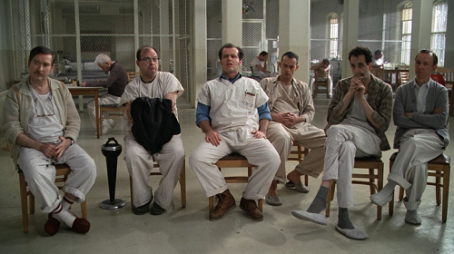
Everyone has at least one hugely acclaimed movie that they simply do not like, for whatever reason. “It’s in black and white.” “It’s too boring.” “It’s got subtitles.” “It’s too violent.” “It’s got so-and-so I dislike in it.” “It’s too long or confusing or uninvolving.” Everyone has one, and One Flew over the Cuckoo’s Nest is mine. Based on Ken Kesey’s novel, this film is an excellent example of how a bottom-dweller can be a good film and still cause a personal distaste, at least for me.

First of all, I want to point out that this film is a great one in terms of strictly filmmaking. It deserved every one of its awards and probably more. Jack Nicholson as R. P. McMurphy and Louise Fletcher as Nurse Ratched won Best Actor and Actress, and the uniformly excellent cast is a who’s who of thespians known for looking rather unhinged or crazy, such as Brad Dourif, Christopher Lloyd, and Vincent Schiavelli (the subway ghost in Ghost). Will Sampson as Chief, William Redfield as Harding, and Danny Devito as Martini are also marvelous, and Sydney Lassick as Cheswick is especially expressive with his psychosis and deserved a Best Supporting Actor Oscar nom that only Dourif received. Cuckoo’s Nest remains one of only three films to win the Big Five: Best Picture, Actor, Actress, Director (Milos Forman), and Screenplay. My objections do not involve its acting or quality, but its characters and how its message is presented.

I suppose the most troubling aspect of the film is its chosen hero and villain. The film’s sentiments obviously lie with McMurphy because he’s got a personality and enjoys the World Series, and someone with a name like Mildred Ratched must be a wretched villain, right? Yet McMurphy is established as a crook and a rapist, lazy and belligerent, right from the beginning, and he’s clearly only there at the asylum to fake his way to an easy confinement (he thinks). He’s meant to represent bucking the system, a rebel to inspire the inmates to try, yet what does he ultimately inspire them to do: chug booze, have sex, cuss like sailors, lose control, euthanize the catatonic? That’s hardly what I would call heroic. In certain scenes, he seems to care about the patients more than the cold nurses, yet he doesn’t help them any more than the staff does, except to have a bit more enjoyment through debauchery.

On the other side of the conflict is Fletcher’s Nurse Ratched, who I consider an antagonist, not a villain. She’s certainly hard-nosed, manipulative, and prone to unwise remarks that make bad situations worse, but when you think about it, she’s simply doing her job as she knows how, even displaying a sense of responsibility to her patients. Her worst moment comes near the end, where she crushes Billy Bibbit’s budding individuality under a domineering thumb, yet she couldn’t know the tragic results of her words. Plus, Billy’s fate is as much McMurphy’s fault for putting him in a situation sure to cause embarrassment in the long run. With her little devil-horn hairdo and glacial demeanor, she’s meant to represent the evil system, but the unstable people she cares for are little more than big children, unable to handle the outside world, and, in my opinion, people in need of the system. I find it laughable that AFI placed her at #5 on their list of movie villains, above truly evil characters like the Joker, Amon Goeth from Schindler’s List, or the demon in The Exorcist. Even at her worst, she’s nothing compared with them.

One Flew over the Cuckoo’s Nest is a film I can admire for its acting, but every time I think of it, the words “I don’t like it” come to mind. The painting of the irresponsible, foul-mouthed antihero as the good guy and the cold but overly demonized nurse as the bad guy makes it a distasteful experience overall. A much better example of McMurphy’s kind of “inspiring” character would be Andy Dufresne from The Shawshank Redemption. From the beginning, the audience knows (or at least assumes) that he is innocent, and his uplifting rebellion against authority is that of a wronged man yearning to be free rather than a guilty man yearning to play the system so he can continue his criminal life. Perhaps my complaints don’t matter to most. My VC agrees with most of my points, yet still finds much to enjoy, mainly in the performances. She may not classify it as such, but for me, this Oscar-winning classic is still a bottom-dweller.

Best line: (McMurphy, speaking of his shock treatments) “They was giving me ten thousand watts a day, you know, and I’m hot to trot! The next woman takes me on’s gonna light up like a pinball machine and pay off in silver dollars!”

 
Rank:  Bottom-Dweller
 

© 2015 S. G. Liput

297 Followers and Counting

#32: Driving Miss Daisy (1989)

25 Thursday Dec 2014

Posted by sgliput in Movies, Poetry, Reviews, Writing

≈ Leave a comment

Tags

Comedy, Drama, Triple A

When Miss Daisy’s car comes alive
And threatens her day to deprive,
Her son Boolie hires
The man she requires,
A black man named Hoke, who will drive.
 
Miss Daisy is opinionated
And wants things exactly as stated,
A faithful old Jew
Who resists what is new
And often leaves poor Hoke berated.
 
At last, she concedes to his aid,
For which Boolie sees he is paid.
As years pass away,
Hoke escorts her each day,
Ensuring that she is conveyed. 
 
Despite her pretentious reproach,
She bonds with the guide of her coach,
Who drives her about
And attempts to help out,
When old age and hatred encroach.
 
Her years leave Miss Daisy ablur,
And though Hoke no longer drives her,
He stays to attend
As her dearest best friend:
The old woman and her chauffeur.
_______________
 

Despite having several potentially Christmas-y films nearby on the list, none actually fell on December 25. Oh, well. Regardless, Driving Miss Daisy is a Triple A film (All About the Acting, though the AAA abbreviation is funny considering all the driving) if ever there was one, relying entirely on the amazing performances of Jessica Tandy and Morgan Freeman. Adapted from Alfred Uhry’s Off-Broadway play, the film retains Freeman from the original stage production and carries the same quiet, character-driven style and geriatric spotlight of another Triple A play adaptation On Golden Pond.

Jessica Tandy was 81 when she became the oldest Oscar winner, thanks to her portrayal of the uppity Miss Daisy, the kind of inflexible old woman who blames accidents on the car, freaks out over a missing can of salmon because it’s hers, and enjoys a nice home with a lifelong servant while taking offense at being called rich. She’s the kind of person who would, quite frankly, drive me nuts, but Morgan Freeman is the ideal companion for her, friendly, unassuming, and patient as Job. Though he lost Best Actor to Daniel Day-Lewis for My Left Foot, I do wish he had won. His folksy longsuffering becomes more and more sweet, as it progresses from just another job to a lifetime commitment on which Miss Daisy clearly relies, even if she would hate to admit it. By the end, the audience feels like they know these two dissimilar people far better than one might expect from a plot synopsis, and the film ends on a bittersweet but not morbid note, as if the writer was also too fond of the characters to let either go.

Dan Aykroyd found his best dramatic role and only Oscar nomination as Miss Daisy’s son Boolie, and Hans Zimmer’s score deserved a nomination it didn’t receive. If I had to criticize, I do wish that the progression of time had been made clearer, perhaps with subtitles explaining what year it is rather than small details, like a radio in the background, which are easy to miss. While Oliver! was the last G-rated Best Picture, Driving Miss Daisy was the last to be rated PG (though The Artist could have been rated such). While some have said it didn’t deserve to win Best Picture, I consider its simple, nuanced approach to characterization and unlikely lifelong friendships to be more than worthy.

Best line: (Idella, Miss Daisy’s maid) “I’m goin’, Miss Daisy.”
(Miss Daisy, from upstairs) “All right, Idella. See you tomorrow.”
(Hoke) “I’m goin’ too, Miss Daisy.”
(Miss Daisy) “Good!”
 
VC’s best line: (Idella, who gets some great lines, to Hoke) “I wouldn’t be in your shoes if the Sweet Lord Jesus come down and asked me himself.”
 
 
Rank: 58 out of 60
 

© 2014 S. G. Liput

275 Followers and Counting

P.S. Merry Christmas to all you readers out there! And for those who enjoy sketch comedy and poetry adaptations, here’s something I came across on YouTube. Have a laugh!

#85: Shadowlands (1993)

30 Thursday Oct 2014

Posted by sgliput in Movies, Poetry, Reviews, Writing

≈ Leave a comment

Tags

Drama, Romance, Triple A

C. S. Lewis is content to live as he has always done,
To teach and study, chat with colleagues, answer questions he presents.
He is happy to debate on arguments he knows he’s won.
Both he and Oxford rarely change, for they’ve got all the common sense.
 
Then in 1952, he meets Joy Gresham, who’s a fan,
A poet and American who leaves him speechless now and then.
Soul and intellect converge to make her special to this man,
Whose own experience with love is only in his reading den.
 
Fleeting visits with her son endear her to the author till
Divorce allows them to relocate to the London she admires.
By entreaty, Lewis marries Joy, a sign of their good will,
But even then he does not see the happiness that she inspires.
 
Sadly, Joy is cancer-stricken, and the promise of her loss
Convinces Lewis that he loves her deeply, though he knows not how.
He requests a holy marriage as he helps her bear her cross.
When she recovers for a time, they both are faithful to their vow.
 
Honeymooning is idyllic until Joy reminds instead
That as a part of happiness, they can’t ignore the coming grief.
Death arrives, and life goes on despite the tears her darlings shed.
Experience best helps us learn of truest love, however brief.
__________________
 

Shadowlands is one of the purest and most poignant of biographical romances. From the popular Narnia series to the insightful The Screwtape Letters, C. S. Lewis (Jack, to his friends) ranks among my favorite authors, and no one could bring him to life like Anthony Hopkins. Coming only two years after his star-making role in The Silence of the Lambs, there is no trace of the deranged serial killer here; instead, Hopkins embodies Lewis’s intelligence, wisdom, and genuine surprise at the advent of love. Oscar nominee Debra Winger may have seemed like an odd choice to portray his beloved Joy Gresham (pen name Joy Davidman), but their interactions have a warmth and reality that gradually morphs their professional respect into personal chemistry.

The late Richard Attenborough was a skilled director, but even his Oscar-winning Gandhi does not compare to Shadowlands. Instead of the sweeping view of a legendary life, he gives us a quiet, contemplative story of unexpected romance that, to me and my VC, is much more moving and intimate. The direction is understated but beautiful throughout, allowing emotions, reverence, and beauty to permeate every scene. On top of all that, the script is intelligent, being based on William Nicholson’s TV and stage productions.

Early monologues by Lewis establish his views on pain as “God’s megaphone to rouse a deaf world,” but he has never experienced such pain since childhood. His attachment to and loss of Joy might have made him contradict his prior beliefs, but even when his and Douglas’s faith is shaken, it isn’t repudiated. Rather, the main intellectual conflict is the disparity between knowledge and experience, without either really negating the other. It’s a classic case of “easier said than done”; philosophizing is fine on one level, but experience challenges the detached serenity with which Lewis views the world as an Oxford professor. His prior lesson still applies, but the moral difficulty of pain becomes more real when it is endured firsthand. Even when we know the suffering yet to come, we love anyway, a mystery of being human that even Lewis could not fully explain.

At the beginning, the film claims that “This is a true story,” which is only mostly true. It does omit Joy’s other son David Gresham, only depicting the more well-known Douglas (played by young Joseph Mazzello, who was in Jurassic Park that same year). Also, the film focuses on Lewis’s academic and personal life without touching on his literary life: he published numerous books during the film’s events, including several Narnia installments. Even so, the story is undeniably powerful, though it is rather slow and best watched when one is fully awake, eating, or both. My VC, who “adores” Anthony Hopkins in this rare romantic leading role, would rank Shadowlands in her top 50 and just recently was able to view it without crying. Beautiful and heartbreaking, Shadowlands is Attenborough’s masterpiece.

Best line: (Harry, a friend) “Christopher can scoff, Jack, but I know how hard you’ve been praying, and now God is answering your prayers.”   (Lewis) “That’s not why I pray, Harry. I pray because I can’t help myself. I pray because I’m helpless. I pray because the need flows out of me all the time, waking and sleeping. It doesn’t change God; it changes me.”

VC’s best line: (Lewis, to Joy) “Will you marry this foolish, frightened old man… who needs you more than he can bear to say… who loves you, even though he hardly knows how?”

 
Rank: 54 out of 60
 

© 2014 S. G. Liput

235 Followers and Counting


#94: The Pursuit of Happyness (2006)

19 Sunday Oct 2014

Posted by sgliput in Movies, Poetry, Reviews, Writing

≈ Leave a comment

Tags

Drama, Triple A

Though Christopher Gardner desires success
And actively tries to pursue happiness,
He seems to be caught in a permanent rut;
The doors of reality always slam shut.
 
The debts and the taxes are piling up;
His wife’s irritation is dialing up.
He tries to sell bone scanners, plugging away,
Yet nothing pans out by the end of the day.
 
At last, his wife leaves and announces she’s done,
But Chris will not let her escape with his son.
Insisting he’ll care for him, Christopher starts
An internship in all the stockbroking arts.
 
Unfortunately, training there is unpaid;
For six months, he trusts in the scanner sales trade.
When IRS claims leave him suddenly broke,
He’s forced into lines with the destitute folk.
 
He’s forced to work harder than fellow interns,
Employing charisma and methods he learns.
Pursuit of his happiness ends in frustration;
It’s nowhere as easy as in the quotation.
 
Yet through all the heartache and difficult trials,
The proneness to tears and the fakeness of smiles,
He merits the job, chances twenty to one,
And “happyness” happens, for him and his son.
_________________
 

The American dream is a unique hope, a driving force of immigration to this country and an enduring promise to those harboring yet-unfulfilled ambitions. In most films, success comes fairly easily, through situations either comedic (The Secret of My Success) or dramatic (Citizen Kane). No film I’ve seen captures the true difficulty of success as powerfully as The Pursuit of Happyness.

Portraying real-life homeless-man-turned-success-story Chris Gardner, Oscar nominee Will Smith’s finest and most sensitive performance provides the heart of the film. His retrospective narration and recognition of mistakes add to the film’s structure, which is essentially one man’s efforts to survive between an unpaid job, fatherhood, and homelessness. Quite frankly, most of the film is intensely depressing. Many times when Chris seems to be on the verge of a turning point for improvement, circumstances decline even further; opportunities become disappointments, and hopes become letdowns. “Happyness” (a misspelling seen on his son’s daycare mural) seems always out of reach. Yet through all of these obstacles, Chris himself is an entirely admirable father, long-suffering and tenacious, the kind of guy the audience can root for without reservation. Smith’s on-screen relationship with his real son Jaden is genuine throughout, and there’s never any doubt about Chris’s paternal love.

At times, the film is reminiscent of Kramer vs. Kramer; there’s even an exchange in which the son wonders if Mommy left because of him, only to be reassured by Dad. Yet, whereas Ted Kramer had much to learn about fatherhood and needed to fight to keep his son, Chris Gardner was already an ideal father and was forced to fight for a bed, a meal, and a future. While Kramer’s happy ending was essentially an act of goodwill from his ex-wife, Chris’s final success was hard-fought and satisfying. The moment when he finally gets the well-paid stockbroker position for which he had only hoped for the last six months is a quiet, understated scene that pulls at the heartstrings in a legitimately deserved way, like when Rudy earns admission to Notre Dame in Rudy. It’s a brief realization of “happyness” that makes all the inordinate hardships and struggles he endured at last worthwhile. The Pursuit of Happyness depicts the highs and lows of the American dream, which, though elusive, is eminently gratifying when achieved.

Best line: (Mr. Frohm, when Chris is forced to show up to an interview underdressed) “What would you say if a man walked in here with no shirt, and I hired him? What would you say?” (Chris Gardner, after a moment of thought) “He must have had on some really nice pants.”

 
Rank: 53 out of 60
 

© 2014 S. G. Liput

229 Followers and Counting


← Older posts
Newer posts →

Recent Posts

  • We Didn’t Start 2025 (Recap)
  • NaPoWriMo 2025 Recap (Finally)
  • Sonic the Hedgehog 3 (2024)
  • It Happened One Night (1934)
  • Spellbound (2024)

Recent Comments

associatesofshellymann's avatarassociatesofshellyma… on My Top Twelve La La La So…
Kit's avatarKit Nichols on Bonnie and Clyde (1967)
lifelessons's avatarlifelessons on Look Back (2024)
Carol Jackson's avatarCarol Jackson on The Thief of Bagdad (1940…
Stephen's avatarStephen on Love Story (1970)

Archives

  • January 2026
  • December 2025
  • May 2025
  • April 2025
  • March 2025
  • February 2025
  • January 2025
  • December 2024
  • May 2024
  • April 2024
  • March 2024
  • February 2024
  • January 2024
  • December 2023
  • November 2023
  • October 2023
  • September 2023
  • July 2023
  • June 2023
  • May 2023
  • April 2023
  • March 2023
  • February 2023
  • January 2023
  • December 2022
  • November 2022
  • October 2022
  • September 2022
  • August 2022
  • July 2022
  • June 2022
  • May 2022
  • April 2022
  • March 2022
  • February 2022
  • January 2022
  • December 2021
  • November 2021
  • October 2021
  • September 2021
  • August 2021
  • July 2021
  • June 2021
  • May 2021
  • April 2021
  • March 2021
  • February 2021
  • January 2021
  • December 2020
  • November 2020
  • October 2020
  • September 2020
  • August 2020
  • July 2020
  • June 2020
  • May 2020
  • April 2020
  • March 2020
  • February 2020
  • January 2020
  • December 2019
  • November 2019
  • October 2019
  • September 2019
  • August 2019
  • July 2019
  • June 2019
  • May 2019
  • April 2019
  • March 2019
  • February 2019
  • January 2019
  • December 2018
  • November 2018
  • October 2018
  • September 2018
  • August 2018
  • July 2018
  • June 2018
  • May 2018
  • April 2018
  • March 2018
  • February 2018
  • January 2018
  • December 2017
  • November 2017
  • October 2017
  • September 2017
  • August 2017
  • July 2017
  • June 2017
  • May 2017
  • April 2017
  • March 2017
  • February 2017
  • January 2017
  • December 2016
  • November 2016
  • October 2016
  • September 2016
  • August 2016
  • July 2016
  • June 2016
  • May 2016
  • April 2016
  • March 2016
  • February 2016
  • January 2016
  • December 2015
  • November 2015
  • October 2015
  • September 2015
  • August 2015
  • July 2015
  • June 2015
  • May 2015
  • April 2015
  • March 2015
  • February 2015
  • January 2015
  • December 2014
  • November 2014
  • October 2014
  • September 2014
  • August 2014
  • July 2014
  • June 2014
  • May 2014
  • April 2014
  • March 2014
  • February 2014
  • January 2014
  • December 2013

Categories

  • Blindspot
  • Blogathon
  • Christian
  • Movies
  • Music
  • NaPoWriMo
  • Poetry
  • Reviews
  • TV
  • Writing

Meta

  • Create account
  • Log in
  • Entries feed
  • Comments feed
  • WordPress.com

Recent Posts

  • We Didn’t Start 2025 (Recap)
  • NaPoWriMo 2025 Recap (Finally)
  • Sonic the Hedgehog 3 (2024)
  • It Happened One Night (1934)
  • Spellbound (2024)

Recent Comments

associatesofshellymann's avatarassociatesofshellyma… on My Top Twelve La La La So…
Kit's avatarKit Nichols on Bonnie and Clyde (1967)
lifelessons's avatarlifelessons on Look Back (2024)
Carol Jackson's avatarCarol Jackson on The Thief of Bagdad (1940…
Stephen's avatarStephen on Love Story (1970)

Archives

  • January 2026
  • December 2025
  • May 2025
  • April 2025
  • March 2025
  • February 2025
  • January 2025
  • December 2024
  • May 2024
  • April 2024
  • March 2024
  • February 2024
  • January 2024
  • December 2023
  • November 2023
  • October 2023
  • September 2023
  • July 2023
  • June 2023
  • May 2023
  • April 2023
  • March 2023
  • February 2023
  • January 2023
  • December 2022
  • November 2022
  • October 2022
  • September 2022
  • August 2022
  • July 2022
  • June 2022
  • May 2022
  • April 2022
  • March 2022
  • February 2022
  • January 2022
  • December 2021
  • November 2021
  • October 2021
  • September 2021
  • August 2021
  • July 2021
  • June 2021
  • May 2021
  • April 2021
  • March 2021
  • February 2021
  • January 2021
  • December 2020
  • November 2020
  • October 2020
  • September 2020
  • August 2020
  • July 2020
  • June 2020
  • May 2020
  • April 2020
  • March 2020
  • February 2020
  • January 2020
  • December 2019
  • November 2019
  • October 2019
  • September 2019
  • August 2019
  • July 2019
  • June 2019
  • May 2019
  • April 2019
  • March 2019
  • February 2019
  • January 2019
  • December 2018
  • November 2018
  • October 2018
  • September 2018
  • August 2018
  • July 2018
  • June 2018
  • May 2018
  • April 2018
  • March 2018
  • February 2018
  • January 2018
  • December 2017
  • November 2017
  • October 2017
  • September 2017
  • August 2017
  • July 2017
  • June 2017
  • May 2017
  • April 2017
  • March 2017
  • February 2017
  • January 2017
  • December 2016
  • November 2016
  • October 2016
  • September 2016
  • August 2016
  • July 2016
  • June 2016
  • May 2016
  • April 2016
  • March 2016
  • February 2016
  • January 2016
  • December 2015
  • November 2015
  • October 2015
  • September 2015
  • August 2015
  • July 2015
  • June 2015
  • May 2015
  • April 2015
  • March 2015
  • February 2015
  • January 2015
  • December 2014
  • November 2014
  • October 2014
  • September 2014
  • August 2014
  • July 2014
  • June 2014
  • May 2014
  • April 2014
  • March 2014
  • February 2014
  • January 2014
  • December 2013

Categories

  • Blindspot
  • Blogathon
  • Christian
  • Movies
  • Music
  • NaPoWriMo
  • Poetry
  • Reviews
  • TV
  • Writing

Meta

  • Create account
  • Log in
  • Entries feed
  • Comments feed
  • WordPress.com

Blog at WordPress.com.

Is this your new site? Log in to activate admin features and dismiss this message
Log In
  • Subscribe Subscribed
    • Rhyme and Reason
    • Join 814 other subscribers
    • Already have a WordPress.com account? Log in now.
    • Rhyme and Reason
    • Subscribe Subscribed
    • Sign up
    • Log in
    • Report this content
    • View site in Reader
    • Manage subscriptions
    • Collapse this bar