• Home
  • About Me
  • The List
  • THE LIST (2016 Update)
  • THE LIST (2017 Update)
  • THE LIST (2018 Update)
  • THE LIST (2019 Update)
  • THE LIST (2020 Update)
  • THE LIST (2021 Update)
  • THE LIST (2022 Update)
  • Top Twelves and More
  • The End Credits Song Hall of Fame

Rhyme and Reason

~ Poetry Meets Film Reviews

Rhyme and Reason

Tag Archives: Sci-fi

Suicide Squad (2016)

11 Friday Nov 2016

Posted by sgliput in Movies, Poetry, Reviews, Writing

≈ Leave a comment

Tags

Action, Sci-fi, Superhero, Thriller

Image result for suicide squad film


Evil is as evil does,
And evil doesn’t mind because
While good is following the rules,
The baddies laugh them off as fools.

To be a nut or psychopath,
You dwell in envy, greed, and wrath
And do your best to put the pest
Of conscience finally to rest.

Despite the evil laugh and smirk,
A qualm or two may be at work.
Though hearts of darkness look askance,
Perhaps the good just needs a chance.
_________________

MPAA rating: PG-13

Suicide Squad proves that an awesome trailer does not always mean an awesome movie. Like many, I was disappointed with the dreary excesses of Batman v. Superman and had real hope that Suicide Squad would be a much-needed dose of cheeky fun for the DC Extended Universe. While it could be seen that way, the packaging leaves much to be desired. Suicide Squad continues the DC trend of jamming as many plots and characters as possible into a feature-length film and never reaching the full potential of any of them. I keep coming back to what one of my coworkers said after watching it. As a DC purist, she excitedly announced, “That movie was… [I expected descriptors like “awesome,” “thrilling,” “hilarious,” but no, she said] …not bad.” Okay, I’ll give her that.

Suicide Squad is DC’s version of The Dirty Dozen. Ruthless government official Amanda Waller (Viola Davis) decides to recruit the most skilled prisoners of Belle Reve Prison as an insurance policy against rogue metahuman threats, one of which crops up from her own meddling with supernatural beings. I have to admit that it’s a talented cast they’ve assembled here. Will Smith as gunmeister Deadshot could be considered the heart of the team, with his concern for his young daughter, and Smith’s natural likability makes him the most sympathetic of the group, along with Jay Hernandez’s fire-wielding Diablo. Margot Robbie gets all of the attention as bat-crazy Joker groupie Harley Quinn, while Adewale Akinnuoye-Agbaje (Lost alert!) and Jai Courtney can’t quite represent Killer Croc and Captain Boomerang as more than one-note characters with some occasional comic relief. And that’s not even mentioning team chaperone Rick Flag (Joel Kinnaman), his dark-sided lover June Moone/Enchantress (Cara Delevingne), his sword-swinging bodyguard Katana (Karen Fukuhara), and one other member of the Squad who is given such little attention that he might as well have “REDSHIRT” taped to his back. Oh, and wasn’t the Joker in this too?

Image result for suicide squad film diablo

Let’s be honest: this is DC trying to do what Marvel did with Guardians of the Galaxy, teaming up purported baddies as a ragtag fighting force that falls somewhere in between the definitions of “hero” and “anti-hero.” Guardians succeeded with that middle ground, thanks to the fact that one was repentant, one was driven by grief until a moment of realization, and the other three weren’t all that bad at heart, but Suicide Squad stumbles by giving us actual villains without much in the way of reform. This commitment to anti-heroism leaves the audience grasping for someone to root for. Every time you start sympathizing with a character, you’re reminded that they’re an unrepentant psychopath or a brutal enforcer, and that’s supposedly okay? Waller herself is no better than her minions, willing to kill her subordinates without a second glance or any repercussions.

The tone and look of the film also fall short of the mark. The special effects are top-of-the-line, but the editing and visual aesthetic are frequently choppy and muddled. What was intended as gritty, fun, and irreverent turns out to be loud, garish, and confusing. Perhaps the latest version of the Joker exemplifies the film’s unsavory aspects. Jared Leto is not a bad actor, but as the Joker, he’s no Heath Ledger or Jack Nicholson. Instead of the maniacal jokester we’ve come to expect, he’s basically a gaudy gangster whose craziness fails to stand out from that of the other characters. While some have complained about his limited screen time, I didn’t mind.

Image result for suicide squad film joker

It wasn’t my intention for this to be an entirely negative review. Suicide Squad is not without its strengths; they’re just buried in the mountain of plot that the filmmakers couldn’t bear to part with. While Deadshot and Harley Quinn have received most of the acclaim, I preferred some of the less developed characters. Diablo’s remorse for his past misdeeds made him the most admirable of the group, coupled with some cool powers, and I would have liked to have seen more of Katana and her soul-capturing sword. One moment of hallucinations revealed the positive dreams that even villains have, and I wish they could have built on that source of sympathy. Flashbacks aside, the plot actually made for a decently paced action movie, even if it yielded to the familiar overblown climax toward the end. And though there was nothing laugh-out-loud, I suppose I appreciate the fact that Suicide Squad wasn’t afraid to chuckle at itself. Plus, it at least didn’t have any obviously stupid twist like Batman v. Superman.

I wanted to enjoy Suicide Squad more than I did, but while my respect for many films often increases with time and thought, this one has actually lessened in my estimation the more I think of it. It’s not terrible, just muddy and flawed. DC may still be a powerhouse moneymaker, but if they can’t churn out a better superhero movie soon, they won’t have the longevity of Marvel. Wonder Woman looks pretty darn good at this point, and I just hope that the trailer is actually a good representation next time.

Best line: (Griggs, a petty prison guard afraid of Deadshot) “Ames, If this man shoots me, I want you to kill him, and I want you to go clear my browser history.”


Rank: Honorable Mention (only because I’d probably see it again)


© 2016 S.G. Liput
421 Followers and Counting
 

Star Trek Beyond (2016)

18 Tuesday Oct 2016

Posted by sgliput in Movies, Poetry, Reviews, Writing

≈ Leave a comment

Tags

Action, Drama, Sci-fi, Thriller

Image result for star trek beyond

Space, the final frontier
Entices the brave pioneer.
Adventures await
When cadets graduate
At the start of a thrilling career.

Yet in between alien wars
And interdimensional doors,
The truth is that space
Can be one boring place
For a hero in search of encores.

Sometimes a more perilous foe
Must devastate our status quo,
Reminding us why
We decided to fly
And where we’re committed to go.
_____________________

MPAA rating: PG-13

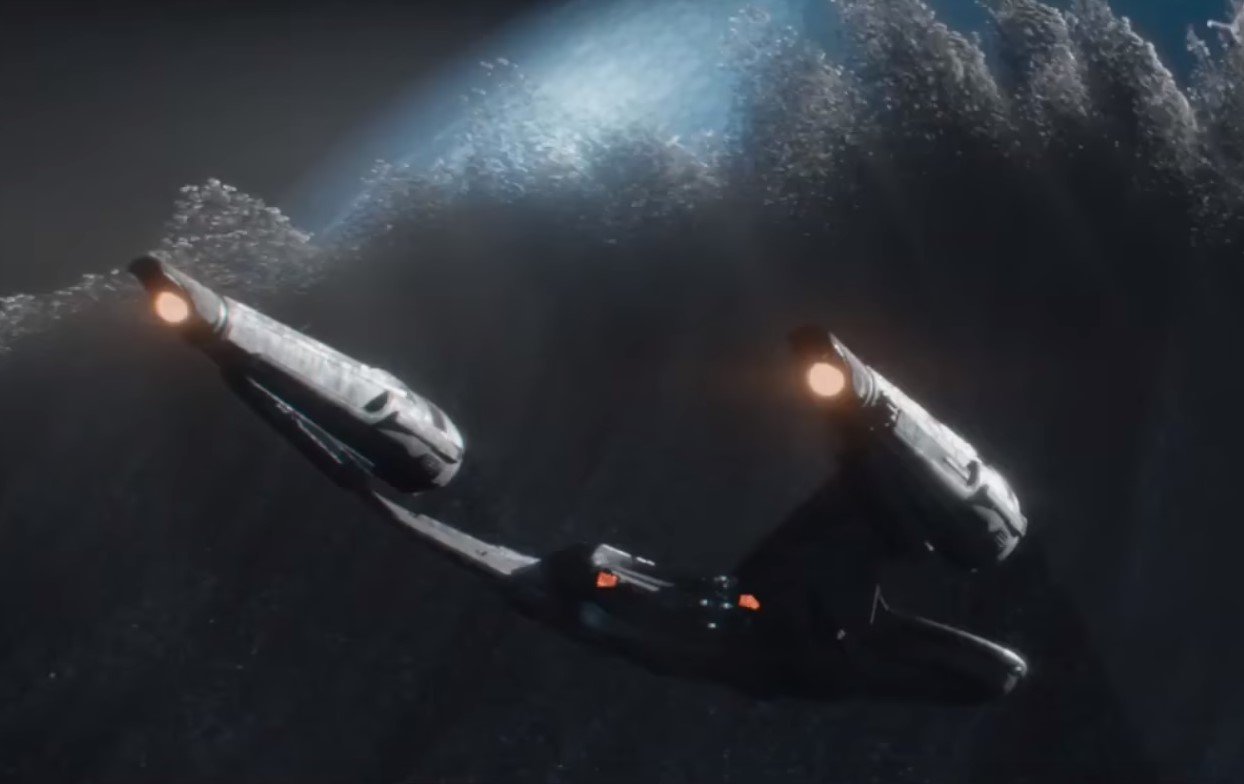
After the rebooted Star Trek had its glorious return in 2009 and its original-continuity-referencing sequel in 2013, it’s logical that the filmmakers for its third entry asked “What next?” Surely they thought it wise to distance Star Trek Beyond from the original series timeline and stories that so influenced the first two, and I’m glad to say they succeeded. Star Trek Beyond feels like it’s settled into the story-of-the-week format that the series had, and this particular story both references that potentially dull routine and spices it up with audacious sights we’ve never seen before.

The famous characters have already been established in prior films and pop culture, so the film doesn’t spend much time on new character development (aside from the brief but unnecessary implication that Sulu is gay). Yet the film still finds a way to insert emotional weight at the beginning, from a much more mature Kirk (Chris Pine) dealing with how the thrill is gone to Spock (Zachary Quinto) getting some sad news. We also get to see the eye-popping Yorktown, a space station so futuristically cool it makes you wonder why we’ve never seen it before in the Star Trek universe (though it does have visual echoes of Inception and Upside Down).

This setup is rather slow at the start, but once the action starts, it doesn’t let up. Before you know it, a swarm of bee-like ships are crashing into the Enterprise’s hull, and all hell breaks loose. Much of the crew become stranded on a nearby planet, hunted by a mysterious alien named Krall (Idris Elba). To make sure everyone in the ensemble gets their fair share of screen time, they’re split into twos, a method that works rather well in spreading the characters out and exposing them to different elements relevant to the plot. Also added is Sofia Boutella as another stranded ally named Jaylah, who helps the crew battle Krall.

Image result for star trek beyond

Being a fan of Star Trek: Voyager, I noticed that this latest film seemed to draw some inspiration from that show. In the third season episode “The Swarm,” Voyager runs into a fleet of small swarming ships not unlike Krall’s armada, and they even defeat the swarm in a similar manner, though admittedly with less style. Voyager also seemed to have more episodes where one or two crew members were stranded on alien planets, making that aspect of the film also feel more familiar.

Even more than the others, Star Trek Beyond is an action movie, with new director Justin Lin bringing some flair from his experience with the Fast and Furious franchise. The camerawork makes the running and explosions a bit more frenetic and hard to follow at times, but there’s no shortage of dynamic thrills. Several impressive scenes and set pieces just left me saying “Dang!” (in a good way, of course), though if there was any Trek movie I would not want to be a redshirt in, this is it. The effects are still awesome to behold, not least of which is “that scene,” the one so many reviewers have noted as being particularly over-the-top, for good or ill. I for one thought it was brilliant and spectacular, especially on the big screen, as well as a nice musical callback to the 2009 film.

The only place Star Trek Beyond seriously stumbled was the villain. Elba is all right as Krall, though hard to understand at times, but his character’s backstory was far too ambiguous. Why did he look the way he did? Where did the fleet of alien ships come from? I’m not sure if these questions were answered and I missed it, or if the writers just glossed over those details. Either way, it could have been clearer.

Of the reboot trilogy, I still love the first most, but Star Trek Beyond is just as good and more original than Into Darkness. Couple the rousing action with the bittersweet tributes to deceased cast members Leonard Nimoy and Anton Yelchin, and Beyond becomes a well-rounded addition to the Trek canon. Yelchin’s death, in particular, throws the future of the series into doubt, but I certainly hope that there are more Star Trek stories to tell.

Best line: (Krall) “You can’t stop it. You will die.”   (Kirk) “Better to die saving lives, than to live by taking them. That’s what I was born into.”


Rank: Top-100-Worthy (Joining Star Trek into Darkness)


© 2016 S.G. Liput
413 Followers and Counting


Cartoon Comparisons: Upside Down (2012) / Patema Inverted (2014)

15 Thursday Sep 2016

Posted by sgliput in Movies, Poetry, Reviews, Writing

≈ 2 Comments

Tags

Animation, Anime, Cartoon Comparisons, Drama, Romance, Sci-fi

Image result for upside down 2012 film

Image result for patema inverted


Right-side up is upside down
To those who smile when they frown,
To those who plunge whene’er they jump
Or rise when tripping on a bump
Or gobble down and up their meals
And sink a little in high heels,
To those who elevate a bit
If they lean over, kneel, or sit,
To those who set a precedent
When they descend on their ascent.
Up and down can be subjective.
‘Tis a matter of perspective.
____________________

MPAA rating for Upside Down: PG-13
MPAA rating for Patema Inverted: should be PG

For the next Cartoon Comparison, I’ve chosen two science fiction films with wildly imaginative concepts that happen to be suspiciously similar. Both the live-action Upside Down from Canada and the anime Patema Inverted from Japan feature the idea of opposite gravities: people walking on the ceilings, objects falling up, and the unlikelihood of two oppositely oriented young people overcoming the hatred of their politically hostile worlds. What differs is the way their worlds interact and the pseudo-scientific “explanation” for the curious gravitational situation.

Upside Down came first so if there was any copying being done, the live-action film can claim to be the original. Here, as explained by the narration of Adam (Jim Sturgess), two planets orbit each other so closely that there is essentially no sky. Looking up from either world, one simply sees the other planet’s surface, about as far away as a skyscraper, echoing perhaps the folding city street in Inception. One planet is considered Up Top, full of wealth and societal power, while the other is the economically exploited Down Below, though there’s no telling how they were named, considering the potential confusion of “up” and “down.” Luckily, the extraordinary visuals elevate the film’s none-too-subtle class struggle. Even if there were moments that I wasn’t sure what I was seeing at first, the remarkable effects were a marvel to the eye.

Image result for upside down 2012 film

As for the love story, Adam from Down Below happens to meet Eden (Kirsten Dunst) from Up Top, and they share remote romantic rendezvous in the mountains until the government breaks them apart. Years later, as Adam experiments with a practical anti-gravity serum, he seizes a chance to see Eden again at Transworld, the tower-like corporate bridge between the two worlds. The two leads certainly have chemistry, but due to a certain plot point, they don’t get to take much advantage of it, and Sturgess’s behavior can be awkward at times.

Yet Adam’s quest to reunite with Eden without being caught by the authorities leads to a good deal of inventiveness, such as his attempt to weigh himself “up” and pose as a citizen of Up Top. Unfortunately, logic gets in the way at times, including the film’s own invented gravitational rules. For instance, Adam never seems to have a problem with the blood flowing to his head when upside down. Wouldn’t that be both uncomfortable and a possible give-away to anyone who might notice? In addition, one of the planetary laws is that matter from opposite worlds eventually burns, but the time it takes for this to happen seems inconsistent. By film’s end, the conclusion is peculiarly rushed, offering a blanket resolution to crucial issues it couldn’t hope to address and doesn’t try. Upside Down is brilliant in concept, less so in execution, but the visuals alone are worth the watch.

Image result for upside down 2012 film adam and eden

Upside Down may have come first, but Patema Inverted utilizes the notion of inverse gravity far better, in my opinion. Perhaps the fantastical image of falling up is simply more credible in animation rather than live-action CGI, but it certainly captured the imagination of director Yasuhiro Yoshiura, who previously directed the compelling series-turned-movie Time of Eve. (I was impressed by both Patema and Time of Eve separately but didn’t realize till afterward that they shared the same director.)

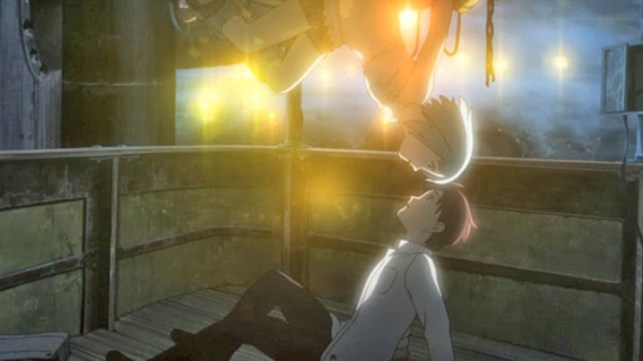
Instead of the up-front exposition of Upside Down, Patema Inverted takes its time to show and develop the gravitational anomalies as the characters discover them. Patema is a girl living in a City of Ember-like underground bunker and seems to be one of the few inhabitants to show an interest in the Forbidden Zone, where dust floats upward and “bat people” are rumored to lurk. After a close encounter, she finds herself dangling from a fence with the sky looming “below” her. Luckily, she is saved by the equally curious surface boy Age, who seems upside down to her. Age lives under a totalitarian dystopian government, whose leader is determined to root out the surviving inverts, who made their way underground after a catastrophic accident sent most of them falling into the sky years ago.

Image result for patema inverted

Upside Down basically lacked any sky; there was only so far someone could fall. Patema Inverted, however, makes the sky an imposing threat, a beautiful but dangerous abyss ready to swallow Patema without Age’s assistance. The animation is frequently dazzling, especially when the point of view shifts to contrast Age’s perspective with Patema’s. As Patema ventures into Age’s world and he ventures into hers, the distinction of up and down becomes fluid. The plot even takes some initially confusing twists that challenge the viewer’s perceptions and require some extra thought to fully comprehend. Some might be befuddled, but I found it fascinating. Plus, the musical score is enchanting and perfectly complements the film, including the gorgeous credits song “Patema Inverse,” which is sung in Esperanto and earns a place in the End Credits Song Hall of Fame. Between this and Time of Eve, I’m definitely hoping that Yoshiura continues to create such intriguing films.

I will admit that Patema Inverted seems to draw some inspiration from Upside Down. The cause of the inverted gravity differs (natural phenomenon vs. manmade disaster), but how the two gravities interact is the same: the lesser weight lightens the gravity of the other. This leads to the couples in both films holding on to each other to prevent the other from falling away, and being able to defy gravity by using each other’s weight. Writing about it doesn’t seem to do it justice, but it’s clever, cool, and undeniably similar in both films. As original as Patema Inverted is, I can’t help but wonder how much inspiration it drew from the earlier film. In addition, Patema is also rather slow in its gradual plot progression, and the villain is stereotypically bad for bad’s sake.

Image result for patema inverted


Despite these minor “down”-sides, Patema Inverted is easily the better film. Upside Down may have brought gravitational sci-fi to life first, but its conventional plot can’t compare with the thought-provoking vision of its animated counterpart.

Best line from Upside Down: (Adam) “Gravity, they say you can’t fight it. Well, I disagree. What if love was stronger than gravity?”

Best line from Patema Inverted: (Age, when holding onto Patema) “I get it! Your weight makes me light.”  (Patema) “Girls don’t like it when you talk like that!”


Rank for Upside Down: List Runner-Up
Rank for Patema Inverted: List-Worthy


© 2016 S. G. Liput
408 Followers and Counting

X-Men: Apocalypse (2016)

28 Sunday Aug 2016

Posted by sgliput in Movies, Poetry, Reviews, Writing

≈ Leave a comment

Tags

Action, Drama, Sci-fi, Superhero

Image result for x-men apocalypse film


The X-Men are back…yet again, it would seem.
Professor X still is collecting a team
Of mighty good mutants, both young men and ladies,
But what kind of evil would threaten the ’80s?

An evil so great none remember his name,
Who’s awfully annoyed at the loss of his fame
And wants to subdue the whole world since he can.
Now that’s an original motive and plan!

A good thing for us that some teens will defend us
From egos tremendous and costumes horrendous.
Destruction is nigh…yet again, it would seem,
But we know the future, so don’t worry, team.
____________________

MPAA rating: PG-13

Most were doubtful as to whether Bryan Singer could follow up the success of Days of Future Past with a worthy sequel. X-Men: Apocalypse confirmed that those doubts were not unfounded, yet this is no The Last Stand. Singer has proven that he can produce a great X-Men movie, so it stands to reason that he can also give us a mostly good one. Even if Apocalypse is the awkward third child of the most recent reboot trilogy, it still received enough care and attention to be a worthwhile member of the family.

Set in the 1980s, ten years after mutants were revealed to the world in Days of Future Past, the film reintroduces younger versions of other characters from the original trilogy: Cyclops (Tye Sheridan), Nightcrawler (Kodi Smit McPhee), Storm (Alexandra Shipp), and Jean Grey (Sophie Turner). In Cyclops’s case, we get a firsthand example of a new student being introduced to the school (through his brother Alex Summers/Havoc from First Class) and learning about his new powers, echoing the early days of Rogue’s arrival in the first X-Men. In addition, there’s quite a bit of globe-hopping, from Magneto’s too-good-to-last family life in his native Poland to Mystique’s mutant rescue missions to Moira McTaggert’s discovery of the long-dormant super-mutant known as En Sabah Nur or Apocalypse (unrecognizable Oscar Isaac). As Apocalypse gathers empowered minions to his cause of, you know, the end of the world, it’s up to the X-Men to band together and stop him.

I do want to make it clear that I enjoyed X-Men: Apocalypse, seeing all of the characters together again, the action-packed showdowns and references to other films, from Nightcrawler’s Catholicism to an explanation for Xavier’s baldness. While the reason for his presence is never really resolved, a visit from Evan Peters’ Quicksilver proved to be the highlight of the whole movie; he got the best scene in Days of Future Past, and once again his standout moment alone was worth the price of admission.

I liked a good deal of this Apocalypse, but there are some unavoidable flaws that bothered me as well. The most noticeable issue is an excess that’s hard to put into words. Certain scenes were just a bit…much. The opening scene, in which ancient Egyptian rebels bury Apocalypse under a very poorly constructed pyramid, has a lot of noise and effects without much context. Other scenes are similarly over-the-top. One big oh-no calamity is blaringly melodramatic, intercut with worldwide reactions and an extravagant “you-are-nothing-compared-with-me” speech from Oscar Isaac. Likewise, the pacing sometimes lags in the big fights as the clearly overpowered Apocalypse delivers “I-will-destroy-you” monologues while the heroes encourage each other to “release your power!” which they, of course, do. It’s rather wearisome by the end.

The other problem is one that seems to have annoyed me more than others: continuity. I love and value attention to continuity, and it’s one of the aspects that made Days of Future Past so amazing, since it delivered a satisfying and believable closure to both timelines. Yet for the events of X-Men: Apocalypse to make any sense with the original trilogy, we must assume that Days of Future Past began an alternate timeline, such that the other films never will happen or at least not as the movies depict events. In Apocalypse, characters meet when they shouldn’t yet, Wolverine shows up with Stryker in a way that seems to ignore Origins, and the writers have given up trying to make Mystique into the villain from the first X-Men. Remember that last tantalizing little Stryker/Mystique scene from the end of Future Past? It’s entirely disregarded. The other prequels had their continuity issues too, but so much in Apocalypse has to be taken separate from the other films that it indeed feels like an alternate timeline, making one wonder why Singer had to muddy the waters. I suppose that’s not hard to believe; unlike the Marvel Cinematic Universe, the X-Men films have probably gone on far longer than anyone expected them to, leading different filmmakers to essentially make it up as they go along. It’s just made more confusing for us continuity seekers when Singer actively tries to reference events that will happen, like the whole Dark Phoenix debacle.

I’m not the first to point out Jean Grey’s self-referential line as she and her friends exit a screening of Return of the Jedi: “Well, at least we can all agree the third one’s always the worst.” As X-Men films go, Apocalypse falls squarely in the middle of the pack; it’s nowhere near the best, but DC’s efforts this year have at least saved it from being labelled the worst superhero movie of 2016. As much as I enjoy these movies, I can’t help but feel that, after nine films, the X-Men franchise might be ready to end. Hugh Jackman is supposedly hanging his claws up after one more outing as Wolverine, which is allegedly set up by the after-credits scene that will make no sense to non-comic readers. There’s so much comic material still uncovered, but I wonder if the X-Men have been played out. I wish the franchise could end on a high note like Days of Future Past, but only time will tell.

Best line: (Charles, defying Apocalypse and still able to sum up the entire point of the X-Men) “Those with the greatest power… protect those without. That’s my message to the world.”


Best line: List-Worthy (joining First Class)


© 2016 S. G. Liput
404 Followers and Counting


King of Thorn (2010)

21 Sunday Aug 2016

Posted by sgliput in Movies, Poetry, Reviews, Writing

≈ Leave a comment

Tags

Action, Animation, Anime, Drama, Horror, Mystery, Sci-fi, Thriller

Image result for king of thorn film


The world was collapsing
With panic forecast
And death in the news everyday,
Yet we were persuaded
That one short sleep passed
Would sweep the dark future away.

We woke to a nightmare
More dire than the last,
Confronted and hunted and trapped.
We slept to thwart death,
Which would not be outclassed
By sleepers with secrets untapped.
________________

MPAA rating: Not Rated (should be R)

One movie-watching emotion that I especially love and rarely get the chance to experience is the feeling of having my mind blown. The best example I can point to for that would be Inception, and to a lesser extent The Prestige, both Christopher Nolan features with unspoiled twists and a provocative narrative boldness. All too often the twist is either spoiled for me (Predestination, The Sixth Sense) or it’s not all that surprising (The Usual Suspects, Interstellar), so when a film provides me with that rare blend of shock and wonder, I treasure it. King of Thorn did just that.

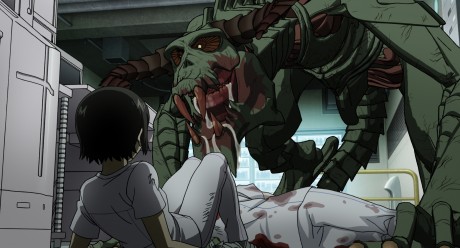
I had heard that this anime film was a combination of Inception, Aliens, and Lost, and…that’s exactly what it is, with a little Matrix and Akira thrown in for good measure. In the first scene, we see a woman commit suicide by jumping off a building, but when she lands, her body shatters, revealing the effects of a new fatal disease dubbed the Medusa virus. This plague that turns humans to stone quickly becomes a worldwide pandemic; in response, the Venus Gate organization selects 160 infected individuals to be put into a Cold Sleep until a cure can be found. When the diverse group is awakened from stasis, surrounded by thorny vines, a horde of monsters attacks them, thinning the herd (not unlike the plane crash at the beginning of Lost) in a scene sure to make you even more afraid of falling down an elevator shaft. Only seven survive, including timid Kasumi, who had to leave her twin sister behind and now must survive with the others and escape from this nightmare.

Now the typical viewer might think that they slept in stasis for hundreds of years to awaken in a post-apocalyptic future, and that’s actually exactly what the characters assume at first. But let’s just say there’s more to it, a lot more. Almost every character has a secret or a past trauma, and the plot twists just keep coming. Like Lost, the film even teases suggestions of what is really going on. Is all of this a dream? Did Kasumi and her sister somehow switch places? There’s no way I’m going to spoil it, though, and I guarantee you that you’ll be kept guessing right up to the last ten minutes.

Because King of Thorn is so packed with plot, from repeated flashbacks that slowly reveal more to overly explanatory references to Sleeping Beauty, it’s not surprising that not everything gets a resolution. Some plot points are dropped without a second glance, and the ending doesn’t even try to address a major uncertainty. Plus, even if I think I understand how everything came about, I’m not sure I get why it all happened the way it did, perhaps due to the significant omissions from the manga the film is based upon (which everyone who’s read it seems to agree is better than the film). Yet the fast-paced action and thought-provoking narrative made up for these faults. If you’re one of those people who hated all the loose threads in Lost, King of Thorn will leave you equally perplexed; but I for one didn’t mind at all, and I know quite a few friends and fellow bloggers who would find this film fascinating. I’ve already introduced it to a friend of mine, and he loved it.

Image result for king of thorn film


On the down side, it’s a film worthy of an R rating, with gruesome killings and a little nudity toward the end. Yet, the gore was far from constant, and like Aliens, it’s the kind of violence one can easily see coming and just turn away from at the right moment. At least, that’s what I did. As for the question of whether to see the subtitled or dubbed version, both have their strengths. The English dub features accents that make it clear that the survivors are from around the world (British, Italian, American, Australian), but it also has the foul language one would expect from an R-rated horror thriller. If you care about avoiding profanity, the original subtitles have far less.

Despite the few negatives, King of Thorn is an exceptional sci-fi thriller that played with my mind in the best way and even managed to touch the heart. The cast of characters are all unique and sympathetic as their back stories are clarified, and the music adds to an epic sense of mystery, especially in the early scenes. (The song “Edge of This World” also earns entrance to the End Credits Song Hall of Fame.) The animation beautifully brought to life both the thrilling and the grotesque, and even if some might complain about the occasional merging of 2D and 3D animation in the action scenes, I didn’t find it distracting. In the days since I first saw it, King of Thorn has only risen in my estimation, and while it might further mess up my original Top Twelve Anime List, I think I’ve got another favorite to add.

Best line: (Marco) “Even if you’re overcome by unspeakable loneliness, endure it and encourage someone who can follow where you left off.”


Rank: List-Worthy


© 2016 S. G. Liput
404 Followers and Counting


VC Pick: Minority Report (2002)

07 Sunday Aug 2016

Posted by sgliput in Movies, Poetry, Reviews, Writing

≈ Leave a comment

Tags

Action, Drama, Sci-fi, Thriller

Image result for minority report film


Some people insist that the future is written
In stone,
Worry-prone
And forever unknown.
For every mistake, we are twice shy once bitten,
Yet fate
Will dictate
Whether we are too late.

How grand it would be if the future were clearer,
To see
Finally
What we can’t guarantee.
If destiny was not a wall but a mirror,
Events
To lament
We perhaps could prevent.

Yet what if the future were actually written
In sand,
To expand
Or to change what is planned.
How could you know if the course that you fit in
Is still
To fulfill
Or to change if you will?
______________________

MPAA rating: PG-13

Since most of her movie choices thus far have been romantic comedies, my VC wanted to prove her interests do extend beyond, to science fiction, for example. Thus, she recommended Minority Report, Steven Spielberg’s adaptation of a Philip K. Dick story about a world where crime can be stopped through precognition. You can’t go wrong with Spielberg and sci-fi, and as with his later pairing with Tom Cruise in War of the Worlds, Minority Report is a darkly polished cautionary tale with no shortage of futuristic effects.

Cruise plays John Anderton, a PreCrime cop whose division prevents murders through the oracular visions of three medicated “precogs” who float in a vat of milky fluid. When you say it like that, it sounds rather, um, strange, but the technological methods and theoretical concepts employed are explained understandably enough and brought to life with all manner of futuristic gadgets, from jetpacks to hand-operated holographic screens that look suspiciously like those in Tony Stark’s garage. After dealing with the probing questions of DOJ agent Danny Witwer (Colin Farrell), Anderton finds himself on the wrong side of this supposedly flawless system when he is singled out as a would-be murderer, and as he says, “Everybody runs.”

Cruise himself delivers a solid performance as Anderton, one of his first sci-fi roles. Despite being a drug addict, Anderton is consistently sympathetic due to his grief over his son’s abduction, after which he threw himself into his Precrime work. He insists on the system’s infallibility, yet when he’s on the receiving end of the accusation of murder, he proves to have the strength and intelligence to evade capture and dig deeper into how the system works. It’s a credit to the story that, even after an apparent breakthrough moment, the plot still has more twists up its sleeve. The secrets Anderton uncovers also open up philosophical quandaries he had chosen to ignore, from the humanity of the seemingly braindead precogs to whether the future is really set in stone, particularly when that future can be foreseen.

One thing seems certain: 2054 will be a problematic year. I find it curious that at least three different dystopian sci-fi films take place in that year, Surrogates, Harrison Bergeron, and this one. I suppose it’s a year that seems close enough to still be recognizable to our current lifestyle but distant enough to hold guessable technological advances. Those advances are some of Minority Report’s greatest strengths, of which we see more as Anderton’s journey continues. Autopilot cars and vertical highways? That’s cool. Spider drones that scout out entire buildings? That’s even cooler. The practical advantages of seeing the future? That too. Eventually, these cool moments add up to an all-around cool movie with some food for thought at its heart.

In addition to the moral issue of punishing people for crimes not yet committed, the tech side of things also offers questions to consider. As convenient as it would be for cars to drive themselves or public ads to be instantly customized to you based on an eye scan, such advances are only harmless for as long as you remain in the good graces of the powers that be. Those conveniences become liabilities and dangers once Anderton goes on the run. One could say that good, law-abiding people have nothing to worry about, but what is good or law-abiding can change depending on who is in power.

Minority Report is a thought-provoking mystery and one more credit to Spielberg’s sci-fi filmography. The dark cinematography makes every source of light glow, often placing an aura or halo around people, suggesting perhaps, like many dystopian films, that this shining future is only bright on its edges with shadier secrets below. The film’s one negative, aside from an unanswered question or two, was an uncomfortable scene of an eye transplant. My VC is especially squeamish about such scenes and didn’t even want me to look.

Nonetheless, Minority Report’s style and futuristic creativity made for an entertaining what-if scenario with ethical debates that will only grow as 2054 gets closer.

Best line: (Dr. Hineman, co-founder of Precrime) “Sometimes, in order to see the light, you have to risk the dark.”


Rank: List-Worthy


© 2016 S. G. Liput
401 Followers and Counting


Captain America: Civil War (2016)

15 Sunday May 2016

Posted by sgliput in Movies, Poetry, Reviews, Writing

≈ Leave a comment

Tags

Action, Drama, Sci-fi, Superhero


What’s right,
Worth a fight
And the height of loyalty?
What’s wrong
Won’t last long
If right’s champions agree.

Surely all with decency
On seeking justice would agree,
And yet on how we seek and why
So many don’t see eye to eye.

Won, lost,
Wars have cost;
Lines are crossed and drawn once more.
Wrong, right,
And the fight
Never make a simple war.
________________

MPAA rating: PG-13

Marvel has at last reached its Phase 3, and despite being the thirteenth film in the Marvel Cinematic Universe, the reigning lords of summer blockbusters show no sign of stopping. In fact, Phase 3 might be the best era of the MCU, if Civil War is any indication. Captain America’s third film is a thrilling continuation of both the Bucky fiasco of The Winter Soldier and the Sokovian destruction of Age of Ultron, stressing the emotional damage that such disastrous circumstances can wreak on individuals and relationships.

Unlike other single-character-focused entries up to this point, Civil War doesn’t have just a few cameos from other MCU stars. It has nearly every Marvel hero introduced thus far — Cap (of course), Bucky, Iron Man, War Machine, Black Widow, Falcon, Hawkeye, Ant-Man, Vision, Scarlet Witch, and the newest additions of Black Panther (Chadwick Boseman) and a non-Sony Spider-Man (Tom Holland) — all being forced to choose between two equally defensible sides concerning how much freedom the Avengers should have to do their danger-prone duty. Even the notable absence of Thor and the Hulk is used to support the argument that ultra-powerful people should not be left unaccountable.

Most reviews of Civil War, including the initial reaction of my VC, have proclaimed it as the best Marvel movie yet. (I think the first Avengers edges it out, IMO.) However, I do know at least one naysayer, a DC fan, who considers the “Civil War” a mere petty squabble amid the big picture leading up to Infinity War. I’ll grant that much of the fighting between the heroes is not a life-and-death struggle, and it isn’t meant to be. For most of the film, the battles are meant for defense or damage control (not that they’re any less awesome), but the clash of ideologies is genuine. The seeds of it have been well-established, from the distrust of authority that The Winter Soldier instilled in Steve to the understandable guilt felt by Tony, who knows that, unlike most threats, Ultron really was his fault. Considering how much damage has been wrought by the MCU’s various baddies and heroes alike, it’s not surprising that the world’s governments would seek to reaffirm their authority. The other Avengers choose their sides based on loyalties or believable reasoning, with the exception of Hawkeye, who chooses Cap over his pal Black Widow for no other reason than to keep the fight six against six.

Considering how much ideological and character terrain is covered, it’s amazing how entertaining Civil War is. (The worst thing I can say about it is that the globe-hopping location titles are a little too HUGE.) Even if it seems odd now to introduce Spider-Man and Black Panther long before their respective stand-alone movies, both Boseman and Holland offer game interpretations of their characters that somehow manage to stand out among the crowd of heroes. Black Panther is the more mysterious of the two, reserved and stately outside his vibranium suit and vicious for revenge within it, while Holland as the youngest Spider-Man yet manages to top Andrew Garfield’s version with only a fraction of the screen time, even if his gee-whiz astonishment gets a little old. (I’m still partial to Tobey Maguire for now.) Despite their rushed introduction in Age of Ultron, Scarlet Witch and Vision also get some needed clarifying character moments. I was thrilled too to see Martin Freeman in a small governmental role, and I can’t wait to see if he’ll ever run into his Sherlock co-star as Dr. Strange. The semi-climactic battle between the twelve heroes at a German airport is really the crowning moment of the film and the franchise thus far and manages to surprise, poke fun, grieve, and impress with all the cleverness and enjoyment Marvel delivers so well. Casual viewers not up-to-date on the MCU may be lost at times, but for long-time fans like my VC and me, this is geek heaven. Stan Lee also gets one of his funniest cameo moments to date.

The advertisements for Civil War have urged audiences to “choose a side,” a choice which actually isn’t as clear-cut as the typical good-vs-evil battle. Tony has good reasons for his actions in trying to make amends for his mistakes, while Cap is trying to help his friend Bucky and remain unfettered by bureaucratic agendas. Considering his name is in the title, Cap seems like the obvious choice, and Bucky’s story is tragic enough to make him naturally sympathetic; but even the American hero can’t stop regrettable casualties. The costs of revenge become more real over time, and by the end, sympathies change back and forth until it’s hard to say where one’s allegiance lies. That’s what makes a brilliant conflict, the kind of built-up feud that can’t be done the same with one movie (ahem, Batman v Superman). It’s what sets Marvel and Civil War above the competition.

Best line: (Sharon Carter, speaking of Peggy Carter) “And she said, ‘Compromise where you can. Where you can’t, don’t. Even if everyone is telling you that something wrong is something right. Even if the whole world is telling you to move, it is your duty to plant yourself like a tree, look them in the eye, and say, “No, you move”.’”

Rank: Top 100-Worthy

© 2016 S. G. Liput
386 Followers and Counting


Captain America: The Winter Soldier (2014)

14 Saturday May 2016

Posted by sgliput in Movies, Poetry, Reviews, Writing

≈ 4 Comments

Tags

Action, Drama, Sci-fi, Superhero

Idealists are few, and unflinching ones rare.
Too many are loath to commit.
More often, agendas too secret to share
Give heroes good reason to quit.

Yet, sometimes a principled stalwart of right
Is wise to not trust quite so much,
So when the agendas collapse in a fight,
There’s something still solid to clutch.
___________________

MPAA rating: PG-13

Before I review Cap’s third awesome outing in Civil War, I thought I should cover the only major Marvel movie I haven’t reviewed yet. (I’ll get to Thor 2 eventually.) The First Avenger was a pitch-perfect origin story for Captain America while The Avengers paired the patriotic hero with his super-powered team, but it was The Winter Soldier that brought the 1940s Steve Rogers into the modern world.

After adapting to his new century, Steve Rogers butts heads with Nick Fury (Samuel L. Jackson, who gets to do more in this movie than in most of his cameos), only to uncover a conspiracy within S.H.I.E.L.D. itself, going right up to its president Alexander Pierce (Robert Redford in rare villain mode). With help from Scarlett Johansson’s ever-resourceful Black Widow and new ally Sam Wilson/Falcon (Anthony Mackie), Cap faces off against the mysterious Winter Soldier and tries to contain the damage of the inevitable coup. Oh, and a gut-punch twist reminds everyone that no one but villains really die in these comic book movies.

Though The Winter Soldier has a reputation for being better than its predecessor, I do prefer the nostalgic action of The First Avenger more. Nevertheless, the second Cap film features one of the most significant plots of any Marvel film with some of the deepest ripples through the MCU. Not only is Nick Fury “killed” and HYDRA resurrected but S.H.I.E.L.D. is effectively toppled as well, and the film builds on the first film with its revelation of the Winter Soldier’s tragic identity (which I knew going in since it reflects the comics, but it was a genuine surprise for my VC). Being a fan of Marvel’s Agents of S.H.I.E.L.D., I find it amazing how the events of the film were incorporated into the TV show’s concurrent first season (such as the appearance of Agent Sitwell), and the entire second season continued to incorporate elements (like the face-changing mask) and dealt with the fallout and the need to rebuild S.H.I.E.L.D.

There’s really very little negative that I can say about The Winter Soldier. The action and special effects are as spectacular as Marvel’s best films, especially in the slightly numbing final battle. Every actor is on point, and it was an odd pleasure seeing Johansson’s confrontation with Redford, considering he gave her one of her first major roles when they co-starred in The Horse Whisperer. The only bad thing I can say about The Winter Soldier is that its overall product feels rather generic (car chases, fist fights, etc.) compared with Marvel’s more inventive or colorful adventures, like Guardians of the Galaxy or even The First Avenger. It’s nonetheless an essential installment of Marvel’s canon and a highly entertaining one at that.

Best line: (the end of Cap’s speech to S.H.I.E.L.D.) “I know I’m asking a lot, but the price of freedom is high. It always has been. And it’s a price I’m willing to pay. And if I’m the only one, then so be it. But I’m willing to bet I’m not.”


Rank: List-Worthy (joining The First Avenger)


© 2016 S. G. Liput
385 Followers and Counting


Waterworld (1995)

27 Wednesday Apr 2016

Posted by sgliput in Movies, NaPoWriMo, Poetry, Reviews, Writing

≈ 3 Comments

Tags

Action, Drama, Sci-fi


(Today’s NaPoWriMo prompt was to write a poem with long lines, so I used twenty-syllable lines in this meditation on the ocean.)


Look to the north, to the south, to the east, to the west, and as far as you can;
Your whole field of view is a blending of blue with the sea and the sky in your sight.
At the end of the day, in first orange, then gray, they display for the sea-faring man
The blush that soon fades in the darkening shades as the two become one in the night.

Again, when the sun declares darkness is done and awakes from its sunken abode,
The sea and the sky heave a secretive sigh as the line that divides them is drawn.
The sailor can stare with a personal prayer as he plies the invisible road,
But all he will glean is duel aquamarine till the sundering stria is gone.

A seafarer seeks the foreseeable peaks that he hopes the horizon will yield,
And promise of land is as sharp a command as any ship captain could give.
Yet after he’s tasted the crowd and embraced the stability water can’t wield,
He’ll miss the blue pair and their distant affair where the loneliest mariners live.
____________________

MPAA rating: PG-13

After years of huge successes like The Untouchables, Field of Dreams, and Dances with Wolves, Kevin Costner delivered one of the most notable career-stalling bombs in Hollywood history, 1995’s over-budget Waterworld. Despite the jeering reviews at the time, Waterworld did break even in the end, but it has pretty much receded into the ranks of forgettable science fiction. This is a waterlogged shame because, regardless of its reputation as a flop, I enjoyed Waterworld. In fact, I watched it with the incredulous realization that “Hey, this is a great movie.” (Note that I say movie rather than film. It’s not what I would consider Oscar-worthy, but it’s darn good.)

Perhaps Waterworld didn’t take off simply because it was ahead of its time. It’s essentially Mad Max: Fury Road on water. An unrealistic cataclysm has covered the world in water rather than desert, forcing humans to adapt and settle in isolated communities or else join roving gangs of water-skiing thugs. A laconic wayfarer lacking a name (Costner) wanders this dystopia where seeds and dirt are rare commodities (as opposed to seeds and water) and is grudgingly forced to protect some fleeing females (Jeanne Tripplehorn and young Tina Majorino) in search of a fabled paradise, while being chased by the hammy head of a cult-like water gang (eyepatch-wearing Dennis Hopper). Like Fury Road, it takes a while for any of the characters to get some actual development, but the explosive action ably makes up for such faults. It even ends in similar Fury Road fashion, with an unlikely happy ending and a reluctant departure.

The themes and characterizations don’t quite have the nuance of Fury Road. There’s no female empowerment subtext or criticism of utilitarian societies, but when Deacon the villain stands high above a crowd of his followers with promises of survival, it’s hard not to see the resemblance. Waterworld does include a few mockable elements, such as making Costner’s mariner a mutant with gills, but they work with the story, and hey, Fury Road had some silly aspects too (“V8! V8! V8!”). The eccentric characters and expansive action were clearly influenced by the earlier Mad Max films, but the plot seemed to prefigure the latest installment.

It’s certainly not on par with his best films, but Kevin Costner didn’t deserve the mockery he received for Waterworld. From what I’ve read, it did take his ego down a peg, but I for one found it to be a fun and exhilarating boat ride with many set designs and effects worth praising, one particularly awesome boom, and more water than you can shake a lit flare at. I just don’t understand why Fury Road earned universal acclaim while Waterworld became the butt of jokes. Waterworld is proof that one shouldn’t always trust the critics.

Best line: (Deacon) “Let’s have an intelligent conversation here: I’ll talk, and you listen.”


Rank: List-Worthy


© 2016 S. G. Liput

384 Followers and Counting


Time of Eve (2010)

23 Saturday Apr 2016

Posted by sgliput in Movies, NaPoWriMo, Poetry, Reviews, Writing

≈ 6 Comments

Tags

Animation, Anime, Drama, Sci-fi


(Today’s NaPoWriMo prompt was to write a sonnet, which can be considered an essay in verse. Thus, I chose a Spenserian sonnet inspired by a fascinating film well worth an essay or two.)


As God made Man in image same as He,
For years mankind has tried the same rare feat,
Creating sculpture, doll, and effigy,
And now most recently the great conceit
Of making human service obsolete
With robots meant to wear a human guise.
Can such attempts end only in defeat?
If not, has playing God been ever wise?
As children, we may gaze deep in their eyes,
Intent on some faint flicker of a soul;
While lack of one should come as no surprise,
Perhaps it’s but too much under control.
Within and out, this can of worms we dread,
And yet progress proceeds full steam ahead.
__________________

MPAA rating: Not Rated (should be PG)

Time of Eve was a series of six fifteen-minute Japanese animations released online from 2008 into 2009, which were then combined with slight additions into a 2010 film. It also is one of the most thought-provoking entries in the robot genre and an exceptional example of speculative fiction, allowing its themes to play out in an advanced world that remains decidedly plausible.

As the opening sentences explain, “in the future, probably Japan” (which is undoubtedly Japan, based on all the signs and names), “’humanoid robots’ (androids) have come into common use.” Their uses range from office duties to making coffee, and they are often owned by a family and treated more like an appliance than a maid, with their passive expressions and a glowing holographic ring above their heads distinguishing them from their masters. After studying the memory logs of his houseroid Sammy, highschooler Rikuo notices a mysterious log labelled “Are you enjoying the Time of Eve?,” a repeated question with the same uncertain mystique as “Who is John Galt?” When Rikuo tracks down the location of the log with his friend Masaki, who protests too much that he doesn’t own a robot, they discover the titular café, where a sign prominently declares that no one may discriminate between humans and robots here.

Over the course of several days, the boys visit and get to know the regular patrons, all lacking the holographic ring, in this gray zone flouting governmental robot laws: the cordial barista Nagi, whose enforcement of the rule doesn’t really extend beyond annoyed warnings; outgoing Akiko; a pair of lovers Koji and Rina; the grandfatherly Shimei and young Chie; and discreet Setoro, who often just reads in the corner. As Rikuo gets to know these customers, analyzing their personalities and actions to see if they are machine or human, his own opinions are challenged. When robots begin acting on their own, can they really be considered nothing but tools? If they can be considered even close to being human, is not the constant prejudice shown them worth opposing? Rikuo is at first troubled and then intrigued by what the café represents, and knowing Isaac Asimov’s Three Laws of Robotics about how robots must protect and obey humans, he explores how his robotic acquaintances manage to test their independence with humans and each other.

While most of the story has a straightforward focus on Rikuo, his explorations are clearly part of a bigger whole. The enigmatic Ethics Committee is a persistent presence with TV ads warning against the over-personalization of robots, and constant peer pressure from friends and the danger of being labeled a robo-freak often guilt people from even thinking to thank machines for their help. One of the creative choices that makes Time of Eve special is what it doesn’t explain. Key plot points are often hinted at early with merely a brief scene or still (which rewards repeat viewings), while clues about forces in the background supporting or resisting the Ethics Committee are left intentionally ambiguous. It’s the stuff of fan theories, but the filmmakers give just enough information that the uncertainty adds to rather than detracts from the story.

The narrative’s emotional involvement crept up on me with profound emotions hidden behind even a small smile, and the challenging of Rikuo’s views also challenged my own. While I personally don’t think that robots will progress to the point of sentience, the world is well on its way to trying. Just recently, Chinese scientists created a realistic-looking female robot named Jia Jia, prompting Ethics Committee-style headlines that included words like disturbing and creepy. If androids should ever reach the level of humanity seen in Time of Eve, I might even be open to considering them people, though the idea of a soul is a different debate. Still, there would be a line at which only truly human-like machines would earn my sympathy, yet Time of Eve challenges that too, suggesting that even primitive intelligences are worthy of pity or comfort. Even if real-life robotics never reaches that point (and I hope it doesn’t), the questions raised by this animated tale have remained with me.

Time of Eve: The Movie is not much different from the series, simply tying the episodes together, but small additions provide a little more clarity to the original’s ambiguity. It may not have the action and fantasy of other anime, but within its subdued tone and handsomely intimate animation, its provocative themes surpass many better-known titles. In fact, though I’ve already compiled my Top 12 Anime List, I think Time of Eve would now replace Princess Mononoke as my #12 favorite. In addition to the cogent sci-fi drama, I also liked the small touches of humor, some of it awkward, some of it genuinely funny, especially a great moment at the end that lightens up the most poignant scene. It even ends in my favorite Neverending Story-style fashion, suggesting further stories for another time and (at least in the series) adding a barely visible question mark to The End. There’s no shortage of robot movies, from Short Circuit to A.I.: Artificial Intelligence, Bicentennial Man to Ex Machina, but Time of Eve ranks up there with the best.

Best line: (Official Ashimori, quoting another barely seen character) “Preconceptions distract from the truth.”


Rank: List-Worthy


© 2016 S. G. Liput

383 Followers and Counting


← Older posts
Newer posts →

Recent Posts

  • We Didn’t Start 2025 (Recap)
  • NaPoWriMo 2025 Recap (Finally)
  • Sonic the Hedgehog 3 (2024)
  • It Happened One Night (1934)
  • Spellbound (2024)

Recent Comments

associatesofshellymann's avatarassociatesofshellyma… on My Top Twelve La La La So…
Kit's avatarKit Nichols on Bonnie and Clyde (1967)
lifelessons's avatarlifelessons on Look Back (2024)
Carol Jackson's avatarCarol Jackson on The Thief of Bagdad (1940…
Stephen's avatarStephen on Love Story (1970)

Archives

  • January 2026
  • December 2025
  • May 2025
  • April 2025
  • March 2025
  • February 2025
  • January 2025
  • December 2024
  • May 2024
  • April 2024
  • March 2024
  • February 2024
  • January 2024
  • December 2023
  • November 2023
  • October 2023
  • September 2023
  • July 2023
  • June 2023
  • May 2023
  • April 2023
  • March 2023
  • February 2023
  • January 2023
  • December 2022
  • November 2022
  • October 2022
  • September 2022
  • August 2022
  • July 2022
  • June 2022
  • May 2022
  • April 2022
  • March 2022
  • February 2022
  • January 2022
  • December 2021
  • November 2021
  • October 2021
  • September 2021
  • August 2021
  • July 2021
  • June 2021
  • May 2021
  • April 2021
  • March 2021
  • February 2021
  • January 2021
  • December 2020
  • November 2020
  • October 2020
  • September 2020
  • August 2020
  • July 2020
  • June 2020
  • May 2020
  • April 2020
  • March 2020
  • February 2020
  • January 2020
  • December 2019
  • November 2019
  • October 2019
  • September 2019
  • August 2019
  • July 2019
  • June 2019
  • May 2019
  • April 2019
  • March 2019
  • February 2019
  • January 2019
  • December 2018
  • November 2018
  • October 2018
  • September 2018
  • August 2018
  • July 2018
  • June 2018
  • May 2018
  • April 2018
  • March 2018
  • February 2018
  • January 2018
  • December 2017
  • November 2017
  • October 2017
  • September 2017
  • August 2017
  • July 2017
  • June 2017
  • May 2017
  • April 2017
  • March 2017
  • February 2017
  • January 2017
  • December 2016
  • November 2016
  • October 2016
  • September 2016
  • August 2016
  • July 2016
  • June 2016
  • May 2016
  • April 2016
  • March 2016
  • February 2016
  • January 2016
  • December 2015
  • November 2015
  • October 2015
  • September 2015
  • August 2015
  • July 2015
  • June 2015
  • May 2015
  • April 2015
  • March 2015
  • February 2015
  • January 2015
  • December 2014
  • November 2014
  • October 2014
  • September 2014
  • August 2014
  • July 2014
  • June 2014
  • May 2014
  • April 2014
  • March 2014
  • February 2014
  • January 2014
  • December 2013

Categories

  • Blindspot
  • Blogathon
  • Christian
  • Movies
  • Music
  • NaPoWriMo
  • Poetry
  • Reviews
  • TV
  • Writing

Meta

  • Create account
  • Log in
  • Entries feed
  • Comments feed
  • WordPress.com

Recent Posts

  • We Didn’t Start 2025 (Recap)
  • NaPoWriMo 2025 Recap (Finally)
  • Sonic the Hedgehog 3 (2024)
  • It Happened One Night (1934)
  • Spellbound (2024)

Recent Comments

associatesofshellymann's avatarassociatesofshellyma… on My Top Twelve La La La So…
Kit's avatarKit Nichols on Bonnie and Clyde (1967)
lifelessons's avatarlifelessons on Look Back (2024)
Carol Jackson's avatarCarol Jackson on The Thief of Bagdad (1940…
Stephen's avatarStephen on Love Story (1970)

Archives

  • January 2026
  • December 2025
  • May 2025
  • April 2025
  • March 2025
  • February 2025
  • January 2025
  • December 2024
  • May 2024
  • April 2024
  • March 2024
  • February 2024
  • January 2024
  • December 2023
  • November 2023
  • October 2023
  • September 2023
  • July 2023
  • June 2023
  • May 2023
  • April 2023
  • March 2023
  • February 2023
  • January 2023
  • December 2022
  • November 2022
  • October 2022
  • September 2022
  • August 2022
  • July 2022
  • June 2022
  • May 2022
  • April 2022
  • March 2022
  • February 2022
  • January 2022
  • December 2021
  • November 2021
  • October 2021
  • September 2021
  • August 2021
  • July 2021
  • June 2021
  • May 2021
  • April 2021
  • March 2021
  • February 2021
  • January 2021
  • December 2020
  • November 2020
  • October 2020
  • September 2020
  • August 2020
  • July 2020
  • June 2020
  • May 2020
  • April 2020
  • March 2020
  • February 2020
  • January 2020
  • December 2019
  • November 2019
  • October 2019
  • September 2019
  • August 2019
  • July 2019
  • June 2019
  • May 2019
  • April 2019
  • March 2019
  • February 2019
  • January 2019
  • December 2018
  • November 2018
  • October 2018
  • September 2018
  • August 2018
  • July 2018
  • June 2018
  • May 2018
  • April 2018
  • March 2018
  • February 2018
  • January 2018
  • December 2017
  • November 2017
  • October 2017
  • September 2017
  • August 2017
  • July 2017
  • June 2017
  • May 2017
  • April 2017
  • March 2017
  • February 2017
  • January 2017
  • December 2016
  • November 2016
  • October 2016
  • September 2016
  • August 2016
  • July 2016
  • June 2016
  • May 2016
  • April 2016
  • March 2016
  • February 2016
  • January 2016
  • December 2015
  • November 2015
  • October 2015
  • September 2015
  • August 2015
  • July 2015
  • June 2015
  • May 2015
  • April 2015
  • March 2015
  • February 2015
  • January 2015
  • December 2014
  • November 2014
  • October 2014
  • September 2014
  • August 2014
  • July 2014
  • June 2014
  • May 2014
  • April 2014
  • March 2014
  • February 2014
  • January 2014
  • December 2013

Categories

  • Blindspot
  • Blogathon
  • Christian
  • Movies
  • Music
  • NaPoWriMo
  • Poetry
  • Reviews
  • TV
  • Writing

Meta

  • Create account
  • Log in
  • Entries feed
  • Comments feed
  • WordPress.com

Blog at WordPress.com.

  • Subscribe Subscribed
    • Rhyme and Reason
    • Join 814 other subscribers
    • Already have a WordPress.com account? Log in now.
    • Rhyme and Reason
    • Subscribe Subscribed
    • Sign up
    • Log in
    • Report this content
    • View site in Reader
    • Manage subscriptions
    • Collapse this bar