(Late again, I know, but for Day 25 of NaPoWriMo, the prompt was to write a poem celebrating an occasion. Thus, the occasion is the end of the world, with the monster responsible speaking.)
Hello, all you humans and lovely to meet you, And what an enchanting doomsday! I hope you don’t mind it too much if I eat you, The whole giant monster cliché. I see you down there; You can’t help but stare, And I cannot blame you, For I’m come to claim you And wipe your whole species away.
You’ve had a good run for a few thousand years. You’ve come a long way from the caves. But civilization is fragile with fears When nature no longer behaves. Don’t cry since it’s done; You’re wiser to run. It won’t do much good, But you did what you could. I’ll be sure to dance on your graves. _________________________
MPA rating: PG-13
Considering I have already seen and reviewed 10 Cloverfield Lane, an in-universe sequel with no direct connection to this film, I figured I ought to actually watch the original Cloverfield. Yet while the later film was presented in typical movie style, Cloverfield is a prime example of the found footage genre, with all the first-person interactions and disorienting shaky cam that goes along with it. The plot is paper thin as five New Yorkers (among them T.J. Miller, Michael Stahl-David, and Lizzy Caplan) are interrupted from their party-going and relationship drama by the sudden appearance of a giant rampaging monster.
Cloverfield doesn’t reinvent its genre, but it’s still serviceably entertaining, with the best moments involving the horrifying beasts tearing through the city, shrewdly keeping them off-screen as much as possible to tap into that monster-you-barely-see tension. Yet its chosen format also comes off as hard-to-believe, as Miller’s character Hud continues to film every little thing long after any sane person would have put the camera down. For comparison, I thought The Dinosaur Project handled that well by making the cameras small and wearable rather than the eye-level camcorder here. I can appreciate Cloverfield’s best moments, such as the iconic Statue of Liberty head, but its repetitive, dizzying camerawork and grim ending make it less appealing than 10 Cloverfield Lane, which is a better film on every level.
If actors in movies are merely fakes, How do you manage to up the stakes? How do you take the viewers’ slump And get their blood to truly pump? How do you take a film’s façade And prove it’s more than just a fraud?
Reality! I’ve said it here; It’s not enough to fake a tear, To cry on cue, to feign a scream, To cheapen what should be extreme. I want a shark that really bites, Real zombie hordes with appetites, A true disaster caught on tape From which the cast may not escape.
Alas, such things we can’t get at, With contracts, laws, and things like that, But if real danger should appear Why not record the drama, fear, Reality?! No thought for taste, Let no disaster go to waste. _______________________
MPA Rating: Not Rated (probably R for bloody violence and F words in the subtitles, though there’s clear fakery to the gore)
At long last, I have reached the end of my 2020 Blindspot list, and once more I tap the trite but apt phrase “better late than never.” I didn’t intend to wrap up the list with this Japanese zombie film; it just happened to fall to last place, which only makes it even more surprising that it turned out to be my favorite of all the Blindspots from last year. In case there is doubt, I am typically averse to extreme violence in movies, so zombie flicks are far from my cup of tea. Yet I did love Train to Busan, and the 100% Rotten Tomatoes score for One Cut of the Dead gave me hope that this one might be something special. It is.
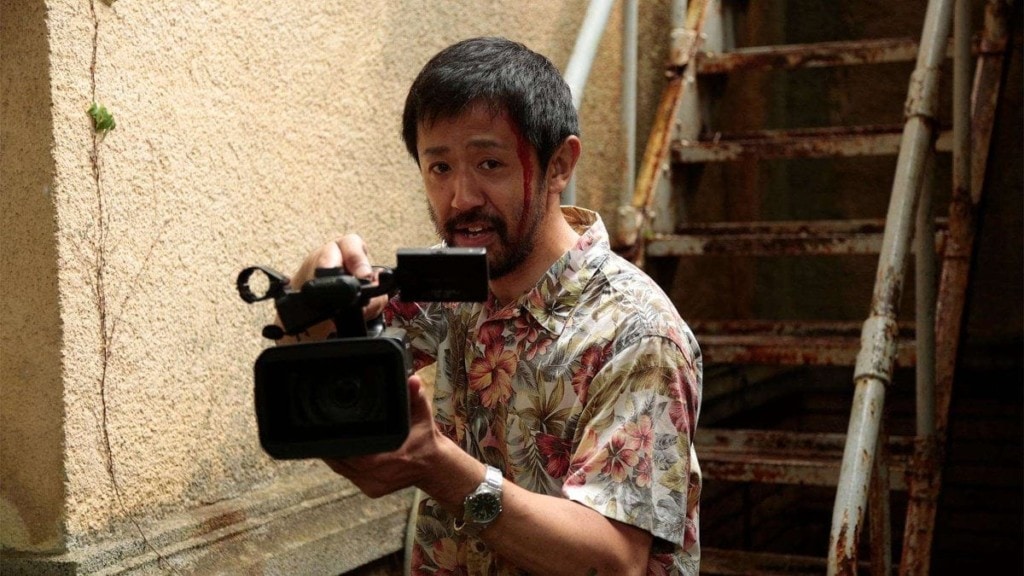
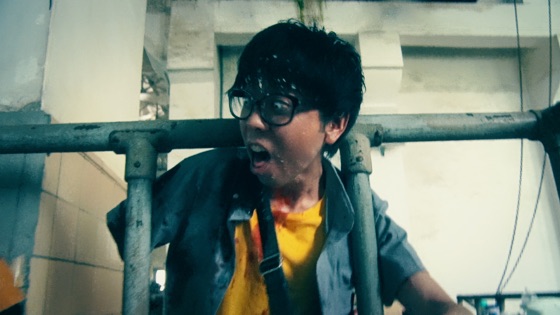
For starters, One Cut of the Dead is gleefully meta, being a film about the making of a film about people making a zombie film when real zombies appear. It is also the kind of film that is hard to talk about without giving too much away, but I’ll try to avoid spoilers. Director Higurashi (Takayuki Hamatsu) is trying to wring emotion out of his actors as they shoot an ultra-low-budget zombie flick in an abandoned factory. While the cast and crew grow weary of his demands, actual zombies suddenly appear, and he seizes the life-and-death situation to bring realism to his film, insisting on keeping the camera rolling as the undead move in.
That synopsis alone probably doesn’t seem particularly innovative, but let’s just say there’s more to it. The film’s most impressive achievement is that the first 37 minutes are all one long tracking shot with no cuts (a favorite technique of mine), following the characters from zombie chases to Higurashi’s sabotaging of their escape attempts. As impressive as this is, the film’s low-budget status is evident from the awkward pauses, stilted dialogue, and schlocky violence that largely stays off-screen, building into increasingly funny absurdity. Yet the rest of the movie adds so much more to the initial film within a film, providing context of what happened beforehand and what happened off-camera, making the proceedings even more hilarious, quirky, and (as strange as it may sound) heartwarming.
Modern comedies rarely hold a candle to the older classics, in my opinion, but I’ll admit that One Cut of the Dead had me grinning much more than I expected going in. What seems at first like a groan-worthy wannabe horror turns into a celebration of film and the enormous effort put into it, and I loved how even seemingly insignificant details were given amusing explanations as the story unfolded. Even the director’s name had me wondering if it was an oblique reference to the classic Higurashi horror series.
As much as I enjoyed the film, I wasn’t quite sure if it warranted placement on my list; then I found that there was actually a follow-up sequel of sorts from last year called One Cut of the Dead: Remote Mission, in which the same cast made a short film from their homes during COVID lockdown. Just revisiting the characters and their quirks made me smile all over again and confirmed to me that One Cut of the Dead should be List-Worthy. As a comedy masquerading as horror, its inventive plot, endearing characters, and brilliant execution make it an instant classic in my book.
Best line: (Higurashi’s wife) “Pom!” (You’ll get it when you see it.)
We all have our ghosts, And we carry them close, An undying weight Doctors can’t diagnose.
Our parents, our fears Echo on through the years, And so many drown them In vices and beers.
The shaft of despair Has no bottom down there But does have a top If we’d only seek air.
Yourself you may yield, With no hope to be healed, But the sight of another In need of a shield,
Unbent, hopeful yet, In the path of a threat, Just might be enough To redeem your regret.
__________________
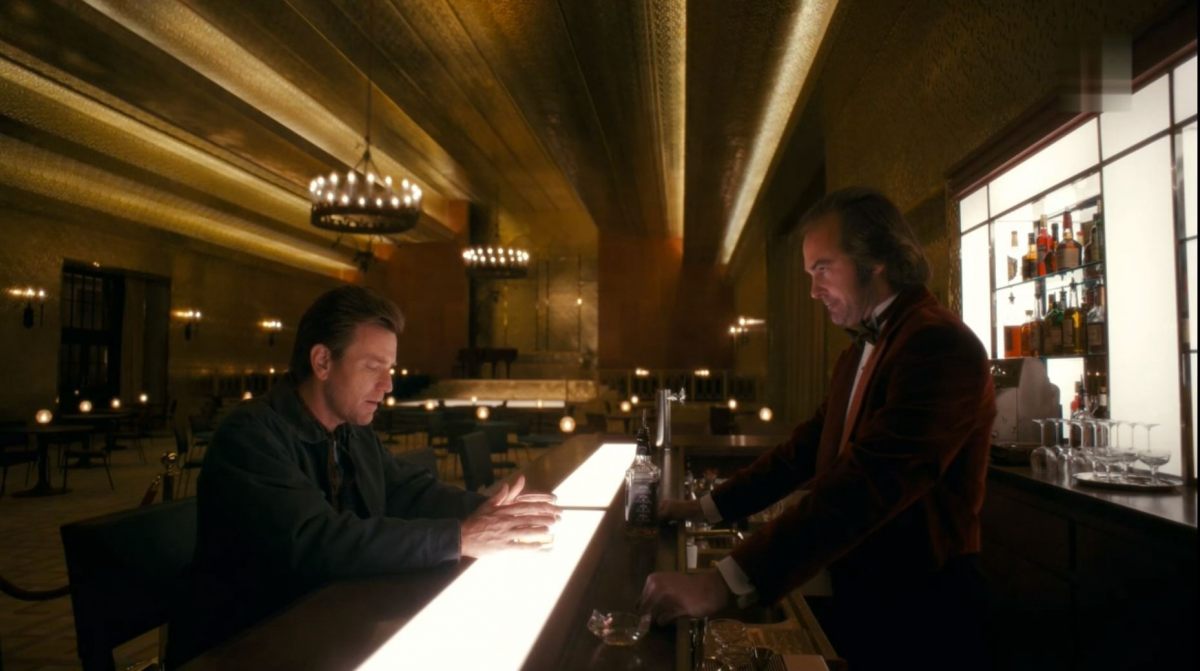
MPA rating: R (for horror violence, language, and that creepy naked ghost from The Shining)
Where has October gone? I’m thinking I should probably stop apologizing for the long stretches in between posts since the demands of full-time work and school just make it hard to find enough time for anything else. Nevertheless, I felt like Halloween was a good time to make my return to the blogosphere and resurrect my annual tradition of reviewing a scary movie that I watched by myself late at night. Past notables include The Conjuring, The Babadook, and Under the Shadow, and this year’s is also up there with the best.
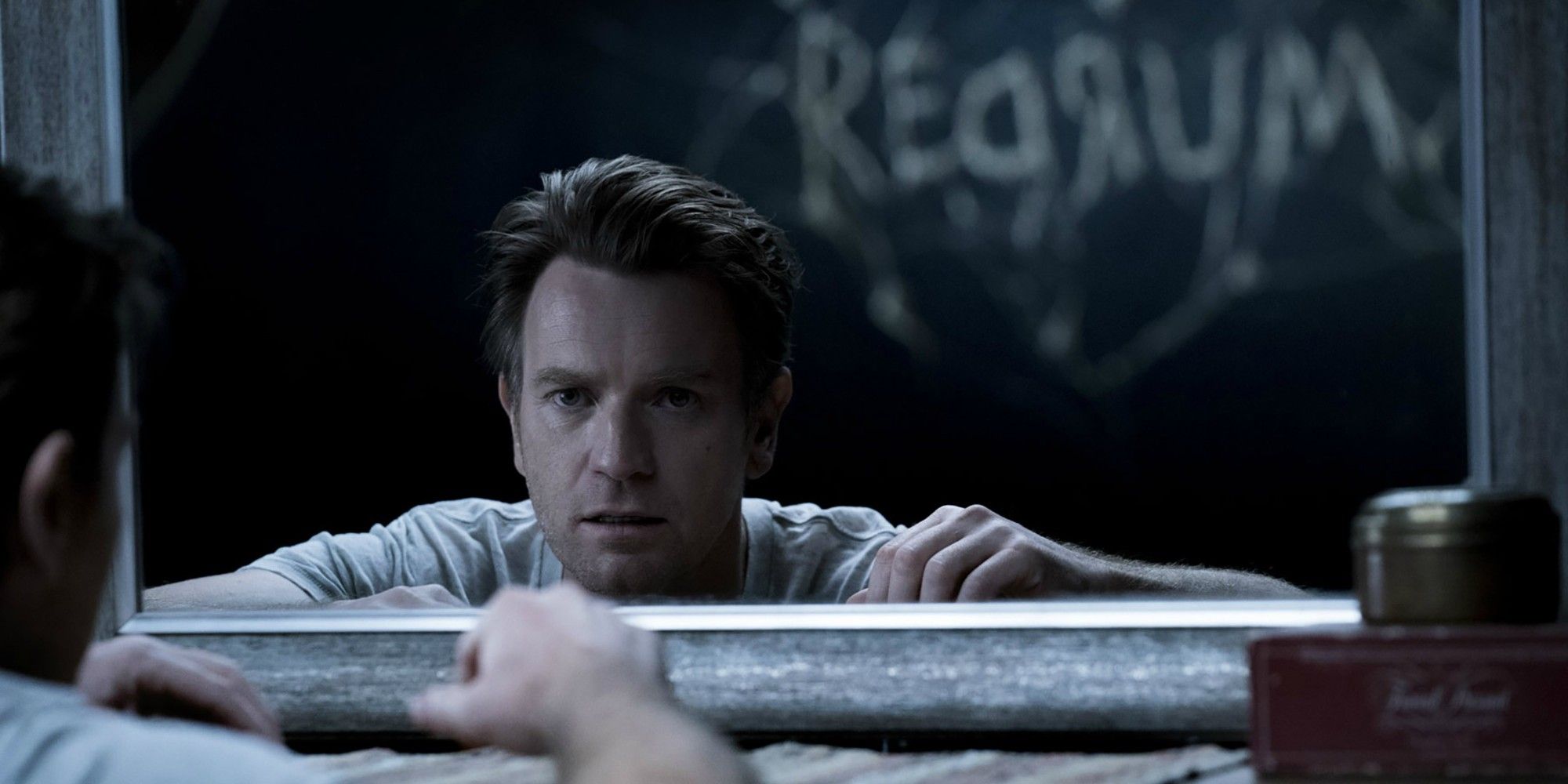
With so many sequels being made to cash in on thirty-to-forty-year-old classics, it was easy to underestimate Doctor Sleep, the long-delayed follow-up to The Shining and likewise based on Stephen King’s novel of the same name. Stanley Kubrick’s adaptation of the original may have been divisive, but it’s iconic enough that you would think Hollywood would have the sense to leave it alone. (Then again, look at Ready Player One.) Yet this subsequent story about a grown-up Danny Torrance (Ewan McGregor) turns out to be more than worthy of its celebrated ancestor and creates a surprisingly mature and entertaining tale built on the trauma of the Overlook Hotel.
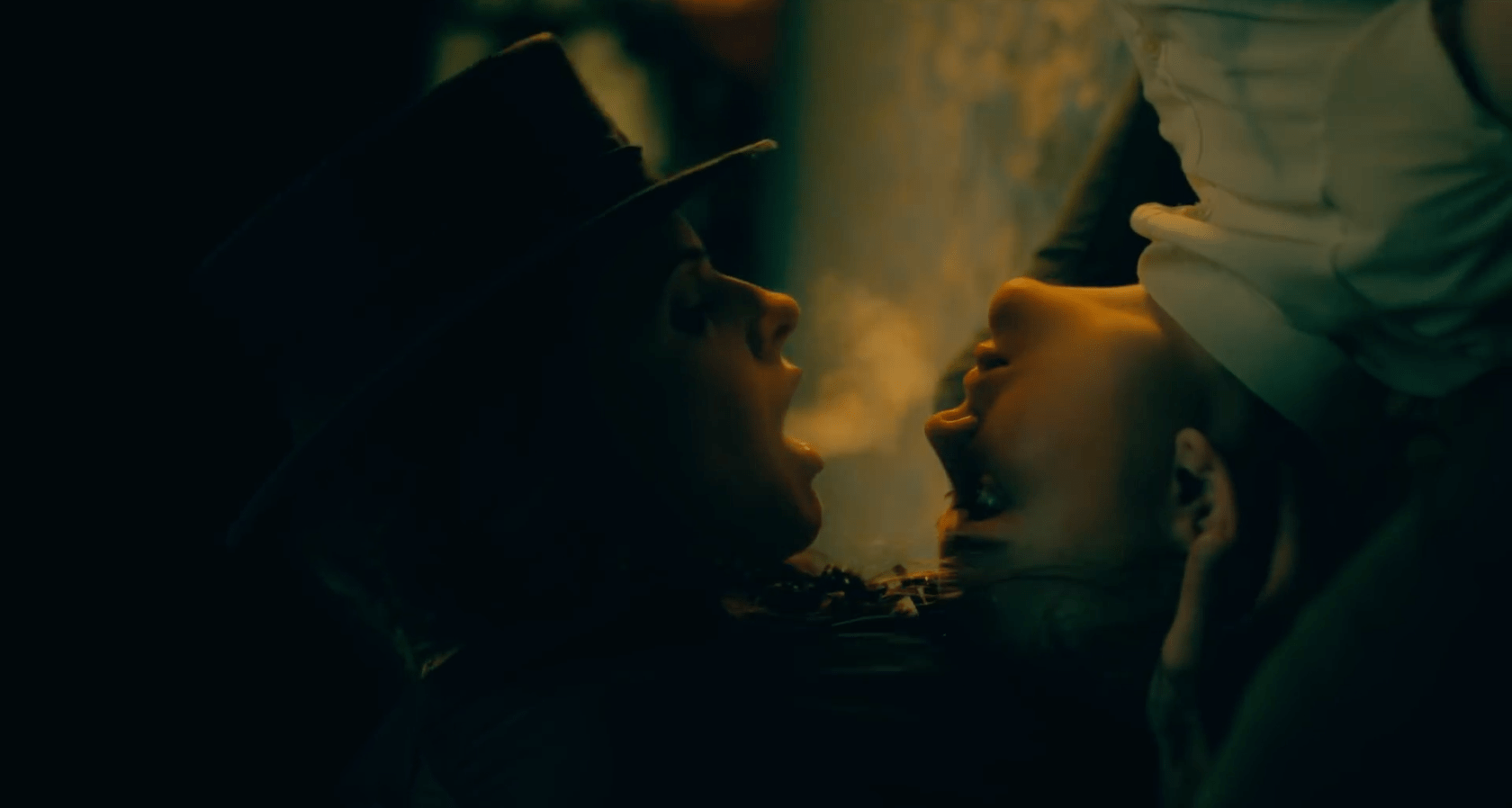
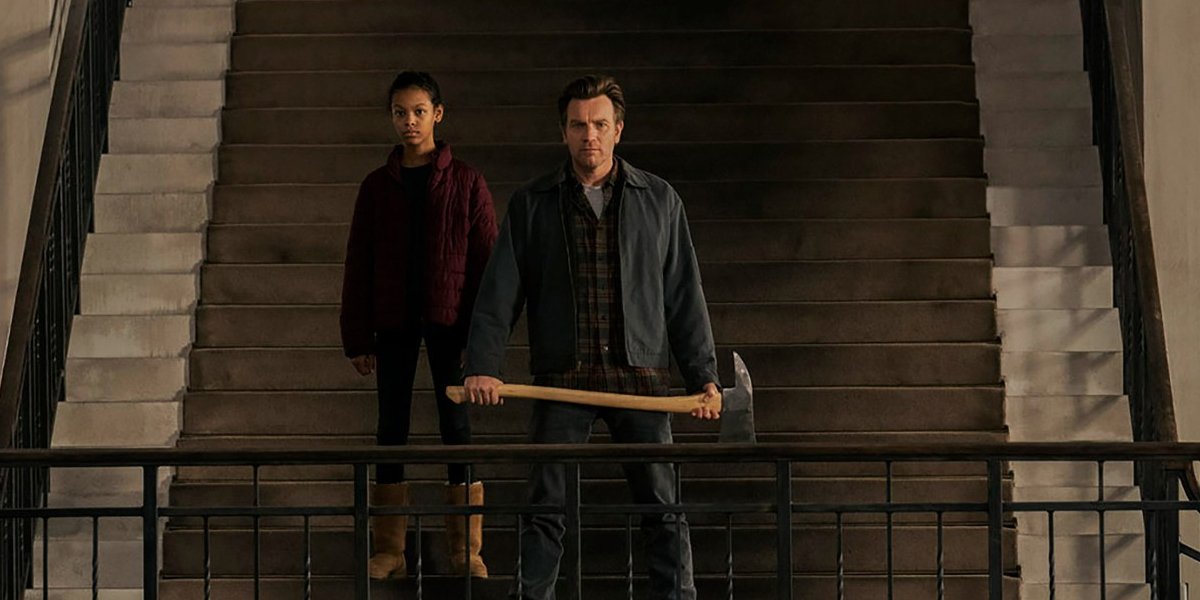
Whereas many of these decades-later sequels are content to rehash more or less the same story as the original, Doctor Sleep goes the other way, showing far more interest in the underdeveloped psychic abilities of Danny and others than in the haunting of malicious ghosts. This “shining” or “steam” that only a few individuals possess makes those people targets, not just for spirits but for a vampiric cult called the True Knot, led by the top-hatted Rose (Rebecca Ferguson), who seek out such gifted children to torture and consume their essence. Over the years, Danny has sunk into alcoholism and despair, yet when the spunky Abra (Kyliegh Curran), a particularly powerful wielder of the “shining,” makes herself known, Danny decides to help her fend off the unholy villains craving her power.
One of the most interesting aspects of Doctor Sleep is that it almost feels like a superhero origin story. While Danny thought he had to suppress his psychic talents, young Abra revels in them and proves to be a match for Rose herself, putting the girl in even more danger. In that superhero vein, the good guys are unfailingly sympathetic, even lovable (I liked recognizing a RWBY figurine and poster in Abra’s room, perhaps connecting her own gifts with that show’s concept of semblance abilities), while the bad guys are irredeemably despicable. One scene of child torture could have been worse but went on uncomfortably long for my taste, even if it confirmed just how wicked the True Knot were.
Of course, I would have liked it to be less R-rated, but the story itself and its thoughtful script is masterfully composed, from the gradual development of the True Knot’s nature to the psychic friendship between Danny and Abra to Danny’s overcoming of his latent shame and terror surrounding his childhood. One scene between Danny and the ghost of his father has some powerful dramatic tension that almost overshadows the horror tension that follows. It seems too long at two and a half hours, but it’s a length that feels deserved rather than unnaturally stretched like, say, theHobbit movies. Another interesting creative choice is the recasting of Jack Nicholson, Shelley Duvall, and Scatman Crothers with very close lookalikes (including Henry Thomas as Jack Torrance) rather than any attempt at digital manipulation, which feels more natural even if the difference is unmistakable. And the film definitely points back to its roots by the end, providing some difficult catharsis that The Shining lacked.
I’ve never been a huge fan of The Shining, even if I appreciate the iconic terror of its most memorable scenes. Too much was left unexplained for my taste, and as I said, it offered no closure to its tale of insanity. In contrast to the claustrophobia of the first film’s secluded setting, Doctor Sleep builds up a far more expansive world without wasting Danny’s history, an accomplishment that transcends its status as a horror movie. While The Shining prided itself on dread and insanity, Doctor Sleep actually manages some hope as well, which makes it the superior film, in my opinion. Director Mike Flanagan is no slouch when it comes to horror, and Doctor Sleep is a testament to his skill as writer and director. Even Stephen King himself said it “redeemed” his dislike for the first film, which is as high praise as any adaptation sequel could wish.
Best line: (Danny) “Our beliefs don’t make us better people. Our actions make us better people.”
(Today’s NaPoWriMo prompt was to incorporate twenty random elements into a poem, but, since using all of them would likely result in nonsense, I tried to use at least 8 or 9 in a poem from the viewpoint of a tortured reflection.)
My life is death, for I don’t live. I imitate. I mock.
A mirror image knows its cage, no need for bars or lock,
A mime condemned to emulate another round the clock.
“I’m just so happy,” says my smile, when I am forced to wear it.
My joie de vivre is copy-pasted, hollow when I bare it.
Only when my twin shows grief can I completely share it.
“Keep up! No rest!” the glass wall cries between my twin and I.
The fluid hardness of its bounds compels me to comply.
I do the simulated dance, no understudy nigh.
I am, therefore I think, but no one else can hear my thoughts.
For no one thinks that life is real for something so ersatz.
A mime depicting stories based on someone else’s plots.
______________________
MPA rating: R
After the cultural splash that Get Out made, Jordan Peele had a lot to live up to with his next foray into horror, and in light of some strange confusion surrounding his first film’s genre, he left no doubt that Us is straight-up horror. Peele is definitely an auteur, able to brilliantly craft tension and chills and blessed with gifted actors to bring his stories to life, but Us feels like a tale he didn’t think through enough.
At the beginning, we meet Adelaide (Madison Curry as a child, Lupita Nyong’o as an adult), a young girl who wanders off at a beachside carnival and comes face to face with a terrifying doppelganger in a hall of mirrors. Many years later, she’s married to Gabe (Winston Duke, Nyong’o’s Black Panther co-star), and together with daughter Zora (Shahadi Wright Joseph) and son Jason (Evan Alex), the Wilson family goes on vacation not far from that same beach that has haunted Adelaide ever since. Without warning one night, an identical family breaks into their house with bloodthirsty intentions, and the Wilsons must fight to survive against their doubles.
Us does a lot of things really well, from the visceral panic of the home invasion to Peele’s skillful direction that keeps the adrenaline up and only shows you what he wants you to see. And like his previous film, he manages to incorporate some dark comedy, more successfully than in Get Out I thought, such as the Wilsons comparing their kill counts during a break in the action. Indeed, the first two thirds of Us are a horror masterclass, albeit a bit too bloody for my liking, but undeniably well done, even taking a rap song and turning it into a creepy segment of the score. All the actors do wonders with their dual roles, Nyong’o especially, nailing both their frightened and malevolent personas with apparent ease.
But then there’s the last third, which seeks to offer explanation where none suffices. The origins and previous lives of the doppelgangers are purposely bizarre, but their “way of life” simply makes no sense. Why are they sometimes compelled to mirror the Wilsons’ actions and other times not? Where do the rabbits come from? What is the purpose of the “Hands Across America” re-creation? I could go into a lot more spoiler-y detail, but suffice to say, the logical side of my brain was left screaming, “What the heck? This. Doesn’t. Make. Sense!” I see the intended symbolism of a grotesque mirror image of our world, as well as the overplayed theme of one person’s prospering resulting in another’s suffering, but it’s as if Peele forced the story to fit the message and no one wanted to tell him how illogical it had become.
For a film that initially feels so well-made, it’s a shame that the plot is ultimately so half-baked. I will admit the final twist packs a surprising and disturbing punch, which was unfortunately spoiled for me by none other than Lupita Nyong’o herself on Inside the Actor’s Studio. I didn’t think Get Out was the masterpiece many people said it was, but it at least didn’t leave me bewildered with its own implausibility, as Us did. I hope Jordan Peele takes more time for his next film to flesh out the story with the same talent he brings to the scares.
Best line: (Jason) “When you point a finger at someone else, you have three pointing back at you.”
(Today’s NaPoWriMo prompt was to take a list of random words and use Rhymezone.com, which I do all the time incidentally, to find rhymes and similar words to use with them, which naturally leads to some welcome alliteration.)
I crave a crunch within my keep
And crawl and creep from out the deep
And sleekly sneak and slink toward prey
To snag the snack that runs away.
The peril of my pool is plain,
But how I prowl is not in vain;
The haunted hunted hate the wait
And heed the hazard much too late.
Before the fear is fully felt,
My sudden strike of death is dealt.
The walking world has one more dead,
And I, the predator, am fed.
____________________________
MPA rating: R
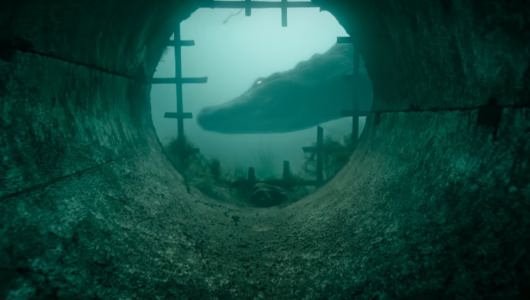
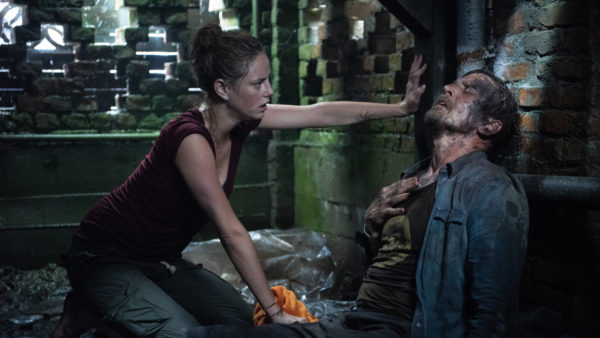
I enjoy a good creature feature and got Crawl from my library, thinking it was PG-13; I was wrong. If I’d known gorehound director Alexandre Aja was behind it, I probably would not have sought it out at all, but I’m glad I gave Crawl a chance. It’s an effectively pulse-pounding thriller that does for gators what Jaws did for sharks.
Kaya Scodelario plays Haley, a swimmer who drives into a flood zone as Hurricane Wendy bears down upon the Florida coast. She searches for her unresponsive dad (Barry Pepper) who hasn’t evacuated, and when she finds him, wounded beneath his house, the two humans and a dog are caught between the rising flood waters and a hoard of hungry alligators.
Crawl doesn’t need to be more than it is, a white-knuckle man/woman-against-nature flick with ravenous reptiles, and it succeeds. It develops the tension and the characters laudably well, providing convincing throw-away victims to up the stakes while the strained father-daughter dynamic grows stronger through the peril.
Like nearly all horror flicks, there are moments of foolishness that smarter-than-thou audiences can shake their heads at, but I doubt I’d fare as well as the main characters do. It has a few gruesome scenes on the level of Jaws, but Crawl’s violence is surprisingly restrained overall, considering the director, and turned out to be an unrealistic but enjoyably tense watch.
Whenever some genius succeeds in inventing a teleportation device,
Whoever created it ought to be wary and test the darn thing at least twice.
For things can go well in initial experiments; but, due to bug or pollutant,
It only takes one time for things to go wrong, and next thing you know, you’re a mutant.
_________________________
MPA rating: R (very R)
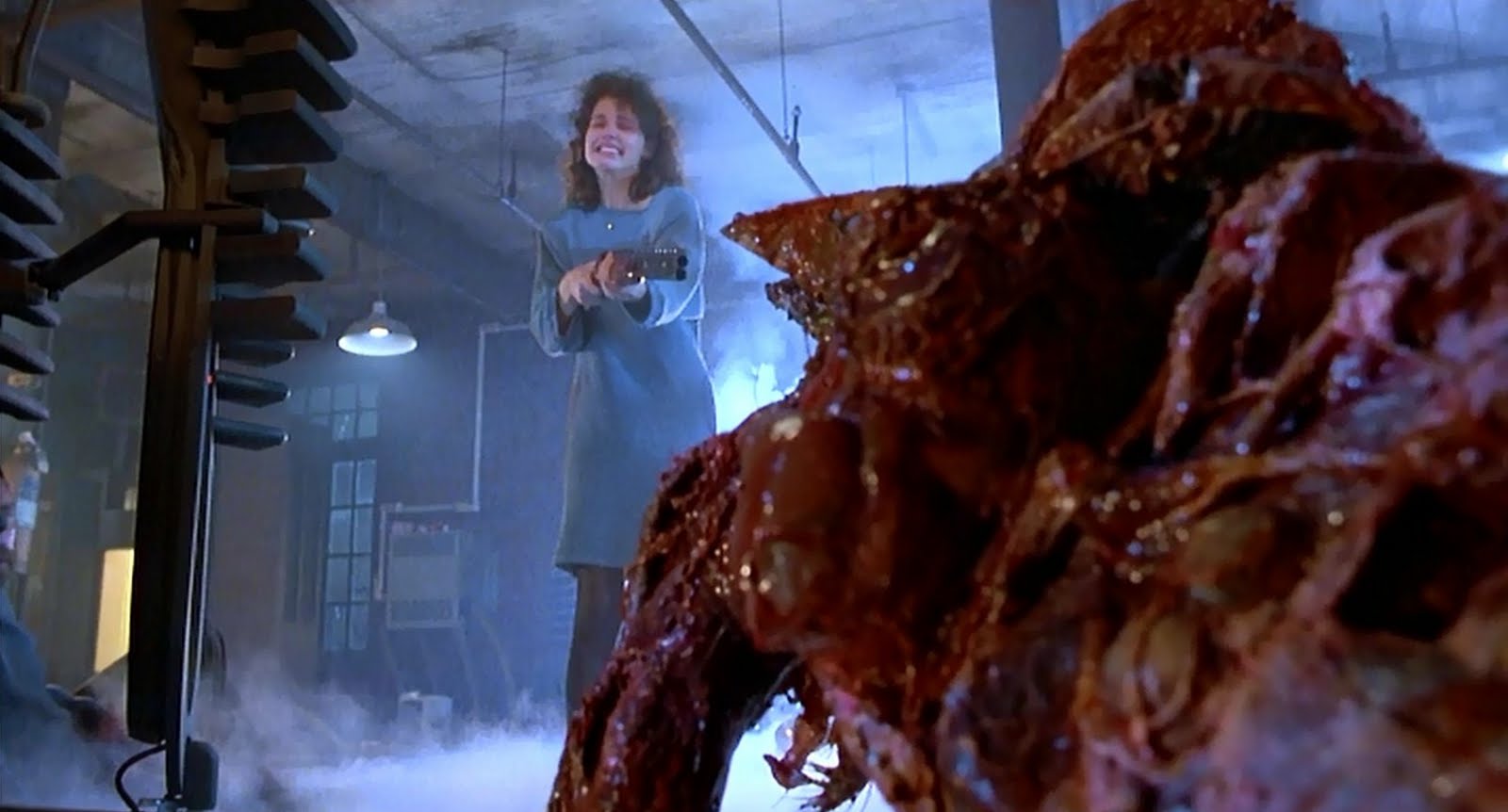
Remakes often get a bad reputation, but certain remakes are more well-known than the original. Although I haven’t seen all of it, the original version of The Fly has that famous scene of a woman screaming into the compound eyes of a fly-headed scientist. Yet I’ll bet most people think of Jeff Goldblum before anything else in the 1958 film (except maybe the high-pitched “Help me! Help me” scene). That’s probably because David Cronenberg’s version of The Fly is extremely… memorable, one of the great gross-out flicks that still carries something of a message in its extreme body horror.
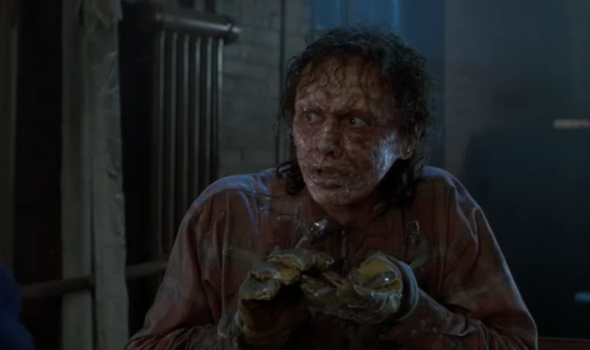
The Fly works well because of its gradual nature. Goldblum’s Seth Brundle, a scientist working out of a deserted warehouse, proudly shows attractive journalist Ronnie Quaife (Geena Davis) what he’s been working on, a pair of teleportation pods. They’re unfinished, though, and despite the horrific results of testing it on a baboon, he perseveres until he believes it safe for human testing. Spoiler alert: it’s not. Whereas the original film had an immediate head-and-arm swap between the man and the fly inside the telepod, Brundle’s transformation is gradual, taking a while for him to realize what went horribly wrong, and the results are anything but pretty.
The transmogrification of Seth Brundle is a pitiful sight, and Goldblum succeeds in exposing the character’s initial hubris and later desperation, even while being covered in more and more disfiguring makeup. Comparisons with unstoppable diseases like cancer or leprosy are unmistakable. One scene felt like a precursor to a similar scene in Prometheus that I’ve always found deeply disturbing. And then there are the final scenes, in which the visual effects and Oscar-winning makeup make the most of a gruesome finale. The ending is a bit too abrupt, not unlike An American Werewolf in London, but it has staying power, haunting the brain and keeping the heartbeat elevated even after the credits roll.My VC thinks this is possibly Jeff Goldblum’s best role, but I’m still surprised that she recommended this movie, considering she is far from a fan of shock horror, and neither am I. Still, The Fly felt like a higher form of it, one that’s hard to ignore. It was also a nice surprise when I was reminded that the famous line below originated in this film. If you don’t enjoy grotesque imagery, The Fly is not for you, but if you can stomach some for the sake of compelling sci-fi, it’s a classic of its genre.
Best line: (Ronnie, to a potential victim of Seth’s) “No. Be afraid. Be very afraid.”
When the world is collapsing, the nation on edge,
The whole of society out on a ledge,
The sky close to falling, disease at a high,
And dead people don’t even know when to die,
It only makes sense that, when fear’s on the rise,
The level heads left of us prioritize.
Sure, some go for water, and some hunt for food,
And some say we just need the right attitude,
But while these survivalists weigh their concerns
And plan for the worst to diminish returns,
A few must step up to remind all the rest
Of one thing emergencies need when distressed.
MUSIC! That’s right. It’s so often neglected,
But soundtracks do wonders for those not infected.
When life’s at a low, just compose your own cure
And let a good melody help you endure.
Just sing your heart out, out of range of the ghouls,
For songs are survival’s most critical tools.
______________________
MPAA rating: R
What a weird, catchy, sad, gruesome, delightful movie! I’m sure it was an interesting pitch when someone first described the plot of Anna and the Apocalypse, a Christmas musical zombie film that manages to nail all three aspects of its split personality. I normally shy away from zombie movies, but the prospect of an original musical convinced me to give this unique mish-mash a try.
Due to my aversion to gore, I’m always very wary of the zombie genre, yet I know it can be done exceptionally well (Train to Busan and Gakkou Gurashi are two prime examples), so I wanted to give Anna and the Apocalypse a chance. Unsurprisingly, it had the inventive undead bloodshed so common to the genre and so off-putting to me, yet I must admit I loved just about everything else about this British experiment.
It starts out so innocent with its high school setting and teenage misfits and then veers into zombie action and some surprisingly touching moments by the end. And through it all is the magic of song and dance, at first fitting in a High School Musical sort of way and later used as an ironic contrast to the zombie apocalypse. And the music, courtesy of Scottish artists Roddy Hart and Tommy Reilly, is actually darn good! I wouldn’t have been surprised if it came from a Broadway musical or showed up on the radio, yet the fact that it’s all original gives me pure delight.
Putting aside the feeling that I’ve seen versions of all of these characters in other movies many times before, the entire cast of mostly unknowns give their all, instilling a fresh and likable energy to their roles. Ella Hunt is especially good as the wistful Anna, whose zombie-killing weapon of choice is a giant candy cane, and Paul Kaye is a downright ham as the school’s power-mad vice principal. Despite the initial poking fun at how juvenile high-schoolers might actually react to zombies, the whole cast later prove their acting chops as things get more dire. And while dire is to be expected from a movie with Apocalypse in the title, it also sadly saps some of the earlier fun away. Not everyone I wanted to live does, and the half-hopeful ending can’t disguise the inescapable bleakness that almost always accompanies a zombie outbreak. One of the songs even says, “There’s no such thing as a Hollywood ending.”
So Anna and the Apocalypse left me with a strange mix of admiration and indecision. The musical numbers are a blast, and, while I wish I could say I loved every minute of it, I enjoyed far more minutes of it than I ever thought I would in a zombie film. Every actor is on point, and the audacity of its holiday spirit deserves appreciation, especially when it’s this darn likable. Yet it also earns its R rating with the blood-splattering violence and didn’t leave me with the smile I wore through much of it. Thus, I’m pulling out a ranking I’ve only used once: the Semi-Dishonorable List Runner-Up, which sums up my mixed feelings. I hesitate to recommend it, but if the gore and mixed tone don’t bother you, absolutely seek out this ebullient gem. Minus the violence, it would easily be List-Worthy for me. It will no doubt end up as a cult classic addition to the Christmas horror catalog, among which it certainly has the best soundtrack.Best line: (Mr. Savage, after Lisa asks about her boyfriend’s sick grandmother) “Look around you, Miss Snow. What do you see?”
(Lisa, Anna’s friend) “Um…tables?”
(Mr. Savage) “I see civilization on the edge. And what does civilization do when it finds itself on the edge?”
(Lisa) “We help each other?”
(Mr. Savage) “We prioritize.”
The night is black,
A bleak throwback
To when the world was without shape.
A shadow shifts,
The darkness drifts
And snares your eye with no escape.
You crane your neck
To merely check
That all is well outside your bed.
And pray no face
Or graver case
Will give you reason for your dread.
________________
MPAA rating: PG-13
I’m not really into horror generally, but it’s become something of a tradition for me to watch a scary movie alone at night, just to review it for Halloween. Like The Conjuring, The Babadook, and Lights Out in years past, I decided to check out an acclaimed creepfest that focuses more on atmospheric tension rather than gross-out gore. This time, though, I went outside the English-speaking world to watch Under the Shadow, a Persian-language horror (with a 99% on Rotten Tomatoes) set in 1980s Tehran.
Of course, 1980s Tehran wasn’t the best place to be, especially during the increasingly frequent bombings of the Iran-Iraq War. It’s already a tense setting, as the inhabitants of an apartment building must head downstairs into the basement at the sound of bomb sirens, much to the chagrin of mother Shideh (Narges Rashidi) and her daughter Dorsa (Avin Manshadi). Disgruntled by her country’s rigid decrees keeping her from becoming a doctor, Shideh is further unsettled when her husband is sent off to war, and as strange events start to occur late at night, she wonders if there is indeed something haunting her family.
In many ways, Under the Shadow is exactly the kind of horror movie I like, with a creeping dread serving as the main source of fear, knowing that something could happen at any moment and jumping out of your skin when it occasionally does. There’s zero blood on display, and it doesn’t need it. While it taps into the mythology of malevolent air spirits or djinns, it’s surprising how well the frights work when they stem from what is essentially the most minimalist ghost, a floating sheet (technically a chador, a Persian women’s cloak). The uncanny fear conjured by its sudden appearances is potent stuff.
However, there’s nothing especially notable about the story itself, aside from its unique cultural setting, which is itself a danger, since Shideh can be punished for even fleeing her home without a head covering. Yet the plot isn’t too far from that of The Amityville Horror, and the mother/child dynamic, while showing growth, has been done with better closure elsewhere. Even so, Under the Shadow provided exactly what I look for in a scary movie, while excluding what I avoid in the genre. Well-acted with a slow-burn anxiety, it’s an excellent addition to my Halloween reserve, even if it’s made me look over my shoulder more often than before.
(Today’s final NaPoWriMo prompt was for a minimalist poem, and since I can’t quite understand how one word could be a poem, I’ll at least end the month with a short couplet.)
Perish the thought
That the perished are naught.
__________________
MPAA rating: apparently Not Rated? (should be PG-13)
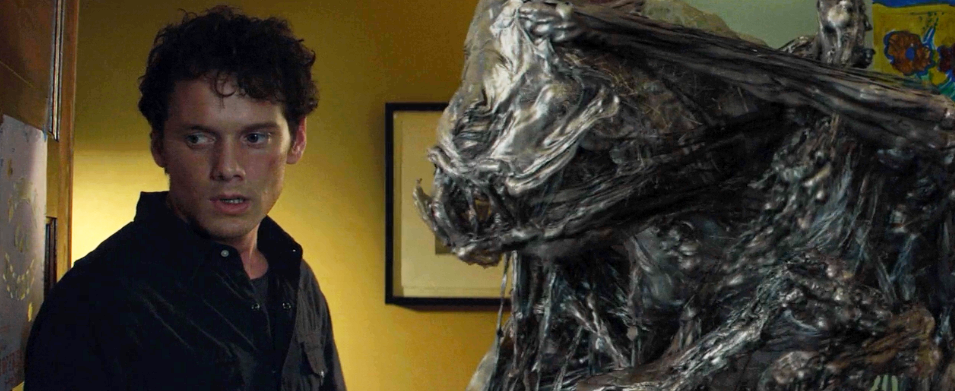
Odd Thomas is one of those movies that makes me wonder why it’s not more popular. A starring vehicle for Anton Yelchin three years before his untimely death, this horror-comedy-mystery hybrid is an overall fun watch that made me want to check out the Dean Koontz novels on which it is based.
Odd (Yelchin, and yes, that is his first name) is what I would imagine Haley Joel Osment’s psychic character from The Sixth Sense might grow up into, an everyday fry cook and oddball whose ability to see dead people aids in bringing justice to killers and peace to their victims. Further supported by a trusting detective (Willem Dafoe) and Odd’s devoted girlfriend Stormy (Addison Timlin), he also can see vicious spirits called bodachs who are attracted to evil, and when an especially large number appear in town, he knows some great calamity is close at hand.
This is yet another movie that floors me with how low its Rotten Tomatoes score is (a mere 36%) when I’d place it solidly in the 70s or 80s. I’ve read that some were annoyed by the lovey-dovey dialogue between Odd and Stormy, but they really make a cute couple so I don’t begrudge the film its bit of romance.
As for the horror-comedy side, those who enjoyed the mix in The Mummy will likely enjoy this one too, since Stephen Sommers directed and wrote both. The mystery is actually quite riveting, by the end especially, and finds a good balance between human evil and its supernatural side that only Odd can see. With its tepid reviews and the loss of its lead actor, it’s a shame that Odd Thomas will probably never get the sequel it deserves. It’s the kind of film I can see putting on every time it’s on TV, and I gladly will.
Best line: (Odd) “I see dead people, but then, by God, I do something about it.”
(Today’s NaPoWriMo prompt was for a poem about animals, so I tried to be less literal and wrote of how man is the most dangerous animal of all.)
Animals, animals!
What an insult
For mankind to level at one of his own!
An absence of conscience,
Deeds unprincipled –
For these, as an animal you will be known!
But animals do not
Take life for mere fun,
Nor yet do they harbor a conscience to lose.
No, those are unique
To the broken human,
The one so-called animal known to abuse.
It’s man that can foster the good and the just
Or evil that leaves animals in the dust.
_____________________
MPAA rating: R
Science fiction has always been one of my favorite genres, so it was only a matter of time for me to catch up on Vin Diesel’s cult-classic Riddick series, which all started with Pitch Black. Oddly enough, Pitch Black is the highest rated of the trilogy on Rotten Tomatoes, yet still bears a 59% Rotten rating. Yet most films don’t garner a trilogy without doing something right, and Pitch Black does more right than wrong.
You know what I considered Pitch Black both before I saw it and while I was watching it? A more R-rated version of Aliens. While its plot is undoubtedly inspired by Aliens, I didn’t realize till afterward that Aliens has more profanity and comparable violence. I guess I’m just so used to seeing it cut when it comes on TV that such things stood out more in Pitch Black. Regardless, though, I love Aliens, and I enjoyed Pitch Black for many of the same reasons.
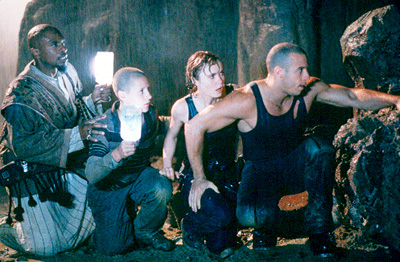
It doesn’t start out as a monster movie. A shipful of passengers in cryostasis are rudely awakened by disaster (not unlike Alien: Covenant) and stranded on a planet of perpetual daylight. Among them is the now-famous Richard B. Riddick (Diesel), a dangerous and shiny-eyed prisoner freed in mid-transport. As the survivors seek a way off the planet, they learn that they’ve arrived just in time for a long eclipse and that deadly swarms of darkness-loving creatures live underground and will soon be free to hunt above it. Good thing Riddick can see in the dark, right?
Like Aliens, Pitch Black thrives on the thrill of man vs. alien, with the aliens being either slithery, hammer-headed beasts or smaller pterodactyl-like swarms. Aside from Diesel’s hard-boiled convict, the human characters aren’t as memorable as some in this genre, but they fill their roles well, especially in how they are forced to balance survival with their general distrust of Riddick and the bounty hunter (Cole Hauser) gunning for him. Radha Mitchell even has a stirring character arc concerning the weighing of lives, and Keith David plays a travelling imam, highlighting how unusually diverse it is to see a Muslim in science fiction.
The creatures and visual effects work surprisingly well, considering they’re not as polished as most Hollywood features; in fact, the way writer-director David Twohy shot it sometimes gives scenes an odd TV movie quality. This belies its modest budget yet somehow works to the film’s advantage, keeping some of the more violent parts blurry and contributing to its cult classic status.
In many respects, Pitch Black feels like someone wanted to give their own spin to the Aliens formula, but it has enough plot twists and unique action sequences to set it apart as more than a lazy copycat. There are still moments where characters act stupidly and don’t seem to realize that darkness = bad, but it’s also memorably tense, particularly a death scene involving a lighter that ought to be more famous simply for its chilling visual impact. Pitch Black may not rival Aliens for sci-fi horror and doesn’t exactly end as I would have liked, but it’s quite an entertaining member of the genre with perhaps the best antihero I’ve come across, one worthy of a cult classic status.
Best line: (Johns, the bounty hunter) “Battlefield doctors decide who lives and dies. It’s called ‘triage’.” (Riddick) “They kept calling it ‘murder’ when I did it.”






 My VC thinks this is possibly Jeff Goldblum’s best role, but I’m still surprised that she recommended this movie, considering she is far from a fan of shock horror, and neither am I. Still, The Fly felt like a higher form of it, one that’s hard to ignore. It was also a nice surprise when I was reminded that the famous line below originated in this film. If you don’t enjoy grotesque imagery, The Fly is not for you, but if you can stomach some for the sake of compelling sci-fi, it’s a classic of its genre.
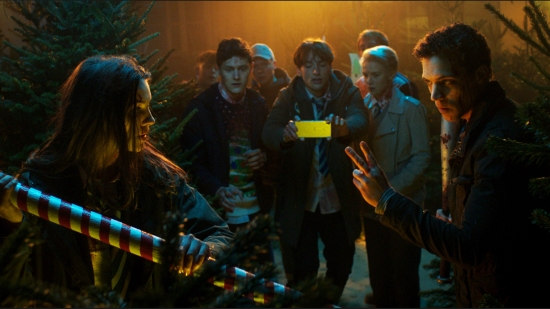
 Putting aside the feeling that I’ve seen versions of all of these characters in other movies many times before, the entire cast of mostly unknowns give their all, instilling a fresh and likable energy to their roles. Ella Hunt is especially good as the wistful Anna, whose zombie-killing weapon of choice is a giant candy cane, and Paul Kaye is a downright ham as the school’s power-mad vice principal. Despite the initial poking fun at how juvenile high-schoolers might actually react to zombies, the whole cast later prove their acting chops as things get more dire. And while dire is to be expected from a movie with Apocalypse in the title, it also sadly saps some of the earlier fun away. Not everyone I wanted to live does, and the half-hopeful ending can’t disguise the inescapable bleakness that almost always accompanies a zombie outbreak. One of the songs even says, “There’s no such thing as a Hollywood ending.”
 Best line: (Mr. Savage, after Lisa asks about her boyfriend’s sick grandmother) “Look around you, Miss Snow. What do you see?”





 Rhyme and Reason