Persepolis (2007)

Tags

, ,


(Today’s NaPoWriMo prompt involved writing a poem based off of answers to an almanac questionnaire. In this case, question subjects like “Childhood dream,” “lover,” “hometown memory,” and “today’s news headline” brought to mind this animated drama.)


A culture builds a person
In a way they cannot hide.
By fine degrees, their memories
Instill a private pride.

I’m proud of where I come from,
And I love the U.S.A.,
But others feel an equal zeal
For countries far away.

I hear news full of chaos,
And my sense of pity grows,
For other nations have frustrations
Worse than Western woes.

Yet, being sympathetic,
I must not presume their shame:
Despite the vultures, other cultures
In the midst of flame
Have dignity and pride to be
Both different and the same.
________________

MPAA rating: PG-13

I’ve stated before that I love animation that can tackle mature themes without wallowing in mature content. This is why I’m often drawn to anime and why I admire 2007’s Persepolis, which lost the Best Animated Feature Oscar (barely but deservedly) to Pixar’s Ratatouille.

The Iranian Revolution isn’t the first topic I’d think of for a cartoon, but Iranian expatriate Marjane Satrapi translated her personal experiences first into a French comic/graphic novel and then into this feature film. She did so not only with insight and honesty but with the perfect reason for siding with animation over live-action: that animated characters are far more universal in appeal and connection, allowing audiences worldwide to relate to something that is not inherently “foreign.” She succeeded. Her childhood home in Tehran seems like any number of world cities, and her personal tastes in movies and music (Bruce Lee, Iron Maiden, etc.) remind us that pre-Revolution Iran wasn’t entirely different from the West. (I liked how the young Marji enjoyed ABBA until her friends guilted her into considering them uncool. My mom has mentioned that it was much the same with her in 1970s America.)

Thus, when the actual revolution takes place, bringing Islamic fundamentalists to power, the sudden forced changes to the culture are understandably jarring, as women are compelled to wear head scarves while alcohol and all things Western are banned. While my knowledge of the politics of the time is limited, I was intrigued by how Marjane’s opinions were formed by her parents and dissident uncle, who opposed the Shah but were also persecuted by the new government. The sequence of events reminded me of the Russian revolution in Doctor Zhivago, particularly when Marji’s mother comments, “Well, whatever the outcome is, it can’t be worse than the Shah.” The shortsightedness of revolutions is still an issue today and just one of the many thought-provoking facets of Persepolis.

Marjane’s rebellious spirit eventually forces her to move to Europe, where she grows into a wayward young woman. Her activities range from communing with thoughtless anarchists to unsuccessful love affairs, and while much of it is rather depressing, the storytelling manages to incorporate a smart mix of profundity (such as the wisdom of Marji’s grandmother, a sterling example of an honorable elder) and amusement (such as Marjane’s post-breakup rant against her ex, which resembles and predates a similar scene in (500) Days of Summer).

Satrapi has insisted her graphic novel should be called a comic book, and though it’s more mature than many animations, in several ways Persepolis is a cartoon. The black-and-white simplicity of the flashbacks (which is the majority of the film) is usually realistic, but sometimes reactions are exaggerated, dreams become surreal, or certain scenes are hyperbolized as only animation can. Other times, serious moments are reduced to silhouettes, like a deadly flight from police across rooftops.

While the ending is both fitting and disappointingly melancholy, what comes before is not without its shortcomings. The depiction of the Islamic government is clearly negative, but the overall political message remains muddled from varied character opinions and a dream sequence associating Karl Marx with God. Though not too profane, some of the language is also a tad harsh, and the PG-13 rating is deserved. (There’s also an odd preoccupation with Marjane’s grandmother’s breasts, which are discussed three separate times, perhaps because of a distinct memory she had.) Persepolis is a wholly unique animation, a coming-of-age tale that views a tumultuous time through the eyes of both a child and a young woman, whose subsequent real-life success makes it that much more praiseworthy.

Best line: (Marjane) “We were so eager for happiness, we forgot we weren’t free.”


Rank: List Runner-Up


© 2016 S. G. Liput

380 Followers and Counting


Maze Runner: The Scorch Trials (2015)

Tags

, , ,


(Today’s NaPoWriMo prompt, inspired by this month’s halfway point, is to write a poem incorporating doubles. Thus, I chose to write in couplets and picked a sequel to review.)


Run, run, run, through glade and through maze;
Run and trust not this new world set ablaze.

Run from the torchbearers firm in their cause,
So sure of its virtues, no thought for its flaws.

Run from the dangers that line every path;
The world is less suited to kindness than wrath.

Run from the greedy, who serve themselves first,
And those who do wrong, by good reasons coerced.

Run till you realize your flight is in vain;
When all the world’s crazy, you stand and be sane.
____________________

MPAA rating: PG-13

I very much enjoyed the first Maze Runner film and was looking forward to continuing the intriguing mystery set before the characters. It was a darker installment in the YA dystopian genre and a bit more intense than others of its ilk. The Scorch Trials both strengthens and weakens the series, which is to say it both entertained and disappointed me, which is to say it’s good but could have been better, which is to say . . . oh, I’ll just explain.

After escaping from the maze, Thomas and his Glade buddies are whisked away to a locked-down compound where they find other rescued inhabitants from other mazes and a great many secrets. One common complaint about the first film is the lack of answers, and The Scorch Trials does supply some, such as why the young people are so important and why Thomas joined the Gladers. We still don’t know what exactly the Maze was for, but there’s still another film yet to come. While the first film was almost completely confined, this one has a much wider scope as Thomas and the gang are introduced to the scorched wasteland and a zombie-like plague that has caused a breakdown in society.

I wasn’t expecting this to turn into a zombie apocalypse movie since we’ve had even more of those than YA dystopias, but it works quite well. In lieu of the first film’s Grievers, those infected with the Flare virus offer the same awesome, edge-of-your-seat action and lots and lots of running. A key part of zombie scenarios is how people deal with them, and the film includes a believable variety of responses, from ruthless science to mercenary self-interest. One reason I avoid zombie movies is my aversion to gore, and I did appreciate this film’s restraint, proving (like World War Z) that it can be done effectively.

Sadly, with so much eventfulness, the characters are little more than placeholders. Thomas (Dylan O’Brien) is the leader making things up as he goes along, and he connects with a couple new characters, but everyone from the first film is just following along. This film so relies on the first one to establish its “main” characters that my VC didn’t even remember one of the expendables along for the ride.

Another gripe is that The Maze Runner was fascinatingly original while this one seems content to borrow plot elements and even specific scenes from other sources. Watching the film, I kept pointing out what such-and-such reminded me of. The zombie setup and search for a cure brought to mind I Am Legend and World War Z. Zombies in a mall seemed like a Dawn of the Dead reference. Oh, that scene is like the beginning of Mad Max: Fury Road. Oh, that’s like Coma, and Aliens, and The Way Back, and Fallout, and The Lost World: Jurassic Park. When a film constantly brings other franchises to mind, more than its originality suffers.

Thus, The Scorch Trials furthers the plot and little else, but that’s luckily still enough to keep me interested and entertained. The stage is set for the final chapter, and I’m glad the characters have something to run toward instead of always away. Time will tell if this trilogy can end on the high note with which it began.

Best line: (Thomas, at a pivotal scene) “I’m tired of running.”


Rank: List-Worthy (joining the first film)


© 2016 S. G. Liput

380 Followers and Counting


The 33 (2015)

Tags

, ,


(Today’s NaPoWriMo prompt was for a san san, in which three words or ideas are repeated three times each in a eight-line rhyme scheme of a-b-c-a-b-d-c-d. Since san san is Chinese for “three three,” I thought the perfect film for this was last year’s The 33 about the Chilean miners.)


The sun was swapped for stone, above our heads and in our hearts.
With patience, we awaited news from those who thought us dead.
We lived within our hollow grave, refusing to be still.
How many lack the patience that a hollow grave imparts,
No choice but to bemoan in hope the stone above our heads?
Anticipating sky again, we found our patience heaven-sent
And looked beyond the stone above our heads, as doomed men will.
Arising from a hollow grave is not without its precedent.
__________________

MPAA rating: PG-13

I’m sure most recall the rollercoaster of emotions that accompanied news of the Chilean miners who were trapped by a cave-in for 69 days in the San Jose mine. The international rescue effort and the strong faith of the miners turned the 2010 mining accident into one of the most inspirational true-life stories in years, and as soon as the last miner reached the surface, I knew it was only a matter of time before a movie dramatized the incident.

Honestly, I thought it would be much sooner than five years, but here we have the based-on-a-true-story film for which we’ve been waiting. I expected it to be great, but I’m content that it’s good. The filmmakers succeed in presenting a comprehensive account of what happened before, during, and after the accident, and it’s hard to fault their efforts. The beginning introduces the most notable of the thirty-three miners: Mario Sepúlveda (Antonio Banderas), who acted as the leader of the buried miners; Luis Urzúa (Lou Diamond Phillips), the danger-conscious foreman; Álex (Mario Casas), the family man with a baby on the way; Darío, who is estranged from his sister (Juliette Binoche); Yonni (Oscar Nunez), whose extramarital affair comes to a head during the crisis; and numerous others who aren’t given enough screen time to make an impression. It’s easy to confuse the characters at first, but time and some earnest character moments help to distinguish the most important.

Above ground, the drilling plans are spearheaded by both professionals (James Brolin; Gabriel Byrne, who I never would have considered for a Hispanic role) and politicians (Bob Gunton, also pretending to be Latino; and Brazilian actor Rodrigo Santoro, known to me as the much-maligned Paulo on Lost). After the search effort turns into a rescue effort, the details of the operation are prudently depicted through real-life news reports.

I suppose the worst thing I can say about The 33 is that it feels inconsistent. The actual accident is spectacular, if a bit hard to see in the dark, but then the emotions and tensions of the subsequent waiting and anticipating come in fits and starts depending on which miners are on-screen. One potentially powerful final meal strikingly captures the men’s hopes and fears, but the tone oddly drifts between heavy and light.

Despite the inconsistencies, The 33 triumphs where it matters most, that climactic rescue that had people around the world wiping tears from their eyes. The ending will come as no surprise to those who know the story, but the film manages to give its audience further understanding of how the miners and their families felt and represents the solidarity both below and aboveground. It may not be the Oscar-worthy powerhouse I feel it could have been, but the pre-credits depiction of all thirty-three real-life miners ends the film on the highest note possible.

Best line: (one of the miners, answering why he doesn’t hate an outcast) “Hate is for children.”


Rank: List Runner-Up


© 2016 S. G. Liput

380 Followers and Counting


Opinion Battles Round 7 – Worst Remake

Don’t forget to vote for the latest Opinion Battle at Movie Reviews 101, this time the Worst Remake. With so many awful ones to choose from, I went with Tim Burton’s Alice in Wonderland, which took something silly and colorful and tried to make it disturbing. Ugh!

Unknown's avatarMovie Reviews 101

Opinion Battles Round 7

Worst Remake

Every year we seem to get remakes, we do get a couple of good ones but we also get some of the worst films in modern times, this upcoming week we have just got a remake of Martyrs which nobody wanted to see but what do we think is the Worst Remake.

If you want to take part in the next Opinion Battles we are picking our Favourite Disney Animated (Non Pixar) film, to enter email moviereviews101@yahoo.co.uk by 17th April 2016.

Darren – Movie Reviews 101

Evil Deadevil dead

Evil Dead to me is the worst remake because to me what the original Evil Dead did was show how much you can make with such a limited budget, we also got to meet one of the most iconic characters in horror history in Ash Williams. With the remake we see a film with a…

View original post 2,158 more words

The Curse of the Jade Scorpion (2001)

Tags

, ,


(Today’s NaPoWriMo prompt was to draw inspiration from a fortune cookie. The best fortune I’ve seen was, “Sorry, wrong cookie.” Instead, though, I chose my movie and poem based on one that said, “Don’t expect romantic attachments to be strictly logical or rational!”.)


That woman they just hired
Makes me wish I could get fired,
And what’s worse she has authority to do it.
Whatever hospital conferred her
On this world so ripe for murder,
I’ve a mind to find the big behind and sue it.

Her sarcasm is offending,
And she’s always condescending
And expects me to stay silent as a mime.
She’s an ever-present itch;
Her heart and soul are black as pitch;
And she’s other unattractive words that rhyme.

She’s conceited; she’s annoying,
And I know that she’s enjoying
Every day that brings me close to suicide.
But to see if I can win her,
I’ll be taking her to dinner
In the hopes that I can put all that aside.
__________________

MPAA rating: PG-13

I don’t have much experience with Woody Allen’s films. I’ve only seen Midnight in Paris, which I rather liked, and Hannah and Her Sisters, which I really don’t remember, but those whose opinions I trust often write him off as a sex-obsessed dirty old man. Of course, even sex-obsessed dirty old men can make good movies, and The Curse of the Jade Scorpion is a good example.

Allen plays C.W., a 1940s investigator for an insurance company who butts heads with the new efficiency expert Betty Ann (Helen Hunt), secretly in the middle of an affair with their boss (Dan Aykroyd). The two of them have a textbook case of anti-chemistry: everything about each of them gets under the other’s skin, and they both revel in colorful insults and behind-the-back complaints. Their coworkers love the irony when C.W. and Betty Ann are hypnotized by a magician into believing they are in love, but when that same magician (David Ogden Stiers) uses their trances to turn them into thieves, how can anyone discover the truth?

Allen himself considers this one of his worst films, but except for one key aspect, I can’t see why. The insults and innuendo are sharp and clever without ever crossing the line into distasteful, and the mystery is consistently amusing. The one less-than-ideal element is Allen as the lead, with which the director was himself dissatisfied. A younger and more appealing actor as C.W. would have been more likable and would have made the development of C.W. and Betty Ann’s relationship a bit more believable.

Toward the end, the film threatens to go in a manipulative direction, but rights itself with romantic aplomb, showing that Allen knew what he was doing as the screenwriter. As it is, The Curse of the Jade Scorpion still succeeds on the strength of its dialogue and warmly nostalgic period setting, but I’d love to have seen Tom Hanks in the lead. (A Cast Away reunion with Hunt! I can see it.)

Best line: (C.W.) “The house is messy. If I knew you were coming, I’d have rearranged the dirt.”

Other best line: (Laura Kensington, a socialite) “You have a fresh mouth. I don’t think I like it.”   (C.W.) “I tend to grow on people. We could meet later, and I could grow on you.”


Rank: List Runner-Up


© 2016 S. G. Liput

380 Followers and Counting
 

Mr. Holmes (2015)

Tags

,


(Today’s NaPoWriMo prompt was for an index poem made up of unconnected snippets of words. Since this experimental idea typically results in a “poem” that defies interpretation, I chose a more traditional form instead.)


When I am in the twilight of my years,
And memories are brittle as each bone,
I wonder if my life will be worth tears
Or only a gravestone.

By then, I will have little need to fret,
But ere my mortal body’s fully worn,
I feel I’ll leave this world with less regret
If someone’s left to mourn.

I could go through this life with blinded eye
Toward anyone whose worth I overlook,
But fools are those who do not verify
The cover of a book.

I could live life content in solitude,
With intellect my only confidante,
But when my mind and body come unglued,
A friend is all I’ll want.
____________________

MPAA rating: PG

With so many adaptations of Sherlock Holmes stories, including Young Sherlock Holmes, it was only a matter of time before a film focused on the detective in retirement, as in last year’s Mr. Holmes (which might well have been titled Old Sherlock Holmes). Ian McKellen fills the title role superbly, though he emphasizes the 93-year-old Holmes’s fragility by showing his own obvious age. (He’s currently 76.) The understated but tremendous acting also extends to Laura Linney and Milo Parker, who play the mother and son who care for the aging Holmes. I should also note (Lost alert!) that Hiroyuki Sanada, who portrayed Dogen in Lost’s final season, plays Mr. Umezaki, an embittered reader who invites Holmes to Japan in search of a plant to aid his failing memory.

Despite the illustrious thespianism on display, the pacing of this unhurried mystery is positively glacial, making it a film to be best watched and appreciated when fully awake. Sherlock Holmes productions are known for foreshadowing and weaving together varied threads to the mystery, and though elements like Holmes’s beekeeping habits and his final case involving a glass armonica and a glove don’t necessarily influence each other, Holmes himself is the touchstone of these several aspects. His current retirement and friendship with young Roger (Parker) serve as a foundation from which Holmes struggles to remember his guilt-ridden past.

One key ingredient of Holmes’s character that so many adaptations have incorporated is his unequivocal bluntness, which often borders on insulting. While not obvious, the personal toll of this habit is finally detailed here. The failure of Holmes’s final case is owed to his self-satisfied assertion of the facts without fully understanding the emotions behind them, and his admirer Roger seems to follow in his footsteps in correcting and humiliating his mother with impertinent disregard for her feelings. So many Sherlock Holmeses, from Benedict Cumberbatch to Robert Downey, Jr., never seem to fully grasp their insensitivity, and seeing an older Holmes express his regret at alienating others is a believable development for the character.

Although Mr. Holmes may threaten one’s consciousness, its muted, handsomely mounted drama is a somber but fulfilling conclusion to the famed detective’s career. It’s also a sterling example of an aging actor proving he’s still got it.

Best line: (Holmes) “And thus concludes the true story of a woman who died before her time, and a man who, until recently, was certain he had outlived his.”


Rank: List Runner-Up


© 2016 S. G. Liput

379 Followers and Counting


Teachers (1984)

Tags

,


(Today’s NaPoWriMo prompt was to write a description poem with a seemingly abstract ending. It’s not exactly abstract, but the final lines are a bit of a twist on what comes before.)


Welcome to hell, but you knew that, of course.
I thought I’d warn you about joining the force.
In this job, you’ll witness both folly and filth
And other things many find bad for their health.

The hoodlums round here are a menacing bunch,
Who’ll likely have mugged your coworkers by lunch.
If one pulls a knife or a gun or an axe,
Just pay and be grateful he doesn’t charge tax.

First day on the job, I saw somebody shot,
And three cars were stolen from our parking lot,
And years before Tyson changed boxing frontiers,
Our district was famed for the biting of ears.

I’m off to warn your fellow teaching recruits.
Good thing the school managed to find substitutes.
__________________

MPAA rating: R

Few movies make me grateful that I did not attend public school like 1984’s Teachers. This dark comedy gives a comprehensive look at everything that can and does go wrong in the public school system, from exaggerated ruckus like two teachers starting a fight to surprisingly earnest true-to-life situations like a pregnant student seeking an abortion. At the heart of the film is Nick Nolte as slacker social studies teacher Alex Jurel, who floats through his job earning admiration from his students while never giving a thought to his responsibility for their futures. A lawsuit headed by a former student and crush (JoBeth Williams) forces him to take stock of his duty to his students, particularly one delinquent (Ralph Macchio) with a troubled family life and an even more troubled friend (Crispin Glover). Nolte is especially good as everyone’s favorite teacher who just needs a rekindling of his zeal for teaching, although I still find it weird watching him before his more recent transformation into a grizzled old man. The highlight of the film, though, is Richard Mulligan as a substitute teacher with greater eccentricities than usual.

Somehow I expected Teachers to be more comedic in tone, and certain parts are drolly wacky in depicting the excesses of public school life, from the apathy of teachers to the rowdiness of students. Yet most of the film’s satire is grounded in seriousness. The brief abortion section with Laura Dern avoids treating the matter flippantly and parallels the desensitizing of Alex and his peers to everything wrong at the school. In addition to the lawsuit that challenges Alex to play along with his bosses (Judd Hirsch, Lee Grant) or take a stand, several of the minor plotlines are cynically insightful in their lessons, such as how a crazy man can teach better than the sane or how lazy indifference can be hard to distinguish from death.

The message of teachers taking more responsibility for their students reminded me of similar ideals in films like Won’t Back Down and Here Comes the Boom, but though it ends on a triumphant note, the details of how to fix the problem are left rather vague. Aside from the frequent language, I also felt one climactic scene was taken too literally in order to throw in some nudity. Despite this, Teachers views its educational themes through a bleak but incisive lens that still acknowledges humor and hope.

Best line: (Alex) “There’s nothing worse than a female lawyer with a cause.”   (Lisa) “Except a male teacher without one.”


Rank: List-Worthy (tied with Won’t Back Down)


© 2016 S. G. Liput

378 Followers and Counting


Dead Men Don’t Wear Plaid (1982)

Tags

,


(Today’s NaPoWriMo prompt was for a “book spine” poem made up of book titles. In this case, I strung together movie titles, which are underlined, with the perfect movie for this kind of composite idea.)


This gun for hire, Rigby Reardon knows indeed the facts of life,
That little women seeking justice bring a touch of class and strife.
In the bedroom, on the town, and everywhere pulp fiction goes,
The cheap detective gets his man, although how only heaven knows.

One time, his dangerous liaisons, full of dark secrets & lies,
Brought a new fatal attraction, sure to tempt the other guys.
The mission stuck, but was her father missing or a saboteur?
The hours spent in sly suspicion made him fall in love with her.

The night and the city complement the risky business of a sleuth:
The malice of the usual suspects running from the awful truth,
The prestige of that awkward moment when a wrong turn stalls the chase,
The signs that stink like my left foot and help the clueless crack the case.
_________________

MPAA rating: PG (probably could be PG-13 due to innuendo)

Boasting a genius idea that seems ripe for a modern incarnation, Carl Reiner’s Dead Men Don’t Wear Plaid lets Steve Martin play hard-boiled detective while interacting with extracted clips from various old movies of the 1940s. While names and key events are drawn mainly from 1949’s The Bribe, fans of classic film noir will also recognize scenes from The Killers, Double Indemnity, White Heat, and The Postman Always Rings Twice, among others. I for one am not well-versed in the black-and-white classics, and the only one that I’ve actually seen is Hitchcock’s Notorious, the scene from which I didn’t even recognize. Part of the fun, though, is playing “name that face” as stars like Cary Grant, Kirk Douglas, Charles Laughton, and Humphrey Bogart grace the screen.

Of course, this is a spoof, and while Martin’s comedic talents aren’t at their best, he’s still effortlessly amusing, as is Rachel Ward as the alluring femme fatale. Certain gags get funnier with repetition, especially when they’re fused into the old films, and my life is now fuller having witnessed Steve Martin shave his tongue.

A lot of praise is also owed to the set and costume designers, who matched everything from crowds to crown molding with what is seen in the old footage. Old film noirs have a habit of shooting scenes over a character’s shoulder which lends itself to the interactions on display, and the costumes brilliantly uphold the illusion. While those less interested in vintage movies may not get as much out of it, Dead Men Don’t Wear Plaid is a cleverly mounted parody.

Best line: (Rigby) “All dames are alike: they reach down your throat so they can grab your heart, pull it out, and they throw it on the floor, and they step on it with their high heels. They spit on it, shove it in the oven, and they cook the s*** out of it. Then they slice it into little pieces, slam it on a hunk of toast, and they serve it to you. And they expect you to say, ‘Thanks, honey, it’s delicious.’”


Rank: List Runner-Up


© 2016 S. G. Liput

378 Followers and Counting


Rope (1948)

Tags

, ,


(Today’s NaPoWriMo prompt was to write something you’re afraid to say, so here’s an opinion that might be unpopular.)


Though my opinion may not count compared with greater critics,
Who see more cinematic worth with fancy analytics,
There’s something rather overblown that most would not dare knock,
And that’s the reputation of the great Alfred Hitchcock.

His reputation’s such that everybody knows his skill
Long before they may or may not glean from him a thrill.
He was a master filmmaker and could make showers tense,
But does he merit being called “the master of suspense?”

Perhaps we have been spoiled with more recent horror thrillers,
With darker shades of wickedness and more alarming killers,
But looking at Rebecca, Rope, Notorious, and such
Just doesn’t make my mind or heart start racing very much.

I freely will admit that Psycho is a masterwork;
Rear Window gets good at the end, though Jimmy plays a jerk;
And while The Birds does have its moments of anxiety,
The lead-up that should hold my breath gets boring, honestly.

In films like Dial M for Murder, tension’s at its best
In one distinct, iconic scene, but who recalls the rest?
So though most may cry blasphemy, I feel it must be stated
That many of “the master’s” works are tedious and dated.
No offense, but for suspense, he’s rather overrated.
_____________________

MPAA rating: PG

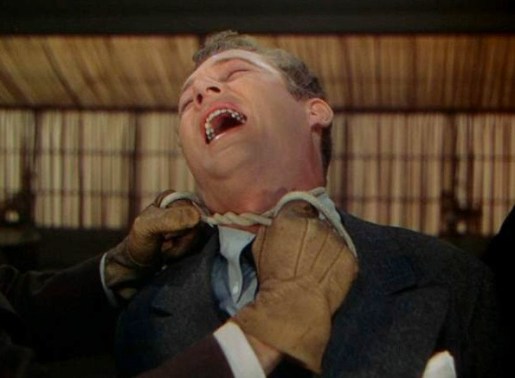
Having seen Alfred Hitchcock’s most successful films like Psycho and The Birds, I thought I’d check out one of his smaller and more inventive efforts. Rope is based on a play and one of the most purely translated plays, enclosed as it is in a single apartment with careful attention to its setting and structure. Decades before Birdman, Hitchcock experimented with long takes and a bare minimum of cuts, which are craftily hidden, sometimes obviously, sometimes not.

Clearly based on the infamous Leopold and Loeb murder, the plot revolves around two arrogant school chums Brandon and Phillip (John Dall and Farley Granger) who strangle a classmate with rope merely to prove their superiority and then invite the victim’s family and friends for a dinner party over the hidden body. As an intellectual experiment, Rope is intriguing and thought-provoking. As a thriller from the master of suspense, it’s rather disappointing. There is far more talking and plotting than actual tension, and the plot hinges on the revelation of how the truth will come out rather than if. One point of contention I didn’t see was rumors about the assumed homosexuality of the killers. Sure, they live together as roommates, but if there was such a subtext, it was so subtle to avoid controversy that I didn’t even recognize it.

Like the motivation for the crime, Rope’s message is more cerebral than visceral. The murderers make it clear that their “superior” ideology stemmed from their teacher Rupert Cadell, played by a serious James Stewart. At the party, Rupert confirms his elitist leanings but only in theory and only until he sees cause for grief. It’s all innocent discussion to debate who is more or less intelligent, cultured, or worthy of life, but such philosophy can be put into action by the unprincipled, like the two killers or Nazi Germany. Rupert was not involved in the murder, but Rope emphasizes that the seed of an immoral idea can be just as regrettable as the crime itself.

Best line: (Mrs. Atwater, a guest) “Do you know when I was a girl I used to read quite a bit.”   (Brandon) “We all do strange things in our childhood.”


Rank: Honorable Mention


© 2016 S. G. Liput

376 Followers and Counting


Cabin in the Sky (1943)

Tags

, , ,


(I decided to forgo today’s NaPoWriMo prompt about flowers, because really, how many movies about flowers are there? At least one of the characters in this random choice is named Petunia.)


When your mind is debating on whether or not
You should go for that third piece of pie,
Or whether you’re better off tying the knot
With a sinner or saint worth a try,
You may not be able to see who is there
As they whisper advice you might take,
But angels and devils are rapt in midair,
Intent on your every mistake.

So next time you manage to fend off temptation
And choose to obey that red light,
Or when you hold in your off-color frustration
At stubbing your toe late at night,
Just know that, although you may not hear a sound,
Your good choices made someone upset,
And that someone is probably pounding the ground,
Because you just lost him a bet.
_________________

MPAA rating: might as well be G

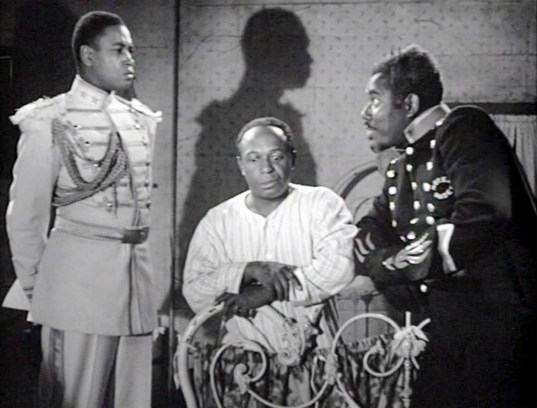
One day not long ago, I decided to just watch this random old movie for no other reason than it was there. Directed by Vincente Minnelli, Cabin in the Sky is a notable film due to its entirely African-American cast, which was unheard-of back in 1943, and it surprised many by performing well with white audiences too, perhaps because the vices, virtues, and caricatures on display are not exclusively black.

Little Joe (Eddie “Rochester” Anderson) can’t seem to shake his gambling addiction, despite the insistence of his religious wife Petunia (excellent Ethel Waters, who reprised her role from the play from which the film was adapted). After his bad habit ends up killing him, Little Joe is confronted by demons eager to take him to hell, but his wife’s prayers earn him a temporary second chance to straighten out his life. Aside from the fact that the plot seems to have inspired a memorable Tom and Jerry cartoon (“Heavenly Puss” if I’m not mistaken), it was a rather fun dynamic watching literal versions of a shoulder angel and devil pulling the characters in different directions. Once Little Joe returns to life, he doesn’t remember or see the spirits, and watching the spiritual enemies vying for him to make right or wrong choices is like a lighthearted version of The Screwtape Letters.

Where Cabin in the Sky falls is in its status as a musical. A musical number is supposed to enhance emotions or be generally enjoyable, but the few songs here just drag the pace to an unnecessary standstill. “Happiness Is a Thing Called Joe” is the only one worth hearing and earned an Oscar nomination for Best Song, but the rest are wholly forgettable, with one wince-inducing number confirming that Eddie Anderson’s scratchy voice was not meant for singing. Duke Ellington and Louis Armstrong have small roles, but it was odd that Armstrong never even got to sing.

The music aside, Cabin in the Sky is a reasonably charming old movie with good work from its black cast, including Lena Horne as Little Joe’s worst temptation. If you’re looking for a random movie to watch, you could do worse.

Best line: (Georgia, played by Horne) “I’m just speaking my mind.”   (Petunia) “And I ain’t heard nothing yet.”


Rank: Honorable Mention


© 2016 S. G. Liput

376 Followers and Counting