Nebraska (2013)

Tags

,

 
One million dollars—I won it! It’s mine.
I’ve got here a letter to prove that I’m right;
It says I’m a winner in plain black and white.
My son says I’m not, but I’ll never decline.
I’ll walk if I must to make good on my claim
In Lincoln, Nebraska, for fortune and fame.
 
He finally yielded to drive me the distance,
But here we are now in my boring hometown
To visit old kin whose default is to frown.
My wife is here too, though she hates my persistence.
I’m old and I’ll die and there’s no use in bragging,
But if I go soon it will be from her nagging.
 
My son doesn’t get it, but I must have won.
Now money’s a mutt with no loyalty due,
But when you’re its master, no need to pursue,
There’s deep satisfaction that something you’ve done
Succeeded. At last I can meet kith and kin
And know that they’re seeing a man who can win.
 
My son says I’m wrong, but he’ll know soon enough
That I can earn something deserving of pride.
I do want that truck, though I only can ride,
And that new compressor, just trivial stuff.
I won a grand prize, and perhaps that will be
Enough to redeem an old codger like me.
_________________
 

Based on NaPoWriMo’s poetry prompt of money, I decided to review Oscar nominee Nebraska, a uniquely matter-of-fact film whose eccentricity derives from its ordinariness. Bruce Dern won acclaim and a Best Actor nomination for playing Woody Grant, whose self-delusion about a sweepstakes letter sends his family back home to Hawthorne, Nebraska, while he and son David are en route to “collect the prize.” I’m not familiar with Alexander Payne’s films, but I quite liked this one (and thought it should have been PG-13 rather than R). Filmed in black-and-white, Nebraska might seem dull in its true-to-life approach, but it derives unusual humor and drama, much of it verbal, from the down-to-earth performances. In some ways, the film is a testament to the American family of yesteryear, full of distant cousins and less-than-warm reunions. My VC was tickled by the silent assembly of relatives, watching TV with sparse, intermittent fragments of conversation among themselves, because she remembers old family reunions that were exactly so, sometimes even without the TV involved.

Also celebrated is the affable friendliness of small-town America. Hawthorne has a certain warmth to it, the kind that some will pity and some will envy. Woody’s supposed win electrifies the town, where a visiting former resident’s good fortune is apparently front page news. Unfortunately, it also attracts family and friends eager to cash in on old debts, such as old rival Ed Pegram (Stacy Keach) and cousins Cole and Bart. (Did anyone notice that Cole is Devin Ratray, otherwise known as Buzz, Kevin’s older brother in Home Alone?!) Yet for every fortune-seeker, there are several genuine friends who merely congratulate Woody with no sense of entitlement to his winnings, offering the perfect balance to the greed of others.

Though Bruce Dern’s scraggly, no-nonsense portrayal of Woody earned the most critical praise and an Oscar nomination, it was so subdued and laconic that it failed to stand out for me. It was a very good performance, but not a great one worthy of an Oscar. Thus, I tend to consider his nomination a nod to his entire career, similar to the comparable performance of Richard Farnsworth in The Straight Story, which was also nominated for Best Actor. The surprise for me was Will Forte as David, shedding his SNL roots for a sincere, conflicted role that balanced comedy with drama (the compressor thief scene easily the funniest part). While David’s life is far from perfect, he proves to be a far more likable character than drunk Woody or his irritable and crude wife Kate (June Squibb), who reminded me of a harsher version of Grandma from The Waltons (compare her final line “You idiot!” with Ellen Corby’s “You old fool!”) While David is flustered by Woody’s brusqueness and misconceptions, he wishes to humor him for as long as they still have together, going to great lengths in the end to comfort his ailing father. Woody could hardly be considered a good father, but David proves himself as a good son.

Best line: (Bart, the speed demon) “We could get you to Lincoln in an hour.”   (David) “Lincoln is over 200 miles.”   (Bart) “Okay, hour-and-a-half.”

 
Rank: List Runner-Up
 

© 2015 S. G. Liput

290 Followers and Counting

Whose Life Is It Anyway? (1981)

Tags


From death in sleep to death in life, I wake
And look about the room in which I lay,
The hospital room where, for mercy’s sake,
I’m forced to stay and “live” day after day.
Not that I have a choice, for I lay still,
A quadriplegic, watered, cleaned, and fed.
They care more for my body than my will
And scoff when I insist that I am dead.
 
I gaze upon my hands, so limp and vain,
That once could sculpt with vigor and create,
And though my body feels no patent pain,
I suffer more with every passing date.
The dawn and light—I used to welcome both,
But they are now a source of pointless dread,
And if not for Hippocrates’ cursed oath,
Perhaps I might escape this bitter bed.
 
Some flowers and some friendly banter can
In no way lend advantage to my plight.
The right to live is that of every man,
But what of death? Do I not have that right?
__________________
 

(The above poem is my first stab at following NaPoWriMo’s poetry prompt, today’s being to write an aubade, or morning poem. In this case, I chose a darker tone than most, with influence from Phillip Larkin’s death-inflected “Aubade.”)

Recommended to me by my VC, John Badham’s Whose Life Is It Anyway? is a thought-provoking film adaptation of a Brian Clark play, which offers a morally challenging view into the subject of suicide. After a car accident (one of those sudden film sequences that remind us just how abruptly life can change), sculptor Ken Harrison is admitted to the hospital and returned to health, except for the fact he can no longer move anything below his neck. He jokes with the orderly (director Thomas Carter in a rare film role) and spews good-natured sexual innuendo at the attentive nurses, but deep down he believes his life is over and decides he does not wish to live. Yet when he asks to be released and left alone to die, the hospital administrator (John Cassavetes) refuses, believing he is not of sound mind. The legal battle that follows is sometimes funny, often heartbreaking, and impervious to any hard-and-fast answer for either side of the debate.

Richard Dreyfuss gives one of his finest performances as the bedridden artist with a death wish, and it’s a wonder that he wasn’t at least nominated for Best Actor. Whether you agree with his stance or not, his grief at the loss of his former life easily elicits sympathy, and like his lawyer (Bob Balaban), one cannot help but root for Ken, despite moral objections. The film itself would be hard to watch, if not for Ken’s frequent humor, which Dreyfuss delivers expertly (his “bunny rabbit” voice gets my VC into hysterics every time), and moments of levity alternate with reminders of the tragedy, both past and in progress. The film taps into questions regarding personal rights: If a clear-minded person does not want treatment, do doctors necessarily know best? What constitutes unbearable pain? Can people be forced through such pain on the promise that things will get better?

As persuasive as Ken’s pleas are, they failed to change my view from the start, that he should do his best to live with his condition and not throw his obvious intellect away. His most cogent argument involves his desiring the same courtesy mankind gives to wounded animals, putting them out of their misery, yet wounded animals lack the mental abilities that Ken still possesses. The way I see it, Ken focuses far too much on what he’s lost, his skills and his lover (both of which he dreams of in an unnecessary nude scene), concentrating on the past rather than the future; even if he’s lost nearly everything, he never tries to find something else he can do or find comfort in God. For me, the clearest refutation of his position is the life of Joni Eareckson Tada, the renowned quadriplegic who suffered the same kind of despair but overcame her handicap by learning to use her mouth to paint. There’s no reference to her inspirational story, but it seems that it may have aided Ken in daring to hope for a future he couldn’t see. While the film seems to take sides, the ending is open-ended enough for those of either opinion to hope for their preferred resolution, an impressive balancing act for such a difficult subject.

Best line: (Ken) “Some nurses and I went out for a little midnight skateboarding last night. The only trouble was that I was the skateboard.”

 
Rank: List Runner-Up
 

© 2015 S. G. Liput

290 Followers and Counting

Watership Down (1978)

Tags

,


Since the world was first contrived,
When Frith made creatures as they are,
Rabbits have survived and thrived,
Fleet of foot, the best by far,
Relying on their speed and tricks.
 
When a runt named Fiver feels
A danger coming for the warren,
Brother Hazel makes appeals
To leave for someplace safe but foreign,
Ere the danger he predicts.
 
On the journey toward a home
That Fiver sees upon a hill,
His companions dare and roam
Through perils always set to kill.
As rabbits, though, they must increase.
 
In Efrafa, a place oppressed,
Our heroes plan a great escape.
The wits and speed that serve them best
Must rescue them from quite a scrape
Before they rest in warren peace.
________________
 

From the greatest novel about rabbits ever written comes the greatest film about rabbits ever made. While I chose this film for Easter Sunday because of the obvious bunny connection, it is indeed about rabbits, not bunnies. While the characters are frequently cute, just as real rabbits tend to be, some of them also manage to be grotesque and cruel, and there’s a striking frankness about the violence inherent in the lives of wild animals. For those sensitive Thumper-lovers like my VC or those who didn’t like a certain kitchen scene in Fatal Attraction, this may not be for you. Bunnies die, sometimes in a stark sudden disappearance like Bambi’s mother, sometimes in brief but bloody maulings. Because of this, its rating (U in Britain or G for the US) has come under fire repeatedly since its release; as a mature but not adult cartoon, the film is, I think, appropriate for older children, like the next step up from the kid-friendliness of Bambi.

The film itself is fascinating, not only for the rabbits’ epic quest for safety and prosperity on Watership Down, but in how author Richard Adams managed to create a rabbit culture at once understandable but distinctly different from our own. In the vast majority of films that build worlds involving talking animals, the filmmakers tend to anthropomorphize the characters to the point of human intelligence, wearing clothes, cooking, reading books, fashioning entire civilizations analogous to our own (An American Tail, The Fantastic Mr. Fox, et cetera, et cetera). I don’t object to this, but it is as if filmmakers can’t seem to let animals be animals. The main exceptions would be Bambi and Watership Down.

The rabbits, like Hazel, Bigwig, Fiver, and Hyzenthlay, are all appealing personalities, but they’re still rabbits, guided predominately by instinct, to eat, to reproduce, to be free. Their intelligence is limited, and the ways of man are inexplicable to them, but they survive, despite all the dangers that threaten their lives every day. The opening scene, drawn in a creatively cartoonish style, brilliantly establishes the mythology of the leporine culture, explaining in rabbit terms why life is as it is. The dialogue between the characters also borrows freely from the book’s Lapine terminology, which may not be fully understood upon its first hearing (Owsla=the warren enforcers, going tharn=freaking out, silflay=aboveground foraging).

If you’ll forgive the expression, this bunny tale is a slow boiler, so to speak; some may find it hard to get into (a musical interlude featuring Art Garfunkel singing “Bright Eyes” is lovely but slows the film down), yet it builds to a genuinely exciting climax with a last-minute escape, an underground siege, and a furry battle to the death. Production quality is also top-notch. The imagery ranges from beautiful and bucolic to surreal and nightmarish, and the voice acting is excellent, particularly John Hurt as Hazel, Michael Graham Cox as Bigwig, and Zero Mostel (in his last film role) as the tempestuous gull Kehaar. As a whole, the film succeeds whether as pure adventure or an animalized endorsement of freedom over totalitarian and fatalistic societies. Plus, the end is also subtly moving, and knowing myself, I probably would have cried had I seen it at a younger age. I’ve been meaning to read Watership Down for some time now, and this excellent animated adaptation just increases my interest. Happy Easter!

Best line: (Kehaar) “You stupid bunnies! You got no mates!”

 
Rank: List-Worthy
 

© 2015 S. G. Liput

290 Followers and Counting

Invasion of the Body Snatchers (1956)

Tags

,

 
They came from the stars with one mission in mind,
To slowly invade us and conquer mankind!
When Doctor Bennell and his lovely old flame
Became more aware of the creatures to blame
For copies of loved ones devoid of emotion,
They tried to resist the invasion in motion.
But who can escape these pod people when vexed?
You dare not nod off or else you may be next!
_______________
 

Though I missed the first three days of April, this is my first official post for National Poetry Writing Month (NaPoWriMo), for which I will attempt to write a post a day, sort of like the majority of last year. While I probably won’t always follow the official website’s idea prompt, I’ll try when I can, based on whatever movie I review.

Following up a little late on a prompt about stars, today I chose an science fiction classic, which for some reason I’ve never seen. The original Invasion of the Body Snatchers has the title of a laughable B-movie, but it actually takes itself seriously and manages to be unusually gripping for a black-and-white thriller from the 1950s. While it feels more or less like an extended episode of The Twilight Zone, it’s an exceptionally good one, even if its villains are essentially plants.

Before the science fiction takes hold, the relationship between Doctor Miles Bennell (Kevin McCarthy) and Becky Driscoll (Dana Wynter) feels right at home in a romance film, with witty repartee and a likely second chance at love. Soon, though, paranoia sets in as various townspeople fear their family members have subtly changed for the worse, and enigmatic duplicates begin appearing and disappearing. By the time the main two realize what’s happening, mere escape may be impossible, let alone stopping the invaders.

While some involved with the film’s production have stated that there was no political message in mind, many reviewers since have latched onto perceived Cold War themes, such as the secretive invasion of America, defiance against involuntary conformity, and the “turning” of friends into foes. Whether viewers study such topics or just enjoy the film’s building tension, Invasion of the Body Snatchers is intelligent viewing and one of the better entries in the alien invasion genre, taking a less destructive but perhaps more pernicious path compared with War of the Worlds. Even if the final depiction of a character’s “replacement” goes against previously established revelations, it’s still chilling, and Kevin McCarthy’s warnings of “You’re next!” are no less unsettling than they were sixty years ago.

Best line: (Dr. Bennell) “In my practice, I’ve seen how people have allowed their humanity to drain away. Only it happened slowly instead of all at once. They didn’t seem to mind. All of us, a little bit, we harden our hearts, grow callous. Only when we have to fight to stay human do we realize how precious it is to us, how dear.”

 
Rank: List Runner-Up
 

© 2015 S. G. Liput

290 Followers and Counting

The Passion of the Christ (2004) (Encore)

Tags

,


Praying in the garden
Is a Man Whose heart is hardened
To the fact that He will soon endure the worst of any pain.
That devil snake unnerves Him,
Saying man does not deserve Him;
Jesus nonetheless resigns Himself to die, but not in vain.
 
He remains reserved and docile
When His ally and apostle
Judas gives his last betraying kiss to seize the Son of Man.
His other friends desert Him
As the soldiers bind and hurt Him.
He is led away, according to the Jewish leaders’ plan.
 
The Sanhedrin asks and mocks Him,
But it seems that nothing shocks Him,
And He’s all but silent till He says He is indeed divine.
They’re infuriated by it,
And, regardless if He’s quiet,
They insist that He be put to death because He crossed their line.
 
As He’s taken for His sentence,
Judas cannot find repentance
And is hounded by his demons till he hangs himself in grief.
Meanwhile, as Jesus eyes him,
Peter thrice in fear denies Him,
And he flees and weeps in bitterness for slandering his chief.
 
Jesus stands in Pilate’s power,
But He does not beg or cower;
He stands silent as the Jews accuse their King of wicked lies.
Though both he and Herod gather
That He’s innocent, he rather
Has his soldiers scourge the Man, perhaps to forgo His demise.
 
Still the Jews demand damnation
And will not accept placation,
And they free the foul Barabbas rather than a guiltless Man.
Pilate fears a new uprising
So he ends up compromising.
Pilate cleans his hands while giving in to his taxpayers’ plan.
 
As the soldiers strike and beat Him,
All the angry crowds mistreat Him,
And He’s forced to bear the heavy cross on which He will be hung.
Through the teeming streets, He carries
Quite a weight, that’s also Mary’s,
As His mother watches helplessly, unlike when He was young.
 
When He strains His final sinew,
When He falls and can’t continue,
They compel a man named Simon to assist Him with the beams.
When a woman comforts Jesus,
Wiping off the blood that frees us,
All the soldiers start to beat Him until Simon intervenes.
 
On the hill of crucifixion,
They complete the Lord’s affliction,
And they nail His hands and feet against the hard, abrasive wood.
As He knew the night preceding,
When His followers were feeding,
He is lifted overhead in utter pain for mankind’s good.
 
As the Jewish leaders scorn Him,
And His friends and mother mourn Him,
He forgives His own accusers, barely drawing enough breath.
When He feels abandoned even
By the God He did believe in,
He gives up His soul and spirit and thus triumphs over death.
 
As a sudden storm blows straight in,
There is only loss for Satan,
Though disciples round the cross are still in sorrow for their Lord.
Mary’s woe may dominate her,
But it’s only three days later
That the Savior Jesus rises, having life for all restored.
_____________________
 

First off, let me say that this poem and review are written solely from my position as a Christian, more so than my other posts. I personally believe that Jesus Christ died for my sins and those of the world, but like so many Christians, my convictions sometimes tend toward complacency. It’s easy to skim the Gospels and read that Jesus was flogged, mocked, and nailed to a cross, but after years of such tame review, His death often fails to achieve the level of meaning it once had. It takes a brutally honest portrayal like The Passion of the Christ to help viewers to fully appreciate the severity of his suffering, to recognize just how much He endured for me and for you.

Embroiled in controversy, Mel Gibson’s foreign-language, cinematic passion play, the highest-grossing R-rated film in the US, is exceedingly violent, an almost continuous cavalcade of tortures and ugliness, yet Jim Caviezel is a subtle and credible Jesus, bestowing a patient solemnity on all he suffers. Gibson himself has stated that the film falls short of depicting the crucifixion in its full horror (which is true to some extent since Jesus was likely crucified naked rather than with the traditional loincloth), while others have called the film’s agonies overwhelmingly excessive and more than enough to kill a man. To address the latter grievance, I must point out that Jesus did not merely suffer physically but spiritually as well. In addition to all the blood and humiliation, the weight of mankind’s sin throughout the ages was piled on Him so unbearably that God the Father turned His back on His Son. As opposed as I am to violence, I see The Passion of the Christ as an unflinching reminder of the Lord’s atonement to snap unexcitable believers like myself to a fuller appreciation of it.

The film also possesses notable artistic merit that cements its status as one of the quintessential Jesus movies. The literal interpretation of Genesis 3:15 (about crushing a snake’s head) is a brilliant symbol of Jesus’ final determination to go through with the dreaded task ahead of Him, and well-placed flashbacks offer meaningful respites from the carnage. The depiction of the Last Supper is saved for the arrival at Calvary as a fitting remembrance of Christ offering His Body and Blood. Other smaller details also hold significance, such as Mary’s wiping up her Son’s blood after the scourging: in the Catholic Church, any spilling of the Eucharistic wine/Blood is an occasion for swift and solemn purification. The most moving scene is Jesus’ rendezvous with His mother on the Via Dolorosa; after a previous good-humored scene together, this heart-breaking reunion portrays one of Jesus’ falls, interspersed with snippets of a childhood accident, and speaks to anyone who has given or received maternal love.

While I now watch The Passion of the Christ around Good Friday every year, it took me a while to muster the courage to view it, and my VC still cannot bring herself to watch such a disturbingly brutal film. I agree it is gruesome (particularly the wince-inducing scourging scene) and certainly not appropriate for children, but light is only fully appreciated and comprehended amid darkness. That light is even portrayed in the brief final scene, a refreshingly explicit reference to the Resurrection compared with artistically oblique endings in Ben-Hur and Jesus Christ Superstar. It’s not for everyone, but The Passion of the Christ is the most spiritually stirring film I’ve seen in some time, one that everyone who can handle it ought to see.

Best line (again given added depth after witnessing the horrors He endured): (Jesus, from the cross) “Forgive them, Father. They know not what they do.”

 
Rank: Still List-Worthy (#101)
 

© 2014 S. G. Liput

290 Followers and Counting

The Wind Rises (2013)

Tags

, , , ,


Before the World War that sent Zeros to soar,
A youngster named Jiro had bright dreams galore.
Airplane engineer was his chosen career,
A striving for beauty, naïve and sincere.
He built and he planned and foresaw something grand
To rise on the wind over enemy land.
 
While deep in his quest for the plane he loved best,
His heart found a partner, and both were soon blessed.
But love has a way of still making us pay,
For sadly short-lived is our happiest day.
He felt the wind rise to the loftiest skies,
Where high-minded dreams tend to meet their demise.
________________
 

Hailed as Hayao Miyazaki’s swan song before his retirement, The Wind Rises is a work of heartfelt beauty worthy of being the celebrated director’s final film (though he had supposedly retired after Princess Mononoke too). It is also an outlier among his films for two reasons: its realism and its poignancy. Looking back, few films directed by Miyazaki are based entirely in the real world, set instead within dystopian jungles, demon-infested landscapes, or steampunk fantasy lands. Some come close to reality, like Kiki’s Delivery Service, My Neighbor Totoro, or Porco Rosso, but even they carry obvious fantasy elements. Only his first film, the James Bond-ish The Castle of Cagliostro, could have actually happened (if you consider James Bond realistic), but not until his last film did he settle upon real people and real events.

Based on the life of avionic engineer and creator of the Japanese Zero Jiro Horikoshi, The Wind Rises (which could have been called Jiro Dreams of Airplanes) details his ambition of creating marvelous flying machines and bringing Japan up to speed with the likes of Italy, Germany, and the U.S.  Honestly, I know nothing about the real Jiro Horikoshi or the extent of the film’s historical accuracy, but, even if it weren’t a fictionalized biopic, it would still be one of Studio Ghibli’s most beautiful films. Certain scenes recall notable realistic scenes in past Ghibli movies. A sequence depicting the Great Kantō Earthquake of 1923 recalls the urban devastation of Grave of the Fireflies, while Miyazaki’s obvious fascination with flight takes center-stage in a story focused on building planes, a process only briefly portrayed in Porco Rosso. Of course, Miyazaki’s fantastical fingerprints are still evident in Jiro’s dream sequences, in which an Italian engineer named Caproni acts as his Chef Gusteau, offering inspiration and advice while they stroll along aircraft wings. Ghibli’s hand-drawn animation has always been impressive, but not since Howl’s Moving Castle have the artistry and attention to detail been so wondrous, from plane-level views of billowy clouds to the fading vapors of Jiro’s chain-smoking habit to the varying shadows cast by Jiro’s glasses on his own face.

The film’s realism is notable in itself, but it would have made it simply an interesting oddity, rather than the bittersweet drama it is. What sets The Wind Rises apart from its Miyazaki brethren is its heart. As much as I enjoy Miyazaki’s films, none of them have ever touched me on an emotional level; there’s visual beauty to spare, but they tend to appeal more to the eyes and the imagination rather than the heart. This latest film is the exception. The first half is entertaining enough on its own, but the film becomes something more special upon the arrival of Nohoko, one of Ghibli’s loveliest female characters to match its loveliest romance.

Consider their early courtship: like Romeo and Juliet, Nohoko stands on a balcony while Jiro deploys paper airplanes to her rather than poetry (though there’s poetry too). As corny as it sounds, it’s remarkably sweet, as is their increasing devotion to each other, despite Nohoko’s tuberculosis. Miyazaki plumbs unusual depths of emotion as the couple is brought together repeatedly by the wind until they become inseparable, the one pursuing a dream and the other wasting away in support of it. Though it does pay tribute to the most memorable scene from Porco Rosso involving the fate of fallen pilots, the ambiguous ending misses an opportunity to become a full-on tearjerker in favor of a pseudo-inspiring sendoff, which still manages to be rather powerful.

I heard an interview with Gary Rydstrom (director of the excellent English dub), which summed up the film’s dually signified message perfectly: the danger of daring to pursue a passion doomed to end badly. Jiro knows his avionic masterpieces will inevitably be used for destruction in the approaching war, just as he knows his time with Nohoko is limited. It’s the timeless struggle of love; though it will surely end, dreams fulfilled and time well spent manage to be worth it in some ways, despite regret. Caproni mentions that an artist has only ten good creative years allotted to him, but Hayao Miyazaki’s career is clearly an exception. Though Disney’s Frozen juggernaut was understandably the Oscar-winning favorite for Best Animated Feature that year, The Wind Rises would have won my vote.

Best line: (Caproni) “Airplanes are beautiful, cursed dreams, waiting for the sky to swallow them up.”

 
Rank: List-Worthy
 

© 2015 S. G. Liput

288 Followers and Counting

Genre Grandeur – The Others (2001) – Rhyme and Reason

Here’s my second review for MovieRob’s Genre Grandeur of Latin-Directed Films. I just couldn’t resist doing another. 🙂

movierob's avatarMovieRob

For this month’s first review for Genre Grandeur – Latin Directors, here’s a review of The Others (2001) by S.G. Liput from Rhyme and Reason.

Thanks again to Anna of Film Grimoire for choosing this month’s genre.

Next month’s Genre has been chosen by James of Back to the Viewer.  We will be reviewing our favorite movies featuring a dystopian world (past or future). Please get me your submissions by 25th April by sending them to dystopia@movierob.net  Try to think out of the box! Great choice James!

Let’s see what S.G. thought of this movie

th

Deep within an old household

Where darkness lurks behind locked doors.

Grace must teach, protect, and scold

Her children, whom the light abhors.


Servants three arrive to seek

Employment here in isolation;

Strange events and portents wreak

Distress on Grace’s situation.


Doors once closed do not stay so,

And faithful sureness yields…

View original post 895 more words

Genre Grandeur – La Bamba (1987) – Rhyme and Reason

Here’s my selection for MovieRob’s Genre Grandeur of Latin-Directed Films.

movierob's avatarMovieRob

For this month’s first review for Genre Grandeur – Latin Directors, here’s a review of La Bamba by S.G. Liput from Rhyme and Reason.

Thanks again to Anna of Film Grimoire for choosing this month’s genre.

Next month’s Genre has been chosen by James of Back to the Viewer.  We will be reviewing our favorite movies featuring a dystopian world (past or future). Please get me your submissions by 25th April by sending them to dystopia@movierob.net  Try to think out of the box! Great choice James!

Let’s see what S.G. thought of this movie

la bamba

(Can be sung to the title song)

Rock-n-roll was still teenage,

In its growing and green stage,

And so was too, Richie (then) Valenzuela,

Who was keen to unveil a music forte,

For his passionate family.

They supported him gladly,

Though brother Bob

Was thought of less

For his success.


With his hits, Ritchie…

View original post 640 more words

The Maze Runner (2014)

Tags

, , ,


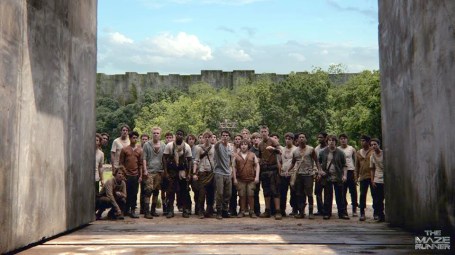
Within a Glade within a Maze are boys without their memories,
Trying to survive and build the best of boy communities.
Outside the Glade, within the Maze are Grievers no one’s lived to see,
And the walls protect as well as hold them in captivity.
 
A final boy is planted here and wonders at the mysteries;
Thomas breaks the rules, impressing some but making enemies.
In search of freedom and some answers, gutsy curiosity
Opens doors as it explores and hopes to set the captives free.
_________________
 

Despite the glut of young adult films based on young adult book series starring young adults, The Maze Runner was one of the few films last year that I actually wanted to see in the theater based on the trailer alone. While I didn’t get to view it until just recently, I found it to be just what I was hoping for, a better-than-average YA thriller that rises above its brethren due to sheer intensity.

Like The Hunger Games, it’s a story built around one central but entertainingly provocative concept: a collection of amnesiac boys trapped in an enigmatic maze. Honestly, I’m surprised this idea was adapted into a book and film before it became a video game, what with its survivalist circumstances, plot-specific terminology (Grievers, the Changing, etc.), and lack of in-depth characters. (I can easily envision “Mini-Games with Minho” as players map and memorize the Maze. It makes me wonder what Halo or Portal would have been like had the game not come first.) Though none of the characters have an explained backstory as yet, they all become more real and likable over time. As second-in-command Newt says, it doesn’t matter who they were but who they are now, and almost all of them are sympathetic and supportive of each other as they band together to face the unknown with surprising maturity. My VC pointed out that the script could have been full of wit or clever dialogue, but instead the character’s lines are very much what real people might say, adding to the realism of the performances.

These YA series seem to act like this generation’s Red Dawn or The Breakfast Club, introducing many fresh faces sure to have promising careers ahead of them. Dylan O’Brian and Kaya Scodelario portray the game-changers Thomas and Teresa, alongside Aml Ameen as leader Alby and Ki Hong Lee as runner Minho. I was excited to see Will Poulter as Gally, a very different role from that of weaselly cousin Eustace Scrubb in the Narnia film The Voyage of the Dawn Treader, and my favorite of the boys would have to be Newt, played by baby-faced Thomas Brodie-Sangster, known to me as the voice of Ferb on Disney Channel’s Phineas and Ferb.

While there’s no Lost alert for any of the actors, several similarities to that great show occurred to me afterward. Think about it: there is a group of people banding together in isolation, hoping to escape, while receiving supplies from a mysterious acronymed organization obsessed with experiments (DHARMA=WCKD) who leave cryptic video messages, all while being terrorized by an unseen creature which emits roars and mechanical clicking noises. On top of that, there are lies built upon lies and mysteries upon mysteries, which foster Lost-style speculation about what it all means (at least for those of us who haven’t read James Dashner’s books). According to IMDb, even director Wes Ball originally called the film “Lord of the Flies meets Lost.”

While the social commentary is not as pronounced as in The Hunger Games series, The Maze Runner surprisingly prompted far more discussion between my VC and me. We mainly debated the morality of Thomas’s search for the truth, which led to many casualties and didn’t better their situation (at least in this installment). On the one hand, she sympathized with Gally, who didn’t want to upset the status quo, a hard-fought peace that had made the Glade more or less an idyllic community. While Thomas wanted to find the truth, he did spoil that peace with his revolutionary curiosity, which ended up costing many lives. On the other hand, I countered that, as Thomas states, the situation in the Glade could not last forever, and his actions may have actually saved more lives (my reasoning behind that would be too spoiler-prone). In addition, the tantalizing idea of freedom and the desire to not be controlled or contained were understandable driving forces for his dissenting inquisitiveness.

The Maze Runner may draw a little from Aliens and The Lord of the Rings: Return of the King, mainly with respect to the frightening Grievers, but it’s an intense and intriguing first installment for a series in which I’m now thoroughly invested, full of tense moments and glowing Broadway musical reviews (after all, “Wicked is good,” right?). That being said, don’t expect a lot of answers to your questions. The ending explains a couple issues but raises even more, and since my VC was not expecting this to be a trilogy, she was unsatisfied by the conclusion. If you enjoy sci-fi thrillers and don’t mind cliffhangers, this film is a must, but if that’s not the case, you might wait to watch after all the films have been released, like I did after Lost’s final season. Guilty as charged. 🙂

Best line: (Newt, to Thomas) “He’s right. It doesn’t matter, any of it. Because the people we were before the Maze, they don’t even exist anymore. These Creators took care of that. What does matter is who we are now and what we do right now.”

 
Rank: List-Worthy
 

© 2015 S. G. Liput

286 Followers and Counting

The Count of Monte Cristo (2002)

Tags

, ,

When Edmond Dantes dares to run
To Elba, where Napoleon
Was exiled, in hopes to save
His ailing captain from the grave,
The captive emperor commands
He take a message to the hands
Of some old friend, and in his debt,
The sailor takes it with regret.
 
When Dantes lands back in Marseilles,
He’s lauded, and his fiancée
Mercedes welcomes him with joy,
Which jealousy will soon destroy.
His friend Mondego goes too far
With envious first mate Danglars,
To have Dantes arrested for
The treason of the note he bore.
 
Before the matter comes to court,
A magistrate named Villefort,
Who might have offered him relief,
Entombs him in the Chateau D’If.
Through painful years, he sits and waits,
Endures and loses faith and hates.
When near the ending of his rope,
A fellow prisoner gives hope.
 
This priest assists him, through despair,
To dig for freedom and prepare.
They learn and burrow gradually,
And when Dantes at last is free,
He plots his vengeance, soon released,
With treasure from the caring priest.
A wealthy count, a different man,
He reaps revenge with righteous plan.
As Edmond nears his final goal,
Perhaps true love can save his soul.
_______________
 

Alexander Dumas is among the most famous of French novelists, but his memory seems often based on mere name recognition. Plenty of people have heard of The Three Musketeers, but far fewer actually know its plot. Such was the case with me and The Count of Monte Cristo, a classic tale of revenge that has resulted in countless adaptations (such as ABC’s current series Revenge), as well as a scrumptious sandwich. Though I had read the book in abridged form as a kid, I had little interest in this 2002 film version when it was released, but I recently sought it out after discovering the unproduced musical version by Frank Wildhorn (Jekyll and Hyde). I’m glad I did, for it turned out to be a clean, exciting, and undeniably entertaining swashbuckler that even manages to improve on the source material.

The evenly talented cast is composed of actors more recognizable from their other roles than from their names. Jim Caviezel as Edmond Dantes also played Jesus in The Passion of the Christ, and his suffering in the Chateau D’If mirrors that film, though Dantes hardly turns the other cheek. Guy Pearce (The King’s Speech, Iron Man 3) is the most famous of the cast and is perfectly odious as his backstabbing “friend” Mondego. Dantes’ faithful love Mercedes is played with romantic earnestness by Dagmara Dominczyk (Marguerite in The Five People You Meet in Heaven), and Richard Harris (Camelot, two Harry Potter films) brings wisdom and unshaken religiosity as Abbe Faria, Dantes’ fellow prisoner and mentor. Also notable are a young Henry Cavill as Mercedes’ son Albert, long before the fame of Man of Steel, and James Frain (known to me as the sleepy college student in Shadowlands) as Villefort, proving that he and Pierce excel at portraying despicable aristocrats.

Despite the large cast, the main point of the tale is very simple: revenge. While The Count of Monte Cristo could be considered the original revenge fantasy, it surpasses imitators like Kill Bill or Darkman by not reveling too much in the morally sticky subject of vengeance but placing it in a religious context. Certainly everyone enjoys watching villains receive their just desserts, but when one becomes an instrument of revenge, obsession and resignation to sin threaten. While there’s an entertaining “gotcha” factor to his enemies’ comeuppance, there are also friends urging Dantes to move past his hatred. It’s a sensitive balance that ultimately sides with the godly faith of Abbe Faria and is not lessened at all by its religiosity. (The only really morally problematic act of vengeance involves the Chateau D’If’s sadistic jailer [Michael Wincott of Hitchcock and Robin Hood: Prince of Thieves in yet another creepy role], but is more or less understandable considering its timing.)

The production itself sometimes has the look of a BBC television production, but with a much higher budget, seen in the ornate set design and the Count’s spectacular entrance into Parisian society. (Hint: There’s a hot air balloon!) The sword fights are riveting, the dialogue is clever, and the final confrontation between Dantes and Mondego is so much better than in the book, which ends with a mere suicide and a less happy ending for some characters. It may depart from the novel, but I prefer this version.

Having seen this film, I’m even more convinced that it would make a great musical. There have been productions in Germany and South Korea, and at BYU just two months ago (its English-language premiere), but I think it ought to be on Broadway. Listen to these examples: “I Will Be There,” a love duet between Dantes and Mercedes,

and “Hell to Your Doorstep,” a rage-fueled tirade as Dantes plans his revenge.

Doesn’t anyone else think this musical deserves more attention than it’s gotten? Then again, so does this film.

Best line: (Abbe Faria) “Here is your final lesson: Do not commit the crime for which you now serve the sentence. God said, ‘Vengeance is mine.’”   (Dantes) “I don’t believe in God.”   (Abbe Faria) “It doesn’t matter. He believes in you.”

 
Rank: List-Worthy
 

© 2015 S. G. Liput

286 Followers and Counting