It seems so very long ago
The journey started with “hello,”
And then despite my disapproving,
Ever onward we were moving
Through the high and through the low,
Through lands I never dreamed I’d go.
And now at last, it’s with a sigh,
I whisper out a strained goodbye.
Despite the pain I had in store,
I’m glad I stepped out my front door.
From comfort’s hearth to dragon’s den,
I’ll treasure there and back again.
___________________
MPAA rating: PG-13
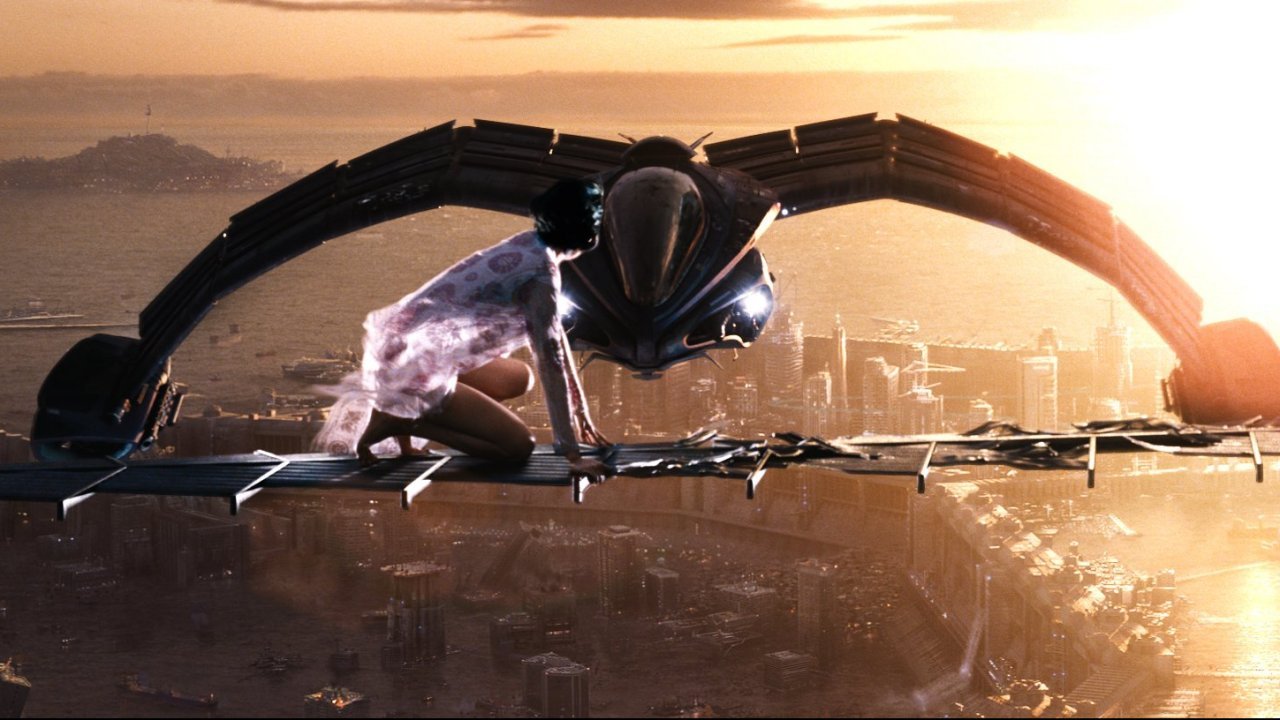
I reviewed the first two Hobbit films long ago as part of my original year-long movie countdown in 2014, when the third installment wasn’t even released yet, and despite my grouping the trilogy together on my list, it’s odd that I haven’t gotten around to reviewing The Battle of the Five Armies until now. Perhaps it’s because this third chapter of Peter Jackson’s prequel trilogy to The Lord of the Rings is most clearly the weakest of the bunch, the main problem being the preponderance of apocryphal embellishments found nowhere in Tolkien’s children’s novel.
It certainly can’t be accused of false advertising: it’s called The Battle of the Five Armies, and that’s exactly what you get—a huge, Middle-earth epic battle between dwarves, elves, the men of Laketown, orcs, and eventually eagles. If all I want out of a movie is sword slashing galore and spectacular set pieces, The Battle of the Five Armies delivers, especially reminding us just how awesome Legolas is. But in stretching out what is only a few pages in The Hobbit book, it falls short of the higher aspirations of The Lord of the Rings, each part of which deserved its near three-hour runtime. What with the painfully forced comic relief of Alfrid (Ryan Gage) and the unsatisfying love triangle of she-elf Tauriel (Evangeline Lilly of Lost) and he-dwarf Kili (Aidan Turner), it’s obvious that Jackson’s trying to string out this bloated third of a story in a less than successful manner. It’s not bad; it’s just forced at times. And don’t get me started on those were-worms! What is this, Dune?
Yet Middle-earth is never without its joys. Jackson does manage to improve certain scenes from the book, most notably the death of the dragon Smaug, and the themes of greed and loyalty started in An Unexpected Journey are fulfilled in Thorin’s obsession with protecting his newly won hoard. As it was from the start, the casting is (mostly) impeccable, whether it be Martin Freeman as the younger Bilbo Baggins, Luke Evans as heroic Bard the Bowman, or returning familiar faces like Ian McKellen and Hugo Weaving. And by the end, it does feel like a worthwhile journey has been taken, especially with the end credits that recall those of The Return of the King, backed by Billy Boyd’s magnificent “The Last Goodbye.” (See my End Credits Song Hall of Fame.) The Hobbit trilogy is undoubtedly less than The Lord of the Rings, but it is unfortunate that the last one received only a single Oscar nomination for Sound Editing. Surely it could have competed in Makeup, Visual Effects, and Best Song, but the series’ general inferiority made that unlikely. Even so, Jackson’s achievement should not be overlooked; he completed two consecutive epic trilogies, a feat that is clearly harder than it seems if James Cameron’s troubles with the Avatar sequels are any indication.
I still can’t help but feel that an opportunity was missed in making The Hobbit a trilogy rather than a two-parter. Early on, I thought it was perhaps to humanize the thirteen dwarfs so that each character wasn’t just one of the thirteen, and while Jackson was more successful with some than others, most of the dwarves still seemed interchangeable, even for me, a hardcore Middle-earth fan. It’s a shame that Jackson couldn’t leave us Middle-earth lovers with more than a CGI free-for-all and a wistful farewell, but any visit to the land of hobbits, dragons, wizards, and rings is still one worth taking.
Best line: (Thorin) “If more people valued home above gold… this world would be a merrier place…”
Rank: List-Worthy (mainly due to the previous two and my own fondness for the franchise)
Into a drug plot are drawn
A father, a nut, and a con.
These unlikely three
Prove a sequel can be
Even funnier than the first one.
_________________
MPAA rating: R
Earlier this year, I enjoyed a little marathon of the Lethal Weapon movies, at least the first three and part of the fourth. (I probably didn’t miss much with 4.) Unfortunately, too much time has passed for me to feel like I can write about most of them, but that time has proven something to me that I suspected at the time too: the second film is the best. How do I know that? Because it’s the one I still remembered months later, and a more recent viewing confirmed how funny and enjoyable an actioner it is.
The first film was a solid buddy-cop tale that established the odd couple chemistry of Martin Riggs (Mel Gibson) and Roger Murtaugh (Danny Glover), but it was rather depressing with Riggs’ suicidal tendencies and a less-than-memorable climax. (Mud-wrestling, wasn’t it?) Without the need to introduce the leads and their relationship, Lethal Weapon 2 picks up right from the start with Riggs and Murtaugh in a thrilling car chase that exemplifies the humor of their quirky partnership, summed up by Riggs as “We’re back, we’re bad, you’re black, I’m mad.” This time, the two cops are pitted against ruthless, racist South African drug dealers, which worked well for the time since the film was released during the height of apartheid when South Africa was viewed in villainous terms anyway.
While Riggs and Murtaugh could have carried the film on their own, the writers (Shane Black and Warren Murphy) add in a third unlikely partner in Joe Pesci’s neurotic book-cooker Leo Getz, whom the duo are ordered to protect as a witness. The odd couple are even more entertaining as an odd trio, and Leo brings another great slant of humor to the proceedings with his constant, semi-annoying catchphrase of “Okay, okay, okay, okay!” Luckily, Riggs and Murtaugh are no less entertaining too, with Riggs still his devil-may-care self and Murtaugh playing the weary straight man to these two eccentrics. It’s telling too that the next two sequels kept Pesci around for no other reason than to uphold the buddy triangle from this movie.
The villains are still menacing and merciless, particularly in relation to Riggs’ past, but the film never forgets to have fun with its buddy cop conventions. It’s full of memorable scenes, from earnest ones like Riggs’ discussion of his late wife to action ones like the nail gun ambush to hilarious ones like Murtaugh’s unfortunate encounter with a toilet and his priceless visit to the South African consulate.
As much as I prefer it without the violence and profanity, Lethal Weapon 2 is undeniably entertaining, and I stand by the idea that a film’s virtues can be measured by how well it’s remembered months or years later. That’s why only Lethal Weapon 2 makes my list and why it’s the member of the franchise to which I’ll most readily return.
Best line: (Dr. Stephanie Woods, after Riggs hurts himself to win a bet) “Why do you do this to yourself, Riggs?” (Riggs) “Well, who else am I supposed to do it to? None of them’ll let me. Besides, I need the money.”
Do you value your life,
All you have, all you know?
And for what would you trade it,
I wonder?
Could you ever decide
To what lengths you would go?
Would you grieve when you’d paid it,
I wonder?
I would never regret,
Says the fool, feeling smart,
To confirm his conviction
Till later.
But regrets always come
When we think with our heart.
‘Tis our own contradiction
And traitor.
___________________
MPAA rating: All not rated (should be PG-13)
Don’t judge a book by its cover, or in this case, a show by its genre. I would think most people even mildly familiar with anime have heard of magical girl shows like Sailor Moon or Cardcaptors, where a group of girls typically gain powers from some adorable talking creature and become cutesy superheroines. Not to dis those shows, but it’s the kind of formula that works well for kids yet becomes insufferable to outsiders and even older former fans, like me. Yet about six years ago, Puella Magi Madoka Magica (that’s Latin, by the way, not Japanese) revolutionized the genre under the mature eye of writer Gen Urobuchi. In American terms, that’s like Christopher Nolan directing a Barbie movie and making it awesome.
Since I’ve been reviewing only films up to this point, I’ll point out that Puella Magi Madoka Magica (I’ll just call it Madoka Magica to save time) isn’t just a TV show; it had a film follow-up subtitled Rebellion, and before that was released, the 12-episode series was edited and retooled as two theatrical films, the first called Beginnings, the second Eternal. Thus, that makes Madoka Magica eligible for my top movie list and well worth reviewing, since it happens to be my third favorite anime series, after Cowboy Bebop and Steins;Gate.
The odd thing about Madoka Magica is that it was marketed like any number of similar shows, light and innocent, and since it was original and not based on a manga, viewers had no idea what to expect. The opening credits are overly bright and cheery and the first couple episodes are nothing out of the ordinary, with the typical banter and buoyancy of color-coordinated middle-school girls, but don’t let that fool you. This series goes to some very dark and very emotional places, and it confirms the unwritten rule of watching at least three episodes of a given series before you write it off.
After school one day, Madoka (the one with pink hair) and Sayaka (blue hair) are rescued from a dangerous witch by upperclassman Mami Tomoe (yellow hair), who became a magical girl by making a deal with the talking animal-thing Kyubey: magical powers and the duty of battling witches in exchange for a single wish. At first, they’re awed by the potential of such a pact, but neither can bring themselves to trade away their old lives. Meanwhile, a black-haired new student and magical girl named Homura seems to have a mysterious mission to keep Madoka from accepting Kyubey’s deal at all costs. The story may threaten to lose your interest at first, but then comes a moment in the third episode that changes the entire tone of the show, a scene so sudden and shocking that it has burned itself into my memory, even though I knew about it beforehand. From there, the story spirals into tragedy, heartache, and themes far deeper than one would expect going in.
The characters are still young and naïve, and they buckle under the weight of the hard, regrettable choices placed upon them. They expect frilly costumes and to help people, and while there’s some of that, before long they must deal with disillusionment, death, lies, time travel, and the laws of thermodynamics. (Told you this wasn’t a typical magical girl show.) The catalyst for all this is Kyubey, who seems like a cute sidekick at first but holds much darker intentions with his Faustian contract. Even with his passive demeanor, high-pitched voice, and blank stare that gets creepier with time, he’s such a manipulative, logical little bugger that, by the end, I hated the very sight of him. He’s also essentially unkillable, but it was satisfying whenever anyone tried. Homura’s story in particular overshadows everyone else’s, and while she’s a mystery for most of the series, her backstory is remarkably compelling.
Like the story, the art style is also distinctive and layered with atmosphere. The animation of the real world is evocative on its own, often setting the mood with stylized angles and amber-tinged sunsets, and the character’s eyes have a unique sketched quality to them. Things get bizarre, though, whenever a witch appears in its labyrinth, not as a pointy-hatted antagonist but as a collage of stop-motion cutouts that go deep into surreal territory. The combination of the traditional animation with this dreamlike setting is often nightmarish and complements the story’s descent into misfortune, while certain scenes in silhouette are both beautiful and disturbing, incorporating artistic details evoking similar themes to Faust and The Little Mermaid. The action scenes are also very well-done, often with spectacular explosions. Boy, this series has everything.
I feel like I’ve been reviewing Madoka Magica the show rather than the movies, but the first two films basically are the series, with the first eight episodes making up Beginnings and the final four forming Eternal. They actually translate quite well, skipping over some of the awkward moments at the beginning and keeping only what’s necessary to the story, while retaining important character moments, like Madoka’s insightful conversation with her mother. Eternal has one extra battle scene and some revised animation but unfortunately includes some cutesy montages that feel out of place since the story’s tone had already changed drastically from the beginning. However, it does follow the same plot to the same heart-tugging finale. The series is full of tragic events that make me want to tear up just seeing the characters, but despite some overwrought execution of the cosmic twist at the end, the conclusion is sublimely bittersweet.
And then… they had to ruin it with a third movie. Rebellion may be more cinematic than the first two, but it’s nowhere near as successful. It tries to replicate the bait-and-switch of the series, with a lighthearted beginning that gets darker as it goes, but it does so by presenting an alternate version of events with an explanation far too long in coming. I suppose it’s a little satisfying to see the characters in the carefree life they thought they’d have as magical girls, but it indulges for too long. Sure, the plot eventually makes sense, but it’s not good when even those familiar with the story are utterly confused for over a half hour.
It’s not all bad. Once the plot deepens, it gets more absorbing, and the eventual reveal of the mystery reconfirms Kyubey as the most hateful cat-bunny-thing imaginable. There’s also an epic gun battle between two popular characters that is jaw-droppingly awesome and may be the action high point of the series. If only the rest of the story could live up to it. One side character has little reason for existing; the surreal visuals are the rule rather than the exception now, as if the filmmakers took turns animating their most unsettling drug trips; and the final twist took Homura’s obsession with Madoka in a wholly unsatisfying direction. And then it ends, with a brand new conflict introduced and no resolution. No! There’s talk of a fourth film in development, and while that may improve things if they can end it right, it doesn’t make the disappointment of Rebellion any better right now. Sequel-makers constantly ignore this demand, but don’t continue a series unless you can end it just as well as it already had!
The final movie aside, Puella Magi Madoka Magica is a brilliant and memorable series, well-written, poignant, and impressively visualized. The music is haunting, the animation arresting, and the character motivations powerfully nuanced yet pitiful and open to interpretation. It’s the kind of psychological story that leaves me with a persistent melancholy long after it’s over. I’m including a fan-made music video down at the bottom (set to one of my favorite Florence and the Machine songs) that might give you an idea of its peculiar power. For anyone still reading this who may be hesitant to check out a magical girl series, I can only say one thing: Don’t judge a book by its cover. You’ll be glad you didn’t.
Best line: (Kyubey, the loathsome, logical little scumball) “Why is it that when humans regret a decision they made based on their own misunderstanding, they feel resentment toward the other party?”
Tied with his punch-worthy “If you ever feel like dying for the universe, call me. I’ll be waiting.”
Rank for Beginnings and Eternal: List-Worthy
Rank for Rebellion: Dishonorable Mention
How would it be
Do you think, do you think,
If a giant of men were required to shrink,
If a shaker and mover who loved his own name
Who terrorized armies and reveled in fame
Were forced to live simply, obscurely, and sad,
Assuming, of course, he did not first go mad?
I would be curious, and yet if it were so,
I doubt that the world and I ever would know.
________________
MPAA rating: PG
Sometimes a film is blessed by perfection in casting. Ian Holm is such an ideal Napoleon Bonaparte, both in talent and height, that he’s played “the little corporal” three separate times, in the mini-series Napoleon and Love, in Time Bandits, and lastly in The Emperor’s New Clothes, a semi-comedic revisionist account of Napoleon’s post-exile days based on a Simon Leys novel.
We all know Napoleon was exiled to St. Helena after the Battle of Waterloo, but what we don’t know (supposedly) is that he switched places with a deckhand lookalike (also played by Holm) and escaped back to France. Why do we not know such a story? Because the plan failed in complete secrecy. While the fake Napoleon enjoyed being famous and pampered a bit too much, the real one endured the yoke of obscurity only to find unexpected appeal in the romance of a simple life, one that didn’t involve conquering the European mainland.
The Emperor’s New Clothes could have been a stronger film and doesn’t inject its clever concept with as much humor as I would expect or hope, but it’s a satisfying one even so. While strong supporting roles are filled by Iben Hjejle as Napoleon’s love interest and Tim McInnerney as her jealous suitor, Holm in his double role is the star of the show.
At first, his Napoleon grumbles over the injustice of his lack of recognition and support, but once he accepts it, he becomes what Napoleon might have been without his despotic mindset, still a brilliant strategist but one bent on less militant pursuits, like distinguishing himself as the best melon salesman in Paris. Yet if you don’t think that the real Napoleon would give up his ambition so easily, the film doesn’t either and offers a hauntingly persuasive twist to make his acceptance and the story as a whole more credible. While the revisionist theory could have had a more humorous bent to it, The Emperor’s New Clothes brings Napoleon Bonaparte down to a relatable level and gives him a far more fulfilling fate than his real-life counterpart.
Best line: (Napoleon, preparing to leave St. Helena) “Six years of English cooking… six years of staring at these dreary walls… and at your gloomy face. You’re quite ugly, did you know that? I haven’t had the heart to tell you.” (Louis) “Yes, sire.”
Our lives seem like a universe,
And yet they’re but a dot,
An inch upon a larger road,
An integer within the code,
A minute of an episode,
One tangle in a knot,
A drop within a mighty sea,
A twist within a tapestry,
The start of a soliloquy
We’ve barely even thought.
For how much larger must it seem
To One who knows its end.
Perhaps we’ll know the more we dream
And someday comprehend.
____________________
MPAA rating: PG-13
I love Marvel movies, and as much as I want to agree with most other reviewers that Doctor Strange is one of the best Marvel origin stories, I can’t quite bring myself to say it. Based on the visuals alone, it’s a cinematic wonder that deserves to be seen on the biggest screen possible. Storywise, I find my feelings similar to how I felt about last year’s widely loved blockbuster, namely Star Wars: The Force Awakens: I liked it a lot, but…. While most people don’t seem to mind the but, it necessarily tempers my praise.
What Doctor Strange gets right from the very beginning is Strange himself. Benedict Cumberbatch is so ideal for the role that I honestly cannot see anyone else donning the red cape. Early on, he essentially brings the same selfish arrogance of his Sherlock Holmes persona to the MCU, somehow making the audience feel invested in a conceited jerk of a surgeon. At first, he’s at the top of his field, but like Tony Stark and Thor before him, his vanity backfires. He’s humbled by one of the worst examples of distracted driving imaginable, and desperate to find healing, he journeys to Kamar-Taj in Nepal and discovers a more supernatural answer than he was expecting.
I do not belittle the visual mastery on display here, which I can best compare to Inception on steroids. After an initial confrontation between Kamar-Taj’s Ancient One (Tilda Swinton) and rogue sorcerer Kaecilius, where an entire city block wraps up on itself, it seems like the visual effects team were holding back during Strange’s initiation, one or two psychedelic mind trips notwithstanding. Yet that was only so that they could go full-on bonkers when Kaecilius returns. Ignoring the fact that the actors are just waving their hands around in real life, it’s amazing how gravity, space, time, and perspective fluctuate with incredible ease, and it truly seems that images and actions are limited solely by the imagination. The time manipulation of the final battle is especially awe-inspiring, clever, and quite different from the typical explosive endings Marvel is known for.
What all these Oscar-deserving effects cover up, though, are some uninspired stock characters. I could see Tilda Swinton trying to make her Ancient One more engaging than a typical wise mentor type, but she only half succeeds, though her final scene does carry emotional weight. Chiwetel Ejiofor as Strange’s compatriot Mordo and Benedict Wong as a librarian named, uh, Wong barely made an impression on me since they too fell into the wise, solemn master stereotype, with not enough humor to escape it. Oddly, I’ve seen Rachel McAdams’s love interest getting most of the character criticism elsewhere, but I thought she filled her small supporting role quite nicely.
The script too falls a tad short, not only in the humor department that we’ve come to expect from Marvel, but in the preponderance of mystical mumbo-jumbo that I can only take half-seriously. I appreciate Christian director Scott Derrickson softening the main character’s occult roots (much like how Thor’s godhood was explained through extradimensional advancement), but a lot of the meaningful lines seem overly familiar, starting with the clichéd “Forget everything that you think you know.” My VC was vastly more negative than I, probably because the mumbo-jumbo caused her to tune out at times, since she couldn’t always keep up with all the names and spiritual terminology, not having any experience heretofore with Strange in the comics. I suspect watching Doctor Strange again with subtitles will improve her opinion and mine in time. (My MCU tastes are just different than most, I guess. My VC and I both immediately loved Ant-Man, but Guardians of the Galaxy took some warming up to. Give us time; we’ll love almost all of them eventually.)
Once again, this whole review feels like one big complaint, but I did indeed like Doctor Strange. I think it’s one of the weaker origin stories, but it has some excellent strengths going forward, especially Cumberbatch (who I really wish would meet Martin Freeman’s character from Civil War now that they’re both in the MCU). Also, despite disliking the weak or undeveloped reason behind one character’s falling out with Strange, I’m definitely excited for the possibilities that the two requisite after-credits scenes imply. Doctor Strange may not be among my favorite MCU chapters, but the groundwork that it lays gives me high hopes for the future.
Best line: (Kaecilius) “How long have you been in Kamar-Taj, Mister…?”
(Dr. Strange) “Doctor!”
(Kaecilius) “Mister Doctor?”
(Dr. Strange) “It’s Strange!”
(Kaecilius) “Maybe, who am I to judge?”
While some prefer a city life
With urban pleasures close at hand,
Still others call for space and land,
For rivers clear and mountains grand,
And do not seem to understand
A noisy, city life.
Some love the woods unpopulated;
Some love the bustling avenues;
And some appreciate both views
And do not know which one to choose.
To pick but one and one refuse
Sometimes is complicated.
____________________
MPAA rating: PG (should be PG-13 for language)
My VC had me watch Continental Divide some time ago, and I never remembered it being anything special, aside from the unlikely casting of John Belushi as a romantic lead. He plays Ernie Souchak, a provocative newspaperman who pushes too hard on a crooked politician and, for his own good, is sent to the Rocky Mountains to write a story about eagle expert Nell Porter (Blair Brown). Helpless as he is and remote as they are, Nell grudgingly agrees to allow him to stay in her cabin, and we all know what can happen when this attractive woman and…well, this man share a cabin for an extended period of time. Yet, eventually they must deal with the fact that the two of them have different homes and different passions that will inevitably keep them apart.
Seeing Continental Divide again, there’s still nothing that would make this a favorite romance of mine, but it was far better than I recalled. The script isn’t as funny as I would expect for a John Belushi film, but the screenplay by Lawrence Kasdan (Empire Strikes Back, Raiders of the Lost Ark, The Big Chill) still establishes two likable characters even before they become lovebirds. As mismatched as they seem at first glance, Belushi and Brown do share some burgeoning chemistry so I see why my VC sighs that “they make such a cute couple.” Yet, what makes the film special is the mountainous setting and Nell’s nature-centric lifestyle; the expansive vistas of Colorado offer a gloriously romantic backdrop to the log cabin love affair.
Continental Divide often has the look and feel of a TV movie, and my VC thinks it would have made a promising TV spinoff, if not for Belushi’s death months after its release. The film eventually presents the expected challenges of a long-distance relationship, and while the resolution won’t please everyone equally, the relationship on display is worth some charming optimism.
Best line: (Souchak) “The air was thin. She was average cute. She was the only girl up there. The air was thin!”
The past has haunted me before,
Mistakes, heartaches I tried to flee,
And when at last I think they’ve gone,
I find not everyone’s moved on,
Sometimes including me.
My enemies have bones to pick,
A few more personal than most.
When bullets make their presence known,
I’ll gladly help to pick the bone
And silence any ghost.
________________
MPAA rating: PG-13
After the exceptional storyline of Skyfall, it was certainly a difficult task for the next installment in the Bond franchise to match it, and it’s not very surprising that it doesn’t. Spectre is a solid Bond adventure, but even with Sam Mendes returning as director, it pales next to its predecessor, if only because it returns to predictable action-movie formulas.
Spectre does start in style, with a long flowing shot that follows a masked Bond from the Mexico City streets up to a sniper position on a hotel roof. The subsequent destruction and helicopter chase exemplify what makes Daniel Craig’s Bond so entertaining in the action department, but after he returns to London for a slap on the wrist, he sinks into suave spy mode with the same ease. From investigations into yet another mysterious international organization to rendezvous with women and an old foe, the plot does what one would expect of a Bond movie, and all of the supporting “good guys” do excellent work with it, including Ralph Fiennes’ M, Ben Whishaw’s Q, and Léa Seydoux as the latest Bond girl named Madeline Swann, who has an interesting connection to Bond’s past adventures.
However, it’s the villains who are the biggest letdown. After Javier Bardem’s malicious Silva in Skyfall, Christoph Waltz fails to make as much of an impression, which is a shame since we know he can play an expert villain. Part of the problem is that he’s absent from the picture for too long, floating in and out of events more like a plot device than an evil genius. Another character is so obviously working for him that I’m not sure if that was meant to be a surprise, especially when he’s played by the clearly untrustworthy Andrew Scott (a.k.a. Moriarty on Sherlock). The sad part is that Waltz’s character is meant as Bond’s arch-nemesis but isn’t given the screen-time or strong motive to warrant that title, even with his supposed mastermind status over Bond’s past exploits.
The film’s technical aspects also feel more pedestrian next to Skyfall. After that initial continuous shot I mentioned, the artistry Mendes showed in the past is hardly noticeable, and the action scenes feel born more out of necessity than creativity. One kidnapping car chase, for instance, takes place in the snowy Alps, and Bond decides to pursue in a small plane, begging the question how he intended to rescue the hostage from the air.
I sound like I’m being harsh, don’t I? It’s a James Bond movie, and I shouldn’t expect much, but after thoroughly enjoying Skyfall, it was hard not to feel a bit let down by Spectre. Nevertheless, taken by itself, formula and all, it’s still an entertaining mission and a deserving member of the Bond franchise. It fits comfortably among the franchise’s second tier, making it probably my least favorite of the Daniel Craig movies, but on the List-Worthy level of Bond’s older, more conventional escapades.
Best line: (C) “You can’t tell me an agent in the field can last long against all those drones and satellites.” (M) “Yes, you have information. You can find out all about a man, track him down, keep an eye on him. But you have to look him in the eye. All the tech you have can’t help you with that. A license to kill also means a license not to kill.”
Rank: List-Worthy (tied with the older Bond movies I’ve seen, which are headed up by A View to a Kill)
The golden orb shone on the heath and lazily it flew,
While muddy plows and barren cows belied a murky charm.
The water troughs reflected back the sky’s pathetic blue,
When Flora Poste arrived to host the old Cold Comfort Farm.
The quarters of the Starkadders had stood for centuries,
And honestly it looked it in its gloomy disrepair.
But deep beneath the seedy heath were possibilities,
And that’s why ‘twas a lucky thing that Flora Poste was there.
_______________________
MPAA rating: PG
I checked out Cold Comfort Farm from my library based on the whimsical description on the back, which made it sound like a British version of Chevy Chase’s Funny Farm, but it’s something else. Based on a Stella Gibbons novel from 1932 and released first on the BBC, then in theaters, it’s a makeover lark with a humor that seems to defy easy categorization. Perhaps that’s because the charm is meant as contrast between the bourgeois sensibilities of Flora Poste (Kate Beckinsale in one of her first roles) and the hyperbolic gloominess of her rural Starkadder relatives with whom she goes to stay at Cold Comfort Farm.
Determined to live off of her relations while working on a novel, Flora appeals for invitations and picks Cold Comfort in Sussex because it sounds “interesting and appalling” as opposed to the others, which are just appalling. There’s a strange old-world charm to the Starkadders, who continually refer to Flora as “Robert Poste’s child” and use fake archaic words like sukebind, scranlete, and clettering. Since the original book was meant as a parody of dreary rustic novels, it’s no surprise that the tone was as if the most melancholy portions of Wuthering Heights or Jane Eyre were played for laughs. Despite the large cast of characters, most of them have a moment to shine, such as Judith Starkadder (Eileen Atkins) with her Frau Blucher-like gravitas, her husband Amos (Ian McKellen) who delivers a fire-and-brimstone sermon that would make Jonathan Edwards quiver, their son Seth (Rufus Sewell) who loves the movies, their other son Reuben (Ivan Kaye) who hopes to run the farm himself one day, and several other colorful personages, all subjugated by the oppressive hand of Aunt Ada Doom (Sheila Burrell), who is haunted by seeing “something nasty in the woodshed” when she was a child. (Boy, that was a long sentence!)
After innocently asking if she might change a few things, Flora quickly takes it upon herself to bring this motley crew into the modern age, encouraging them in different ways to crawl out from under Aunt Ada’s thumb. Flora might have seemed like an overly nosy busybody, but Beckinsale plays her with earnest confidence in her self-appointed roles of matchmaker and wish granter, efforts met with surprising success. By the end, two questions on which the plot seemed to hang are entirely ignored in favor of blithe wish fulfillment, but it’s hard not to be won over by the appeal of a happy ending.
Cold Comfort Farm may not be a typical country farce, but its unconventional wit and talented cast (including Stephen Fry, Freddie Jones, and Joanna Lumley, by the way) make it an entertaining amusement.
Best line: (Amos) “There’ll be no butter in hell!”
Or for a line more indicative of the film’s Jane Austen-ish wit:
(Charles, Flora’s friend) “Do you ever think of getting married?”
(Flora) “I believe in arranged marriages, don’t you?”
(Charles) “Rather out of date.”
(Flora) “Not at all. I’ve always liked the phrase, ‘A marriage has been arranged.’ When I feel like it, I’ll arrange one.”
Insults bring about turmoil.
Injuries cause blood to boil.
Sin and sufferings embitter,
Making spite a heavy hitter.
Malice merits some requital;
Are not victims so entitled?
Vengeance is a worthy cause
For those who follow their own laws.
And when reprisals hit their mark,
The soul falls further into dark.
Revenge does what justice intends,
But when it starts, it never ends.
___________________
MPAA rating: PG-13
I love animation, whether it be Disney, Pixar, anime, or any number of cartoons on television, so I’ve never thought of myself as prejudiced against animated media. (Would that be called an animationist?) My VC is of that mind, considering animation to be, if not inferior, then at least less effective than live action, and we’ve had some strong disagreements on that front. However, I’m split over the various DC animated films that have been released direct-to-DVD over the last decade.
While they all seem to attract excellent voice casts and usually critical appreciation, I can’t help but feel they are second-tier animations. Why else would they be released direct to DVD? The few I’ve seen have been good, but even acclaimed ones like the two-part The Dark Knight Returns seem to fall short of greatness because, well, they’re animated. No, now I feel guilty for even saying that. It’s not that they’re animated; it’s that the animation seems less of an effort and causes me to lower my expectations, even though The Dark Knight Returns is undoubtedly better than, say, Batman v Superman: Dawn of Justice.
All this debate is to provide context since I’ve now seen an animated DC film that does stand toe-to-toe with its live-action cousins. Batman: Under the Red Hood holds to the much darker trend in the DC animated universe, evident right from the beginning, where the Joker (John DiMaggio) mercilessly beats the second Robin/Jason Todd with a crowbar and Batman (Bruce Greenwood) arrives too late to save his sidekick. Jump ahead five years to Gotham City, in which a new vigilante called the Red Hood (Jensen Ackles) keeps criminals in line by becoming a feared crime boss himself. As Batman investigates this lethally skilled foe, his past confronts him in ways he never expected.
Deserving of its 100% Rotten Tomatoes score, Under the Red Hood would have been fantastic enough with its explosive action sequences, but the triple confrontations between Batman, the Joker, and the Red Hood cut right to the heart of Batman’s morality. He and the Red Hood agree that criminals must be kept in line, yet their methods are diametrically opposed, with killing as the great line that Batman refuses to cross, for reasons rarely so compellingly delivered. Their final faceoff provides both tragedy and food for thought, an epic clash of moralities backed by the dark madness of the Joker. This version of the Joker is memorably malicious and unpredictable, and even if DiMaggio still sounds a little like his Adventure Time and Futurama characters, he once again proves how playing the Joker brings out the best in an actor, even a voice actor (except Jared Leto, that is).
Watching Under the Red Hood, I was tempted to throw it into the good-not-great category, but animated or not, it’s a mature and outstanding Batman movie. I wish the ending wasn’t so ambiguous, but this film gives me hope that perhaps other DC cartoons will be better than I’ve given them credit for.
Best line: (Red Hood, about killing the Joker) “What? What, your moral code just won’t allow for that? It’s too hard to cross that line?”
(Batman) “No. God Almighty, no. It’d be too damned easy. All I’ve ever wanted to do is kill him. A day doesn’t go by I don’t think about subjecting him to every horrendous torture he’s dealt out to others, and then end him.”
(Joker) “Awwww, so you do think about me.”
(Batman) “But if I do that, if I allow myself to go down into that place, I’ll never come back.”
When morn dawns optimistically,
Like all the morns before,
No thought have we for jeopardy
That could be yet in store;
No thought for smoke or lives at stake
Or bodies in the street,
For blasts and chaos in their wake
Or desperate, dazed retreat;
No thought for tears and tattered nerves
And hopes soon left for dead,
Or courage once in vast reserves
Reduced to helpless dread.
No thought for such, and why should we
Let life be worry-marred?
That’s how we maintain normalcy
And why we’re caught off-guard.
_______________________
MPAA rating: R
In the unnerving tradition of The Twilight Zone, Right at Your Door thrusts ordinary people into an alarming situation, a worst-case scenario that is compellingly realistic because it is so possible. As Brad (Rory Cochrane) bids farewell to his wife Lexi (Mary McCormack) as she heads to work in Los Angeles, a typical day takes a sharp turn when the news reports explosions downtown. His incredulous panic growing, Brad listens as reporters give ever-worsening descriptions of the damage done by a suspected dirty bomb. When Brad tries to reach Lexi and is forced to return home, he and a desperate passerby (Tony Perez) seal themselves into the house with tape and plastic covers, isolating themselves from the reported toxins and anyone who might be infected.
The film’s low budget and limited locations actually work to its advantage, focusing its scope on Brad’s home and increasing the apprehension and doubt of what may or may not be happening. Except for some billowing smoke and ash, most of the disaster is kept to news reports, begging the question of how much we hear is truth, conjecture, or misinformation. The film emphasizes just how little we’d know in a quarantine during a disaster, and as Brad and others must make stressful personal decisions, it’s disconcerting to see how even small impulses or mistakes can mean the difference between life and death.
Written and directed by first-time filmmaker Chris Gorak, Right at Your Door is a potently plausible what-if scenario spoiled only by the near-constant profanity, which, considering the stressful circumstances, is at least understandable. The three main actors emote that fear effectively, selling the tension that might have petered out with less convincing performances. We rarely can tell the best course of action in a disaster, and while everyone hopes they’ll never have to experience it firsthand, Right at Your Door brings that anxiety closer to home than most disaster films even try.