
How can you know that it’s love close at hand
And deeper romance than the rest understand
Until there is distance to feel
The pain of the parting, detachment’s demand,
The grief that goodbye makes more real?
Things taken for granted, more often than not,
Are prized more profoundly than we would have thought.
Their value is only revealed
When losing such treasures leaves lovers distraught,
Confessing what once was concealed.
___________________
MPAA rating: R (solely for language)
A happy Valentine’s Day to all, and in the spirit of love, I thought I’d review one of the best romantic comedies of recent years.

Unfortunately, I don’t know how to review The Big Sick without sounding like a complaining puritan. It’s certainly one of the best films of 2017 and one worth recommending to others, but I suppose I’ll get my objections out of the way first. (Sorry to any who disagree, but please hear me out or skip the next two paragraphs.) As much as I enjoyed it, the amount of profanity really disappointed me, despite the fact that I usually ignore it. It’s impossible to escape the F-word these days since it’s now an ingrained part of everyday speech for the apparent majority of people, and it’s no longer as offensive as it once was. Yet more than two (if I’m correct) can still give a movie an R rating, and the simple truth is that The Big Sick did not need to be R. There’s no violence or nudity, but there are stretches where every noun has to be preceded by F-ing. Why? Could they not think of some better adjective? It’s not so much offensive to me as it is annoying and not reflective of the creativity in the rest of the script.
This is why I don’t watch much Tarantino or Scorsese, but usually R-rated films like theirs have more than just objectionable language. Here, the frequent language is the only thing that makes it R, and that annoys me because not only would I rather not hear it but it limits the audience. This is an extremely worthwhile film that I think everyone, even older kids and teenagers, could greatly appreciate, if it weren’t for the language (though that probably doesn’t stop most kids these days either). Despite what writer/star Kumail Nanjiani says, the F-word is not inherently funny, and there are plenty of good and clean rom coms that have proved how unnecessary it is.
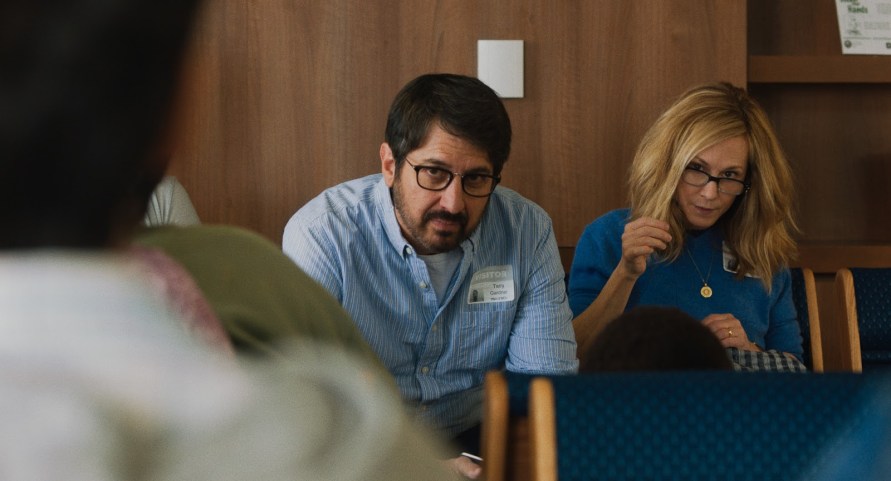
So there, I’ve had my rant, and I will now praise The Big Sick as if the language weren’t there. Without it, the script is a brilliant balance of funny and poignant, drawing both from Kumail’s job as a stand-up comedian and from his first-hand brush with tragedy. It was written by Nanjiani and his wife Emily V. Gordon (both now nominated for Best Original Screenplay) and based off of their own experiences, with Nanjiani playing himself and Zoe Kazan as Emily. After their initial meeting at a comedy club and a series of charming dates, their romance hits a snag due to Kumail’s traditional Pakistani family, who keep trying to coax him into an arranged marriage. When things seem over between them, Emily suddenly falls ill and is placed in a medically induced coma, leaving Kumail to decide how much he really cares for her while also getting to know her worried parents Terry and Beth (Ray Romano, Holly Hunter).
I suppose the best thing about The Big Sick is its authenticity, both in its dialogue and performances, the kind that can find amusement in a 9/11 joke yet quickly acknowledge its inappropriateness. It’s easy to believe that this is based on a true story, and Kumail’s connection with Emily is entirely natural, as is the older coupling of Romano and Hunter, whom I’m glad to see getting such strong roles. I loved the way that Hunter’s dislike of Kumail (based solely on how Emily had described their break-up) slowly melted into fondness, helped along by the ever-likable Romano. Even Kumail’s comedy seemed like an honest work-in-progress, since he repeatedly has to tell people when he’s joking. The realness extends to the end as well, where things don’t wrap up as quickly and easily as one might have hoped, yet strong themes of forgiveness, faithfulness, and sincerity are fostered in more satisfying ways than one.

Perhaps it was Romano’s presence, but I couldn’t help but notice traces of Everybody Loves Raymond in Kumail’s family dynamics, particularly with his overbearing but loving mother. The Muslim family is depicted in a largely relatable and sympathetic way, contrasted no less sympathetically with Kumail’s agnosticism, and one heated conversation between Kumail and his parents feels like a talk that many traditional immigrants might have with their more free-thinking children.
So yes, I was able to look past the language and recognize The Big Sick as the outstanding film it is. I’m just sorry that others with similar objections (such as my VC) might not. I’ve overlooked such objectionable content before, which is why I’m still awarding it a List-Worthy ranking. As much as I wish it were cleaner, I can’t help but admire the total package.
Best line: (Kumail) “You’ve never talked to people about 9/11?”
(Terry) “No, what’s your, what’s your stance?”
(Kumail) “What’s my stance on 9/11? Oh, um, anti. It was a tragedy; I mean, we lost nineteen of our best guys.”
(Beth) “Huh?”
(Kumail) “That was a joke, obviously. 9/11 was a terrible tragedy. And it’s not funny to joke about it.”
Rank: List-Worthy
© 2018 S.G. Liput
536 Followers and Counting
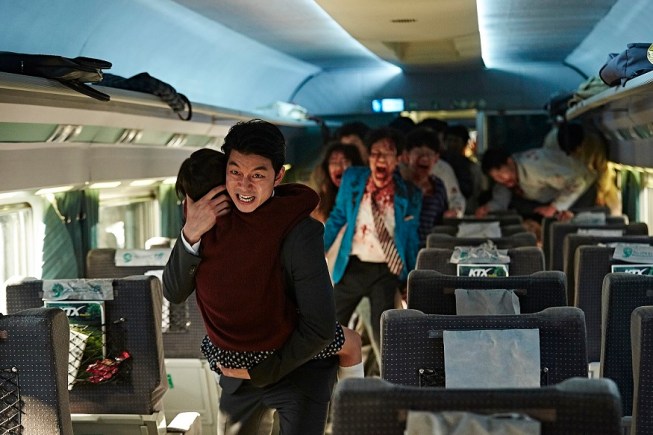


 Since I’ve said I don’t like the gory side of zombie movies, I should address that part of it. There is blood, but Train to Busan is still greatly restrained compared with a lot of others out there. Heck, some of the commercials for Walking Dead are worse than anything in Train to Busan. A big part of that is the absence of knives and guns, which draw maximum blood while also dehumanizing the still human-like zombies. (Sorry, but all the head-shots and such bother me.) Here, baseball bats are as bad as it gets, and most of the blood comes from the initial outbreak of zombies biting people’s necks. The fact that the victims quickly “turn” also does away with the whole flesh-eating element while also making the ever-growing horde even scarier. So I was thankful that the film didn’t rely on violence for its scares. In fact, after the initial outbreak, it’s really more of a fast-paced thriller than a horror. The zombies are the running type also seen in World War Z, and there are several moments that had me going “oh my gosh” as things devolve from bad to worse, often making great use of the visual effects.
 Seoul Station has some merit to it, mainly in the strictly horror department. There are some moments of genuine terror, particularly a white-knuckle encounter with a crazy woman, so if you enjoy zombie movies for the situational tension alone, you might like it. I, however, found plenty to dislike. For one, the animation, while mostly good, has the stilted look that 3-D-ish anime hasn’t gotten past, such as the way the characters walk. In addition, the gore and foul language (subtitled) are more pronounced here than in Train to Busan, and the characters are dumber compared to the rather clever survival techniques in its live-action counterpart. For one thing, everyone seems very slow to grasp the idea of a zombie outbreak, as if they’ve never heard of a zombie before, whereas Train to Busan showed that “zombies” were exactly where people’s minds went.