• Home
  • About Me
  • THE LIST Through the Years
  • Top Twelves and More
  • The End Credits Song Hall of Fame

Rhyme and Reason

~ Poetry Meets Film Reviews

Rhyme and Reason

Category Archives: Poetry

Cartoon Comparison: Train to Busan (2016) / Seoul Station (2016)

07 Wednesday Feb 2018

Posted by sgliput in Movies, Poetry, Reviews, Writing

≈ 2 Comments

Tags

Action, Animation, Anime, Cartoon Comparisons, Drama, Foreign, Horror, Thriller

See the source image

See the source image

When certain death surrounds you,
You’d be foolish not to fear,
To run and hide and save yourself
And those few you hold dear.

Yet in the face of jeopardy,
What will you sacrifice?
Your conscience and humanity?
For those too have a price.

For some, to care for more than self,
The risk may be too high,
But ask yourself how proud you’ll be
Both if and when you die.
________________________

MPAA rating for Train to Busan: Not Rated (I guess R but it’s not as bad as some)
MPAA rating for Seoul Station: Not Rated (should be R)

If someone had told me last year that the first movie I’d love in 2018 was a South Korean zombie flick, I’d never have believed it. I only half-believed all the positive buzz around Train to Busan because hey, it’s a zombie movie, and I don’t watch zombie movies. I’ve never seen Dawn of the Dead or The Walking Dead and have only really liked a precious few of that genre (World War Z, Warm Bodies). The living dead concept is intriguing, but usually it seems like an excuse for excessive gore and end-of-the-world futility. But for some reason I checked out Train to Busan, which I can now say is my favorite of the genre and honestly one of my favorite horror films period, mainly because it goes beyond its horror limitations to deliver exceptional thrills and emotional stakes worth caring about too. Since I loved Train to Busan then, I had to check out its animated prequel, if only for comparison’s sake, a prequel that reminded me exactly why I don’t typically enjoy zombie movies.

See the source image

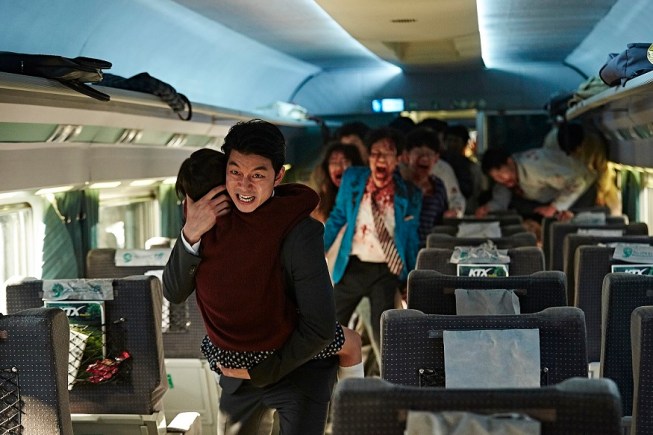
First, let’s focus on the good one. Train to Busan seems like such a simple idea: zombies on a train. It could easily have been the concept of a B-grade cheesefest, but the filmmakers went above and beyond to make it gripping. A big part of that is giving us worthwhile characters, particularly Seok-woo (Gong Yoo), a disengaged father who decides to accompany his young daughter Soo-an (Kim Su-an) as she returns to his ex-wife in Busan. There are various other passengers that quickly stand out as “survivor characters”: a man and his pregnant wife, a traumatized tramp, two high school students, and a self-serving businessman, among others. Things seem to start normally as the train sets out, but an abundance of warning signs builds the tension as a zombie outbreak engulfs the nation and the train itself. From there, it’s an all-out flight of survival with a few much-needed moments to catch one’s breath (even a disarming chuckle or two), but the suspense is ever-present. I don’t think I’ve been this tense during a movie since Dunkirk.

What’s impressive about Train to Busan is that it delivers the scares and shocks alongside an insightful character arc without sacrificing either. Seok-woo starts out as an apparent coward, fearfully closing a door in the face of someone fleeing the zombie onslaught, yet his self-first philosophy is called out in the criticisms of his daughter, while also playing out to an extreme in the uncaring actions of other passengers. The contrast between these mindsets imparts to the action some deeper themes behind it. There are sacrifices aplenty, some meaningful, some pointless, but the film seems to affirm the importance of helping others in the face of desperation rather than just oneself. To that end, the conclusion is surprisingly emotional as well, right up to the film’s anxious final moments.See the source imageSince I’ve said I don’t like the gory side of zombie movies, I should address that part of it. There is blood, but Train to Busan is still greatly restrained compared with a lot of others out there. Heck, some of the commercials for Walking Dead are worse than anything in Train to Busan. A big part of that is the absence of knives and guns, which draw maximum blood while also dehumanizing the still human-like zombies. (Sorry, but all the head-shots and such bother me.) Here, baseball bats are as bad as it gets, and most of the blood comes from the initial outbreak of zombies biting people’s necks. The fact that the victims quickly “turn” also does away with the whole flesh-eating element while also making the ever-growing horde even scarier. So I was thankful that the film didn’t rely on violence for its scares. In fact, after the initial outbreak, it’s really more of a fast-paced thriller than a horror. The zombies are the running type also seen in World War Z, and there are several moments that had me going “oh my gosh” as things devolve from bad to worse, often making great use of the visual effects.

How then does Seoul Station, from the same director Yeon Sang-ho, compare? It’s not exactly anime since it’s Korean rather than Japanese, but it has a similar visual style. I think it purports to be a prequel showing the origin of the zombie apocalypse, but it doesn’t really give any further details about the actual cause. A wounded homeless man is apparently patient zero, and while he slowly “turns,” we meet a runaway girl named Hye-sun who has a falling out with her cash-strapped and selfish boyfriend. The boyfriend is soon confronted by her father, and the two of them go in search for Hye-sun right as the city starts spiraling into zombie-infested chaos.See the source imageSeoul Station has some merit to it, mainly in the strictly horror department. There are some moments of genuine terror, particularly a white-knuckle encounter with a crazy woman, so if you enjoy zombie movies for the situational tension alone, you might like it. I, however, found plenty to dislike. For one, the animation, while mostly good, has the stilted look that 3-D-ish anime hasn’t gotten past, such as the way the characters walk. In addition, the gore and foul language (subtitled) are more pronounced here than in Train to Busan, and the characters are dumber compared to the rather clever survival techniques in its live-action counterpart. For one thing, everyone seems very slow to grasp the idea of a zombie outbreak, as if they’ve never heard of a zombie before, whereas Train to Busan showed that “zombies” were exactly where people’s minds went.

Still, I could look past most of that if the ending were worthwhile, but this is one case where the ending completely ruined it for me. The film pulls out a dark twist that pounds in the whole end-of-the-world futility I mentioned earlier I didn’t like. The characters are far less sympathetic, and the end only amplifies that. I didn’t hate the movie as I was watching it, but by the end, I did. Seoul Station tries harder to focus on its themes of class warfare, which were much more subtle in Train to Busan, yet it comes off as a cheaper offshoot of a much better original.See the source imageI’ve said before that I have very particular tastes when it comes to horror movies, but seeing two ostensibly similar zombie films side by side made me consider why exactly I loved one and hated the other. I can say I prefer genuine creepiness and atmosphere over gore, but in this case, I think it comes down to this (spoiler warning): I don’t like stories whose main purpose is killing off its characters. If there’s no survivor by the end, then everything that came before was pointless. If I actually care about the characters who live and die, then the end product becomes even better. That’s why Train to Busan exceeded my expectations. Clearly, I’m not about to become a fan of zombie movies in general, but I’m glad to have found one member of the genre that truly impressed me.

Best line (from Train to Busan): (Soo-an, pricking her father’s conscience) “Dad, you only care about yourself. That’s why mommy left.”


Rank for Train to Busan : List-Worthy
Rank for Seoul Station: Dishonorable Mention


© 2018 S.G. Liput
536 Followers and Counting


2018 Blindspot Pick #1: All Is Lost (2013)

04 Sunday Feb 2018

Posted by sgliput in Blindspot, Movies, Poetry, Reviews, Writing

≈ Leave a comment

Tags

Disaster, Drama

See the source image

It isn’t easy to admit
That all my effort was in vain.
I’m not the type to whine and quit,
And seldom do I dare complain.
I gave my all;
I fought the squall;
I beat my chest at each downfall,
Until my lowest point was hit,
My lowest while still staying sane.

Don’t pity me, who did decide
To hold to life long as I could.
Perhaps I’ll fathom, once I’ve died,
That all this effort did no good.
But till my end
By God is penned,
With my own fate I must contend.
All is lost, yet still I tried,
As all beset by struggle should.
____________

MPAA rating: PG-13 (for brief language)

Well, I’m kicking off this year’s Blindspot series a bit late, but what’s a few days’ difference? I was nonetheless eager to see how my Blindspot picks this year would measure up to last year’s, especially since my #1 last year (Shuffle) was the first one I saw. I had high hopes for All Is Lost as well, due to its simple survival narrative that I knew would have echoes of Cast Away. Yet, while those echoes are present and the film overall is well executed, I was rather disappointed in the end product.

All Is Lost is notable for being essentially a one-man show, in which Robert Redford is the sole actor on screen in a straightforward survival tale of man vs. nature. Credited as “Our Man,” Redford barely speaks throughout (though there were a few more words than I was expecting), instead reacting to the various maritime dangers that plague him as a lone sailor, from destructive debris to vicious storms. It’s a credit to Redford’s acting ability that he can hold a movie completely on his own while in his seventies, and his nameless protagonist remains admirably calm through much of his travail, finding clever survival solutions others might not think of while also doing an inexplicable action now and then (like going up on deck in a storm for reasons I didn’t quite grasp).

See the source image

As an acting showcase for Redford and a no-frills survival story, All is Lost delivers reasonably well, with an understated Golden Globe-winning score and convincing effects and aquatic photography to create the man’s seafaring isolation. But somehow I expected more. My VC pointed out right away that we’re given no details about Our Man, no background or reason to care about him other than that he’s in the plight he is. Again, it’s easy to point to other isolation movies for comparison: In Cast Away or Life of Pi (both favorites of mine), we get to know the main characters before they’re thrown to the elements, strengthening our sympathy because we see what they’ve lost and what brought them to their predicament. Even with an oddly vague opening voiceover, we know literally nothing about “Our Man” except his immediate circumstances; that was likely the successful intent, but it doesn’t keep me as invested as those other films.

Plus, there’s the simple fact that the film was rather boring. I probably shouldn’t have tried to watch it after a long day at work, but I stuck with it still. My Redford-loving VC, on the other hand, gave up after a half hour, despite the fact she once thought she’d be happy watching Robert Redford read the phone book. (I guess that would have more dialogue, though.) I’m sure the lack of dialogue is more realistic, but there’s a reason Tom Hanks had a volleyball to talk to in Cast Away. Wilson allowed for greater character engagement, just as Richard Parker the tiger did in Life of Pi, which also benefited from a consistent voiceover narration. They gave us a glimpse into the mindset of the human character, while Our Man’s actions don’t really reveal anything about him, even though his story is propelled by action and reaction alone. Redford evokes his growing desperation and despair, but those emotions only go so far. Without fully engaging with the character, we’re simply watching what any competent person would do in this situation, and that detachment was a bit of a letdown.

See the source image

I can’t impugn Redford’s acting ability or the production values since All Is Lost does what it means to do expertly. It just wasn’t as involving as other survival stories. And it’s not solely because of the sparse dialogue either, nor the lack of character development alone. The Red Turtle held my attention with literally no dialogue at all, while Dunkirk was absolutely thrilling with hardly any character backgrounds. I guess it’s the combination of its monotonous pace and surface-only protagonist that made it feel wanting compared with more engaging films of its genre. While my VC might disagree, it’s by no means a bad film, just one I can’t see myself spending time on again.

Best line: (part of opening lines) “I’m sorry. I know that means little at this point, but I am. I tried; I think you would all agree that I tried. To be true, to be strong, to be kind, to love, to be right. But I wasn’t. And I know you knew this… in each of your ways. And I am sorry. All is lost here, except for soul and body, that is, what’s left of them, and a half day’s ration.”


Rank: Honorable Mention


© 2018 S.G. Liput
536 Followers and Counting


Get Out (2017)

26 Friday Jan 2018

Posted by sgliput in Movies, Poetry, Reviews, Writing

≈ 2 Comments

Tags

Drama, Horror, Mystery, Thriller

See the source image

“Get out! Get out!” said common sense,
“You know that something’s wrong.
You linger at your own expense,
But shan’t do so for long.
You feel your muscles growing tense,
Your nerves a warning gong.
Would safety ever cause suspense?”
Yet still you play along.

When signs of danger first commence,
You’ll surely waver on the fence,
But when the strangeness of events
Grows ever more and more intense,
You’ll quickly wish you’d scorned pretense
And listened to your common sense
And all the warning signs about
The fact you should have gotten out!
_____________________

MPAA rating: R (for frequent language and some violence)

Not being a big fan of horror, I tend to only watch those that have a significant amount of positive buzz, and Get Out is about as positively buzzy as any movie of 2017, especially now that it’s received several Oscar nominations. Despite his reputation as a comedian, director Jordan Peele crafted a narrative that clearly tapped into America’s social consciousness more than anyone expected, and now that I’ve watched it, I can see why.

Get Out definitely has influences from other films, notably The Stepford Wives, but it’s really more of a dark twist on Guess Who’s Coming to Dinner, another ripple-causing film about race. When black photographer Chris (Daniel Kaluuya) goes with his white girlfriend Rose (Allison Williams) to meet her family, he’s hesitant about how he’ll be received, but her parents (Bradley Whitford and Caroline Keener) seem generous and warm to him, perhaps a bit too warm. More troubling is the odd behavior of the black servants and visitors on their wealthy estate, who seem bizarrely genteel and, well, don’t act like black people, one telling contradiction being when a fist bump from Chris is met with an oblivious handshake. The horror!

See the source image

Despite its loose categorization as a horror-comedy (the comedy is relegated to one side character), Get Out does seem to hearken back to an older class of horror movie, the kind where a large chunk of the movie is kept tame and spent noticing strange causes for unease before coming to a crazy head near the end. For an apparently low budget production, though, Peele makes it look excellent, creating that uneasy mood with disquieting music and some evocative visuals. Plus, it starts with one of those extended one-shot scenes I so admire. The acting is also good across the board, though I don’t think Kaluuya’s performance warranted a Best Actor nomination, despite a few strong dramatic moments.

Of course, the quality of the movie is beside the point since everyone seems much more interested in its social satire, and the fact that wealthy liberals are the target did come as a surprise. Rose’s parents are textbook white liberal elites, as are their wealthy friends at a dinner party, all of whom fawn over Chris to an uncomfortable degree. “Black is in fashion,” as one guest states. It’s a cogent example of passive racism. Get Out shows that the way progressives often highlight racial differences, even in an apparently supportive or positive manner, can still make minorities uncomfortable. Shouldn’t the goal be for such differences to not matter at all? While there were still a few moments that annoyed me (why are cops always implied to be racist?), the social themes help Get Out aspire to a higher class of horror, reminding me of how The Silence of the Lambs (another February release) also stayed relevant throughout a whole year and transcended its genre at the Oscars.

See the source image

As strong a film as Get Out is overall, I still wouldn’t have foreseen its Best Picture nomination, but I can understand it. As much as I suspect that its many nominations were an easy way for the Academy to avoid the whole #OscarsSoWhite controversy, its timeliness does deserve recognition. That said, with its 99% Rotten Tomatoes score, it does veer into the overhyped category, for me at least. Plus, there’s something about the ending that makes me feel it missed a chance for an ideal final moment. I won’t say it for spoilers’ sake, but one extra line at the end would have been a perfect closer, so I can’t help but feel a tiny bit disappointed when I think a film squandered an opportunity, however small it may be. It’s still a better ending than the alternate one I’ve heard about, though. Get Out has exceeded more than a few expectations, and even if it’s not as faultless as many say, the fact that it’s still being talked about a year later means it did something right.

Best line: (Chris, with a good reminder of how minorities can feel) “All I know is sometimes, when there’s too many white people, I get nervous, you know?”

Rank: List Runner-Up

© 2018 S.G. Liput
535 Followers and Counting


The Secret Life of Pets (2016)

23 Tuesday Jan 2018

Posted by sgliput in Movies, Poetry, Reviews, Writing

≈ Leave a comment

Tags

Comedy, Family

See the source image

If I were a cat, sleeping soundly and snug,
Sure of my sweetness and rightfully smug,
My owner would sneak out the door as I yawn,
Hoping to leave ere I knew he was gone.
But little would he know, as soon as he split,
I’d stretch out my limbs like a good hypocrite
And head for the places I wasn’t to go,
Except for right now because how would he know?
I’d scratch every curtain and claw every chair,
Knowing I was quite safe while he wasn’t aware.
I’d go where I pleased, if you know what I mean,
Since compared to my box, everywhere else is clean.
And when he again would return home at last,
My many offenses now safe in the past,
I’d wait till he calmed down and cleaned up my crime,
Then snuggle his lap as I plan for next time….

But since I’m the owner instead of the cat,
I guess I’ll just hope that she doesn’t do that.
_____________________

MPAA rating: PG

Since it’s so obviously a rip-off of Toy Story (what do _____s do when humans are away?), I didn’t hold out much hope for The Secret Life of Pets. In fact, most of the recent American animated films outside Disney and Pixar haven’t really sparked my interest at all. But after finally giving Illumination’s 2016 hit a look-see, it proved to be quite an enjoyable little film.

See the source image

If you’ve seen the Toy Story films, you know the general plot: When humans leave their homes, the pets come out to play, after maybe pining for their owners a bit. Little dog Max (Louis C.K.) is the beloved of his owner Katie (Ellie Kemper), missing her every time he’s left alone in her New York apartment, until his world is disturbed by much larger adoptee Duke (Eric Stonestreet). They clash, not unlike Woody and Buzz, and are soon on the streets and on the run from the dogcatchers and a band of crazy abandoned pets, led by a bunny (Kevin Hart) bent on revenge on mankind. The bitter abandonment motive probably brings to mind Toy Story 3, and Duke’s backstory has shades of Toy Story 2 as well.

So yes, we’ve seen every narrative beat in The Secret Life of Pets before, but that doesn’t mean there’s not still fun to be had, thanks to the colorful animation and diverse cast of characters, which seems to grow exponentially so every kind of pet can be represented. I, for one, am a cat lover, so naturally the jokes surrounding Chloe the cat (Lake Bell), one of Max’s friends who goes in search of him, tickled me the most. Even so, my favorite character had to be Gidget (Jenny Slate), a fluffy Pomeranian with a strong crush on Max, which drives her to act ruthless against her cute appearance. I really do love that puffball, and her big action scene on a bridge was both awesome and hilarious! I guarantee I would have wanted a Gidget stuffed animal when I was a kid. Kevin Hart does the same appearance-contrasting-with-personality thing by playing the bunny villain as an amusing psycho, but the rest of the characters aren’t nearly as well developed as the side cast in Toy Story, probably because there are too many of them.

See the source image

If I haven’t made it clear enough yet, this is no Toy Story, and Max’s “bonding” with Duke is just plain by-the-numbers compared with Woody and Buzz. Yet The Secret Life of Pets has enough good humor and warmth to exceed its conspicuous unoriginality, and I honestly enjoyed it more than Despicable Me, so I guess that makes it my favorite Illumination film (which doesn’t say that much, but oh well). The animation was particularly polished, and I liked several scenes designed as long tracking shots. It’s a perfectly kid-friendly jaunt, though in the end, I suspect pet lovers will find more relatable chuckles than non-pet owners, which might be why I found quite a few.

Best line: (Chloe, explaining Max’s owner’s behavior to him) “Because she’s a dog person, Max. And dog people do weird, inexplicable things. Like… they get dogs instead of cats.”


Rank: List Runner-Up


© 2018 S.G. Liput
534 Followers and Counting


VC Pick: The Mountain Between Us (2017)

19 Friday Jan 2018

Posted by sgliput in Movies, Poetry, Reviews, Writing

≈ Leave a comment

Tags

Drama, Romance, VC Pick

See the source image

Higher than most men would dare,
The mountains stand in sparser air
To touch the blue abyss above
And tempt mankind’s desire to share
In their ambitious love.

Yet those who underestimate
The mountain’s ever lofty state
Will find what awed from lower heights
Can rapidly retaliate,
To prove how beauty bites.
_________________

MPAA rating: PG-13

Since I’m the bigger movie fan, it’s unusual for my VC to watch a movie in the theater before me, but The Mountain Between Us was so clearly her kind of movie that she did and I just now caught up. Kate Winslet and Idris Elba in a gradual romance? Stunning mountain scenery? Survival story based on a book she had to read beforehand? Yep, definitely her kind of movie.

See the source image
That doesn’t necessarily mean it’s not my kind of movie too. The survival story and romance work hand in hand as Ben (Elba) and Alex (Winslet) go from sharing a chartered plane to braving the elements together after their pilot (Beau Bridges) has a stroke midflight, crashing them in the gorgeous but treacherous Rockies. While it could be said that they help each other survive, the bulk of the helping comes from Ben, who’s a doctor luckily enough, but as the two disagree on how to respond to their predicament, it quickly becomes clear that they need someone else to rely on (aside from the dog).

Maybe you’ve had this experience where you watch a movie with someone who’s read the book and mentions throughout all the differences between them, how so-and-so was actually married or she was injured much worse or there’s a whole subplot and twist they left out. It’s hard to say whether that helps or hurts the viewing experience, but thanks to my VC, I at least feel like I read Charles Martin’s novel vicariously. I do wonder, though, why they let Elba keep his British accent while Winslet hid it. One thing the book didn’t have is the actual scenery on display, and the Canadian Rockies where filming took place are among our favorite places to behold in awe, at least in pictures (hopefully in person one day, though maybe not by charter plane).

See the source image
The Mountain Between Us isn’t an objectively great movie nor an awards contender, but it gets three things very right: the casting, the setting, and the end. When you’re watching high-caliber actors go a little schmaltzy in such breathtaking environs, it’s easy to appreciate the tale for what it is, especially when it sticks the landing.

Best line: (Ben, who later questions this) “The heart’s nothing but a muscle.”


Rank: List Runner-Up


© 2018 S.G. Liput
533 Followers and Counting


Testament of Youth (2014)

17 Wednesday Jan 2018

Posted by sgliput in Movies, Poetry, Reviews, Writing

≈ Leave a comment

Tags

Biopic, Drama, History, Romance, War

See the source image

How keenly and eagerly do wars begin,
When winners and losers have yet to be picked,
Before its true horror and hardship set in
And man is reminded how great is its sin!
The world returns ever, a careless addict,
To battle and blood, as the wise can predict.

Each new generation discovers firsthand
The truth only mastered when foolishness dies.
It cannot be scheduled; it cannot be planned;
It comes only when the naïve understand
That war is a futile and grave exercise.
Then do the innocent fools become wise.
___________________

MPAA rating: PG-13

Alicia Vikander broke onto most people’s radars with 2015’s Ex Machina and her Oscar-winning role in The Danish Girl, but Testament of Youth not long before them should not be forgotten. Based on the same-titled World War I memoir by Vera Brittain, Testament of Youth features the kind of lead performance that makes one wonder why it didn’t get more awards attention. As Brittain herself, Vikander plays an early feminist whose academic dreams are dashed by the onset of war and its unforeseen tragedies.

See the source image

I’d never heard of Vera Brittain or her apparently famous memoir before this movie, but that’s why I love well-done adaptations that introduce me to new and worthwhile stories. Early on, Brittain is a relatively carefree girl whose greatest challenge is convincing her father to let her go to Oxford. Thanks to the intervention of her brother Edward (Taron Edgerton in one of his first roles) and a sympathetic professor (Anna Chancellor), she is able to attend her dream school, right as she’s also finding love with one of Edward’s friends, Roland (Kit Harington of Game of Thrones fame). Before long, though, the Great War begins, and when all her male friends enlist, Vera’s priorities shift as well, compelling her to join the war effort as a nurse, first on the home front and later in France.

Testament of Youth may seem like your typical beautifully mounted British period piece, and if you don’t like beautifully mounted British period pieces, you might find it boring. Yet the cinematography is sumptuous and the acting of everyone involved stellar, with Vikander in particular embodying the wartime transformation of the nation as she develops from a naïve schoolgirl who advocates her brother joining the military to a war-weary mourner reeling from all that was lost. There are times when it seems to be treading familiar ground, such as a shot lifted straight from Gone with the Wind, but a scene where Vera declares to a vengeful crowd the best way to respond to the defeated Germans is especially powerful. While the end could have been depressing as heck, there are glimmers of hope as she discovers how to move beyond misfortune.

See the source image

As far as style, the closest thing I can compare Testament of Youth to is the John Keats biopic Bright Star, which also imbues a tragic true romance with a poignant beauty and literary passion. The anti-war themes center on loss and empathy, which is strongly endorsed through Brittain’s nurse experiences, as when she cares for both British and German soldiers as if they were her own brother or fiancé. Whether you’ve heard of it or not, Testament of Youth is a prime choice the next time you’re in the mood for a beautifully mounted British period piece.

Best line: (Vera’s college partner Winifred Holtby) “All of us are surrounded by ghosts. Now we need to learn how to live with them.”


Rank: List Runner-Up


© 2018 S.G. Liput
530 Followers and Counting


Deep Impact (1998)

12 Friday Jan 2018

Posted by sgliput in Movies, Poetry, Reviews, Writing

≈ Leave a comment

Tags

Disaster, Drama, Sci-fi, Thriller

See the source image

One day the world will end, they say,
In ice and dark or fiery doom,
And there’s been many a prior day
When men believed such tales of gloom
Would make a certain day their tomb.

If true, then what’s the point of life
If it should be cut short so soon?
The universe with readied knife
Will strike when most inopportune,
And in its wake, our deaths are strewn.

If such you think, make peace with fact,
For die you will someday indeed.
But till I feel my death’s impact,
Such prophecies I will not heed,
For life’s too precious to concede.
___________________

MPAA rating: PG-13

It’s been almost two years since I reviewed Armageddon, so it’s about time I watched the other catastrophic asteroid movie from the summer of 1998. I’ve heard varying opinions on whether Deep Impact or Armageddon is the better film, and I see why now. They’re both great for end-of-the-world spectacle, but they approach the disaster in different ways that make the question of “which is better” simply a matter of preference. Do you want Michael Bay-style cheesiness and frenetic action, or a somewhat more serious take on how the world might react in an apocalyptic scenario (dark cheese, you might say)? The latter is Deep Impact.

See the source image

Technically, Deep Impact features a world-ending comet rather than an asteroid, a comet discovered by high school student Leo Biederman (Elijah Wood). Once a nosy reporter (Téa Leoni) stumbles upon this government secret, the President (Morgan Freeman) announces a space mission to divert it, as well as some extreme evacuation and protection measures should the worst happen. Like Armageddon, there’s a game all-star cast to elevate the disaster flick, including Maximilian Schell, Vanessa Redgrave, James Cromwell, Jon Favreau, Kurtwood Smith, Denise Crosby, and Robert Duvall as the most experienced astronaut on the earth-saving mission. Together, they provide varied views of the incoming cataclysm, from reporters to politicians to would-be heroes to everyday folks, but the best has to be Freeman as the President we’d all want in such a situation: calm, honest, and willing to invoke God and prayer in encouraging people.

Despite the life-and-death stakes, Armageddon had that Michael Bay action movie quality with strong doses of humor from the rough-and-ready drillers, but Deep Impact has much more weight to it and isn’t afraid to embrace the tragedy of the disaster. I’d heard it was darker, which led me to believe the characters’ efforts would wind up being hopeless and futile. The fact that I was proven wrong was a pleasant surprise and helped me enjoy the movie far more than I expected going in.

See the source image

It still can’t quite escape shades of the cheesy and impractical. For example, my VC found it totally unrealistic for Leoni’s reporter to get on TV covering the astronaut’s mission and just leave dead air as she stares at the screen with everyone else. Still, it’s easier to take seriously than Armageddon, with good effects and the benefit of being easier on the eyes than Michael Bay’s editing. It also affirms heroism and hope in the face of apparent doom, and on retrospect, I liked how some characters’ seemingly foolish clinging to that hope actually paid off compared with others’ resignation to death. They both have their strengths, but as far as which of the two “asteroid” disaster movies is objectively better, I think Deep Impact gets my vote.

Best line: (President Tom Beck) “Cities fall, but they are rebuilt. And heroes die, but they are remembered. We honor them with every brick we lay, with every field we sow, with every child we comfort and then teach to rejoice in what we have been re-given: our planet, our home. So now, let us begin.”


Rank: List Runner-Up


© 2018 S.G. Liput
527 Followers and Counting


War for the Planet of the Apes (2017)

30 Saturday Dec 2017

Posted by sgliput in Movies, Poetry, Reviews, Writing

≈ 1 Comment

Tags

Action, Drama, Sci-fi, Thriller, War

See the source image

As long as wars and battles rage,
The world will yearn for peace;
So says the pacifist with sage
Detachment and release.

Yet when the battles come too close
And reap their ruthless wound,
How quick is he made bellicose,
His former faith impugned!

Yes, grief can make the wholesome hate,
The peaceful prime for war.
Sometimes their conscience wakes too late,
With much to answer for.
_________________

MPAA rating: PG-13

Perhaps the most surprising thing about these new Planet of the Apes movies is how good they are compared with how bad they could have been. Think about it: apes using sign language, sparse and simple dialogue, “monkeys riding horses,” as Everybody Loves Raymond once put it, concepts that could so easily become laughable. And yet both Rise and Dawn of the Planet of the Apes raised the bar for what this science fiction series could be, and 2017’s War for the Planet of the Apes continued the high quality and stuck the landing, so to speak.

Picking up two years after Dawn, this end to the trilogy sees Caesar (Andy Serkis) and his band of intelligent apes embattled with a military garrison led by the fanatical Colonel (Woody Harrelson, in grand villainous mode). There is plenty of wreckage still from Koba’s uprising in Dawn, from defecting gorillas siding with the humans against Caesar to the emotional baggage of Koba’s and Caesar’s actions. When the Colonel exacts a personal toll on Caesar’s family, the ape leader starts to share in Koba’s hatred and soon sets out with his most loyal friends on a quest for revenge. The story morphs several times as it goes, from western-like journeying through snowy mountains to brutal incarceration to a thrilling prison escape tale, all while following Caesar’s emotional rollercoaster and completing the allegorical Moses narrative begun in Rise.

See the source image

With each film in this trilogy, the visual effects have gotten more and more polished. The previous two still had moments when I could tell the apes weren’t real, but War makes them as realistic as any effect I’ve seen. Even if motion-capture technology  is perhaps not entirely perfected, it’s jaw-droppingly convincing at this point, which allows the apes’ emotions to be as clearly conveyed as any of the human characters’. The characters behind that effects façade are also better defined here than in prior films. The chimp Rocket and orangutan Maurice have been with Caesar since the first film, and while they barely registered in Dawn, the fact that they join Caesar on his trek allows them to stand out better from the rest of the apes. Also joining them is the eccentric Bad Ape (Steve Zahn), a zoo escapee who adds some much-needed humor to an otherwise bleak tale.

My VC has had a more restrained appreciation for these movies, admiring the visual skill but finding the execution a bit plodding and slow-paced. Even so, she found the story of War to be the strongest of the three, and although I prefer Dawn, War had the clearest character arc of the three, continued the subtle references to past movies, and worked in some evidence of how the world becomes as Charlton Heston found it in the original.

See the source image

I agree with her that the pacing could be tighter, particularly during the grueling prison scenes, but these films aren’t content to be mere action spectacles. They instead tackle deeper moral questions and universal themes of humanity, enlivened by moments of refreshing sweetness and stunning action. They’re a rare breed of blockbuster, and if their example overran Hollywood, that wouldn’t be such a bad thing.

Best line: (Caesar) “If we strive but fail, and the world remains armed against itself, then we’ve been divided, because the hunger for peace is in the hearts of all.”


Rank: List-Worthy (joining the previous two)


© 2017 S.G. Liput
524 Followers and Counting


Spider-Man: Homecoming (2017)

29 Friday Dec 2017

Posted by sgliput in Movies, Poetry, Reviews, Writing

≈ Leave a comment

Tags

Action, Comedy, Sci-fi, Superhero, Thriller

See the source image

If there is money to be milked,
Hollywood is there!
If there are empires to be built,
Hollywood will dare!
If there are purists they can jilt,
If there are wishes they can wilt,
Hollywood won’t care!

If franchises refuse to die,
Some revel at the sight,
While others weakly question why
And still tune in despite.
But if you silence your outcry,
Hollywood might satisfy.
They sometimes get it right.
_________________

MPAA rating: PG-13

I was among the most skeptical when yet another Spider-Man was announced, and as amazing as Tom Holland’s debut in Captain America: Civil War was, I still wasn’t sold on Homecoming’s potential. I’m one of those people who grew up loving Tobey Maguire’s Spider-Man, and I’m firmly convinced that no other Spider-Man will replace him as my favorite or Spider-Man 2 as the best in the series. All that said, I loved Spider-Man: Homecoming far more than I was expecting and certainly more than the Andrew Garfield films (which I didn’t exactly hate either).

The trick that this new Disney/Sony partnership pulls off successfully is making this version of Spider-Man sufficiently different that it doesn’t feel like a rehash of what we’ve already seen. For example, Peter Parker’s origin story is completely skipped, assuming the audience already knows the basics about a radioactive spider and the death of his Uncle Ben. Instead, it focuses much more on Peter’s high school life, with fawning crushes, scholastic decathlon training, and his geeky friend Ned (Jacob Batalon) and more nonchalant friend Michelle (Zendaya). The typical Mary Jane, Gwen Stacy, and Harry Osborne aren’t here (mostly), and instead we have some fantastic continuity with the MCU, embodied in Tony Stark (Robert Downey, Jr.) as Peter’s detached mentor/benefactor.

See the source image

In avoiding past Spider-Man movies, we also get a new villain in Michael Keaton’s Adrian Toomes, who becomes the Vulture using alien tech left over from the Chitauri battle in The Avengers. Aside from the priceless in-joke of casting Birdman himself as the Vulture, Keaton makes his embittered contractor-turned-weapons dealer one of the best and smartest Marvel villains in a while, one who’s not evil for evil’s sake but who is still ruthless in doing what he thinks is necessary and justifying it as a family man. His battles with Spider-Man are far more thrilling than I expected from a second-rate villain like Vulture, and the fact that his motivations don’t involve world domination or destruction is actually refreshing at this point in the MCU.

Of course, the biggest challenge goes to Holland, who embraces Peter Parker’s inexperience and high school geeky side with appealing charm and an amusing tendency of being awestruck by all the coolness he encounters. What’s missing is his reason for helping people, which is unavoidable if you leave out Uncle Ben, but the filmmakers managed to create a decent replacement inspiration. With the high-tech suit provided by Stark, there’s a lot of fun to be had as Peter learns the bells and whistles available to him, including his own A.I. he names Karen (Jennifer Connelly), but he also begins thinking that the suit is what makes him a hero. How he comes to terms with that is quite well-handled, even if “With great power comes great responsibility” is still better.

See the source image

Surprisingly, Spider-Man: Homecoming exceeded my expectations (especially an awesome action scene at the Washington Monument), which is always welcome. There are still things I would have changed, from an off-hand porn joke to a few politically correct jabs. Plus, I’m not a fan of Marisa Tomei as the new “hot” Aunt May, who is no longer the wise and pious counselor of past versions and made me miss Rosemary Harris from the first three films. Even so, the plentiful humor and overall entertainment value of the whole made up for these lesser elements, though my VC was less pleased with the constantly joking tone.  So, although it doesn’t exceed Tobey Maguire’s movies for me, I’m largely satisfied with a new generation growing up with this Spider-Man (especially since they’ll likely still watch the original to get the full origin story).

Best line: (Peter) “I’m nothing without the suit!”  (Tony) “If you’re nothing without the suit, then you shouldn’t have it.”


Rank: List-Worthy


© 2017 S.G. Liput
524 Followers and Counting


2017 Blindspot Pick #12: Cinema Paradiso (1988)

28 Thursday Dec 2017

Posted by sgliput in Blindspot, Movies, Poetry, Reviews, Writing

≈ 5 Comments

Tags

Drama, Romance

See the source image

The world might keep more hope and zeal,
Might waver closer to ideal,
Might capture greater curb appeal
If life were like the movies.

Our friends might longer stay our friends,
Our enemies might make amends,
Our chances rise for happy ends
If life were like the movies.

But no, they’re not, we’re often told.
Such dreams decay as we grow old.
And yet they never lose their hold;
That’s why we watch the movies.
_____________________

MPAA rating: PG (should perhaps be PG-13, though the director’s cut is R)

It’s time now for my final Blindspot of the year, the Italian classic Cinema Paradiso (or to use the Italian title, Nuovo Cinema Paradiso). I’ve been curious about this film for a while since it seems that everyone who sees it loves it to pieces, not least of all Cinema Parrot Disco, who named her blog after it. Of the three different versions that are apparently floating around, I watched the original international release of 123 minutes, as opposed to the 155-minute Italian release or the 173-minute director’s cut. Even apart from the long list of accolades that were listed prior to the film’s actual start, I undoubtedly recognize why it is hailed as such a classic, but it also left me a tad perplexed simply because I wanted to absolutely love it but instead just really, really, really liked it. That is to say, it didn’t quite bridge the tiny gap between fondness and favorite, but fondness isn’t too shabby.

See the source image

Told mostly in flashback, Cinema Paradiso is at its heart a coming-of-age tale about a young boy named Salvatore (Salvatore Cascio), who is enamored of his post-war Italian village’s local theater, the Nuovo Cinema Paradiso, and constantly pesters the big-hearted projectionist Alfredo (Philippe Noiret). Their bond is the sweetest aspect of the whole story. Despite Alfredo’s tendency to make hyperbolic threats while waving his hands around as Italians do, his affection for young “Toto” is unmistakable, from teaching him how to operate the projector to encouraging him to seek out bigger things than their rural village.

The town at large is also full of colorful characters, from the rich man who spits on the poorer folks from the theater balcony to the crazy tramp who claims the entire town square as his own. It’s a community of mischievous lads, indignant priests, and avid movie lovers, perhaps idealized by Salvatore’s nostalgia, but still feeling dynamic and genuine. It’s also a look at an era long past. While many today scorn the old black-and-white films of yesteryear, Cinema Paradiso shows a time when they thrilled the whole neighborhood, where theaters erupted with laughter and chair-stealing mobs would form if they were denied their latest favorite. Film itself is a prominent character here, a reminder of how magical it once was, how dangerous it could be, and how beloved it still is.

See the source image

Deserving Winner of the Academy Award for Best Foreign Language Film, Cinema Paradiso is full of moments designed to make you smile and even tear up by the end, and it presents them with good humor and romantic sweetness that never loses its honesty. With such strong performances, appealing sentimentality, and sincere love of film, it’s hard to pin down why it didn’t quite affect me the way I was hoping. I can’t really point to anything specific, aside from perhaps its length or the less-than-satisfying romance aspect, but I also feel that my appreciation will only grow if I see it again. It’s easily a five-star movie and an affecting tribute to the magic of film.

Best line:  (Alfredo, to Salvatore) “Get out of here! Go back to Rome. You’re young, and the world is yours. I’m old. I don’t want to hear you talk anymore. I want to hear others talking about you…. Whatever you end up doing, love it. The way you loved the projection booth when you were a little squirt.”


Rank: List Runner-Up


© 2017 S.G. Liput
523 Followers and Counting


← Older posts
Newer posts →

Recent Posts

  • Hope (2026)
  • Superman (2025)
  • THE LIST (2026 Update)
  • My Overdue 12th Blogiversary and 2025 List Additions
  • We Didn’t Start 2025 (Recap)

Recent Comments

Hope (2026) | Rhyme… on Predator (1987)
Superman (2025) | Rh… on Guardians of the Galaxy (…
Superman (2025) | Rh… on Shazam! (2019)
Superman (2025) | Rh… on Wonder Woman (2017)
Superman (2025) | Rh… on My Overdue 12th Blogiversary a…

Archives

  • September 2026
  • June 2026
  • May 2026
  • January 2026
  • December 2025
  • May 2025
  • April 2025
  • March 2025
  • February 2025
  • January 2025
  • December 2024
  • May 2024
  • April 2024
  • March 2024
  • February 2024
  • January 2024
  • December 2023
  • November 2023
  • October 2023
  • September 2023
  • July 2023
  • June 2023
  • May 2023
  • April 2023
  • March 2023
  • February 2023
  • January 2023
  • December 2022
  • November 2022
  • October 2022
  • September 2022
  • August 2022
  • July 2022
  • June 2022
  • May 2022
  • April 2022
  • March 2022
  • February 2022
  • January 2022
  • December 2021
  • November 2021
  • October 2021
  • September 2021
  • August 2021
  • July 2021
  • June 2021
  • May 2021
  • April 2021
  • March 2021
  • February 2021
  • January 2021
  • December 2020
  • November 2020
  • October 2020
  • September 2020
  • August 2020
  • July 2020
  • June 2020
  • May 2020
  • April 2020
  • March 2020
  • February 2020
  • January 2020
  • December 2019
  • November 2019
  • October 2019
  • September 2019
  • August 2019
  • July 2019
  • June 2019
  • May 2019
  • April 2019
  • March 2019
  • February 2019
  • January 2019
  • December 2018
  • November 2018
  • October 2018
  • September 2018
  • August 2018
  • July 2018
  • June 2018
  • May 2018
  • April 2018
  • March 2018
  • February 2018
  • January 2018
  • December 2017
  • November 2017
  • October 2017
  • September 2017
  • August 2017
  • July 2017
  • June 2017
  • May 2017
  • April 2017
  • March 2017
  • February 2017
  • January 2017
  • December 2016
  • November 2016
  • October 2016
  • September 2016
  • August 2016
  • July 2016
  • June 2016
  • May 2016
  • April 2016
  • March 2016
  • February 2016
  • January 2016
  • December 2015
  • November 2015
  • October 2015
  • September 2015
  • August 2015
  • July 2015
  • June 2015
  • May 2015
  • April 2015
  • March 2015
  • February 2015
  • January 2015
  • December 2014
  • November 2014
  • October 2014
  • September 2014
  • August 2014
  • July 2014
  • June 2014
  • May 2014
  • April 2014
  • March 2014
  • February 2014
  • January 2014
  • December 2013

Categories

  • Blindspot
  • Blogathon
  • Christian
  • Movies
  • Music
  • NaPoWriMo
  • Poetry
  • Reviews
  • TV
  • Writing

Meta

  • Create account
  • Log in
  • Entries feed
  • Comments feed
  • WordPress.com

Recent Posts

  • Hope (2026)
  • Superman (2025)
  • THE LIST (2026 Update)
  • My Overdue 12th Blogiversary and 2025 List Additions
  • We Didn’t Start 2025 (Recap)

Recent Comments

Hope (2026) | Rhyme… on Predator (1987)
Superman (2025) | Rh… on Guardians of the Galaxy (…
Superman (2025) | Rh… on Shazam! (2019)
Superman (2025) | Rh… on Wonder Woman (2017)
Superman (2025) | Rh… on My Overdue 12th Blogiversary a…

Archives

  • September 2026
  • June 2026
  • May 2026
  • January 2026
  • December 2025
  • May 2025
  • April 2025
  • March 2025
  • February 2025
  • January 2025
  • December 2024
  • May 2024
  • April 2024
  • March 2024
  • February 2024
  • January 2024
  • December 2023
  • November 2023
  • October 2023
  • September 2023
  • July 2023
  • June 2023
  • May 2023
  • April 2023
  • March 2023
  • February 2023
  • January 2023
  • December 2022
  • November 2022
  • October 2022
  • September 2022
  • August 2022
  • July 2022
  • June 2022
  • May 2022
  • April 2022
  • March 2022
  • February 2022
  • January 2022
  • December 2021
  • November 2021
  • October 2021
  • September 2021
  • August 2021
  • July 2021
  • June 2021
  • May 2021
  • April 2021
  • March 2021
  • February 2021
  • January 2021
  • December 2020
  • November 2020
  • October 2020
  • September 2020
  • August 2020
  • July 2020
  • June 2020
  • May 2020
  • April 2020
  • March 2020
  • February 2020
  • January 2020
  • December 2019
  • November 2019
  • October 2019
  • September 2019
  • August 2019
  • July 2019
  • June 2019
  • May 2019
  • April 2019
  • March 2019
  • February 2019
  • January 2019
  • December 2018
  • November 2018
  • October 2018
  • September 2018
  • August 2018
  • July 2018
  • June 2018
  • May 2018
  • April 2018
  • March 2018
  • February 2018
  • January 2018
  • December 2017
  • November 2017
  • October 2017
  • September 2017
  • August 2017
  • July 2017
  • June 2017
  • May 2017
  • April 2017
  • March 2017
  • February 2017
  • January 2017
  • December 2016
  • November 2016
  • October 2016
  • September 2016
  • August 2016
  • July 2016
  • June 2016
  • May 2016
  • April 2016
  • March 2016
  • February 2016
  • January 2016
  • December 2015
  • November 2015
  • October 2015
  • September 2015
  • August 2015
  • July 2015
  • June 2015
  • May 2015
  • April 2015
  • March 2015
  • February 2015
  • January 2015
  • December 2014
  • November 2014
  • October 2014
  • September 2014
  • August 2014
  • July 2014
  • June 2014
  • May 2014
  • April 2014
  • March 2014
  • February 2014
  • January 2014
  • December 2013

Categories

  • Blindspot
  • Blogathon
  • Christian
  • Movies
  • Music
  • NaPoWriMo
  • Poetry
  • Reviews
  • TV
  • Writing

Meta

  • Create account
  • Log in
  • Entries feed
  • Comments feed
  • WordPress.com

Blog at WordPress.com.

  • Subscribe Subscribed
    Rhyme and Reason
    Join 791 other subscribers

    Have a WordPress.com account? Log in now.

  • Rhyme and Reason
    View site in Reader
    Manage subscriptionsSign upLog in
    Report this content
    Collapse this bar