• Home
  • About Me
  • The List
  • THE LIST (2016 Update)
  • THE LIST (2017 Update)
  • THE LIST (2018 Update)
  • THE LIST (2019 Update)
  • THE LIST (2020 Update)
  • THE LIST (2021 Update)
  • THE LIST (2022 Update)
  • Top Twelves and More
  • The End Credits Song Hall of Fame

Rhyme and Reason

~ Poetry Meets Film Reviews

Rhyme and Reason

Tag Archives: Western

High Plains Drifter (1973)

21 Wednesday Sep 2016

Posted by sgliput in Movies, Poetry, Reviews, Writing

≈ 3 Comments

Tags

Drama, Western

Image result for high plains drifter


Into town the stranger rode,
No history or name.
Revenge was due, a debt was owed,
And yet no other came.
All in town their worry showed
But covered up their shame,
Remembering the episode
For which they were to blame.
The still and sullen streets forebode
A secret, savage aim.
Into town the stranger rode,
And justice did the same.
________________

MPAA rating: R

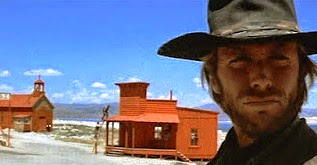
For someone who loves movies, I do seem to have some glaring blind spots when it comes to expanding my repertoire. I’m a stranger to Tarantino and zombie films (though I don’t really care to be acquainted), and I’ve just recently begun exploring the most recent James Bond, Oliver Stone, and classic Hitchcock. One actor/director I know more by reputation than experience is Clint Eastwood. High Plains Drifter is actually the first western I’ve seen of his, and it confirmed why he is such a commanding screen presence.

Drawing from Eastwood’s experience with spaghetti westerns, High Plains Drifter also borrows certain elements from the likes of Seven Samurai and High Noon. Like Seven Samurai and its American remake The Magnificent Seven, the small desert town of Lago, named for the oddly located lake bordering it, lives in fear of the return of vengeful bandits and looks to a skilled stranger for salvation. Like High Noon, the film builds to the inevitable showdown between the lone defender and the encroaching enemy. A key question that sets High Plains Drifter apart, though, is “Is the town worth saving?” The townspeople in Seven Samurai and High Noon were prone to ingratitude and fear, but the settlers of Lago sit upon a cruel secret that takes much of the sympathy out of their plight.

Eastwood has played many a tough guy for the ages, not least of which is the nameless Stranger who rides into town without a word, backed by Dee Barton’s spookily atmospheric score. When the Stranger proves his grit and his aim by killing Lago’s supposed defenders, the sheriff begs him to protect them, promising him anything he wants in return. Despite his distaste for the town, the Stranger agrees and proceeds to take full advantage of the open-ended offer, ordering free drinks, the entire hotel to himself, and other unreasonable demands that seem meant to punish the town as a whole. The film walks a fine line between the Stranger’s abuse and how deserving the town may be of it, crossing the line on occasion when he freely rapes two women, who unrealistically don’t seem to mind too much after the fact. Except for that needless exploitation, Eastwood’s Stranger proves to be a compellingly mysterious anti-hero, whose intentions for the town itself remain uncertain right to the end. When asked what comes after the showdown, he defiantly replies, “Then you live with it.”

Far from Eastwood’s first rodeo, High Plains Drifter is a brazen western that questions the decency of frontier folk. Aside from Eastwood, Billy Curtis plays his closest ally, the diminutive Mordecai who has also felt the town’s malice, and Richard Bull appears as a shopkeeper, a year before he played the owner of Oleson’s Mercantile on Little House on the Prairie. I can’t say how High Plains Drifter compares with Eastwood’s other westerns (yet), but it’s a somewhat haunting entry in the western genre that gives a whole new meaning to “painting the town red.”

Best line: (the Stranger, after an overdue assault from his rape victim) “Wonder what took her so long to get mad?”


Rank: List Runner-Up


© 2016 S. G. Liput
411 Followers and Counting


Bottom-Dweller: Urban Cowboy (1980)

22 Friday May 2015

Posted by sgliput in Movies, Poetry, Reviews, Writing

≈ 6 Comments

Tags

Bottom-Dweller, Drama, Romance, Western


(Can be sung to “The Devil Went Down to Georgia”)
 
Travolta went down to Houston,
He was lookin’ for a job to take.
He was young and dumb, just a country bum,
And he was waiting for his big break,
 
When he came across this young girl
Dancin’ round in a honky-tonk,
A promised land of beer and band
With a metal bull or bronc.
 
When the misfit pair were married,
Things at first were going well,
But some stubbornness made a jealous mess
And the marriage quickly fell.
 
While the two just boozed and pined away
And rode that bucking bull,
I began to think that this movie stinks
And was near unbearable.
__________________
 

This is it, the original bottom-dweller. This is the first movie I sat through and immediately hated, or, to coin Roger Ebert’s quote from his review of North, I “hated hated hated hated hated this movie.” Urban Cowboy was yet another star vehicle for John Travolta, but with films like this, it’s a wonder he became a star at all. I don’t usually subject myself to terrible films, but never before have I asked “Is it over yet?” so many times.

It starts out with some promise: small-town wannabe cowboy heads to the big city to find his fortune, meets girl, marries girl. That storyline alone might have been worth seeing, but the relationship between Bud and Sissy is hardly one for the ages. They meet each other in the famous Gilley’s Club, a multi-acre theme park of booze and cowboy paraphernalia, and Sissy (Debra Winger) has to practically twist Bud’s arm to convince him to dance with her. After some dancing and an argument and a roll in the mud, they’re suddenly walking down the aisle. Did either of them really think a marriage starting like that would last? As it turns out, barely a week passes before Bud’s pride is hurt, and both go their separate ways to make the other jealous, with increasingly depressing results.

One of my biggest problems with Urban Cowboy is the character of Bud. Travolta isn’t appealing in the slightest; he’s a juvenile man-child so unconfident in his masculinity that the slightest hint that someone may be better than he throws him into a blind rage, especially if it’s his own wife. In addition, he’s the kind of bumpkin that gives country music a bad name, content to work (sometimes) during the day and wile away his nights at the bar, picking fights and slapping his wife when she disagrees too much (but not too hard, of course). Plus, he’s supposedly in Houston to work and save up enough money to buy land and become prosperous, yet never seems to realize that he’s pouring his paycheck down the drain every night on beer and bets and pointless mechanical bull rides. Oh, and let’s not forget that he doesn’t just pretend to cheat on Sissy to make her jealous; he freely sleeps around, too stubborn to actually care for the girl he uses (Madolyn Smith) and too dense to realize why Sissy isn’t running back to him with open arms. What exactly am I supposed to like about this guy?

A series of misunderstandings keeps the couple apart, and Sissy ends up with “real cowboy” Wes Hightower, played by a leery Scott Glenn, who’s just a slightly harsher version of Bud, hitting a little too hard and stealing what he can’t earn. If Bud and Wes are “real cowboys”, they’re the worst kind, selfish he-men just trying to prove their own toughness to girls they only moderately care about. By the end, Bud trains Rocky-style for a mechanical bull showdown, and he seems to think that winning it will win Sissy back. How so? A silly championship is not going to repair a relationship; all his training is pointless, since all he really needed to do was go and apologize for his own pigheadedness. While he ends up doing exactly this, it’s as if he can’t muster the effort until he’s once again proven his alpha male status. Of course, it all works out for a happy ending, where assault turns into just desserts and a whirlwind romance rekindles into a whirlwind reconciliation. And then, thank God!, it was over!

This just might be my most hated bottom-dweller, with hardly any redeeming value. The only bright point is the classic country music soundtrack, particularly Charlie Daniels’ “The Devil Went Down to Georgia.” For reasons beyond my comprehension, my VC and many other critics actually liked the film itself, looking past its unlikable characters and petty squabbling. She tells me that she finds the movie “interesting for its dysfunctional lifestyle” and as compelling to watch as a car accident, while I’d prefer just to not look at all. I don’t plan to ever see Urban Cowboy again; I have much better things to do than watch white trash with superficial, totally screwed-up priorities cheating on each other.

Best line: (Bud) “All cowboys ain’t dumb. Some of ’em got smarts real good, like me.”

VC’s best line:  (Bud’s Uncle Bob) “You know, Bud, sometimes even a cowboy’s gotta swallow his pride to hold on to somebody he loves.”  (Bud) “What do you mean?”   (Uncle Bob) “Hell, I know I pretty near lost Corrine and the kids a couple of times just ’cause of pride. You know, you think that ol’ pride’s gonna choke you going down, but I tell you what, ain’t a night goes by I don’t thank the Boss up there for giving me a big enough throat.”

 
Rank: BOTTOM-DWELLER!
 

© 2015 S. G. Liput

311 Followers and Counting

#47: True Grit (1969, 2010)

08 Monday Dec 2014

Posted by sgliput in Movies, Poetry, Reviews, Writing

≈ Leave a comment

Tags

Drama, Western

Mattie Ross’s father’s shot
By hired hand Tom Chaney.
She means to see the killer caught
And tried and hanged, just as he ought.
Although she’s young, afraid she’s not
But rather tough and brainy.
 
She needs a man who will commit
To show this fiend the noose.
The marshal she feels is most fit
Is Rooster Cogburn, who has grit
And gives in (when she doesn’t quit)
To chase this wild goose.
 
Accompanying them out west
Is Texas law LaBoeuf.
Though Rooster cares not for this guest,
They all continue on their quest
And follow hearsay when confessed
To tail the cutthroat thief.
 
When Mattie finds by accident
The man she has been hunting,
She’s captured by his gang hell-bent,
Who leave them both and can’t prevent
Tom Chaney’s murderous intent,
Until LaBoeuf’s confronting.
 
While Rooster fights Ned Pepper’s gang,
Miss Ross falls in a pit.
Tom Chaney has no need to hang,
But Mattie meets a rattler’s fang,
And Rooster, ere a fatal pang,
Yet proves his truest grit.
_________________
 

Easily my favorite western, True Grit is a story of perseverance and justice the likes of which I have yet to see in the genre. Based on Charles Portis’s 1968 novel, both the 1969 film and the 2010 remake have their strong points and are so similar that I had to include them together (same as my post for A Christmas Carol; the poem pretty much covers any version).

The 1969 True Grit has always been a staple in my house. As evidenced by his lone Best Actor Oscar win, John Wayne found his best role as larger-than-life, trigger-happy, one-eyed marshal and “fat old man” Rooster Cogburn. Kim Darby occasionally overacts, but she displays Mattie’s fierce resolve while remaining appropriately girlish. Many have decried Glen Campbell’s performance as LaBoeuf, criticism I believe he didn’t deserve. While he’s not what I would call a skilled actor, there’s nothing particularly distracting or dreadful about his performance. Besides, when you consider that Elvis Presley was the original choice for LaBoeuf, Campbell seems even more preferable. The Colorado scenery is stunning, and Rooster’s exhilarating charge against Ned Pepper’s gang is (or should be) as iconic a gunfight as any filmed.

As for the 2010 remake by the Coen brothers, it’s basically the same story with different actors, and the latter half from Mattie’s confrontation with Chaney to her rescue is more or less identical in both versions, though some earlier scenes were unnecessarily drawn out. While most of the events are perfectly recognizable, the film as a whole has a much more serious, pitiless, and…gritty tone. Though there is more language and violence, as I would expect from a modern-day remake, the Coens’ film also carries more Biblical messages and a melancholy score imbued with haunting hymns. Considering the often satirical and strange content of other Coen films, True Grit is one of their most restrained and sincere works, with mere glimpses of their comedic voice. Though I have not read the book, I’ve heard the remake is closer in tone and plot to Portis’s novel; the screenplay succeeds in reflecting both the author and the directors, with peculiarly worded dialogue like “I’m puzzled by this” and “You give out very little sugar with your pronouncements.”

My VC considers the 1969 True Grit sacred territory, like The Wizard of Oz or Gone with the Wind, a film that could never be matched by any remake. I, however, found the remake almost as good as the original. As excellent as Jeff Bridges is as Rooster Cogburn, with more uncouth ways and a more gravelly voice, John Wayne is untouchable and remains the main reason I prefer the first film. His delivery of lines like “Fill your hand, you son of a b****” carry so much more force and vitality than Bridges’. There’s a reason Wayne won Best Actor, while Bridges was only nominated (though he had won the previous year for Crazy Heart).

On the other hand, I prefer Matt Damon’s LaBoeuf over Glen Campbell’s; Damon gives him more personality, though his separations from Mattie and Rooster seemed unnecessary. Oscar nominee Hailee Steinfeld acts more mature as the 2010 Mattie, but she’s more or less on par with Darby, in my opinion. (It’s interesting to note that the role of the ill-fated Moon in the violent dugout scene seems to go to up-and-coming stars. Dennis Hopper played the boy in the original, and though Domhnall Gleeson wasn’t well-known in the 2010 version, he soon will be from his inclusion in J. J. Abrams’ Star Wars sequel next year.) Overall, both films boast an exemplary cast that put them on almost even footing.

The Coens’ film may be more artistic and realistic (the flat prairie setting is more as Oklahoma should look than the mountainous vistas of the original film), but the 1969 version is more enjoyable to watch. Even with the onscreen death of a major character, John Wayne’s greatest film ends on an uplifting “Yee haw” note rather than the somber narration of the remake and book. Both are excellent, but John Wayne tips the scale with the culminating performance of his career.

Best line from 1969: (Mattie) “You are too old and fat to be jumping horses.”  (Rooster, before proceeding to jump a fence) “Well, come see a fat old man some time!”

Best line from 2010: (Mattie’s narration, referring to Chaney’s crime) “You must pay for everything in this world, one way and another. There is nothing free except the grace of God.”

 
Rank: 57 out of 60
 

© 2014 S. G. Liput

265 Followers and Counting

The Mask of Zorro (1998)

19 Friday Sep 2014

Posted by sgliput in Movies, Poetry, Reviews, Writing

≈ Leave a comment

Tags

Action, Drama, Romance, Superhero, Western

Don Diego de la Vega is the hero of the poor
Known as Zorro, who has allies and sworn enemies galore.
When the governor Montero learns of his identity,
He arrests him and abducts his child Elena wickedly.
 
Twenty years go by before Montero seeks his captive foe,
Bringing his adopted daughter back with him to Mexico.
De la Vega then escapes, intent on his revenge and hate,
But the sight of his Elena causes him to hesitate.
 
In the meantime, Alejandro Murrieta is well-known
As a bandit with his brother, but he soon is all alone.
Army Captain Love attacks and cruelly claims his partners twain,
Prompting in him dreams of vengeance, which at this point are in vain.
 
Zorro takes young Alejandro, seeing some potential there,
And he trains him in sword fighting in his secret Zorro lair.
After lessons hard and long, the newest Zorro tries his hand,
Posing as a wealthy don to learn of what Montero’s planned.
 
Alejandro is intrigued by beautiful Elena, who
Cannot help but be enamored of this masked intruder too.
When Montero tells his plot to buy the nation with bravado,
He shows off poor peasants forced to labor in his El Dorado.
 
Alejandro steals a map and fences in the poor’s defense,
Even as the bad guys try mass murder to hide evidence.
Both the Zorros, old and recent, battle their respective foes,
And Elena helps their struggle, thanks to shocking truths she knows.
 
Alejandro takes revenge, and de la Vega follows suit,
Though the latter man is wounded, dying worthy of salute.
Alejandro weds Elena now that justice has been won,
And he shares their grand adventure with Joaquin, their infant son.
_________________
 

The Mask of Zorro isn’t exactly an origin story, but a changing of the guard from one Zorro to the next, a difficult endeavor that was amazingly satisfying. The opening action scene of Errol Flynn-style derring-do conveys a lifetime of such heroics, and expert thespian Anthony Hopkins as the elderly Zorro pulls it off, even if his accent is out of place. Antonio Banderas fits in perfectly both because he is actually Hispanic and because his swashbuckling swagger is one of the film’s main pleasures. Banderas was a natural at sword fighting, according to fight choreographer Bob Anderson, and I’m not surprised. Another big draw is his on-screen chemistry with Catherine Zeta-Jones, who manages a seductive Latina allure despite being Welsh.

The film is basically a revenge tale set against a historical backdrop. Historical events, such as the Mexican-American War, are mentioned in passing, and Alejandro’s brother and accomplice were real Mexican bandits who met the same grisly fate (more or less) as in the film. Any historical inaccuracies are not as glaring as in the 2005 sequel The Legend of Zorro, which pales in comparison to the drama of this original.

Though a few scenes during de la Vega’s prison escape recall Spartacus and The Count of Monte Cristo, the film is still dashingly original while paying tribute to its many predecessors from the first half of the century. At a time when overblown reboots were just starting to become the Hollywood norm, The Mask of Zorro favored practical stunts and emotional narrative over gimmicks or cinematic extravagance. It’s a thrilling and mostly clean film (aside from one or two scenes) that brings to life one of the original “superheroes” of pulp fiction.

Best line: (Diego, referring to Alejandro’s sword) “Do you know how to use that thing?”   (Alejandro) “Yeah, the pointy end goes into the other man.”

 
Artistry: 8
Characters/Actors: 9
Entertainment: 9
Visual Effects: 9
Originality: 7
Watchability: 8
 
TOTAL: 50 out of 60
 

Next: #116 – Terminator 2: Judgment Day

© 2014 S. G. Liput

209 Followers and Counting


Spirit: Stallion of the Cimarron (2002)

05 Tuesday Aug 2014

Posted by sgliput in Movies, Poetry, Reviews, Writing

≈ Leave a comment

Tags

Action, Animation, Drama, Dreamworks, Family, Western

(Can be sung to Bryan Adams’s “Where I Belong”)
 
A horse was born so long ago,
Out in the West where free things grow,
An unfettered mustang, an ace in his prime,
Free to run, as they have for all time.
 
Leading his happy herd, defending each foal,
This Spirit’s unrestrained, till he falls under man’s control.
His homeland’s behind him; his future’s unknown,
Yet he keeps on fighting to live on his own.
 
He shows up his captors and earns their distaste,
But, helped by an Indian, he breaks out in haste.
Persistent young Little Creek tries riding in vain,
But he introduces his fair mare named Rain.
 
Though Spirit is shocked that the human and she
Display some connection that lets her run free,
He sees for himself that the Two-Legs possessed
More room for kindness than he had first guessed.
 
Though Spirit could run home, he opts to go back
And rescues the boy from a sudden attack.
Though poor Rain is injured, he still finds his hope
As he helps drag a train up a slope.
 
He halts all their efforts, escaping from flame,
Relieved loyal Little Creek thankfully came.
They flee from pursuers and leap for their lives;
Spirit’s glad when a healed Rain arrives.
 
Goodbyes are not easy when trust has been earned,
But they know it’s time that the mustang returned.
With Rain by his side, Spirit’s now free to roam
And at last he again embraces his home.
____________________
 

Spirit: Stallion of the Cimarron was one of my favorite movies growing up. As I’ve said, movies that have made me cry hold a special place in my heart, and Spirit is one such Childhood Tearjerker. DreamWorks knew from the start that most adults and kids alike love horses, and seeing such a wild and free creature dragged from his home was enough to get my waterworks going. It still touches me, though I don’t weep like I used to.

The animation is absolutely stunning. While some of the CGI from the opening is obvious, still lovely but paling in comparison to that of Dinosaur, the rest of the Western landscapes and the hand-drawn horses are gorgeous (especially the gorges). I’m no artist, but most agree that horses are among the most difficult creatures to draw: after all, Maurice Sendak illustrated Where the Wild Things Are with assorted beasts only because he realized he couldn’t draw horses. Not only are the horses arrestingly beautiful and convincing, but their facial features evoke the full spectrum of emotions without ever lapsing into anthropomorphic talking animal territory. Spirit himself has some inward monologues, provided by Matt Damon, who could have varied his voice more, but the rest of the animal interaction is done skillfully with emotion-filled neighs, whinnies, wickers, nickers, brays, and countless other equine ejaculations. So well is the wordless interplay handled that much of Damon’s voiceover, which ranges from stirring to funny, seemed unnecessary, though my VC felt it served to break up all the whinnying.

Then again, that is why Bryan Adams’s excellent anthems were included. Along with a rousing orchestral score that once again proves Hans Zimmer’s musical facility, Adams’s songs provide the melodious heart of the film. Though some critics decried the soundtrack as “whiny” or “insipid,” I felt they added so much to the film. It may not be on the level of what Phil Collins provided for Tarzan, but every song strikes the right chord of emotion, from free-wheeling liberty to depression to rekindled hope. “Don’t Let Go,” which features Sarah McLachlan with a haunting harmony, certainly deserves a place in my End Credits Song Hall of Fame.

Over the years, I have still seen some flaws: the intruding humans are uniformly bad because of their enslavement of horses, and I don’t usually like to feel guilty for wanting to ride a horse. Since all the Indians’ horses appear happy, the film seems to imply that only they built any relationship with their ponies. All the soldiers’ horses seem to hate their masters and frequently sabotage them, not allowing for the fact that I’m sure plenty of cowboys shared a connection with their steeds. After all, even broken horses can be happy.

Spirit: Stallion of the Cimarron is nonetheless a lovely, G-rated adventure with fantastic music and some genuinely exciting action sequences. It was DreamWorks Animation’s second-to-last hand-drawn film (before Sinbad) and causes me to miss the days before CGI became the only animation style successfully used in film.

Best line: (part of Spirit’s opening monologue) “I was born here, in this place that would come to be called the Old West. But, to my kind, the land was ageless. It had no beginning and no end, no boundary between earth and sky. Like the wind and the buffalo, we belonged here; we would always belong here. They say the mustang is the spirit of the West. Whether that west was won or lost in the end, you’ll have to decide for yourself….”

 
Artistry: 7
Characters/Actors: 7
Entertainment: 7
Visual Effects: 10
Originality: 7
Watchability: 8
Other (crying effect): +1
 
TOTAL: 47 out of 60
 

Next: #156 – As Good As It Gets

© 2014 S. G. Liput

172 Followers and Counting


Butch Cassidy and the Sundance Kid (1969)

17 Thursday Jul 2014

Posted by sgliput in Movies, Poetry, Reviews, Writing

≈ Leave a comment

Tags

Drama, Western

The Sundance Kid can shoot;
Butch Cassidy’s a hoot.
Between the two, they head a crew
Who rob banks for the loot.
 
When they hold up a train,
First once and then again,
They’re followed by a gang, who try
To hound them ‘cross the plain.
 
They run both night and day
And barely get away.
They both decide to simply hide
And leave the USA.
 
Bolivia’s their chance.
With Etta for romance,
The three depart for their new start
As dubious transplants.
 
With heists they have success,
With worries nonetheless.
Despite their plans, blood’s on their hands,
And Etta leaves the stress.
 
While eating lunch in town,
These outlaws of renown
Both shoot their piece against police,
But both men are shot down.
_________________
 

A classic outlaw western, Butch Cassidy and the Sundance Kid succeeds wholly because of its two stars. Butch and Sundance are thieving cowards who rob banks and meet a bloody end, but, unlike the very similar Bonnie and Clyde, the film makes them so likable that one can almost overlook their faults. Paul Newman brings great humor to Butch, the brains of the operation, and, as my VC says, “Robert Redford never looked so good” with that mustache. It’s easy to see why both of them are appealing to Etta, played by Katharine Ross from Shenandoah and The Graduate.

The Oscar-winning screenplay boasts stellar dialogue, perfected by the spot-on chemistry of Newman and Redford. Some say the film has jarring mood swings, but I appreciate how the filmmakers presented both the carefree moments of romance (the famous bicycle scene) and moments in which their lawless deeds come back to haunt them. The scenery is also stunning, as Butch and Sundance flee across it from the team of lawmen.

The mostly clean film also won Oscars for Best Song (“Raindrops Keep Falling on My Head”), Best Score, Best Cinematography, and the aforementioned Best Original Screenplay. It certainly deserved them, and my VC would have it even higher on her list. Still, I’m not a fan of antihero movies, even when the characters are so likable. That doesn’t change the fact that they’re criminals, who deserved the hounding and the violent end they met. Even so, the final scene of the two rushing outside to their deaths, guns ablaze, taps into the romantic, adventurous spirit that makes “cops and robbers” so much fun. I’d just hate to be the robbers.

Best line: (Butch) “Well, that ought to do it.” [whole train car blows up] (Sundance) “Think ya used enough dynamite there, Butch?”

 
Artistry: 7
Characters/Actors: 9
Entertainment: 8
Visual Effects: 8
Originality: 6
Watchability: 7
 
TOTAL: 45 out of 60
 

Next: #175 – How to Train Your Dragon

© 2014 S. G. Liput

158 Followers and Counting


Dances with Wolves (1990)

08 Sunday Jun 2014

Posted by sgliput in Movies, Poetry, Reviews, Writing

≈ Leave a comment

Tags

Drama, History, Western

Wounded in battle, John Dunbar decides
That suicide will be his lot.
He’s unsuccessful as blindly he rides,
Somehow inspiring both of the sides,
Till the Union has captured the spot.
 
Dunbar, a hero, is given his pick
Of posts stationed far off or near.
Choosing a place where the gunfire’s not thick,
A place where a lifestyle is vanishing quick,
He goes to the western frontier.
 
Reaching his post, he is just on his own,
And nobody knows he is there.
Writing his journal and cleaning his zone,
Having no clue how long he’ll be alone,
He simply must wait and prepare.
 
Soon John encounters the curious Sioux,
A neighboring Indian tribe.
Tentatively, they communicate through
Gifts and hand motions, and friendships ensue,
Which John is intent to describe.
 
Hand motions only can get them so far,
So Kicking Bird, one holy man,
Brings out a girl who is less like they are,
White, and who has an emotional scar.
They saved and raised her in their clan.
 
English comes slowly as Stands with a Fist,
The girl, tries to speak for her friends.
Though she at first tried to stall and resist,
Slowly she bridges the gaps that exist,
And each of them soon comprehends.
 
Coveted buffalo enter their lands,
And John assists as the tribe hunts.
Dunbar soon falls for the beautiful Stands.
Feeling this country is yet in good hands,
He lives with the Sioux as he wants.
 
Dances with Wolves is what Dunbar is named
Because of a wolf he befriends.
Soon Dunbar’s marriage to Stands is proclaimed;
John is a Sioux now and stands unashamed;
His new family he defends.
 
Winter approaches, and John will leave too,
But after retrieving his journal.
John finds the fort full of his soldiers, who
Capture him, thinking that he is a Sioux.
The good life proves far from eternal.
 
Charged as a traitor, he’ll soon meet the noose
From soldiers both callous and crass.
After he suffers their constant abuse,
John’s fellow Indians set their friend loose
And flee to a safe mountain pass.
 
John and his wife choose in sorrow to leave
To save his Sioux friends, who move on.
Dances with Wolves and his confidants grieve,
For he is sure there will be no reprieve
Till Indian ways are all gone.
_______________________
 

As Kevin Costner’s directorial debut, Dances with Wolves is an accomplishment of the highest order. It earned seven Academy Awards, including Best Picture, Director, Score, Cinematography, Adapted Screenplay, Sound, and Film Editing. Though Costner fell from Hollywood’s good graces for a time since then, Dances with Wolves stands as a triumph of which he can always be proud. That being said, the end of this film irritates me.

I could claim that I don’t have a problem with a film being realistic, but I suppose I do, at least when it’s done as this film was. It presents a unique lifestyle that has almost completely disappeared and remains fascinating even when the pace may seem slow. Yet it goes beyond this to make you genuinely care for various things (John’s journal, his horse Cisco, his lupine pal Two Socks), only to jerk the rug out from under you, to desecrate these elements for the sake of proving how bad the white man was. I’m not going to argue with history; I am sympathetic to the fact that the Native Americans suffered much over the years, including the loss of their way of life, but this film seems so one-sided that it feels emotionally manipulative by the end.

On the other hand, I can pick up on a number of latent issues that the film doesn’t address directly. For instance, Dunbar technically did desert his post at the fort; however good his reasons were, he was a deserter, certainly at fault in that regard.

Though the film has more obvious intentions (Sioux good, Pawnee and white man bad except for John), the main message I choose to take from the film and its historical context is the importance of prudence and an open mind. One thing that bothers me is how the soldiers shot John at first sight, not even thinking to assess his intentions. They no doubt had only heard tales of the atrocities committed by hostile Indians, which, to be fair, are also presented in the film, though not by the Sioux. Likewise, the Sioux warrior Wind In His Hair’s first reaction to John’s presence is to kill him, but Kicking Bird was wise enough to attempt diplomacy, as John was too. Attacking and asking questions later (if at all) only produced pain and heartache, but both sides’ willingness to come to a mutual understanding sparked friendship and respect.

All this discussion could have been avoided if the filmmakers had left out about twenty minutes of the soldiers’ cruelty, as well as some crude and weird elements at the beginning. The middle of the film, in which John learns the ways of the Sioux, is a pleasure to watch, even with most of the dialogue in the Lakota language. I liked the scene in which Kicking Bird is surprised when he looks through John’s telescope, since it was recycled a year later in Robin Hood: Prince of Thieves with Costner switching roles as the one looking shocked at this strange invention. The magnificent buffalo hunt (featuring a real buffalo herd) and the battle between the Sioux and Pawnee are wonders to behold and were both difficult and dangerous to film. Kevin Costner as Dunbar doesn’t have that much of a personality, but that’s all right since he acts as a decent everyman character through whom the audience is also exposed to the Sioux camp. Mary McDonnell is quite believable as Stands with a Fist, and Graham Greene is also excellent as the reasonable medicine man Kicking Bird.

I’ve visited Rapid City, South Dakota, where part of the film was shot, including the set for Fort Hays, and having actually seen the outdated buildings and the rolling, wide-open prairies helped me appreciate the film and its setting even more.  It may frustrate me that the soldiers in the film defile what it urges viewers to cherish, but Dances with Wolves is still a film of great historical significance that ought to be seen. Its acting, score, and historical importance make it a classic of the western genre, focusing more on the Indians than on the cowboys.

Best line: (Wind In His Hair, as Dunbar acts like a buffalo to get his point across) “His mind is gone.”

 
Artistry: 9
Characters/Actors: 9
Entertainment: 7
Visual Effects: 8
Originality: 8
Watchability: 5
Other (language and aforementioned issues): -6
 
TOTAL: 40 out of 60
 

Next: #214 – Memphis Belle

© 2014 S. G. Liput

125 Followers and Counting


City Slickers (1991)

02 Monday Jun 2014

Posted by sgliput in Movies, Poetry, Reviews, Writing

≈ Leave a comment

Tags

Comedy, Drama, Western

When Ed has ideas for insane daring-do,
He gets his two pals Mitch and Phil to come too.
Mitch feels somehow trapped in his unfulfilled life,
And often complains to his kids and his wife.
They all soon are sick of his cynical view.
 
Phil also has problems; he’s scared of his spouse.
He’s hesitant, timid, and scared as a mouse.
His wife comes to learn that he had an affair,
Since frankly their marriage did not have a prayer;
He loses his job and is kicked from the house.
 
Ed has issues too with commitment and such,
But he has a plan for a surefire crutch:
A real cattle drive with real cattle to drive
To help them be cowboys, austere and alive.
Mitch goes, but he isn’t excited too much.
 
They meet other city folk, bound for the trail,
And Curly the trail boss, who’s tough as a nail.
They transport the herd, starting off with “Yaw hoos,”
To New Mexico with a chorus of moos.
They hope to revitalize life through travail.
 
When Mitch, making coffee, provokes a stampede,
He’s taken by Curly to find cows in need.
He’s scared of the cowboy but proves his own worth
By helping a cow have an impromptu birth.
He looks up to Curly, a now dying breed.
 
The cowpoke tells Mitch he must find his one thing
That makes life worthwhile and keeps it in swing.
Not long after that, Curly suddenly dies.
They must do without him, so rugged and wise.
The trip goes awry without his guiding wing.
 
At last, their friends scattered, it’s Mitch, Ed, and Phil
Who keep the cows moving with moxie and will.
They help cross a river, where Mitch nearly sinks
But saves the young calf he delivered (he thinks).
They all prove themselves by surviving the thrill.
 
They save the cows, but, after crossing the water,
They learn all the cattle are destined for slaughter.
So Mitch takes the calf and his old smile back.
Withstanding their crises, they’re all back on track,
And Mitch found his one thing: his wife, son, and daughter.
_______________________
 

City Slickers is yet another Billy Crystal classic with a winning mix of comedy and drama. The midlife crises of the three friends are all pretty realistic, even when handled comically, and their conversations, such as describing their best and worst days, provide welcome depth to their characters and motivations. Crystal’s typically clever banter again steals the show, and, though the film isn’t a laugh riot all the way through, it has periodic lines and moments of hilarity that make it very entertaining.

Billy Crystal and his When Harry Met Sally… co-star Bruno Kirby are always an amusing pair (Kirby hid his horse allergy very well), and Daniel Stern is equally well-cast as the adulterous Phil, who mourns how his life has gone down the tubes. But the one who earned the most critical praise and an Academy Award for Best Supporting Actor was Jack Palance as the gravelly-voiced Curly, who evokes leathery toughness and rustic sagacity with his impressive if too brief performance. Also, I was surprised to see that this movie was Jake Gyllenhaal’s film debut as Mitch’s 10-year-old son.

There is some unfortunate and unnecessary profanity and sexual dialogue, but City Slickers is still a rousing and enjoyable western comedy. Plus, that calf sure is adorable!

Best line: (Curly, as Mitch is reaching into a cow to help it give birth) “What’s taking so long? Do you see the head?”
(Mitch) “Ew. I only see a tail.”
(Curly) “Oh, s***. It’s turned the wrong way. Get it out.”
(Mitch) “Uh, oh. My watch came off.”
 
VC’s best line: (Mitch, to Ed) “Ed, have you noticed that the older you get, the younger your girlfriends get? Soon you’ll be dating sperm.”


Artistry: 7
Characters/Actors: 8
Entertainment: 9
Visual Effects: 5
Originality: 7
Watchability: 8
Other (language and sexual dialogue): -5
 
TOTAL: 39 out of 60
 

Next: #220 – Pinocchio

© 2014 S. G. Liput

117 Followers and Counting


Silverado (1985)

26 Saturday Apr 2014

Posted by sgliput in Movies, Poetry, Reviews, Writing

≈ Leave a comment

Tags

Action, Drama, Western

When three would-be killers close in on a derelict shack,
One Emmett succeeds in shooting them down in a flash.
He later meets Paden, who’s also endured an attack
But didn’t fare well, having lost both his hat and his cash.
 
The two journey on to a town where the cocky young Jake,
Emmett’s brother, is locked up for murder, awaiting the noose.
When Paden joins him behind bars for his stolen hat’s sake,
He helps the self-confident rogue and himself to break loose.
 
They flee the town’s sheriff with help from a black man named Mal,
And aid a poor wagon train, also the victims of theft.
They ride to the town Silverado, a dusty locale,
Controlled by the rancher McKendrick, with few good men left.
 
The sheriff in town is an old friend of Paden’s named Cobb,
Who brings him to Stella, the small owner of the saloon.
Cobb shoots down a manager, then awards Paden his job,
But Cobb is corrupt and works for the ranching tycoon.
 
Mal’s father is punished for spurning McKendrick’s land grab;
His prostitute sister is likewise in danger in town.
McKendrick hates Emmett, whose presence removes an old scab,
And orders his various henchmen to bring Emmett down.
 
McKendrick’s men take Emmett’s nephew and ride off on horses,
And Cobb lets it happen, an act Paden cannot condone.
So Emmett and Mal, with both Paden and Jake, combine forces
To stop this corruption and pick each particular bone.
 
Jake shoots down his rival, and Mal saves both Stella and sis,
While Emmett surprises McKendrick and brings the man low.
At last, Paden faces down Cobb and is too good to miss,
Defeating the foe and enacting a new status quo.
 
For Emmett and Jake, California is beckoning still,
And Mal will rebuild his old farmstead McKendrick brought down,
But now Silverado’s in need of a leader with skill,
And Paden steps up as the trustworthy sheriff in town.
_____________________
 

I’ve already stated that I’m not a big fan of Westerns since so many share the same themes and character motivations. Revenge, outlaws, rogues with hearts of gold, and standing up for the defenseless are just a few of the western clichés that Silverado employs, but it puts them all together so entertainingly that I don’t mind as much. As Roger Ebert put it, “This is a story, you will agree, that has been told before. What distinguishes [director and writer Lawrence] Kasdan’s telling of it is the style and energy he brings to the project.” Considering Kasdan’s previous film was the well-cast The Big Chill (one of my VC’s favorite movies, not mine), I’d say he also has a knack for assembling impressive ensembles with good characterization as well.

Unlike so many other stock westerns with only one or two memorable characters, if that, Silverado has an excellent cast, including Kevin Kline, Jeff Goldblum (who were both in The Big Chill as well), Scott Glenn, a young Kevin Costner, Danny Glover, Brian Dennehy, Linda Hunt, John Cleese, et cetera, et cetera, et cetera! There’s also (Lost alert) the wild-eyed Jeff Fahey, who portrayed Frank Lapidus on my favorite show. While not every character is entirely developed, whether sympathetically or otherwise, every actor fills their role well enough to definitely be memorable.

Even though the film’s convoluted plot is full of the aforementioned clichés, it has some highly entertaining parts, like the canyon scene and the stampede rescue sequence. That being said, the final showdown between Cobb and Paden felt unoriginal and rather anti-climactic following a couple more inventive death scenes. All in all, Silverado is a fun, well-written, and fairly clean modern western that sadly didn’t quite revive the genre as much as some had expected. There’s a fine line between a cliché and a reinvention, and Silverado walks it pretty well.

Best line: (Cobb) “We’re gonna give you a fair trial, followed by a first class hanging.”

 
Artistry: 6
Characters/Actors: 9
Entertainment: 8
Visual Effects: 7
Originality: 4
Watchability: 6
Other (brief language and anti-climax): -4
 
TOTAL: 36 out of 60
 

Next: #254 – Gettysburg

© 2014 S. G. Liput

82 Followers and Counting


#290: The Quick and the Dead (1987)

22 Saturday Mar 2014

Posted by sgliput in Movies

≈ Leave a comment

Tags

Western

Duncan McKaskel hits town and a snag on
His journey out west with a loaded down wagon.
He, wife Susanna and little boy Tom
Encounter Doc Shabbitt with civil aplomb.
 
But, once they have left, Doc suggests to his forces
They ought to appropriate this family’s horses.
Meanwhile, a man by the name of Con Vallian
Rides up to tell Duncan he’s missing some stallions.
 
The non-violent husband goes back into town,
And Vallian assists in a rousing showdown,
Which sees Duncan flee with the horses they stole
And kills off Doc’s son, making vengeance his goal.
 
From then on, the family flees further west
While Doc’s gang pursues, getting further obsessed.
The gravel-voiced Vallian rides on as their guard
And picks off Doc’s men without showing his cards.
 
Con’s clearly attracted to Duncan’s fair wife,
And they share a kiss in the midst of the strife.
Yet chivalrous Vallian guards all the McKaskels
And tries to discourage ol’ Doc and his rascals.
 
But Vallian desires revenge on another,
An Indian half-breed that murdered his mother.
This “breed” rides with Doc and injures his foe,
But Vallian recovers and brings the “breed” low.
 
Once Duncan and company locate the home
Susanna’s own brother built, no more they roam.
But Doc and his gang, who have shrunk now to three,
Catch up to their trail and approach them with glee.
 
Susanna herself shoots an outlaw point blank,
And Duncan and Con kill the last from their flank.
Now that the McKaskels are safe from their thrills,
Con bids them farewell and rides off toward the hills.
________________________
 

This The Quick and the Dead is a 1987 HBO film starring Sam Elliott as Con Vallian, not the 1995 Sam Raimi film featuring Sharon Stone. While both are westerns, this 1987 movie is based off a novel by the prolific western master Louis L’Amour. Elliott is at his best as the mysterious cowboy defending a family of eastern greenhorns, and the chemistry between him and Kate Capshaw as Susanna makes this one of my VC’s favorite films.

The cinematography starts out flat, like the initial plains the McKaskels are first shown traveling through, but it gets more spectacular as they journey into the gorgeous mountains of Wyoming. The plot itself struck me as almost a reversal on that of a horror film, with the bad guys being the ones picked off one by one by the heroic good guy, who usually shoots only when he or others are being threatened. His vendetta against the Indian, his infrequent profanity, and his prurient glances at Susanna threaten to make him more of an anti-hero, but I appreciate that he at least has the chivalry not only to defend her husband but to curb his own passions, much like Robert Redford in The Horse Whisperer.

The Quick and the Dead is one of the few westerns on my list. It’s not that I don’t like westerns per se; I just think that most of them are rather repetitive and less than original, which is why I believe they have fallen by the wayside in modern cinema. Yet this film features many western clichés in a very entertaining and straightforward way: the family in search of a better life, the enigmatic gunslinger out for blood and justice; the gang of outlaws brought low by the heroes. Tom Conti does a good job as Duncan McKaskel, who may not be as ruggedly appealing as Vallian but at least sticks up for his wife and has the courage to walk up to armed bandits with only a single rifle. Considering her more well-known role in the second Indiana Jones movie, it was also nice to see Kate Capshaw getting her hands dirty and not whining for a change.

This film may contradict my statement a few posts ago that I’ve never watched a film with “dead” in the title (it still isn’t about zombies though), but it remains one of my favorite westerns.

Best line: (Vallian to Duncan) “The meek ain’t gonna inherit nothing west of Chicago.”

 
Artistry: 6
Characters/Actors: 7
Entertainment: 8
Visual Effects: N/A
Originality: 6
Watchability: 8
Other (brief language): -3
 
TOTAL: 32 out of 60
 

Next: #289: Kung Fu Panda

© 2014 S. G. Liput

Newer posts →

Recent Posts

  • We Didn’t Start 2025 (Recap)
  • NaPoWriMo 2025 Recap (Finally)
  • Sonic the Hedgehog 3 (2024)
  • It Happened One Night (1934)
  • Spellbound (2024)

Recent Comments

associatesofshellymann's avatarassociatesofshellyma… on My Top Twelve La La La So…
Kit's avatarKit Nichols on Bonnie and Clyde (1967)
lifelessons's avatarlifelessons on Look Back (2024)
Carol Jackson's avatarCarol Jackson on The Thief of Bagdad (1940…
Stephen's avatarStephen on Love Story (1970)

Archives

  • January 2026
  • December 2025
  • May 2025
  • April 2025
  • March 2025
  • February 2025
  • January 2025
  • December 2024
  • May 2024
  • April 2024
  • March 2024
  • February 2024
  • January 2024
  • December 2023
  • November 2023
  • October 2023
  • September 2023
  • July 2023
  • June 2023
  • May 2023
  • April 2023
  • March 2023
  • February 2023
  • January 2023
  • December 2022
  • November 2022
  • October 2022
  • September 2022
  • August 2022
  • July 2022
  • June 2022
  • May 2022
  • April 2022
  • March 2022
  • February 2022
  • January 2022
  • December 2021
  • November 2021
  • October 2021
  • September 2021
  • August 2021
  • July 2021
  • June 2021
  • May 2021
  • April 2021
  • March 2021
  • February 2021
  • January 2021
  • December 2020
  • November 2020
  • October 2020
  • September 2020
  • August 2020
  • July 2020
  • June 2020
  • May 2020
  • April 2020
  • March 2020
  • February 2020
  • January 2020
  • December 2019
  • November 2019
  • October 2019
  • September 2019
  • August 2019
  • July 2019
  • June 2019
  • May 2019
  • April 2019
  • March 2019
  • February 2019
  • January 2019
  • December 2018
  • November 2018
  • October 2018
  • September 2018
  • August 2018
  • July 2018
  • June 2018
  • May 2018
  • April 2018
  • March 2018
  • February 2018
  • January 2018
  • December 2017
  • November 2017
  • October 2017
  • September 2017
  • August 2017
  • July 2017
  • June 2017
  • May 2017
  • April 2017
  • March 2017
  • February 2017
  • January 2017
  • December 2016
  • November 2016
  • October 2016
  • September 2016
  • August 2016
  • July 2016
  • June 2016
  • May 2016
  • April 2016
  • March 2016
  • February 2016
  • January 2016
  • December 2015
  • November 2015
  • October 2015
  • September 2015
  • August 2015
  • July 2015
  • June 2015
  • May 2015
  • April 2015
  • March 2015
  • February 2015
  • January 2015
  • December 2014
  • November 2014
  • October 2014
  • September 2014
  • August 2014
  • July 2014
  • June 2014
  • May 2014
  • April 2014
  • March 2014
  • February 2014
  • January 2014
  • December 2013

Categories

  • Blindspot
  • Blogathon
  • Christian
  • Movies
  • Music
  • NaPoWriMo
  • Poetry
  • Reviews
  • TV
  • Writing

Meta

  • Create account
  • Log in
  • Entries feed
  • Comments feed
  • WordPress.com

Recent Posts

  • We Didn’t Start 2025 (Recap)
  • NaPoWriMo 2025 Recap (Finally)
  • Sonic the Hedgehog 3 (2024)
  • It Happened One Night (1934)
  • Spellbound (2024)

Recent Comments

associatesofshellymann's avatarassociatesofshellyma… on My Top Twelve La La La So…
Kit's avatarKit Nichols on Bonnie and Clyde (1967)
lifelessons's avatarlifelessons on Look Back (2024)
Carol Jackson's avatarCarol Jackson on The Thief of Bagdad (1940…
Stephen's avatarStephen on Love Story (1970)

Archives

  • January 2026
  • December 2025
  • May 2025
  • April 2025
  • March 2025
  • February 2025
  • January 2025
  • December 2024
  • May 2024
  • April 2024
  • March 2024
  • February 2024
  • January 2024
  • December 2023
  • November 2023
  • October 2023
  • September 2023
  • July 2023
  • June 2023
  • May 2023
  • April 2023
  • March 2023
  • February 2023
  • January 2023
  • December 2022
  • November 2022
  • October 2022
  • September 2022
  • August 2022
  • July 2022
  • June 2022
  • May 2022
  • April 2022
  • March 2022
  • February 2022
  • January 2022
  • December 2021
  • November 2021
  • October 2021
  • September 2021
  • August 2021
  • July 2021
  • June 2021
  • May 2021
  • April 2021
  • March 2021
  • February 2021
  • January 2021
  • December 2020
  • November 2020
  • October 2020
  • September 2020
  • August 2020
  • July 2020
  • June 2020
  • May 2020
  • April 2020
  • March 2020
  • February 2020
  • January 2020
  • December 2019
  • November 2019
  • October 2019
  • September 2019
  • August 2019
  • July 2019
  • June 2019
  • May 2019
  • April 2019
  • March 2019
  • February 2019
  • January 2019
  • December 2018
  • November 2018
  • October 2018
  • September 2018
  • August 2018
  • July 2018
  • June 2018
  • May 2018
  • April 2018
  • March 2018
  • February 2018
  • January 2018
  • December 2017
  • November 2017
  • October 2017
  • September 2017
  • August 2017
  • July 2017
  • June 2017
  • May 2017
  • April 2017
  • March 2017
  • February 2017
  • January 2017
  • December 2016
  • November 2016
  • October 2016
  • September 2016
  • August 2016
  • July 2016
  • June 2016
  • May 2016
  • April 2016
  • March 2016
  • February 2016
  • January 2016
  • December 2015
  • November 2015
  • October 2015
  • September 2015
  • August 2015
  • July 2015
  • June 2015
  • May 2015
  • April 2015
  • March 2015
  • February 2015
  • January 2015
  • December 2014
  • November 2014
  • October 2014
  • September 2014
  • August 2014
  • July 2014
  • June 2014
  • May 2014
  • April 2014
  • March 2014
  • February 2014
  • January 2014
  • December 2013

Categories

  • Blindspot
  • Blogathon
  • Christian
  • Movies
  • Music
  • NaPoWriMo
  • Poetry
  • Reviews
  • TV
  • Writing

Meta

  • Create account
  • Log in
  • Entries feed
  • Comments feed
  • WordPress.com

Blog at WordPress.com.

Is this your new site? Log in to activate admin features and dismiss this message
Log In
  • Subscribe Subscribed
    • Rhyme and Reason
    • Join 814 other subscribers
    • Already have a WordPress.com account? Log in now.
    • Rhyme and Reason
    • Subscribe Subscribed
    • Sign up
    • Log in
    • Report this content
    • View site in Reader
    • Manage subscriptions
    • Collapse this bar