• Home
  • About Me
  • The List
  • THE LIST (2016 Update)
  • THE LIST (2017 Update)
  • THE LIST (2018 Update)
  • THE LIST (2019 Update)
  • THE LIST (2020 Update)
  • THE LIST (2021 Update)
  • THE LIST (2022 Update)
  • Top Twelves and More
  • The End Credits Song Hall of Fame

Rhyme and Reason

~ Poetry Meets Film Reviews

Rhyme and Reason

Tag Archives: Action

Casino Royale (2006) / Quantum of Solace (2008)

19 Friday Aug 2016

Posted by sgliput in Movies, Poetry, Reviews, Writing

≈ Leave a comment

Tags

Action, Drama, Thriller

Image result for casino royale 2006


An agent of will
With a license to kill
And a suavity sporting equivalent skill
With word or with fist
And a need to be kissed
Is an asset the British are brandishing still.

Yet even James Bond,
Whether black-haired or blonde,
Has the human weakness to grow overly fond.
Such a passionate path
Leads to rancor and wrath
In the cruel aftermath and the danger beyond.
__________________

MPAA rating for both: PG-13

I’ve never been particularly well-versed in the James Bond franchise. Although I didn’t grow up in the ‘80s, I was first introduced to Roger Moore as 007 so he’s always been my preferred Bond. Yet whether he’s played by Sean Connery or Pierce Brosnan, what’s there to know? He’s a dashingly handsome British spy with gadgets, who thwarts international villains while bedding international women. With such a simple premise and narrative room for plenty else, the franchise has been content churning out stand-alone features with mainly Bond and his superiors M and Q (and occasionally a villain) as the constants, even if they’ve been recast over the decades.

Thus, when I finally decided to give my attention to Daniel Craig’s now-ended run as Bond, starting with 2006’s Casino Royale, I was surprised to see that the filmmakers went with a more overarching storyline, continuing into Craig’s second film Quantum of Solace. Resurrecting Bond from the campiness of the Moore and Brosnan years, Casino Royale serves as a sort of origin story for the famous agent, even depicting how he obtained his Aston Martin; we still know little of his early years, but witnessing the beginning of his 00 career provides a larger context for Bond himself.

Craig plays the character with grim determination and only a sliver of the charm of past Bonds. He’s certainly skilled at the no-nonsense side of the job, but while his emotions do simmer beneath the spy façade, I still find him rather deadpan, even in the plaintive scenes. The always good Judi Dench as M is the only connection to past Bond films, and her scolding mother-style relationship with Bond provides a pleasant friction to the proceedings, since this less-experienced Bond is prone to rash decisions and unintended force.

Casino Royale sees Bond match wits with Le Chiffre (Mads Mikkelsen), a banker for terrorists who is pushed into holding a high-stakes poker tournament in Montenegro to satisfy his debts. Tagging along to advise and assist are Mathis (Giancarlo Giannini) and the beautiful treasury agent Vesper Lynd (Eva Green), a Bond girl whose relationship with Bond starts off with cold barbs but takes them both much further than one would expect from the famous womanizer.

The brisk action, cracking dialogue, and slick intrigue are the strongest elements, especially a thrilling “gotcha” struggle with a bomber at an airport runway, but Casino Royale takes a left turn in showing Bond truly in love rather than the usual lust, even being willing to quit MI6. Once things settle down after the card game, we get an unexpected amount of romantic bliss right before the climax. It certainly shows a different side to Bond, but it also interferes with the pacing that one would expect from a 007 movie. The final scene does make up for it, though, ending with a perfect lead-in for the subsequent film.

Image result for quantum of solace


Quantum of Solace picks up right there, not with further adventures in the meantime but right after Casino Royale. That makes it the only Bond film I can think of that will leave viewers seriously confused if they haven’t seen its predecessor. For most Bond films, certain characters rather than events are the touchstones, yet here both are equally important. Perhaps this is one of the reasons why Quantum of Solace is considered Craig’s weakest outing; by no means is it a bad film, but if one goes into this Bond movie expecting a self-contained plot, they will be disappointed. Yet for someone like me who loves continuity and didn’t have to wait two years between watching the two, I actually found Quantum of Solace better in some regards.

The most notable improvement is the pacing. It feels more like a James Bond outing, just with the action levels ratcheted up to eleven, making Quantum supposedly the most violent of any Bond movie. There are car chases, foot chases, boat chases, plane chases, Bond chasing others, others chasing Bond. The set pieces are thrilling, and Craig’s Bond continues to be a respectable combination of tough and clever, even if he has a problem with killing potential suspects. The character and plot holdovers from Casino Royale add to the story, and as the mysterious Quantum organization and its conspiracies are discovered, the vendettas pile up, both for Bond and for Bolivian companion Camille Montes (Olga Kurylenko).

Despite the introduction of the still-enigmatic Quantum, I will admit that the plot is downright convoluted. Even with the early secret agent escapades at the beginning, Casino Royale had a focused plot that can be summed up rather easily. It’s not as easy to recall the main point of Quantum of Solace; there was a double agent and a secret meeting at an opera and an evil general and something about oil and the environment that didn’t cast world governments in the best light. By the end, I couldn’t quite keep up with who had a grudge against whom, particularly in the final semi-redemptive scene where Bond confronts two previously unseen characters. (Maybe I was just too distracted by the surprise at seeing Bakshi from Agents of S.H.I.E.L.D. and Beckett from Castle together. I did like the scene’s significance once I understood it, though.)

Neither film is perfect, but as a dual foundation for Craig as the new 007, they’re among the best Bond films I’ve seen. Casino Royale is a uniquely paced debut for the stern-faced Craig and sets up the complex plot and tremendous action of Quantum, which astonishingly leaves at least one female character free of Bond’s sexual charms. I’m still partial to Roger Moore’s incarnation, and A View to a Kill is still my go-to for the series, but Craig’s more solemn version has my respect. I do think it’s laughable that, by the time of Quantum of Solace, some critics were grumbling about the overly serious tone when they used to complain that the old Bonds like Moore were too silly and lighthearted. There’s no pleasing some people, but Casino Royale and Quantum of Solace have convinced me to check out Craig’s further adventures. Skyfall, here I come.

Best line from Casino Royale: (Bond, after losing a lot of money) “Vodka-martini.”   (bartender) “Shaken or stirred?”   (Bond) “Do I look like I give a damn?”

Best line from Quantum of Solace: (Bond) “They say you’re judged by the strength of your enemies.”


Rank: Both List-Worthy


© 2016 S. G. Liput
404 Followers and Counting


Cartoon Comparisons: Batman v Superman: Dawn of Justice (2016) / The Dark Knight Returns (2012)

12 Friday Aug 2016

Posted by sgliput in Movies, Poetry, Reviews, Writing

≈ Leave a comment

Tags

Action, Animation, Cartoon Comparisons, Drama, Superhero, Thriller

Image result for batman v superman dawn of justice

Image result for the dark knight returns film


Titans once clashed in the Greek myths of old,
When swords were the weapon of man sandal-soled.
Men marveled at stories of inhuman glories,
Which none had the privilege or chance to behold.

Now the world watches for titans once more,
For angels and devils to fear or adore,
And mythical quarrels with optional morals
Are thrills for mankind, as they were long before.
_________________

MPAA rating for Batman v Superman: Dawn of Justice: PG-13
MPAA rating for The Dark Knight Returns, Part 1 and Part 2: PG-13

Since my Cartoon Comparisons aren’t limited to just Disney and anime, I decided to compare the recent Batman v Superman: Dawn of Justice with the animated WB adaptation of Frank Miller’s comic book miniseries The Dark Knight Returns. Both follow their own storylines, but Batman v Superman does draw some inspiration from The Dark Knight Returns, most notably in how the famous comic ends with a battle between the Dark Knight and the Man of Steel.

I should start out by saying that I am unapologetically a Marvel fan. Everyone has their preference, and I tend to think that those more drawn to DC or Marvel are more likely to forgive their movies’ faults. For example, one of my coworkers is a DC purist and loves to poke holes in Marvel movies while making excuses for films like Batman v Superman. One thing, though, that I find uncontestable (but I know many do contest) is that in recent years, Marvel films have taken the lead and DC is now struggling to keep up. Oddly, DC seems to be doing the opposite of Marvel; instead of introducing each hero in their own movie and bringing them together Avengers-style, DC is tossing in the likes of Wonder Woman and the Flash without much explanation and then providing a stand-alone film. I know DC is trying to differentiate itself from Marvel, but it’s a strange creative choice that doesn’t lend itself to a cohesive setup.

Honestly, I wasn’t too eager to see Zack Snyder’s Batman v Superman. The trailers were meh, the reviews were worse, and Man of Steel didn’t exactly thrill me as the beginning of a new superhero universe. Yet, with all the other DC films planned to follow, I felt I should give it a try, if only to keep up with the curve. Was it terrible? No. Was it anywhere near good Marvel? No. It was certainly better than I expected, and I found it to be a solid serious take on the DC heroes, particularly Batman, played with surprising intensity by Ben Affleck. While watching it, my main complaints were simply facts of its existence: it’s very dark, very serious, and very long. It still kept my interest through its 181-minute runtime with its mostly sound acting, cleverly symbolic dialogue, and periodic bursts of action, but boy, are there flaws! It’s just that its flaws were more noticeable after the fact than during the movie, and I’m not sure if that’s to the film’s advantage or detriment.

Image result for batman v superman dawn of justice

I suppose my biggest qualm going in was the very concept of Superman and Batman fighting each other, even though it has precedent in the comics. I loved Captain America: Civil War, but I don’t want the good guys to clash among themselves too much. Thankfully, that’s one thing that Batman v Superman does fairly well. Superman’s issues with Batman have to do with his shadowy vigilantism, but Batman’s objections to the Son of Krypton are more deep-seated, stemming from the rampant destruction that made Man of Steel notorious. One must keep in mind that these characters don’t know each other’s intentions, and I could understand Bruce Wayne’s distrust of a godlike alien. Even so, I felt that all of the anti-Superman rhetoric was rather narrow-minded. Most people wouldn’t blame a fireman for only being able to save half of the people in a fire, yet everyone seems to question Superman’s motivations, focusing on the one or two uncertain events instead of the countless lives he does save. No wonder Henry Cavill’s Superman acts so grim and depressed; note to the writers, Batman is supposed to be the brooding one.

There are smaller nitpicks too, such as Jesse Eisenberg’s youthful, God-haunted Lex Luthor, who seems more obviously crazy than the charisma of Gene Hackman’s original or even Kevin Spacey’s knock-off. A friend of mine said Eisenberg would have made a better Riddler, and I tend to agree. The film is also far from cohesive, with plot threads weaving all over the place, and a foreshadowing dream sequence has some unexpected predictive elements sure to confuse the uninitiated. As for the big brawl that may or may not have made DC fans geek out, it’s well set-up and well executed but ends with a semi-obvious plot twist that gets more stupid the more I think about it. Naturally, Batman and Superman couldn’t stay enemies for long, but the turnaround is sudden to the point of absurdity. At least, Gal Gadot’s Wonder Woman does make a nice if underused debut, and I’m actually more interested to see her movie than another Batman/Superman pairing. In trying so hard to set up the upcoming Justice League films, Batman v Superman offers much to appreciate and much to criticize, and it’s all a bit…much. I’m not saying Marvel is perfect either, but at least they’ve found a formula that works. DC is still struggling to find their feet, and, even if they have the spectacle, I’m dubious that they can reach the same level of entertainment.

Image result for batman v superman dawn of justice

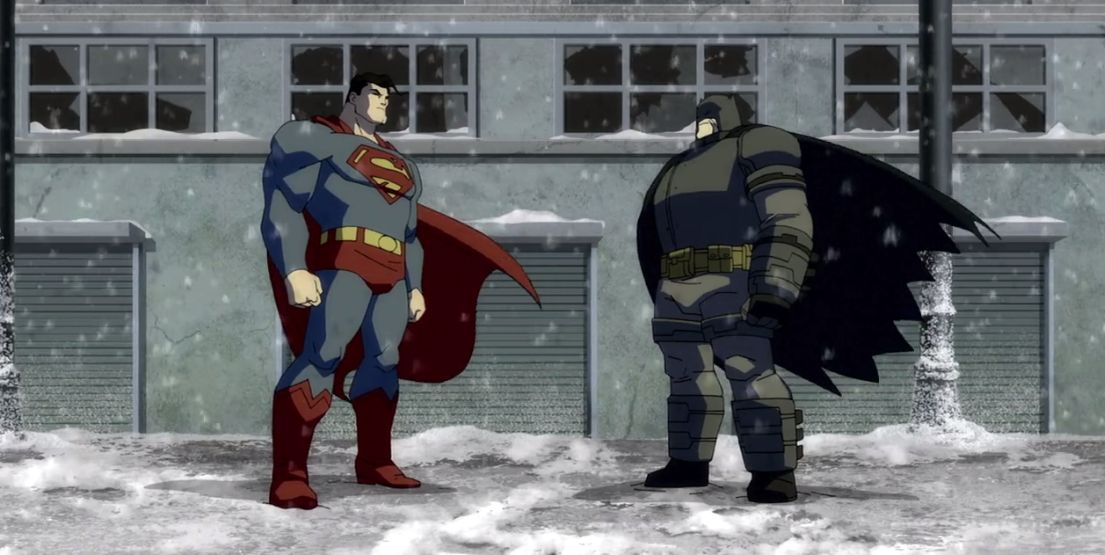
Now for The Dark Knight Returns, which was broken up into a Part 1 and Part 2, both of which are about the same length as Batman v Superman when combined. I used to watch the animated Justice League on TV, but I’m not as familiar with the more recent direct-to-video animated films that lean more on the mature side. The Dark Knight Returns was my first exposure to these, and I see why it has been acclaimed and, despite the different storylines of each film, recognize several similarities with Batman v Superman. Among the aspects it shares with Zack Snyder’s film are the Batman/Superman fight (of course) complete with kryptonite gas, a line from Bruce reminding someone that “We’re criminals. We always have been,” repeated news reports debating the legitimacy of unsupervised heroism, an unexpected televised massacre, a nuclear explosion with Superman high in the atmosphere, and an ending funeral scene, in which the two movies have the characters’ places switched.

Unlike Batman v Superman, where Superman is still a new hero for Earth and Batman is a somewhat older than usual version, having already assumedly beaten the rogues to be seen in Suicide Squad, The Dark Knight Returns features a much older Batman in the 80s, who has retired from hero work after the death of his second Robin named Jason. With Gotham City being terrorized by a violent gang called the Mutants and the return of a supposedly rehabilitated Two-Face, Bruce Wayne decides to “return” as the hero it needs and deserves. As his crusade continues in Part 2, he also battles the once-catatonic Joker and eventually Superman himself, aided by the young Carrie Kelley as the new Robin.

Image result for the dark knight returns film

Part of what sets The Dark Knight Returns above its live-action counterpart, in addition to its more focused narrative that still covers a lot of ground, is the sense of history among the characters without showing it all. Batman is haunted by the deaths he couldn’t prevent, even telling the Joker he blames himself for allowing his foe’s killing spree to last so long, but he acts with the sureness of experience. The police have a varying reaction to the Dark Knight; those like Commissioner Gordon who remember Batman’s past heroics welcome him with a hands-off policy, while the newer recruits and incoming Commissioner Ellen Yindel see him as merely one more violent influence on Gotham City. Debates rage on the news and talk shows over whether Batman should be admired or arrested, with one know-it-all psychiatrist especially criticizing him with some good points, but the mix of opinions is a bit more balanced than the backlash in Batman v Superman. We even get some cameos from much older Selina Kyle and a grizzled Oliver Queen/Green Arrow (who has one arm for some reason, reflecting that unseen history I mentioned earlier).

The Dark Knight Returns also boasts a stellar voice cast, led by Peter Weller of Robocop as Batman. Also (Lost alert!), Michael Emerson, who played such a great villain in Ben Linus, brings a similar ruthless sneer to the Joker. As for Batman’s climactic clash with Superman, it plays out rather similarly, but for entirely different reasons. It goes back to the history they have with each other in this post-Justice League world, and interestingly the reason is more like that in Captain America: Civil War than in Batman v Superman. Unlike Zack Snyder’s Man of Steel, this Superman directly supports the U.S. government and its Reagan-esque President and is sent to put a stop to Batman’s vigilante brand of justice. They clearly disagree, but even in the heat of battle, their respect for each other causes them to hold back. And it doesn’t end with a silly twist so it’s arguably a better confrontation, which is more of a symbolic clash of ideals than the death battle in Batman v Superman.

Another point where The Dark Knight Returns has it over Batman v Superman is its depiction of Batman’s conscience. Both Batman and Superman are well-known for their refusal to kill their villains, which of course lets them come back repeatedly, but Zack Snyder seems to have ignored that fact. I didn’t notice at first, caught up in the impressive action sequences, but Affleck’s Batman doesn’t seem to mind smashing cars into people and general murder of the bad guys, perhaps owing to that “feeling of powerlessness that turns good men cruel,” as Jeremy Irons’s Alfred says. The Dark Knight Returns’s Batman, however, takes care to leave his baddies alive, only coming close to killing when pushed to his limit; one especially cool rampage in the tank-like Batmobile makes a point of using rubber bullets to incapacitate the Mutant gang without killing them.

Image result for the dark knight returns film


Despite the upheld ban on killing, there is quite a bit of violence and some nudity for a PG-13 cartoon. Some of the fistfights are vicious, and while the more gruesome scenes are left offscreen, it doesn’t shy away from blood, mainly in scenes with the Joker. Not to mention, the Joker has a Batarang sticking out of his eye for a while so I can’t help but think an R rating might have been more deserved. Likewise, Batman v Superman has its fair share of brutality, though comparatively little blood.

Both Batman v Superman: Dawn of Justice and The Dark Knight Returns have their strengths and weaknesses. The former is gritty and well-acted for the most part with a jam-packed plot that will likely reward repeat viewings, but its overstuffed length and particularly drab treatment of Superman aren’t about to make it a classic either. The Dark Knight Returns is clearly a stronger film, though that’s owed to its acclaimed source material which didn’t have to set up a whole superhero universe through cameos. The animation is nothing special but it illustrates the story well; the older Batman is a wise and responsible version of the hero who is still susceptible to human weakness and grief yet manages to even rally the citizens of Gotham to his cause. Despite the violence, some weird unexplained slang, and several loose ends left open, such as the Cold War entanglements, The Dark Knight Returns is a strong Batman movie and proves why DC often seems so much more suited to the animated realm (and TV, like Arrow). I won’t begrudge DC fans the pleasure of seeing their favorite heroes in live action on the big screen, but Marvel does it so much better. Only time will tell if that holds true for DC’s future line-up.

Best line from Batman v Superman: Dawn of Justice: (Lex Luthor, actually offering a good point) “You don’t need to use a silver bullet. But if you forge one, you don’t need to depend on the kindness of monsters.”

Best line from The Dark Knight Returns (the real best line is a spoiler but this one will do): (Alfred) “If it’s suicide you’re after, I have an old family recipe. It’s slow and painful. You’d like it.”


Rank for Batman v Superman: List Runner-Up

Rank for The Dark Knight Returns: List Runner-Up


© 2016 S. G. Liput
403 Followers and Counting


VC Pick: Minority Report (2002)

07 Sunday Aug 2016

Posted by sgliput in Movies, Poetry, Reviews, Writing

≈ Leave a comment

Tags

Action, Drama, Sci-fi, Thriller

Image result for minority report film


Some people insist that the future is written
In stone,
Worry-prone
And forever unknown.
For every mistake, we are twice shy once bitten,
Yet fate
Will dictate
Whether we are too late.

How grand it would be if the future were clearer,
To see
Finally
What we can’t guarantee.
If destiny was not a wall but a mirror,
Events
To lament
We perhaps could prevent.

Yet what if the future were actually written
In sand,
To expand
Or to change what is planned.
How could you know if the course that you fit in
Is still
To fulfill
Or to change if you will?
______________________

MPAA rating: PG-13

Since most of her movie choices thus far have been romantic comedies, my VC wanted to prove her interests do extend beyond, to science fiction, for example. Thus, she recommended Minority Report, Steven Spielberg’s adaptation of a Philip K. Dick story about a world where crime can be stopped through precognition. You can’t go wrong with Spielberg and sci-fi, and as with his later pairing with Tom Cruise in War of the Worlds, Minority Report is a darkly polished cautionary tale with no shortage of futuristic effects.

Cruise plays John Anderton, a PreCrime cop whose division prevents murders through the oracular visions of three medicated “precogs” who float in a vat of milky fluid. When you say it like that, it sounds rather, um, strange, but the technological methods and theoretical concepts employed are explained understandably enough and brought to life with all manner of futuristic gadgets, from jetpacks to hand-operated holographic screens that look suspiciously like those in Tony Stark’s garage. After dealing with the probing questions of DOJ agent Danny Witwer (Colin Farrell), Anderton finds himself on the wrong side of this supposedly flawless system when he is singled out as a would-be murderer, and as he says, “Everybody runs.”

Cruise himself delivers a solid performance as Anderton, one of his first sci-fi roles. Despite being a drug addict, Anderton is consistently sympathetic due to his grief over his son’s abduction, after which he threw himself into his Precrime work. He insists on the system’s infallibility, yet when he’s on the receiving end of the accusation of murder, he proves to have the strength and intelligence to evade capture and dig deeper into how the system works. It’s a credit to the story that, even after an apparent breakthrough moment, the plot still has more twists up its sleeve. The secrets Anderton uncovers also open up philosophical quandaries he had chosen to ignore, from the humanity of the seemingly braindead precogs to whether the future is really set in stone, particularly when that future can be foreseen.

One thing seems certain: 2054 will be a problematic year. I find it curious that at least three different dystopian sci-fi films take place in that year, Surrogates, Harrison Bergeron, and this one. I suppose it’s a year that seems close enough to still be recognizable to our current lifestyle but distant enough to hold guessable technological advances. Those advances are some of Minority Report’s greatest strengths, of which we see more as Anderton’s journey continues. Autopilot cars and vertical highways? That’s cool. Spider drones that scout out entire buildings? That’s even cooler. The practical advantages of seeing the future? That too. Eventually, these cool moments add up to an all-around cool movie with some food for thought at its heart.

In addition to the moral issue of punishing people for crimes not yet committed, the tech side of things also offers questions to consider. As convenient as it would be for cars to drive themselves or public ads to be instantly customized to you based on an eye scan, such advances are only harmless for as long as you remain in the good graces of the powers that be. Those conveniences become liabilities and dangers once Anderton goes on the run. One could say that good, law-abiding people have nothing to worry about, but what is good or law-abiding can change depending on who is in power.

Minority Report is a thought-provoking mystery and one more credit to Spielberg’s sci-fi filmography. The dark cinematography makes every source of light glow, often placing an aura or halo around people, suggesting perhaps, like many dystopian films, that this shining future is only bright on its edges with shadier secrets below. The film’s one negative, aside from an unanswered question or two, was an uncomfortable scene of an eye transplant. My VC is especially squeamish about such scenes and didn’t even want me to look.

Nonetheless, Minority Report’s style and futuristic creativity made for an entertaining what-if scenario with ethical debates that will only grow as 2054 gets closer.

Best line: (Dr. Hineman, co-founder of Precrime) “Sometimes, in order to see the light, you have to risk the dark.”


Rank: List-Worthy


© 2016 S. G. Liput
401 Followers and Counting


Captain America: Civil War (2016)

15 Sunday May 2016

Posted by sgliput in Movies, Poetry, Reviews, Writing

≈ Leave a comment

Tags

Action, Drama, Sci-fi, Superhero


What’s right,
Worth a fight
And the height of loyalty?
What’s wrong
Won’t last long
If right’s champions agree.

Surely all with decency
On seeking justice would agree,
And yet on how we seek and why
So many don’t see eye to eye.

Won, lost,
Wars have cost;
Lines are crossed and drawn once more.
Wrong, right,
And the fight
Never make a simple war.
________________

MPAA rating: PG-13

Marvel has at last reached its Phase 3, and despite being the thirteenth film in the Marvel Cinematic Universe, the reigning lords of summer blockbusters show no sign of stopping. In fact, Phase 3 might be the best era of the MCU, if Civil War is any indication. Captain America’s third film is a thrilling continuation of both the Bucky fiasco of The Winter Soldier and the Sokovian destruction of Age of Ultron, stressing the emotional damage that such disastrous circumstances can wreak on individuals and relationships.

Unlike other single-character-focused entries up to this point, Civil War doesn’t have just a few cameos from other MCU stars. It has nearly every Marvel hero introduced thus far — Cap (of course), Bucky, Iron Man, War Machine, Black Widow, Falcon, Hawkeye, Ant-Man, Vision, Scarlet Witch, and the newest additions of Black Panther (Chadwick Boseman) and a non-Sony Spider-Man (Tom Holland) — all being forced to choose between two equally defensible sides concerning how much freedom the Avengers should have to do their danger-prone duty. Even the notable absence of Thor and the Hulk is used to support the argument that ultra-powerful people should not be left unaccountable.

Most reviews of Civil War, including the initial reaction of my VC, have proclaimed it as the best Marvel movie yet. (I think the first Avengers edges it out, IMO.) However, I do know at least one naysayer, a DC fan, who considers the “Civil War” a mere petty squabble amid the big picture leading up to Infinity War. I’ll grant that much of the fighting between the heroes is not a life-and-death struggle, and it isn’t meant to be. For most of the film, the battles are meant for defense or damage control (not that they’re any less awesome), but the clash of ideologies is genuine. The seeds of it have been well-established, from the distrust of authority that The Winter Soldier instilled in Steve to the understandable guilt felt by Tony, who knows that, unlike most threats, Ultron really was his fault. Considering how much damage has been wrought by the MCU’s various baddies and heroes alike, it’s not surprising that the world’s governments would seek to reaffirm their authority. The other Avengers choose their sides based on loyalties or believable reasoning, with the exception of Hawkeye, who chooses Cap over his pal Black Widow for no other reason than to keep the fight six against six.

Considering how much ideological and character terrain is covered, it’s amazing how entertaining Civil War is. (The worst thing I can say about it is that the globe-hopping location titles are a little too HUGE.) Even if it seems odd now to introduce Spider-Man and Black Panther long before their respective stand-alone movies, both Boseman and Holland offer game interpretations of their characters that somehow manage to stand out among the crowd of heroes. Black Panther is the more mysterious of the two, reserved and stately outside his vibranium suit and vicious for revenge within it, while Holland as the youngest Spider-Man yet manages to top Andrew Garfield’s version with only a fraction of the screen time, even if his gee-whiz astonishment gets a little old. (I’m still partial to Tobey Maguire for now.) Despite their rushed introduction in Age of Ultron, Scarlet Witch and Vision also get some needed clarifying character moments. I was thrilled too to see Martin Freeman in a small governmental role, and I can’t wait to see if he’ll ever run into his Sherlock co-star as Dr. Strange. The semi-climactic battle between the twelve heroes at a German airport is really the crowning moment of the film and the franchise thus far and manages to surprise, poke fun, grieve, and impress with all the cleverness and enjoyment Marvel delivers so well. Casual viewers not up-to-date on the MCU may be lost at times, but for long-time fans like my VC and me, this is geek heaven. Stan Lee also gets one of his funniest cameo moments to date.

The advertisements for Civil War have urged audiences to “choose a side,” a choice which actually isn’t as clear-cut as the typical good-vs-evil battle. Tony has good reasons for his actions in trying to make amends for his mistakes, while Cap is trying to help his friend Bucky and remain unfettered by bureaucratic agendas. Considering his name is in the title, Cap seems like the obvious choice, and Bucky’s story is tragic enough to make him naturally sympathetic; but even the American hero can’t stop regrettable casualties. The costs of revenge become more real over time, and by the end, sympathies change back and forth until it’s hard to say where one’s allegiance lies. That’s what makes a brilliant conflict, the kind of built-up feud that can’t be done the same with one movie (ahem, Batman v Superman). It’s what sets Marvel and Civil War above the competition.

Best line: (Sharon Carter, speaking of Peggy Carter) “And she said, ‘Compromise where you can. Where you can’t, don’t. Even if everyone is telling you that something wrong is something right. Even if the whole world is telling you to move, it is your duty to plant yourself like a tree, look them in the eye, and say, “No, you move”.’”

Rank: Top 100-Worthy

© 2016 S. G. Liput
386 Followers and Counting


Captain America: The Winter Soldier (2014)

14 Saturday May 2016

Posted by sgliput in Movies, Poetry, Reviews, Writing

≈ 4 Comments

Tags

Action, Drama, Sci-fi, Superhero

Idealists are few, and unflinching ones rare.
Too many are loath to commit.
More often, agendas too secret to share
Give heroes good reason to quit.

Yet, sometimes a principled stalwart of right
Is wise to not trust quite so much,
So when the agendas collapse in a fight,
There’s something still solid to clutch.
___________________

MPAA rating: PG-13

Before I review Cap’s third awesome outing in Civil War, I thought I should cover the only major Marvel movie I haven’t reviewed yet. (I’ll get to Thor 2 eventually.) The First Avenger was a pitch-perfect origin story for Captain America while The Avengers paired the patriotic hero with his super-powered team, but it was The Winter Soldier that brought the 1940s Steve Rogers into the modern world.

After adapting to his new century, Steve Rogers butts heads with Nick Fury (Samuel L. Jackson, who gets to do more in this movie than in most of his cameos), only to uncover a conspiracy within S.H.I.E.L.D. itself, going right up to its president Alexander Pierce (Robert Redford in rare villain mode). With help from Scarlett Johansson’s ever-resourceful Black Widow and new ally Sam Wilson/Falcon (Anthony Mackie), Cap faces off against the mysterious Winter Soldier and tries to contain the damage of the inevitable coup. Oh, and a gut-punch twist reminds everyone that no one but villains really die in these comic book movies.

Though The Winter Soldier has a reputation for being better than its predecessor, I do prefer the nostalgic action of The First Avenger more. Nevertheless, the second Cap film features one of the most significant plots of any Marvel film with some of the deepest ripples through the MCU. Not only is Nick Fury “killed” and HYDRA resurrected but S.H.I.E.L.D. is effectively toppled as well, and the film builds on the first film with its revelation of the Winter Soldier’s tragic identity (which I knew going in since it reflects the comics, but it was a genuine surprise for my VC). Being a fan of Marvel’s Agents of S.H.I.E.L.D., I find it amazing how the events of the film were incorporated into the TV show’s concurrent first season (such as the appearance of Agent Sitwell), and the entire second season continued to incorporate elements (like the face-changing mask) and dealt with the fallout and the need to rebuild S.H.I.E.L.D.

There’s really very little negative that I can say about The Winter Soldier. The action and special effects are as spectacular as Marvel’s best films, especially in the slightly numbing final battle. Every actor is on point, and it was an odd pleasure seeing Johansson’s confrontation with Redford, considering he gave her one of her first major roles when they co-starred in The Horse Whisperer. The only bad thing I can say about The Winter Soldier is that its overall product feels rather generic (car chases, fist fights, etc.) compared with Marvel’s more inventive or colorful adventures, like Guardians of the Galaxy or even The First Avenger. It’s nonetheless an essential installment of Marvel’s canon and a highly entertaining one at that.

Best line: (the end of Cap’s speech to S.H.I.E.L.D.) “I know I’m asking a lot, but the price of freedom is high. It always has been. And it’s a price I’m willing to pay. And if I’m the only one, then so be it. But I’m willing to bet I’m not.”


Rank: List-Worthy (joining The First Avenger)


© 2016 S. G. Liput
385 Followers and Counting


Ragnarok (2013)

30 Saturday Apr 2016

Posted by sgliput in Movies, NaPoWriMo, Poetry, Reviews, Writing

≈ 3 Comments

Tags

Action, Drama, Family, Fantasy, Foreign, Thriller


(Today’s final NaPoWriMo/GloPoWriMo prompt was to write a translated poem, so I tried to write something homophonically similar to “The Half-Finished Heaven” by Swedish poet Tomas Transtromer. Doing that, I could have ended up with something as inscrutable as some of Gerard Manley Hopkins’ work, so instead I simply began each line of the poem below with the same letter as the original poem and chose a Scandinavian film to review.)

Mid-look was my life cut short,
Aghast at the proven report.
Goodbye to my daughter and son;
Dear father will never see port.

A brave man was I, no mistake.
Oh, Vikings would never forsake.
Vigor was rife in our bones,
Alas, till they littered the lake.

Veiled are we here in our sleep,
Veiled in the dangerous deep.
Still does our conqueror live,
Drowsing upon our corpse heap.

Valiant and foolish to tarry
Is he who finds our cemetery.
______________

MPAA rating: PG-13

Ragnarok may be the first Norwegian film I’ve seen, in a way the Norwegian equivalent of a late-summer blockbuster. Perhaps the closest thing I can compare it to is 2008’s Journey to the Center of the Earth with Brendan Fraser, loaded as both are with clichés and genuinely thrilling moments. Both films start out much the same; like Fraser’s volcanologist, archaeologist Sigurd Swenson (good Scandinavian name!) is desperate for funding, and when an enigmatic clue arises, he brings along his two kids Ragnhild and Brage and a couple colleagues on an ill-advised search for answers that doesn’t go as planned. In lieu of a Jules Verne novel as inspiration, Norse mythology stands in with the story of Ragnarok, a.k.a. the end of the world.

The expedition walks into danger when they raft across a remote, far-north lake to a central island where both Vikings and Russians once visited, never to leave again. It’s an effective build-up to what is ultimately a creature feature. The monster hidden below the surface and the foolish decisions of the humans will bring to mind films like Jaws, Eragon, and Jurassic Park III, but this Norwegian equivalent of those movies usually manages to make the material its own. A few set pieces involving a zip line and a bunker are edge-of-your-seat highs, and my VC was far more terrified than I at one prolonged suspense scene.

It may not be entirely original, but Ragnarok is an entertaining action adventure with some tense thrills that never become un-family friendly. The special effects are usually as good as most American productions, and the isolated Arctic scenery makes for a stunningly rich setting. I will be interested to see how Marvel’s Thor: Ragnarok compares. For a first accessible foray into Norwegian cinema, I’d recommend Ragnarok, though don’t watch the English dub. Most dubs don’t bother me, but when children are screaming and some English voiceover dully says “Help me,” it kinda ruins the moment.

Rank: List Runner-Up

© 2016 S. G. Liput

385 Followers and Counting


Waterworld (1995)

27 Wednesday Apr 2016

Posted by sgliput in Movies, NaPoWriMo, Poetry, Reviews, Writing

≈ 3 Comments

Tags

Action, Drama, Sci-fi


(Today’s NaPoWriMo prompt was to write a poem with long lines, so I used twenty-syllable lines in this meditation on the ocean.)


Look to the north, to the south, to the east, to the west, and as far as you can;
Your whole field of view is a blending of blue with the sea and the sky in your sight.
At the end of the day, in first orange, then gray, they display for the sea-faring man
The blush that soon fades in the darkening shades as the two become one in the night.

Again, when the sun declares darkness is done and awakes from its sunken abode,
The sea and the sky heave a secretive sigh as the line that divides them is drawn.
The sailor can stare with a personal prayer as he plies the invisible road,
But all he will glean is duel aquamarine till the sundering stria is gone.

A seafarer seeks the foreseeable peaks that he hopes the horizon will yield,
And promise of land is as sharp a command as any ship captain could give.
Yet after he’s tasted the crowd and embraced the stability water can’t wield,
He’ll miss the blue pair and their distant affair where the loneliest mariners live.
____________________

MPAA rating: PG-13

After years of huge successes like The Untouchables, Field of Dreams, and Dances with Wolves, Kevin Costner delivered one of the most notable career-stalling bombs in Hollywood history, 1995’s over-budget Waterworld. Despite the jeering reviews at the time, Waterworld did break even in the end, but it has pretty much receded into the ranks of forgettable science fiction. This is a waterlogged shame because, regardless of its reputation as a flop, I enjoyed Waterworld. In fact, I watched it with the incredulous realization that “Hey, this is a great movie.” (Note that I say movie rather than film. It’s not what I would consider Oscar-worthy, but it’s darn good.)

Perhaps Waterworld didn’t take off simply because it was ahead of its time. It’s essentially Mad Max: Fury Road on water. An unrealistic cataclysm has covered the world in water rather than desert, forcing humans to adapt and settle in isolated communities or else join roving gangs of water-skiing thugs. A laconic wayfarer lacking a name (Costner) wanders this dystopia where seeds and dirt are rare commodities (as opposed to seeds and water) and is grudgingly forced to protect some fleeing females (Jeanne Tripplehorn and young Tina Majorino) in search of a fabled paradise, while being chased by the hammy head of a cult-like water gang (eyepatch-wearing Dennis Hopper). Like Fury Road, it takes a while for any of the characters to get some actual development, but the explosive action ably makes up for such faults. It even ends in similar Fury Road fashion, with an unlikely happy ending and a reluctant departure.

The themes and characterizations don’t quite have the nuance of Fury Road. There’s no female empowerment subtext or criticism of utilitarian societies, but when Deacon the villain stands high above a crowd of his followers with promises of survival, it’s hard not to see the resemblance. Waterworld does include a few mockable elements, such as making Costner’s mariner a mutant with gills, but they work with the story, and hey, Fury Road had some silly aspects too (“V8! V8! V8!”). The eccentric characters and expansive action were clearly influenced by the earlier Mad Max films, but the plot seemed to prefigure the latest installment.

It’s certainly not on par with his best films, but Kevin Costner didn’t deserve the mockery he received for Waterworld. From what I’ve read, it did take his ego down a peg, but I for one found it to be a fun and exhilarating boat ride with many set designs and effects worth praising, one particularly awesome boom, and more water than you can shake a lit flare at. I just don’t understand why Fury Road earned universal acclaim while Waterworld became the butt of jokes. Waterworld is proof that one shouldn’t always trust the critics.

Best line: (Deacon) “Let’s have an intelligent conversation here: I’ll talk, and you listen.”


Rank: List-Worthy


© 2016 S. G. Liput

384 Followers and Counting


Maze Runner: The Scorch Trials (2015)

15 Friday Apr 2016

Posted by sgliput in Movies, NaPoWriMo, Poetry, Reviews, Writing

≈ 2 Comments

Tags

Action, Drama, Sci-fi, Thriller


(Today’s NaPoWriMo prompt, inspired by this month’s halfway point, is to write a poem incorporating doubles. Thus, I chose to write in couplets and picked a sequel to review.)


Run, run, run, through glade and through maze;
Run and trust not this new world set ablaze.

Run from the torchbearers firm in their cause,
So sure of its virtues, no thought for its flaws.

Run from the dangers that line every path;
The world is less suited to kindness than wrath.

Run from the greedy, who serve themselves first,
And those who do wrong, by good reasons coerced.

Run till you realize your flight is in vain;
When all the world’s crazy, you stand and be sane.
____________________

MPAA rating: PG-13

I very much enjoyed the first Maze Runner film and was looking forward to continuing the intriguing mystery set before the characters. It was a darker installment in the YA dystopian genre and a bit more intense than others of its ilk. The Scorch Trials both strengthens and weakens the series, which is to say it both entertained and disappointed me, which is to say it’s good but could have been better, which is to say . . . oh, I’ll just explain.

After escaping from the maze, Thomas and his Glade buddies are whisked away to a locked-down compound where they find other rescued inhabitants from other mazes and a great many secrets. One common complaint about the first film is the lack of answers, and The Scorch Trials does supply some, such as why the young people are so important and why Thomas joined the Gladers. We still don’t know what exactly the Maze was for, but there’s still another film yet to come. While the first film was almost completely confined, this one has a much wider scope as Thomas and the gang are introduced to the scorched wasteland and a zombie-like plague that has caused a breakdown in society.

I wasn’t expecting this to turn into a zombie apocalypse movie since we’ve had even more of those than YA dystopias, but it works quite well. In lieu of the first film’s Grievers, those infected with the Flare virus offer the same awesome, edge-of-your-seat action and lots and lots of running. A key part of zombie scenarios is how people deal with them, and the film includes a believable variety of responses, from ruthless science to mercenary self-interest. One reason I avoid zombie movies is my aversion to gore, and I did appreciate this film’s restraint, proving (like World War Z) that it can be done effectively.

Sadly, with so much eventfulness, the characters are little more than placeholders. Thomas (Dylan O’Brien) is the leader making things up as he goes along, and he connects with a couple new characters, but everyone from the first film is just following along. This film so relies on the first one to establish its “main” characters that my VC didn’t even remember one of the expendables along for the ride.

Another gripe is that The Maze Runner was fascinatingly original while this one seems content to borrow plot elements and even specific scenes from other sources. Watching the film, I kept pointing out what such-and-such reminded me of. The zombie setup and search for a cure brought to mind I Am Legend and World War Z. Zombies in a mall seemed like a Dawn of the Dead reference. Oh, that scene is like the beginning of Mad Max: Fury Road. Oh, that’s like Coma, and Aliens, and The Way Back, and Fallout, and The Lost World: Jurassic Park. When a film constantly brings other franchises to mind, more than its originality suffers.

Thus, The Scorch Trials furthers the plot and little else, but that’s luckily still enough to keep me interested and entertained. The stage is set for the final chapter, and I’m glad the characters have something to run toward instead of always away. Time will tell if this trilogy can end on the high note with which it began.

Best line: (Thomas, at a pivotal scene) “I’m tired of running.”


Rank: List-Worthy (joining the first film)


© 2016 S. G. Liput

380 Followers and Counting


Earthquake (1974) / San Andreas (2015)

06 Sunday Mar 2016

Posted by sgliput in Movies, Poetry, Reviews, Writing

≈ Leave a comment

Tags

Action, Disaster, Drama, Thriller


Just another normal day,
Just keeping normal cares at bay,
But then to everyone’s dismay,
The ground begins to shake.
The rocks and hills begin to play,
The soundest structures start to sway,
Entire buildings fall away
Amid the sudden quake.

If you make it through the scare,
You wonder how your loved ones fare.
Do they live and how and where?
You worry more for them.
The worst disasters we must bear
At best encourage us to dare
To save the ones for whom we care,
Whom danger might condemn.
__________________

MPAA rating for Earthquake: PG
MPAA rating for San Andreas: PG-13

There’s something strangely entertaining about a disaster. Whether it be the dated survival tales of the 1970s or the modern effects-heavy world-wreckers, it seems clear that it’s not just the Joker who likes to watch the world burn. Of course, this doesn’t apply to real-life disasters. Films like The Impossible and World Trade Center are serious and painful reminders of tragedies, but others like San Andreas are enjoyed as popcorn fun simply because they’re not real. This seems like a puzzling dichotomy, but it’s no less true.

I thought I’d do a comparison of two similar films from different eras that exploit people’s fondness for destruction: 1974’s Earthquake and last year’s San Andreas. Both revolve around earthquakes blind-siding California and people’s struggles to survive. Both include experts who saw the quake coming but didn’t act fast enough, crumbling cityscapes, characters getting trapped in a parking garage, and a dam’s destruction and subsequent deluge (one at the beginning, one at the climax). While a few of the shaking scenes are even similar (both show a glimpse of a cook suffering at the hands of his stove), the two films are on entirely different levels. Earthquake was groundbreaking at the time and even won an uncontested Oscar for Best Visual Effects, but it seems quaint next to the comprehensive devastation of San Andreas, which is ironic since the quake in Earthquake is a 9.9 on the Richter scale while those in San Andreas only reach 9.6. (Yeah, only.)

I was curious to see Earthquake because of its tie-in to an episode of Quantum Leap, in which Sam leaps into a stuntman who features in a famous scene from this movie, complete with a clip showing Lorne Greene. It’s clear now as it surely was then that Earthquake is a gimmick film. Released at the height of the ‘70s disaster craze and the same year as The Towering Inferno, it seemed to be the result of producers saying to themselves, “Let’s see, we know of movies with a plane disaster, a ship disaster, a hurricane disaster, a fire disaster…What’s left? I know! An earthquake!” Plus, the film was accompanied by a new speaker system called Sensurround, which was meant to heighten the feeling of experiencing an earthquake and which was shorter-lived than the early 3-D craze. With so much effort put into accentuating the quake itself, everything else about the movie seems secondary, even though the actual shaking is relatively short.

Like other disaster films of the era, Earthquake is jam-packed with stars: Charlton Heston as a businessman unhappy with his marriage, Ava Gardner as his sullen wife, Genevieve Bujold as his lover, Lorne Greene as his boss, George Kennedy as a policeman, Richard Roundtree as a stuntman, Walter Matthau (under a pseudonym) as a drunk, and Marjoe Gortner as a psychopathic National Guardsman who uses the disaster for his own empowerment. And that’s not even half of the ensemble. It’s clear what the filmmakers were trying to do, focusing on a large swath of the population dealing with a huge disaster in different ways, yet only five or so characters really matter and even the film seems to forget about many secondaries by the end. Certain scenes are impressive for their time, and several are tense as characters try to escape the aftermath of the quake. I just wish that the cast and the narrative overall had been streamlined, perhaps with a less downbeat ending.

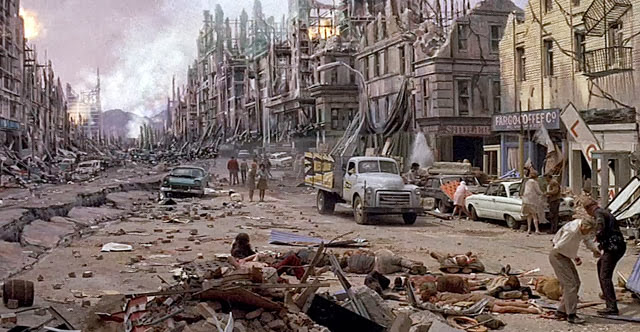
San Andreas, on the other hand, is everything a disaster movie should be, with all the unmitigated damage you could want. We see dams bursting, cars crashing, helicopters crashing, buildings toppled or chipped apart, and entire cities reduced to a flooded, smoking ruin, and it’s cool! Of course, it would be horrific if this actually happened (and I suppose it could), but it’s a feast for the eyes boasting an astronomical body count with no actual bodies. While I don’t really buy the causes for disasters like The Day after Tomorrow or 2012, an earthquake is more plausible and thus more alarming, though I was confused by the inclusion of a tsunami. (Seriously, wouldn’t a tsunami go out toward the sea and hit Hawaii instead of doubling back toward the source of the quake?)

Dwayne Johnson (whom everyone still calls the Rock) isn’t what most would consider a consummate actor, but he certainly knows how to play a tough, capable lead such as air rescue pilot Ray Gaines. Returning as his co-star from Race to Witch Mountain, Carla Gugino plays his soon-to-be ex-wife, whom Ray must save from certain death, along with their daughter Blake (Alexandra Daddario of the Percy Jackson films). There’s also Paul Giamatti’s worried seismologist and Ioan Gruffudd’s architect/home-wrecker, whose character is tested by stress and easily written off as selfish. While there are still many minor players, Ray’s family is the focus, which proves to be far more entertaining than the scattered attention of Earthquake. Screenwriter Carlton Cuse gives just enough emotional baggage and stress-kindled romance to be relatable, while throwing in a few moments that seemed directly drawn from his experience with Lost.

Neither film is what I’d call great cinema, but as a disaster movie, San Andreas is easily the better movie and one of the more exciting entries in the genre. I enjoyed watching it a second time even more because I got to watch my easily excitable dad jump out of his seat with two dozen “OMG” moments. Watching the two films side-by-side did emphasize one of the differences between the old wave and the new wave of disaster movies. While the likes of The Poseidon Adventure and Earthquake weren’t afraid to kill off main roles and leave the audience sharing some grief with the characters, more recent films are more concerned with keeping the protagonists together and finding a silver lining. It’s hard to say which is a better method, but one thing is for sure: movies like San Andreas and Earthquake are why I will never move to California!

Best line from Earthquake (which ties in to my elevator list): (dam caretaker, when told things seem fine after an elevator incident) “Right. People drown in elevators every damn day of the week!”

Best line from San Andreas: (young Ollie, after getting Blake’s phone number for his older brother) “I can’t wait to be twenty.”


Rank for Earthquake: Honorable Mention

Rank for San Andreas: List Runner-Up


© 2016 S. G. Liput

367 Followers and Counting


Mad Max: Fury Road (2015)

25 Thursday Feb 2016

Posted by sgliput in Movies, Poetry, Reviews, Writing

≈ Leave a comment

Tags

Action, Sci-fi


Grab the wheel and rev the motor;
Shift the gear for overload;
Brace yourself and lock and load her;
Hit the gas and hit the road!

Don’t look back at what has been;
Drive for lives and don’t delay.
High on pure adrenaline,
Floor it through a lovely day!
_____________


MPAA rating: R


After reading almost nothing but great things about this movie, I finally decided to check out Mad Max: Fury Road, and I can’t say that I was disappointed. I haven’t seen any of the original Mad Max trilogy, but since each one seems to be its own adventure with one constant character, what’s there to know? The world has been reduced by war to a barren wasteland, with mankind relying on jacked-up vehicles to survive amid ruthless gangs and dangers. While I consider this automotive dystopia entirely unbelievable, Fury Road is a movie meant to be experienced, not watched or analyzed or taken overly seriously, though you’re welcome to do that too once the adrenaline dies down. Directed by George Miller, the 70-year-old director who surprisingly also gave us Babe and Happy Feet, it’s an assault on the senses, and you’re just along for the ride.

I tried watching this with my very hesitant VC, who has seen some of the first three movies and considers them weird. “Weird” still applies. The costumes, makeup, characters, vehicles, and overall package are bizarre, superfluous, and often grotesque but certainly imaginative and oddly cool (seriously, a whole rig dedicated to a background guitar solo?). The central baddies are a fanatical cult led by Immortan Joe (Hugh Keays-Byrne, the first Mad Max’s villain), who rules the mountainous Citadel by controlling his War Boys’ religious fervor and the people’s access to the life-giving fluids of water, milk, gasoline, and blood. When one of his right hands, Imperator Furiosa (Charlize Theron), escapes for freedom with Joe’s scantily clad harem, his entire army takes off in hot pursuit. Oh, yeah, and there’s a guy named Max (Tom Hardy) along for the ride.

I was dubious about many critics considering Fury Road one of the greatest action movies ever, but it kind of is, if only because the entire story relies on action. Details like the War Boys’ method of suicide or Furiosa’s robotic forearm are never explained. They’re just presented while the thin plot and explosions roll along, letting action take the place of any in-depth characterization.

We don’t even get much in the way of character bonding or motivation until about two-thirds of the way through, but somehow it’s forgiven because we’ve already seen everyone in action, from Joe’s five wives with names like Toast and Capable to the dedicated War Boy Nux (Nicholas Hoult). My VC was a bit turned off by the frantic, sometimes sped-up editing, but it did make it hard to look away. The explosions are amazing, and all the more amazing for relying on practical effects and stunts, though one obviously CGI scene at the climax almost spoiled the effect. I also liked how it managed a happy ending that served as an inverse of the beginning, even if the final scene seemed needlessly set up for a sequel.

One aspect that I’ve seen mentioned over and over is how violent the film is, and while it’s certainly R-rated action, I wasn’t that bothered by it. I was fearing something really graphic, but the truth is that Fury Road is nowhere near as gory as things like The Walking Dead or the Deadpool trailer (both of which I’ve seen once and won’t again). There are shootings and stabbings and people being thrown off of fast-moving vehicles, but save for a couple of scenes, the R is really owed to the film’s overall intensity, and even the violent scenes are so brief in the kinetic editing that they didn’t detract for me. The bloodiest scene actually serves a latent purpose in punishing the very weird excesses I mentioned earlier, sort of like the cape critique in The Incredibles. You want to wear over-the-top costumes? Well, you may regret it. In addition, I was pleased that, for once, a gritty actioner was almost entirely free of foul language. Granted, there’s not a lot of dialogue in the first place, but think about it. Was it really missed?

Whether you watch for Hardy’s and Theron’s strong laconic leads or for the girl power thrill of women with guns or for the nonstop epic action, this is one nitro-fueled bandwagon I can’t help but jump aboard, despite its innate strangeness. While I agree on its awesome status among action films, when was the last pure action movie to be nominated for Best Picture? I rather wish Inside Out had been nominated instead. But that’s me. Brilliant at best and entertaining at worst, Mad Max: Fury Road is an unexpectedly great sequel that viewers didn’t know they wanted.

Best line: (Nux, in a line that could be even more iconic if it had been repeated; after all, it’s a lot better than “Witness me”) “Oh, what a day! What a lovely day!”


Rank: List-Worthy


© 2016 S. G. Liput

365 Followers and Counting


← Older posts
Newer posts →

Recent Posts

  • My Overdue 12th Blogiversary and 2025 List Additions
  • We Didn’t Start 2025 (Recap)
  • NaPoWriMo 2025 Recap (Finally)
  • Sonic the Hedgehog 3 (2024)
  • It Happened One Night (1934)

Recent Comments

associatesofshellymann's avatarassociatesofshellyma… on My Top Twelve La La La So…
Kit's avatarKit Nichols on Bonnie and Clyde (1967)
lifelessons's avatarlifelessons on Look Back (2024)
Carol Jackson's avatarCarol Jackson on The Thief of Bagdad (1940…
Stephen's avatarStephen on Love Story (1970)

Archives

  • May 2026
  • January 2026
  • December 2025
  • May 2025
  • April 2025
  • March 2025
  • February 2025
  • January 2025
  • December 2024
  • May 2024
  • April 2024
  • March 2024
  • February 2024
  • January 2024
  • December 2023
  • November 2023
  • October 2023
  • September 2023
  • July 2023
  • June 2023
  • May 2023
  • April 2023
  • March 2023
  • February 2023
  • January 2023
  • December 2022
  • November 2022
  • October 2022
  • September 2022
  • August 2022
  • July 2022
  • June 2022
  • May 2022
  • April 2022
  • March 2022
  • February 2022
  • January 2022
  • December 2021
  • November 2021
  • October 2021
  • September 2021
  • August 2021
  • July 2021
  • June 2021
  • May 2021
  • April 2021
  • March 2021
  • February 2021
  • January 2021
  • December 2020
  • November 2020
  • October 2020
  • September 2020
  • August 2020
  • July 2020
  • June 2020
  • May 2020
  • April 2020
  • March 2020
  • February 2020
  • January 2020
  • December 2019
  • November 2019
  • October 2019
  • September 2019
  • August 2019
  • July 2019
  • June 2019
  • May 2019
  • April 2019
  • March 2019
  • February 2019
  • January 2019
  • December 2018
  • November 2018
  • October 2018
  • September 2018
  • August 2018
  • July 2018
  • June 2018
  • May 2018
  • April 2018
  • March 2018
  • February 2018
  • January 2018
  • December 2017
  • November 2017
  • October 2017
  • September 2017
  • August 2017
  • July 2017
  • June 2017
  • May 2017
  • April 2017
  • March 2017
  • February 2017
  • January 2017
  • December 2016
  • November 2016
  • October 2016
  • September 2016
  • August 2016
  • July 2016
  • June 2016
  • May 2016
  • April 2016
  • March 2016
  • February 2016
  • January 2016
  • December 2015
  • November 2015
  • October 2015
  • September 2015
  • August 2015
  • July 2015
  • June 2015
  • May 2015
  • April 2015
  • March 2015
  • February 2015
  • January 2015
  • December 2014
  • November 2014
  • October 2014
  • September 2014
  • August 2014
  • July 2014
  • June 2014
  • May 2014
  • April 2014
  • March 2014
  • February 2014
  • January 2014
  • December 2013

Categories

  • Blindspot
  • Blogathon
  • Christian
  • Movies
  • Music
  • NaPoWriMo
  • Poetry
  • Reviews
  • TV
  • Writing

Meta

  • Create account
  • Log in
  • Entries feed
  • Comments feed
  • WordPress.com

Recent Posts

  • My Overdue 12th Blogiversary and 2025 List Additions
  • We Didn’t Start 2025 (Recap)
  • NaPoWriMo 2025 Recap (Finally)
  • Sonic the Hedgehog 3 (2024)
  • It Happened One Night (1934)

Recent Comments

associatesofshellymann's avatarassociatesofshellyma… on My Top Twelve La La La So…
Kit's avatarKit Nichols on Bonnie and Clyde (1967)
lifelessons's avatarlifelessons on Look Back (2024)
Carol Jackson's avatarCarol Jackson on The Thief of Bagdad (1940…
Stephen's avatarStephen on Love Story (1970)

Archives

  • May 2026
  • January 2026
  • December 2025
  • May 2025
  • April 2025
  • March 2025
  • February 2025
  • January 2025
  • December 2024
  • May 2024
  • April 2024
  • March 2024
  • February 2024
  • January 2024
  • December 2023
  • November 2023
  • October 2023
  • September 2023
  • July 2023
  • June 2023
  • May 2023
  • April 2023
  • March 2023
  • February 2023
  • January 2023
  • December 2022
  • November 2022
  • October 2022
  • September 2022
  • August 2022
  • July 2022
  • June 2022
  • May 2022
  • April 2022
  • March 2022
  • February 2022
  • January 2022
  • December 2021
  • November 2021
  • October 2021
  • September 2021
  • August 2021
  • July 2021
  • June 2021
  • May 2021
  • April 2021
  • March 2021
  • February 2021
  • January 2021
  • December 2020
  • November 2020
  • October 2020
  • September 2020
  • August 2020
  • July 2020
  • June 2020
  • May 2020
  • April 2020
  • March 2020
  • February 2020
  • January 2020
  • December 2019
  • November 2019
  • October 2019
  • September 2019
  • August 2019
  • July 2019
  • June 2019
  • May 2019
  • April 2019
  • March 2019
  • February 2019
  • January 2019
  • December 2018
  • November 2018
  • October 2018
  • September 2018
  • August 2018
  • July 2018
  • June 2018
  • May 2018
  • April 2018
  • March 2018
  • February 2018
  • January 2018
  • December 2017
  • November 2017
  • October 2017
  • September 2017
  • August 2017
  • July 2017
  • June 2017
  • May 2017
  • April 2017
  • March 2017
  • February 2017
  • January 2017
  • December 2016
  • November 2016
  • October 2016
  • September 2016
  • August 2016
  • July 2016
  • June 2016
  • May 2016
  • April 2016
  • March 2016
  • February 2016
  • January 2016
  • December 2015
  • November 2015
  • October 2015
  • September 2015
  • August 2015
  • July 2015
  • June 2015
  • May 2015
  • April 2015
  • March 2015
  • February 2015
  • January 2015
  • December 2014
  • November 2014
  • October 2014
  • September 2014
  • August 2014
  • July 2014
  • June 2014
  • May 2014
  • April 2014
  • March 2014
  • February 2014
  • January 2014
  • December 2013

Categories

  • Blindspot
  • Blogathon
  • Christian
  • Movies
  • Music
  • NaPoWriMo
  • Poetry
  • Reviews
  • TV
  • Writing

Meta

  • Create account
  • Log in
  • Entries feed
  • Comments feed
  • WordPress.com

Blog at WordPress.com.

  • Subscribe Subscribed
    • Rhyme and Reason
    • Join 789 other subscribers
    • Already have a WordPress.com account? Log in now.
    • Rhyme and Reason
    • Subscribe Subscribed
    • Sign up
    • Log in
    • Report this content
    • View site in Reader
    • Manage subscriptions
    • Collapse this bar