(Today’s NaPoWriMo prompt was for a creation myth, like maybe a sci-fi explanation for the way things are.)
When Earth and its people were young,
From out of the cosmos far-flung,
An alien race
With a butt-ugly face
Found humans worth living among.
They hid their exterior well
To blend in, so no one could tell,
And here they resided
Until they decided
Mankind didn’t raise enough hell.
Whenever they noticed a sign
Of man’s selfishness in decline,
They swayed and brainwashed
And summarily squashed
Good will by their evil design.
On magazines, screens, world affairs,
We see messages unawares.
What we do, they direct,
And as you may suspect,
The Internet’s probably theirs.
That’s how the world got to this place,
So high on hate, lacking in grace.
Although I can’t prove it,
You cannot disprove it,
So who is the real mental case?
__________________
MPAA rating: R (mainly for language and brief nudity)
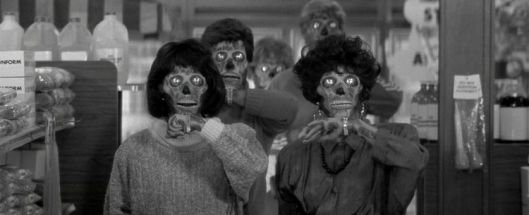
John Carpenter seemed to direct films designed to be cult classics, films that it’s hard to call good cinema on the surface but which end up finding admirers anyway. Escape from New York and Starman are just two favorites that strike a unique balance between sci-fi depth and imaginative cheese, and They Live fits right into that mold. The film centers on a drifter known as John Nada (famed wrestler Roddy Piper), whose discovery of a secret resistance movement and some special sunglasses reveals an alien mind-controlling conspiracy that can only be taken out by a shotgun and a classic one-liner.
As is typical with the other Carpenter films I’ve seen, it takes a while for the story to get going, as Nada meets a fellow construction worker (Keith David) and slowly notes a few nearby oddities at a church. Piper isn’t exactly a world-class actor either, so the only reason to sit through the beginning is for the promise of action to come. When it does, though, it’s pretty darn fun as Nada goes from gawking at a black-and-white world decorated with words like “Conform” and “Consume” to blasting every skull-faced alien in sight. The most famous sequence has to be the five-minute-plus smackdown between Piper and David over convincing the latter to wear the sunglasses, a fist fight that becomes laughable simply by how many times they both get up to keep on slugging each other.
I’ll admit that, after the slow start, They Live is very watchable, but it does seem weak in several areas, and not just the so-so acting or occasionally fake effects. There’s a pointed critique of commercialism at its core, summed up by the invisible message “THIS IS YOUR GOD” printed on all dollar bills, and the film points fingers at the elite as collaborators with the alien overlords. Yet the satire doesn’t seem to develop far enough to have much depth beyond the obvious hidden words, and it’s never clear exactly why the aliens are doing this or what they get out of keeping mankind petty. It’s like the beginning of a great idea that’s only half-fulfilled. Even so, Carpenter’s cult classics don’t always lend themselves to the same kind of criticism as mainstream films, and the final scene of this one sort of encapsulates what it is: weird, a bit indecent, strangely funny, and keen on eliciting a reaction.
Best line: (Nada) “I have come here to chew bubblegum and kick a**… and I’m all out of bubblegum.”
(Today’s NaPoWriMo prompt was for a poem utilizing repetition, so I applied this technique and maybe a little symbolism to a ‘90s action movie. Because why not?)
Upon the air, the vessel soared
To transport evil in its bowels.
Upon the air, the mongrel horde
Attacked where predator never prowls.
Upon the air, they broke their bonds,
And took control upon the air,
Upon the air where hawk absconds
With spoils telling all beware.
Upon the air, the vessel soared
With wickedness its newest norm.
The few good people left on board
Were but a candle in the storm.
Upon the air, some good endured,
And at the crash of evil’s lair,
Whose survival was assured?
‘Twas not the princedom of the air.
________________
MPAA rating: R
Few films sum themselves up as explicitly as Con Air, when Nicolas Cage’s soon-to-be-freed convict Cameron Poe states, “They somehow managed to get every creep and freak in the universe onto this one plane. And then somehow managed to let them take it over. And then somehow managed to stick us right smack in the middle.” That about sums it up. A classic ‘90s action movie based on the Die Hard formula of bad guys taking over the “fill-in-the-blank,” Con Air is a thoroughly enjoyable actioner that revels in its own testosterone.
Imprisoned for accidental manslaughter and on his way to release after serving his sentence, Cameron Poe is simply on the wrong plane at the wrong time when Cyrus the Virus (John Malkovich) and all manner of murderous convicts seize their air transport to escape. Being the upright guy with a phony Southern accent that he is, he plays along and stays to help the few decent people on board (Mykelti Williamson, Rachel Ticotin) while dealing with all the nutcases that have taken over the airborne asylum. The sheer number of recognizable faces is impressive by itself; aside from Cage and Malkovich, there are Ving Rhames, Dave Chappelle, and Danny Trejo as criminals; John Cusack and Star Trek’s Colm Meaney as bickering lawmen trying to ground the flight; M.C. Gainey as the convicts’ pilot (warranting a Lost alert for playing Mr. Smiley in my favorite show); and Steve Buscemi, who channels his inner psychopath as the flight’s own Hannibal Lecter wannabe.
Con Air isn’t anything revolutionary or high-minded; it’s simply a fun action movie, lone good guy against multiple bad guys, and it certainly excels in the action department. The explosions and mayhem are spectacular, if not entirely realistic, and you know you’re watching a ‘90s boom-fest when Nicolas Cage is running in slow motion from a blazing inferno. The various baddies provide different flavors of vileness to despise, and it’s a strange irony that the one psycho who seems like the worst actually doesn’t do anything bad onscreen and is thusly not punished.
I’ve often seen Con Air considered a guilty pleasure, equally ripe for entertainment or mockery (note John Cusack’s disappearing/reappearing pimple over a couple scenes), but what’s there to feel guilty about enjoying, aside from the rampant violence and language that comes with the genre? (I prefer the cut version myself.) On a side note, has anyone else noticed that Cameron Poe’s name might have inspired the name of Oscar Isaac’s character in Star Wars: The Force Awakens: Poe Dameron? Food for thought…. All in all, Con Air is first-rate punch-and-bullet action with a hero worth rooting for and plenty of villains worth hating.
Best line: (Buscemi’s Garland Greene, as the cons celebrate to “Sweet Home Alabama”) “Define irony. Bunch of idiots dancing on a plane to a song made famous by a band that died in a plane crash.”
(For today’s NaPoWriMo prompt, the poem was to be a recipe of some kind, so I rhymed up a recipe for a James Bond movie.)
You start with a superspy so debonair
That an icon is born with one slick, sultry stare.
Pour gunplay and danger and mix them in well,
Then throw in some girls, every one a bombshell.
It’s fine if they’re strong,
Since they won’t be for long.
When entendres are doubled, add one evil villain,
The badder the better, though others may spill in,
And make sure a henchman or two is included
And some evil scheme, even if convoluted.
Betrayal and suspicions
Are classic additions.
To this basic Bond batter, add extras to taste,
Like diamonds or lasers or nuclear waste
Or blimps, satellites, or a Fabergé egg.
Go silly, unless it contains Daniel Craig.
Now savor each thrill.
If half-baked, enjoy still.
_______________
MPAA rating: PG (maybe PG-13 nowadays)
Until I was thoroughly impressed by Daniel Craig’s turn as the famous superspy, A View to a Kill was my favorite James Bond film, and it still sits on top of the massive tie where all the non-Craig Bond films reside in my esteem. And even if Craig’s films are the best, he still doesn’t compare with Roger Moore, who was the first actor I saw in the role and has always had the perfect blend of suavity and charm, in my opinion anyway.
A View to a Kill isn’t necessarily brilliant or different next to its franchise brethren, but it’s a perfect example of the James Bond formula and an entertaining one at that. In tracking an EMP-proof microchip, Bond investigates wealthy industrialist Max Zorin (Christopher Walken), who naturally has an evil plan to make a lot of money by killing a lot of people. Moore’s films are always on the campier side, but this one, which was his last, is a little more serious than Moonraker or Octopussy (remember the Tarzan yell?). There are still some absurd moments, of course, like how no one seems to look in their backseat for killers, but they keep things fun.
Perhaps it’s because this was among the first Bond stories I saw, but there are so many fondly memorable scenes that exemplify the franchise for me: the Eiffel Tower chase, the elevator escape, the fire engine car chase, the mine flood, and especially the blimp climax over the Golden Gate Bridge. Christopher Walken is also a classic Bond psychopath with his taunting superiority, and while his villainy doesn’t stand out at first, he personally carries out one of the most despicable acts of betrayal in the franchise. His sidekick May Day (Grace Jones) is also a unique henchman, an unnervingly strong black woman who is more of an equal to Bond than his usual swooning conquests. Plus, there’s the now-classic title song by Duran Duran that is up there with “Live and Let Die” when it comes to Bond themes.
A View to a Kill may not be the most unique or thrilling of entries, but its entertaining variations on the usual tropes and my own nostalgia make it an old standby among James Bond outings. For me, it’s the best film starring the best Bond.
Best line: (Bond) “Hello. I thought you might like to join the party. By the way, the name is James St. John Smythe. I’m English.” (Stacy Sutton) “I never would have guessed.”
When I am dead, my soul no longer here,
What happens to my body is unknown.
‘Tis but a shell, an empty souvenir
Of my time in a world from which I’ve flown.
Most likely, it will end up in the ground,
A monument for time to chip away,
But if some more productive use were found,
Its former owner would not have a say.
If man no longer buried his remains
And flouted promises of “rest in peace,”
His conscience would be numb as it disdains
What once deserved respect upon decease.
What world of Frankensteins I’d leave behind
If man were to defile his own kind!
________________
MPAA rating: should be PG-13 or maybe older
The Empire of Corpses looks like an incredible, action-packed, thought-provoking movie, but it’s not. It just looks like one. Based on a novel by a Japanese author dubbed Project Itoh, who died of cancer before the book’s completion, this anime zombie film sets up an alternative steampunk version of Victorian England, where technology has allowed mankind to reanimate the dead as essentially robotic slaves, programming them to perform menial labor as a growing workforce in the world economy. These walking corpses can be recognized by their pale gray skin and passive expressions, but though they seem to understand and follow orders, they are without a soul. Into this hypothetical world is placed an amalgamation of historic and literary figures, a la The League of Extraordinary Gentlemen. John Watson is the hero, a corpse scientist who has resurrected a dead friend he renames Friday and now searches for a way to return his soul. Blackmailed by M of the James Bond franchise, he sets out in search of the fabled research of Dr. Victor Frankenstein, aided and impeded by the likes of Ulysses Grant, Thomas Edison, and characters from The Brothers Karamazov and The Future Eve.
While that description sounds rather awesome, especially when paired with a world full of brainwashed zombies, The Empire of Corpses seems eager to spoil a good thing. After the adventure begins on a thrilling note, it quickly descends into opaque philosophical pondering and inscrutable character motivations. After watching it all the way through, I recognize a worthwhile, imaginative story, full of food for thought, but actually watching it scene by scene can easily frustrate and confuse. By the end, the villain’s revealed plot (the second villain since one wasn’t enough) is baffling and poorly explained, making it clear just how vaguely defined the laws of this corpse technology are.
I hate to be so negative, especially when The Empire of Corpses looks so amazing. The animation is crisp and atmospheric and brings this theoretical world to life in ways that far surpass the deficient script. I’m glad I saw it, if only for the visual flair, such as the thrill of seeing a woman on the back of a galloping stagecoach mowing down zombies with a flamethrower. The action scenes are exceptional, but it makes it that much more disappointing that the rest of the film couldn’t measure up.
The Empire of Corpses is not without its virtues; I would just like it much more if it made more sense. It does feature some intriguing themes about life and death and manages to create a unique entry in the zombie genre, complete with zombie suicide bombers. The English dub is actually quite good, but the animation is the main attraction for fans of the medium, though certain scenes can get bloody (begging the question of why a dead corpse would bleed). This film is one of three anime movies based on Project Itoh’s novels (the others being last year’s Harmony and this year’s Genocidal Organ), and I certainly hope the other two have more than visual merit alone.
While Luke was still on Tatooine,
Before his escapades were seen,
The rebels fought
With secret plot
For every desperate, daring shot.
Some fled, some died, and some were caught,
For freedom’s never cheaply bought.
Before the rebels found success,
They found a chance that none would guess,
A chance that few
Would dare pursue
But those who hopes were overdue.
The groundwork of the tried and true
Was laid by names we never knew.
__________________
MPAA rating: PG-13
I’ve been a little disconcerted at Rogue One’s mixed reception, with half the people loving it and the other half accepting it halfheartedly. I know how the latter group feels since that’s how I reacted to The Force Awakens last year, but not this year, not with Rogue One. I enjoyed it a lot, probably more than The Force Awakens, mainly because The Force Awakens will always have the shadow of Han Solo’s death hanging over it. No matter how many times I see it, it will always be “the one where they killed Han Solo.” I remember gloomily walking out of the theater in shock last year, but I left Rogue One as one should leave a Star Wars movie, exhilarated and satisfied, even if the film is meant for a more bittersweet kind of appreciation. I wanted to love it, and there was nothing that kept me from loving it.
What many find iffy about Rogue One is that it doesn’t quite feel like a Star Wars movie. There’s no in-your-face opening crawl and no Jedi; the overall tone is darker and grittier than the other films, and the rebellion is depicted in a more ruthless and morally ambiguous light. All this is true, yet the settings and sci-fi trappings feel enough like Star Wars that it seems more like an unexplored region of the franchise than an entirely separate affair. And of course, since Rogue One is set between the fall of the Jedi and the beginning of A New Hope, there are clear connections to both trilogies, most notably in the return of Darth Vader and another character whose very presence brings the magic of CGI to new heights.
Yet unlike The Force Awakens and its unoriginal blow-up-yet-another-Death-Star climax, Rogue One has no lack of originality. It does take its time getting started, establishing the various rebels and their motivations, particularly Jyn Erso (Felicity Jones), the daughter of the scientist (Mads Mikkelsen) forced to build the Death Star, and Cassian Andor (Diego Luna), a rebel fighter committed to following orders no matter what. The ragtag band that collects around them is especially highlighted with some humor by the blind kicker-of-butt Chirrut Îmwe (Donnie Yen) and the tall droid K-2SO (Alan Tudyk), who combines the snarkiness of R2 and the grumbling of C-3PO.
None of these characters are particularly deep or destined to be fan favorites, but as they band together to find Jyn’s father and the plans for the Death Star, most of them have some moment of truth or coolness that makes them memorable, like the machine-gun blaster of Chirrut’s friend Baze Malbus (Jiang Wen). I can’t say I had that much more connection with the new characters of Force Awakens after one viewing, but at least they have the benefit of further sequels. Rogue One is clearly a stand-alone film with characters that could be viewed as disposable, but by the time sacrifices were made, I cared enough about the characters that they were clearly more than cardboard cutouts. It’s a good balance, one that kept me invested without being overcome by grief like last year.
Even in the most mocked of the prequels, George Lucas always proved his skill at action sequences, and director Gareth Edwards does the same here. The film breaks out of that slow start with some highly entertaining thrills, ranging from ground combat to close escapes, and the big battle at the end had several “whoa” moments to bring out my inner Star Wars geek. Michael Giacchino’s score also complemented every scene, deftly incorporating the original John Williams music where apt. I also liked how the film provided an explanation for the Death Star’s glaring design flaw, which Luke so famously took advantage of. You know, one shot and the whole thing blows up—who thought that up? Well, someone did, and there’s actually a good reason.
Riding high after leaving the theater yesterday, I was brought down a bit by the sad news of Carrie Fisher’s death. Considering how Rogue One ends, it seemed strangely fitting that I picked that day to visit the movies. Now, of course, the film and its final scene will have a touch of bittersweet to it, even more than it already had, but at least I got to see it the first time without the sad connection. Rest in peace, Leia.
Rogue One may not be a perfect Star Wars film. Perhaps the characters are a bit thin; perhaps the effect used in the final scene is a little imperfect; perhaps the tone is a bit different from the familiar stories we grew up with. Forest Whitaker as extremist rebel Saw Gerrera isn’t as important as he seems at first, and he’s probably the reason some of the early scenes felt off. Likewise, I might have liked a little more screen time for known characters like Vader. Yet Rogue One isn’t about the movers and shakers of that galaxy far, far away; it’s about the rough-and-ready rebels on the front lines, the previously unknown players who made the heroics of Luke and Leia possible, and in that it’s a more than worthy addition to the Star Wars universe.
Best line: (Jyn and Cassian) “Rebellions are built on hope.”
The centuries are full of tales,
Not all of which are told for sales.
Some barely dent; some tip the scales,
And those who lived them rarely knew
If theirs for others would ring true.
The choices made for centuries
By king and kid and star and sleaze,
By massive and minute degrees
Affect, destroy, create, and bless
More fates than anyone could guess.
____________________
MPAA rating: R
Remember that feeling of being blown away that I mentioned back when I reviewed Inception and King of Thorn? Well, it’s back with a vengeance. After the credits of Cloud Atlas began rolling, I was left speechless and strangely satisfied. As Tom Hanks said in one of the DVD featurettes, upon reading the script, “I didn’t have any questions.” When the interviewer then asked, “So you understood it?” he replied with an unabashed “No.” Cloud Atlas is such a huge, epic, multi-layered piece of work that it’s no surprise that the most common descriptor from both admirers and detractors has been “ambitious.” It’s one of those rare films that found its way onto the best-of and worst-of lists of different critics, and I can easily understand both opinions. I feel I should recommend it to everyone, yet I can guarantee not everyone will like it. But I did.
I’m having trouble even coming up with a succinct way to describe Cloud Atlas, if there is one. Based on David Mitchell’s novel and adapted by Tom Tykwer and the Wachowskis of Matrix fame, it’s six separate stories in one, all linked by the continuity of souls and the bonds of literature, love, faith, music, kindness, and loss. The first tale is a 19th-century seafaring voyage of a dying lawyer (Jim Sturgess) and a runaway slave (David Gyasi). The lawyer’s journal is later read by a gay composer (Ben Whishaw), whose dealings with a famous maestro (Jim Broadbent) are like The Imitation Game with sheet music. The former’s letters are later read by Luisa Rey (Halle Berry), a journalist whose investigations play out like Silkwood meets Coma and inspire a mystery novel read later by Timothy Cavendish (Broadbent) as he plots against his Cuckoo’s Nest-style incarceration. Then, there’s the distant future, where a submissive clone named Sonmi-451 (Doona Bae) is saved by a resistance fighter (Sturgess) in Neo-Seoul, plus an even further post-apocalyptic future where Zachry (Tom Hanks) and a technologically advanced stranger (Berry) journey to potentially save what is left of mankind. How’s that for succinct?
With so much sheer plot to cover, it’s no surprise that the film stretches for close to three hours and could easily have been lengthened into a mini-series event. One of the most divisive aspects of Cloud Atlas is how it was edited, not with each story being told individually (as is the case in the novel, I’ve heard), but with every other scene jumping randomly to another time period to continue one of the other plotlines. One minute, we’re watching Tom Hanks as an apocalyptic goat herder, the next he’s playing a murderous author in 2012. I don’t know how the editing team kept track of everything, and it so easily could have turned into a confusing mess, but as odd as it seems, this unorthodox strategy works. It’s not every film that begins by explaining that, if the audience “can extend [their] patience for just a moment, you will find that there is a method to this tale of madness.” Each story is straightforward enough that I was able to follow it, especially with the settings and costumes differentiating them from each other. The method works too to drive home certain similarities between the timelines, in one instance someone walking along a precarious perch, in another a villain being knocked out from behind just before killing someone.
Each story seems to have its own genre too, whether it be the corporate espionage of the 1970s plot or the British comedy of the Cavendish tale. Probably the most entertaining are the futuristic Neo-Seoul segments, which also have the coolest visuals. Watching how these stories are connected in ways big and small, with questions raised early and answered late, is a journey which requires patience but which I found rewarding as some of the stories end tragically but some with great satisfaction. I also recognized quite a few little influences from other films, ranging from Silkwood,Soylent Green, and Mad Max to Logan’s Run, Wrinkles, and The Fellowship of the Ring.
As I alluded to earlier, the extensive cast make cameos of varying importance in the six stories, often playing such wildly deviating roles that I can imagine the actors viewing this film as a special treat and challenge for their abilities. Luckily, the entire cast rises to the occasion to make every character distinct, sometimes even playing roles of different gender and ethnicity. It’s practically a game trying to spot every recognizable face. Hanks, Berry, Broadbent, and Sturgess are the most significant presences throughout the film, but also making important impacts on the story are Susan Sarandon, Hugh Grant, Keith David, James D’Arcy, and Hugo Weaving. Weaving may be inescapably recognizable in every role, but he’s certainly diverse as a villain, playing a Nurse Ratched wannabe, a Korean board member, and a specter of the devil called Old Georgie. The care taken to hiding the actors in plain sight is incredible, and not to invalidate that Tom Hanks quote from earlier, but my main question afterward was where they incorporated everyone, even in unrecognizable cameos.
I suppose I should answer why Cloud Atlas appealed to me, when it clearly turns off so many others. I remember seeing the monumental 5+-minute trailer back in 2012, honestly the best trailer I think I’ve ever seen (see the bottom), and I’ve had a burning curiosity about it ever since, which has been delayed by reports of its confusing and objectionable narrative. And yet, I had to see it. I guess I’m simply an enormous appreciator of continuity, the idea that a storyteller knows where he’s going from the start and mixes the myriad ingredients and characters of his tale in subtle but memorable ways. That’s why I love Lost; all the little flashbacks converge at times, with characters bumping into each other long before they meet in earnest, hinting at a larger story and hand at work. I’m a sucker for this concept of cosmic connections which Cloud Atlas manages to capture across centuries; when the tapestry threads of the story come together and the music swells, I…I just can’t help but get goosebumps.
Yet I must admit that it’s not done in a particularly Christian way. Aside from the frequent language and occasional sex and violence, the plot hinges on the idea of reincarnation and the continuity of souls, things in which I do not believe. In fact, I usually roll my eyes at this kind of New Age metaphysical mumbo-jumbo, yet I can accept it as a movie concept for the sake of appreciating the bigger picture it paints, if only in a three-hour movie. Similarly, the long runtime and jarring changes of place and tone can be a bear to sit through, but it’s worth it once you get over the hump in the middle. Oh, and by the way, watch with subtitles; the furthest future segment has a crazily stylized pigeon-English that is admirable in a cultural sense but hard to understand without reading along.
Love it or hate it, Cloud Atlas is a film hard to forget, a piece of crazy cinematic art that is as bizarre and challenging as it is beautiful and daring. If its methods were a bit more mainstream, I could see it as a Best Picture nominee, but it’s a crime that it didn’t receive one Oscar nomination, not even for the effects or the universally lauded score. (It should have effortlessly won Makeup and Hairstyling, at least.) The cinematography and talented cast clearly mark it as a noble effort, and I suppose it’s up to each individual viewer to decide whether it’s a masterpiece or a train wreck. It’s a monument of a film, one full of ideas and themes I do not endorse or believe in and others that are simply universal. This is not a film to watch casually, but it is undoubtedly worth watching.
Best line: (Haskell Moore, played by Weaving) “There is a natural order to this world, and those who try to upend it do not fare well. This movement will never survive; if you join them, you and your entire family will be shunned. At best, you will exist a pariah to be spat at and beaten; at worst, to be lynched or crucified. And for what? For what? No matter what you do, it will never amount to anything more than a single drop in a limitless ocean.” (Adam Ewing, played by Sturgess) “What is an ocean but a multitude of drops?”
It seems so very long ago
The journey started with “hello,”
And then despite my disapproving,
Ever onward we were moving
Through the high and through the low,
Through lands I never dreamed I’d go.
And now at last, it’s with a sigh,
I whisper out a strained goodbye.
Despite the pain I had in store,
I’m glad I stepped out my front door.
From comfort’s hearth to dragon’s den,
I’ll treasure there and back again.
___________________
MPAA rating: PG-13
I reviewed the first two Hobbit films long ago as part of my original year-long movie countdown in 2014, when the third installment wasn’t even released yet, and despite my grouping the trilogy together on my list, it’s odd that I haven’t gotten around to reviewing The Battle of the Five Armies until now. Perhaps it’s because this third chapter of Peter Jackson’s prequel trilogy to The Lord of the Rings is most clearly the weakest of the bunch, the main problem being the preponderance of apocryphal embellishments found nowhere in Tolkien’s children’s novel.
It certainly can’t be accused of false advertising: it’s called The Battle of the Five Armies, and that’s exactly what you get—a huge, Middle-earth epic battle between dwarves, elves, the men of Laketown, orcs, and eventually eagles. If all I want out of a movie is sword slashing galore and spectacular set pieces, The Battle of the Five Armies delivers, especially reminding us just how awesome Legolas is. But in stretching out what is only a few pages in The Hobbit book, it falls short of the higher aspirations of The Lord of the Rings, each part of which deserved its near three-hour runtime. What with the painfully forced comic relief of Alfrid (Ryan Gage) and the unsatisfying love triangle of she-elf Tauriel (Evangeline Lilly of Lost) and he-dwarf Kili (Aidan Turner), it’s obvious that Jackson’s trying to string out this bloated third of a story in a less than successful manner. It’s not bad; it’s just forced at times. And don’t get me started on those were-worms! What is this, Dune?
Yet Middle-earth is never without its joys. Jackson does manage to improve certain scenes from the book, most notably the death of the dragon Smaug, and the themes of greed and loyalty started in An Unexpected Journey are fulfilled in Thorin’s obsession with protecting his newly won hoard. As it was from the start, the casting is (mostly) impeccable, whether it be Martin Freeman as the younger Bilbo Baggins, Luke Evans as heroic Bard the Bowman, or returning familiar faces like Ian McKellen and Hugo Weaving. And by the end, it does feel like a worthwhile journey has been taken, especially with the end credits that recall those of The Return of the King, backed by Billy Boyd’s magnificent “The Last Goodbye.” (See my End Credits Song Hall of Fame.) The Hobbit trilogy is undoubtedly less than The Lord of the Rings, but it is unfortunate that the last one received only a single Oscar nomination for Sound Editing. Surely it could have competed in Makeup, Visual Effects, and Best Song, but the series’ general inferiority made that unlikely. Even so, Jackson’s achievement should not be overlooked; he completed two consecutive epic trilogies, a feat that is clearly harder than it seems if James Cameron’s troubles with the Avatar sequels are any indication.
I still can’t help but feel that an opportunity was missed in making The Hobbit a trilogy rather than a two-parter. Early on, I thought it was perhaps to humanize the thirteen dwarfs so that each character wasn’t just one of the thirteen, and while Jackson was more successful with some than others, most of the dwarves still seemed interchangeable, even for me, a hardcore Middle-earth fan. It’s a shame that Jackson couldn’t leave us Middle-earth lovers with more than a CGI free-for-all and a wistful farewell, but any visit to the land of hobbits, dragons, wizards, and rings is still one worth taking.
Best line: (Thorin) “If more people valued home above gold… this world would be a merrier place…”
Rank: List-Worthy (mainly due to the previous two and my own fondness for the franchise)
Into a drug plot are drawn
A father, a nut, and a con.
These unlikely three
Prove a sequel can be
Even funnier than the first one.
_________________
MPAA rating: R
Earlier this year, I enjoyed a little marathon of the Lethal Weapon movies, at least the first three and part of the fourth. (I probably didn’t miss much with 4.) Unfortunately, too much time has passed for me to feel like I can write about most of them, but that time has proven something to me that I suspected at the time too: the second film is the best. How do I know that? Because it’s the one I still remembered months later, and a more recent viewing confirmed how funny and enjoyable an actioner it is.
The first film was a solid buddy-cop tale that established the odd couple chemistry of Martin Riggs (Mel Gibson) and Roger Murtaugh (Danny Glover), but it was rather depressing with Riggs’ suicidal tendencies and a less-than-memorable climax. (Mud-wrestling, wasn’t it?) Without the need to introduce the leads and their relationship, Lethal Weapon 2 picks up right from the start with Riggs and Murtaugh in a thrilling car chase that exemplifies the humor of their quirky partnership, summed up by Riggs as “We’re back, we’re bad, you’re black, I’m mad.” This time, the two cops are pitted against ruthless, racist South African drug dealers, which worked well for the time since the film was released during the height of apartheid when South Africa was viewed in villainous terms anyway.
While Riggs and Murtaugh could have carried the film on their own, the writers (Shane Black and Warren Murphy) add in a third unlikely partner in Joe Pesci’s neurotic book-cooker Leo Getz, whom the duo are ordered to protect as a witness. The odd couple are even more entertaining as an odd trio, and Leo brings another great slant of humor to the proceedings with his constant, semi-annoying catchphrase of “Okay, okay, okay, okay!” Luckily, Riggs and Murtaugh are no less entertaining too, with Riggs still his devil-may-care self and Murtaugh playing the weary straight man to these two eccentrics. It’s telling too that the next two sequels kept Pesci around for no other reason than to uphold the buddy triangle from this movie.
The villains are still menacing and merciless, particularly in relation to Riggs’ past, but the film never forgets to have fun with its buddy cop conventions. It’s full of memorable scenes, from earnest ones like Riggs’ discussion of his late wife to action ones like the nail gun ambush to hilarious ones like Murtaugh’s unfortunate encounter with a toilet and his priceless visit to the South African consulate.
As much as I prefer it without the violence and profanity, Lethal Weapon 2 is undeniably entertaining, and I stand by the idea that a film’s virtues can be measured by how well it’s remembered months or years later. That’s why only Lethal Weapon 2 makes my list and why it’s the member of the franchise to which I’ll most readily return.
Best line: (Dr. Stephanie Woods, after Riggs hurts himself to win a bet) “Why do you do this to yourself, Riggs?” (Riggs) “Well, who else am I supposed to do it to? None of them’ll let me. Besides, I need the money.”
Our lives seem like a universe,
And yet they’re but a dot,
An inch upon a larger road,
An integer within the code,
A minute of an episode,
One tangle in a knot,
A drop within a mighty sea,
A twist within a tapestry,
The start of a soliloquy
We’ve barely even thought.
For how much larger must it seem
To One who knows its end.
Perhaps we’ll know the more we dream
And someday comprehend.
____________________
MPAA rating: PG-13
I love Marvel movies, and as much as I want to agree with most other reviewers that Doctor Strange is one of the best Marvel origin stories, I can’t quite bring myself to say it. Based on the visuals alone, it’s a cinematic wonder that deserves to be seen on the biggest screen possible. Storywise, I find my feelings similar to how I felt about last year’s widely loved blockbuster, namely Star Wars: The Force Awakens: I liked it a lot, but…. While most people don’t seem to mind the but, it necessarily tempers my praise.
What Doctor Strange gets right from the very beginning is Strange himself. Benedict Cumberbatch is so ideal for the role that I honestly cannot see anyone else donning the red cape. Early on, he essentially brings the same selfish arrogance of his Sherlock Holmes persona to the MCU, somehow making the audience feel invested in a conceited jerk of a surgeon. At first, he’s at the top of his field, but like Tony Stark and Thor before him, his vanity backfires. He’s humbled by one of the worst examples of distracted driving imaginable, and desperate to find healing, he journeys to Kamar-Taj in Nepal and discovers a more supernatural answer than he was expecting.
I do not belittle the visual mastery on display here, which I can best compare to Inception on steroids. After an initial confrontation between Kamar-Taj’s Ancient One (Tilda Swinton) and rogue sorcerer Kaecilius, where an entire city block wraps up on itself, it seems like the visual effects team were holding back during Strange’s initiation, one or two psychedelic mind trips notwithstanding. Yet that was only so that they could go full-on bonkers when Kaecilius returns. Ignoring the fact that the actors are just waving their hands around in real life, it’s amazing how gravity, space, time, and perspective fluctuate with incredible ease, and it truly seems that images and actions are limited solely by the imagination. The time manipulation of the final battle is especially awe-inspiring, clever, and quite different from the typical explosive endings Marvel is known for.
What all these Oscar-deserving effects cover up, though, are some uninspired stock characters. I could see Tilda Swinton trying to make her Ancient One more engaging than a typical wise mentor type, but she only half succeeds, though her final scene does carry emotional weight. Chiwetel Ejiofor as Strange’s compatriot Mordo and Benedict Wong as a librarian named, uh, Wong barely made an impression on me since they too fell into the wise, solemn master stereotype, with not enough humor to escape it. Oddly, I’ve seen Rachel McAdams’s love interest getting most of the character criticism elsewhere, but I thought she filled her small supporting role quite nicely.
The script too falls a tad short, not only in the humor department that we’ve come to expect from Marvel, but in the preponderance of mystical mumbo-jumbo that I can only take half-seriously. I appreciate Christian director Scott Derrickson softening the main character’s occult roots (much like how Thor’s godhood was explained through extradimensional advancement), but a lot of the meaningful lines seem overly familiar, starting with the clichéd “Forget everything that you think you know.” My VC was vastly more negative than I, probably because the mumbo-jumbo caused her to tune out at times, since she couldn’t always keep up with all the names and spiritual terminology, not having any experience heretofore with Strange in the comics. I suspect watching Doctor Strange again with subtitles will improve her opinion and mine in time. (My MCU tastes are just different than most, I guess. My VC and I both immediately loved Ant-Man, but Guardians of the Galaxy took some warming up to. Give us time; we’ll love almost all of them eventually.)
Once again, this whole review feels like one big complaint, but I did indeed like Doctor Strange. I think it’s one of the weaker origin stories, but it has some excellent strengths going forward, especially Cumberbatch (who I really wish would meet Martin Freeman’s character from Civil War now that they’re both in the MCU). Also, despite disliking the weak or undeveloped reason behind one character’s falling out with Strange, I’m definitely excited for the possibilities that the two requisite after-credits scenes imply. Doctor Strange may not be among my favorite MCU chapters, but the groundwork that it lays gives me high hopes for the future.
Best line: (Kaecilius) “How long have you been in Kamar-Taj, Mister…?”
(Dr. Strange) “Doctor!”
(Kaecilius) “Mister Doctor?”
(Dr. Strange) “It’s Strange!”
(Kaecilius) “Maybe, who am I to judge?”
The past has haunted me before,
Mistakes, heartaches I tried to flee,
And when at last I think they’ve gone,
I find not everyone’s moved on,
Sometimes including me.
My enemies have bones to pick,
A few more personal than most.
When bullets make their presence known,
I’ll gladly help to pick the bone
And silence any ghost.
________________
MPAA rating: PG-13
After the exceptional storyline of Skyfall, it was certainly a difficult task for the next installment in the Bond franchise to match it, and it’s not very surprising that it doesn’t. Spectre is a solid Bond adventure, but even with Sam Mendes returning as director, it pales next to its predecessor, if only because it returns to predictable action-movie formulas.
Spectre does start in style, with a long flowing shot that follows a masked Bond from the Mexico City streets up to a sniper position on a hotel roof. The subsequent destruction and helicopter chase exemplify what makes Daniel Craig’s Bond so entertaining in the action department, but after he returns to London for a slap on the wrist, he sinks into suave spy mode with the same ease. From investigations into yet another mysterious international organization to rendezvous with women and an old foe, the plot does what one would expect of a Bond movie, and all of the supporting “good guys” do excellent work with it, including Ralph Fiennes’ M, Ben Whishaw’s Q, and Léa Seydoux as the latest Bond girl named Madeline Swann, who has an interesting connection to Bond’s past adventures.
However, it’s the villains who are the biggest letdown. After Javier Bardem’s malicious Silva in Skyfall, Christoph Waltz fails to make as much of an impression, which is a shame since we know he can play an expert villain. Part of the problem is that he’s absent from the picture for too long, floating in and out of events more like a plot device than an evil genius. Another character is so obviously working for him that I’m not sure if that was meant to be a surprise, especially when he’s played by the clearly untrustworthy Andrew Scott (a.k.a. Moriarty on Sherlock). The sad part is that Waltz’s character is meant as Bond’s arch-nemesis but isn’t given the screen-time or strong motive to warrant that title, even with his supposed mastermind status over Bond’s past exploits.
The film’s technical aspects also feel more pedestrian next to Skyfall. After that initial continuous shot I mentioned, the artistry Mendes showed in the past is hardly noticeable, and the action scenes feel born more out of necessity than creativity. One kidnapping car chase, for instance, takes place in the snowy Alps, and Bond decides to pursue in a small plane, begging the question how he intended to rescue the hostage from the air.
I sound like I’m being harsh, don’t I? It’s a James Bond movie, and I shouldn’t expect much, but after thoroughly enjoying Skyfall, it was hard not to feel a bit let down by Spectre. Nevertheless, taken by itself, formula and all, it’s still an entertaining mission and a deserving member of the Bond franchise. It fits comfortably among the franchise’s second tier, making it probably my least favorite of the Daniel Craig movies, but on the List-Worthy level of Bond’s older, more conventional escapades.
Best line: (C) “You can’t tell me an agent in the field can last long against all those drones and satellites.” (M) “Yes, you have information. You can find out all about a man, track him down, keep an eye on him. But you have to look him in the eye. All the tech you have can’t help you with that. A license to kill also means a license not to kill.”
Rank: List-Worthy (tied with the older Bond movies I’ve seen, which are headed up by A View to a Kill)





 Rhyme and Reason