“When I was in college,” the old monster said,
“We didn’t use laughter but screaming instead
To power our civilization, and so
Each monster who scared was a public hero.
“And where did they go hone their scaring art,
To learn how to quicken a young child’s heart,
To grasp the best method of siphoning screams
While working alone or together as teams?
“Where did they practice their skulking and creeping
And sneaking for when their young target is sleeping
So when the time’s right for the roaring and leaping,
They know that it’s just the right scream that they’re reaping?
“Where did they go? But of course, you all know.
The campus of MU, where scarers went pro.
Those were the days,” sighed the monster named Ed.
“Yeah, what he said,” said his own second head.
____________________
MPAA rating: G
After the disappointment of Cars 2, I was wary of any further Pixar sequels, or prequels in the case of Monsters University, a recounting of Mike and Sully’s wild college days and how they became friends. Even though I enjoy Monsters, Inc., I skipped its prequel at the theater, and the college concept didn’t give me much desire to see it. When I finally did, I was pleasantly surprised. Of course, it’s Pixar. Shame on me for doubting Pixar. It may not be their very best, but it’s a rare spinoff film that surprisingly holds its own with the original. My VC, who isn’t too fond of the original, actually loved Monsters University more.
Monsters, Inc. ended with a more or less satisfying conclusion so I see why they opted for a prequel. First, we go all the way back to an elementary field trip where little Mike gets to visit the scare floor from the first film, reinforcing his hero worship and attracting him to MU, Monsters University, the premier place for the next generation of scarers. When he finally arrives to the colorful campus, there’s a pleasant wink-wink of nostalgia with the arrival of Randall and Sully; we know that Randall will end up the bad guy and Sully the devoted friend, but seeing them in opposite roles that change over time is both intriguing and entertaining. Friendships aren’t always as straightforward as “Hi, let’s be friends” and neither are enemyships (yes, it’s a fake word), and Monsters University develops both in believably gradual fashion.
Mike and Sully are polar opposites, it seems. Mike is the underdog, forced to study hard to keep up with the more natural scarers, while Sully is the carefree frat boy content to coast on his family name and obvious talent. After a disastrous run-in with Dean Hardscrabble (Helen Mirren), the two are thrust together to reclaim their place at the school, which entails joining a loser fraternity called Oozma Kappa and competing in an intramural scaring competition.
Rarely does Pixar aim for the predictable, and this is no exception. Honestly, I highly doubt that the unexpected climax would have been the same had Dreamworks been in charge of production. All manner of animated and family films contain the message of believing in yourself and achieving your dreams with enough effort, and while Monsters University does too, there’s also the rare suggestion that not all dreams are feasible if your true talents lie elsewhere. In addition, it ignores the unspoken assumption that doing something good or impressive somehow washes away past transgressions; that’s a fairly common problem with many films (like how Captain Kirk from Star Trek has been in danger of court-martial more than once but always redeems himself with his heroics), and Monsters University doesn’t fall into it, making the result more realistic in the process.
I don’t know why I assumed Monsters University would be inferior. Perhaps the collegiate setting just didn’t interest me at the time, but it actually provided quite a bit of humor, from the various scaring studies to the madcap fraternity sports. Characters as lovable as Mike and Sully should only be revisited with a worthwhile story, and Pixar succeeded in that. It’s not a game-changer in animation like some of their best films, but it’s second-tier Pixar rather than third-tier. Compared with many of the animated movies out there, that’s certainly good enough for me.
Best line: (Art, mentioning his strengths) “I’ve got a third arm. Not with me, of course.”
To celebrate my blog reaching 400 followers (which may not seem like a lot compared to other blogs but it’s a big deal to me), I decided to finally compile the list I’ve mentioned on and off since my third review ever: the End Credits Song Hall of Fame. That’s right, this is where great songs at a film’s conclusion will be honored, respected, liked, and maybe even listened to. Most movie credits roll with just the score playing as you wait to see if there’s an after-credits scene, but many others feature amazing songs that offer a perfect musical coda to everything that came before. This is their hall of fame.
Now, let me just say up front that this list is by no means comprehensive. It will undoubtedly grow as I watch and remember more worthy songs, and anyone is welcome to comment with suggestions to add. As I said before, these are actual songs with words rather than the film score. (For my top movie scores, check here.) I ranked my favorites as a Top Twelve list, but since this is a hall of fame instead of a countdown, I’ll count up from #1, with the rest of the list being in alphabetical order by film. I’ll also include my VC’s twelve favorites since they’re a bit different from mine. Enjoy the hall of fame!
Wreck-It Ralph is the only film to have three songs worthy of the hall of fame, two being the theme songs for the in-movie games Fix-It Felix, Jr., and Sugar Rush, and the best being Owl City’s utterly catchy “When Can We Do this Again.” I have played this song to death; not only is it an energetic conclusion to a fun and colorful movie, but it’s a fantastic song for walking or mowing the lawn.
Okay, so I’m fudging the top twelve with a tie, but I couldn’t choose between these two incredible songs. Sung by Enya, “May It Be” earned an Oscar nomination, while Annie Lennox’s “Into the West” actually won. Though “Gollum’s Song” at the end of Two Towers isn’t on the same level as these, both offer peaceful and beautiful conclusions to my favorite films.
Speaking of beautiful songs, Alanis Morissette’s haunting performance of “Wunderkind” put a special stamp of loveliness at the end of the first Narnia movie. While my VC doesn’t like to rank her picks, she’ll go so far as to say this is probably her #1.
Celine Dion’s Oscar-winning super-hit will forever be linked with James Cameron’s Titanic. This bittersweet elegy to lost love was the perfect gut punch for me after that final scene.
Now for something completely different. This Michael Jackson-style pop song sung by sound-alike Tevin Campbell was cut short in the actual movie, but the full version was heard in the credits. If it hadn’t been part of a lesser Disney movie, I seriously think this would have been a radio hit.
“I See Fire” and “The Last Goodbye” from The Hobbittrilogy
Middle-Earth strikes again. Peter Jackson definitely knows how to end his films well (when they do finally end), and all three Hobbit films end with some brilliant Celtic-sounding music. Ed Sheeran’s “I See Fire” concludes The Desolation of Smaug with subtle intensity. And Billy Boyd’s singing of “The Last Goodbye” ended The Battle of the Five Armies and the whole Middle-Earth saga on an ideal note of farewell. My VC and I agree this last one was wrongly shunned for an Oscar nom.
The music is often cited as the best part of the classic anime series Cowboy Bebop, and its film spinoff ended with an equally awesome blend of jazzy coolness.
Carly Simon’s African-influenced Oscar-winner begins and ends Working Girl with uplifting hope and a soothing choir. There is a poignancy to the video too, seeing the Twin Towers as a part of the New York skyline.
I love movies that end by showing the actor’s name with their character. It’s just a visual courtesy to those who can’t remember every character’s name, but it’s even better when everyone is singing at the same time. As Jake, Elwood, and the band rock out in jail, all the various players and cameos sing right along.
The same goes for The Martian’s credits, even if everyone’s not singing here. I love how they slip in one more ‘70s song that complements the theme of globally working together. Now whenever I hear this song, I think of this movie.
And back to everyone singing together. Bill Murray ends his Christmas special and the film with one big feel-good sing-along, with a little breaking the fourth wall thrown in for good measure. I also associate this song with the beginning of Stuart Little 2, but it’s a great conclusion to this modern Christmas Carol.
“Breath of Life” from Snow White and the Huntsman
I honestly didn’t notice this song when I first watched the movie, but after recently discovering Florence and the Machine and falling in love with several of their songs, I reevaluated this ending track for Snow White and the Huntsman. It has a building intensity reminiscent of the epic trailer music done by Two Steps from Hell. Definitely epic.
VC’s Top Twelve in no particular order:
The Chronicles of Narnia: The Lion, the Witch, and the Wardrobe – “Wunderkind” Titanic – “My Heart Will Go On” Scrooged – “Put a Little Love in Your Heart” A View to a Kill – “A View to a Kill” The Breakfast Club – “Don’t You (Forget About Me)” Ferris Bueller’s Day Off – “Oh Yeah” Footloose – “Footloose” The Lord of the Rings: The Return of the King – “Into the West” The Hobbit: The Battle of the Five Armies – “The Last Goodbye” School of Rock – “It’s a Long Way to the Top” Same Time, Next Year – “The Last Time I Felt Like This” To Sir, with Love – “To Sir, with Love”
And the rest…
(500) Days of Summer– “She’s Got You High” 9 to 5 – “9 to 5” A Beautiful Mind– “All Love Can Be” Anastasia– “At the Beginning” An Extremely Goofy Movie– “Right Back Where We Started From” Armageddon– “I Don’t Want to Miss a Thing” Around the World in 80 Days (2004) – “Everybody All over the World” A View to a Kill – “A View to a Kill” Babe– “If I Had Words” Batman and Robin – “Kiss from a Rose”
Twilight: Breaking Dawn Part 2 – “A Thousand Years Part 2” Unbroken – “Miracles” WALL-E – “Down to Earth” Won’t Back Down– “I Won’t Back Down” Zootopia– “Try Everything”
Vote for your favorite Pixar film in Round 15 of Opinion Battles over at Movie Reviews 101! This may have been the toughest choice yet, but I sided with Finding Nemo, everyone’s favorite animated fish story.
With Finding Dory finally making it to England it is time to go into Pixar’s back category and pick our favourite of the company’s short history. They have broken our hearts over and over again bringing tears to our eyes many times.
If you want to take part in the next round of Opinion Battles we are celebrating the release of Suicide Squad by looking at our favourite villains from a Batman movie, the closing date is 6th August 2016 and email your choices to moviereviews101@yahoo.co.uk
Darren – Movie Reviews 101
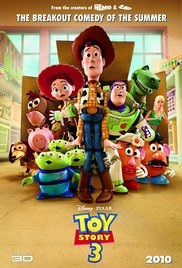
Toy Story 3
Toy Story 3 is the third chapter of the adventures of Woody and Buzz Lightyear who find themselves in the day care centre because Andy has reached college age. The fact this film represents the stage of life where we move on and will no longer need toys in…
A night on the town can be thrilling or fun,
When you know what you’re doing and not on the run,
But if you’re unprepared for the city at night,
I’d highly advise that you do as I write.
Don’t chitchat with strangers or pull someone’s leg,
Unless you need money, in which case just beg.
Do not leave your car, unless you have no choice;
Don’t take a stage unless you have a good voice.
Don’t steal magazines or pet cats you can’t see
And try to avoid any known felony.
And whatever you do in your probable mess,
Don’t bring kids along, unless you like stress.
__________________________
MPAA rating for 1987 version: PG-13
Rating for 2016 version: G
Adventures in Babysitting is one of those movies that could have well been on my original list, but it took a more recent viewing to remind me of this fun ’80s classic and convince me to add it to my list, which I updated all the way back at the beginning of the year. I do want to review all the films I added last year, and the recent Disney Channel remake gave me the perfect opportunity to revisit this one as a Version Variation.
Released by Disney’s Touchstone label, the original Adventures in Babysitting from 1987 was the first lead role for Elizabeth Shue, who plays Chris the babysitter, and I dare say it wasn’t just Keith Coogan’s Brad who had a crush on her. Singing along to “Then He Kissed Me” in the opening credits, she’s the ideal girl next door, soon thrust into extraordinary circumstances when her friend Brenda (Penelope Ann Miller) begs for rescue from an ill-conceived attempt at running away. Forced to bring Brad, his sister Sara (Maia Brewton), and his friend Daryl (Anthony Rapp) along for the ride, Chris holds herself and her under-age entourage together surprisingly well as they ramble from one Chicago danger to the next.
A coworker of mine told me she doesn’t see what makes Adventures in Babysitting a classic, but while it isn’t on the level of Ferris Bueller’s Day Off, it’s a film in which individual moments outshine the whole. There’s the scary hook story and its unexpected punchline, the gang confrontation on the L train, the tense climax high on a skyscraper, and the disarming payoff for Sara’s obsession with Thor, long before anyone thought Marvel would give him his own movie. (It’s still hard to believe that hunky mechanic was Vincent D’Onofrio, you know, the scuzzy bad guy in both Men in Black and Jurassic World. No wonder he’s known as a chameleon.) And of course, the film’s high point is its impromptu musical number where Chris and the kids sing their own babysitting blues on stage. Even if you don’t see the film as a classic, that scene certainly is. Through all their risky ordeals, the easily likable main characters ensure Adventures in Babysitting is likewise easy to enjoy.
As for the remake…. Perhaps to capitalize on the boom in ’80s nostalgia and to give its 100th Disney Channel Original Movie some name recognition, Disney decided to give Adventures in Babysitting a kiddie makeover this year, and the results were mixed to say the least. The film features Disney Channel stars such as Sabrina Carpenter from Girl Meets World, Sofia Carson from Descendants, and Kevin Quinn from Bunk’d, and like their shows, it’s a juvenile mix of humor and heart that will appeal far more to tweens than to anyone much older. I used to watch and enjoy Disney Channel Original Movies while growing up (I still love the High School Musical series), but having drifted away from DCOMs and now watching this one, my older self can’t help but wonder if the quality has gone down or my perceptions have simply matured. Maybe both.
Either way, this new Adventures in Babysitting comes up way short of the original even as it seemingly tries to outdo it. Instead of one babysitter, we get two, one a deeply responsible good girl (Carpenter) and the other an unreliable sitter-impersonator (Carson). Instead of three kids, we get five from two different families, ranging from an aspiring chef to a would-be fashionista. Instead of a car-stealing ring with genuine danger implied, we get a couple of bumbling smugglers doing something illegal with a spray-painted ferret.
Yet for all its changes, it’s still recognizably the same general story, hitting the same beats and notable scenes, yet mirroring my main complaint about Maleficent, every scene from the original that they try to recreate is consistently worse. Most atrocious of all is the “musical number,” which has morphed from a blues anthem to a rap battle with dreadful lyrics like “we ain’t no quitters; we’re the babysitters.” It’s enough to make me gag.
Yet even with all the ways the newer version of Adventures in Babysitting falls short of the original, it’s hard to totally disparage. It’s likely far more engaging to its target age group than to me and, for them, probably captures some of the same fun that ’80s kids felt in 1987. For the most part, it’s decent; perhaps someone someday might consider it a classic, but I doubt it. The most the remake has going for it is its kid-friendliness (i.e., “Don’t mess with the babysitter!” as opposed to the original version), since the original was more intended for teens and up with its occasional language and talk of Playboy. If it has to exist, I suppose the latest version of Adventures in Babysitting can act as an introduction to younger audiences before they see the far better original. Now enough already with the lackluster remakes!
Best line (from the original): (Brad) “Where we gonna get 50 bucks?” (Sarah) “We could sell Daryl. You think?”
Rank for 1987 version: List-Worthy
Rank for 2016 version: Dishonorable Mention
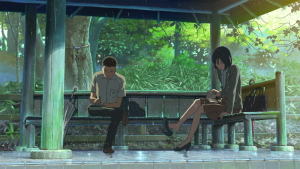
Here’s my second review for the Timely Blogathon, this time for The Garden of Words, a short anime film from Makoto Shinkai. Check out all the other marvelous reviews for films of 90 minutes or less. Thanks again to MovieRob and Anna of Film Grimoire for hosting a great blogathon!
This post is the next entry in this month’s A Timely Blogathon being run by Anna of Film Grimoire and myself. This review of Garden of Words (2013) is by S.G. of Rhyme and Reason
Check out his site which is filled with movie reviews along with a poetry twist!
Don’t forget to vote for your favorite Leonardo DiCaprio character in Round 14 of Opinion Battles. I picked his breakout role as poor Jack Dawson in Titanic, but there’s quite a diverse selection this round.
In the year we finally got to see Leonardo DiCaprio take home the Oscar on his 5th attempt it could easily be argued just how iconic he has become to the modern era of cinema. Having only 37 credits to his name we have seen DiCaprio work with some of the best directors in the business today. We will be picking our favourites of his career to so.
If you want to take part in the next round of Opinion Battles we will be looking at our Favourite Pixar Movies, send you choice to moviereviews101@yahoo.co.ukby Sunday 24th July 2016.
Darren – Movie Reviews 101
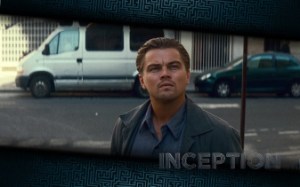
Cobb – Inception
Cobb is the leader of a group that break into people’s minds to steal information but this time he must risk everything to planet an idea so he can go back to…
“Seize the day,” the proverbs say,
But what if, trying to obey,
You find your hope
A slippery slope
That lets potential slip away.
Some days are high, while others die
In grief no matter how you try.
Your only hope
Those days, to cope,
Is that the next may dry your eye.
(If you don’t like this woeful rhyme,
You’ll find this film a waste of time.)
________________
MPAA Rating: Unrated (should be PG-13)
I’d almost forgotten about my Bottom-Dwellers, six films I personally loathe and wouldn’t mind forgetting entirely. Though I still have two left to excoriate eventually, it took the arrival of a seventh to get me to return to a truly negative review. This latest Bottom-Dweller worth despising is 1986’s Seize the Day, an early dramatic turn for Robin Williams before he made that line famous in Dead Poets Society. It was the presence of Williams that got me curious to see it, but even if he does well with the material, said material is not nearly worth his talent.
On the DVD case, Seize the Day is hailed as the only adaptation of respected author Saul Bellow’s works, and it doesn’t induce me to seek out the novel at all. Williams plays Tommy Wilhelm, a struggling salesman whose years of hard work for the same company resulted in his bitter unemployment. Having left his wife, he must pay alimony, even though she refuses to grant him a divorce, for which his girlfriend (Glenne Headly) is growing impatient. Tommy travels to the city, only to find a dearth of well-paying jobs, a reminder of how disdainful and unloving his father is (Joseph Wiseman), and a slight chance at pay dirt with the stock market advice of a poker buddy called Dr. Tamkin (Jerry Stiller). Things start out bad and then get worse and worse and worse, and then it ends.
I’m not necessarily opposed to depressing movies, but there’s usually some redeeming factor. Grave of the Fireflies makes me cry every time, but there are moments of light and sweetness sprinkled throughout. The Italian classic Bicycle Thieves is another example of a “worse and worse and then it ends” kind of movie, but at least there’s a potent social commentary at its heart. Seize the Day has nothing to recommend it, except Williams’ fine acting that makes you genuinely pity this poor man as his life is stamped into the dust of an uncaring world.
I suppose you could read a warning into it, like “Never fall for a con artist who eats like a pig,” but any lesson to be had pales next to just how pathetic Tommy becomes. Perhaps the point was for him to face up to his mistakes in life (not taking his father’s career advice, leaving his vindictive wife), but so much cold callousness piles on him that all he and the audience want is a tiny bit of relief that never comes. The author described Seize the Day almost as a dark comedy, but certainly nothing seems funny at the time. The closest thing to gallows humor is the final scene (which I’ll spoil since no one should waste their time on this movie), in which Tommy finds a funeral and uses the opportune setting to break down sobbing at his shattered hopes. And then it ends. Bad days happen; I had one just yesterday (which might explain why I’m going all medieval on this movie), but there are few things less appealing than watching someone else’s day and/or life ruined.
I’ve never read Saul Bellow’s novels, but if Seize the Day is any indication, it’s no wonder why others haven’t been adapted to film. As an old HBO movie, the quality of the filmmaking is also shabby, with choppy editing and uninspired direction. But beyond such practical complaints, Seize the Day is an oppressively bleak and dismal contrast to the American dream, a story whose only goal seems to be driving its main character to suicide, and considering what became of its star, this film’s purpose of hopelessness is in retroactive bad taste. Williams’ first scene in the film is of him giving another driver the finger, a sentiment also deserved by the film itself.
Best line: (a man in an elevator) “The truth is one parent can support ten children, but ten children can’t support one parent.”
A paper town stands as a dot on a map,
The mapmaker’s special distinguishing mark
To make it his own and to fool any sap
Who happens to visit the place on a lark.
You may well have hopes for that fake little dot,
Which only arrival can fully repeal.
When maps are affirmed by a town that is not,
The rest of the dots become all the more real.
_____________________
MPAA rating: PG-13
After John Green’s The Fault in Our Stars was translated into such a successful young-adult film in 2014, the same studio heads apparently hoped that lightning could strike again with a second Green adaptation, this time Paper Towns. Since Paper Towns was written in 2008 without all the hype of Fault in Our Stars, the film version was an understandably lesser release, and mixed reviews didn’t help. And yet…I enjoyed it a lot, perhaps not more than Fault but on something of a more personal level.
After playing Gus’s friend going blind in Fault, Nat Wolff steps up to lead character status as Quentin Jacobsen, or Q, one of those awkward, easily relatable high-schoolers that tend to be YA protagonists. As a kid, he befriended his adventurous neighbor Margo Roth Spiegelman (Cara Delevingne), but as the years passed, he settled into mundane normalcy while she became an ever more reckless local legend. His crush on Margo doesn’t diminish with their lack of contact, though, and when she unexpectedly asks for his assistance on a daring night of revenge, he tags along with sheepish compliance and has one of the best nights of his life. And then she vanishes, apparently to satisfy her wanderlust, but Q finds clues to her whereabouts and feels compelled to follow her.
Paper Towns has identifiable ingredients from other recent YA films, from The Fault in Our Stars (Green’s subtly profound dialogue, an urging to live life to the fullest) to Me and Earl and the Dying Girl (the sex-obsessed friend, the quirky family details). Whereas both of those dealt with the serious issue of cancer, Paper Towns keeps itself lighter, transitioning from enigmatic mystery to memory-making road trip, peppered with endearing character interactions. It was these small moments between the characters that left me with a smile more often than not. Q’s pals Radar and Ben are archetypal buddies, the former a slight nerd with girlfriend anxiety and the latter a swaggering goofball, but their conversations felt realistic and fun, like when they all segue into a Sean Connery accent. I do that myself sometimes! Probably my favorite moment came when a suggestion to sing leads the three to start in on the Pokémon theme song with growing exuberance. I know not everyone is into Pokémon (and I couldn’t care less about the recent Pokémon Go fad), but that original theme song is an ever appealing source of nostalgia for my generation. After all, how many people still remember the words to some show’s opening that they grew up watching? For me anyway, it was a terrific scene.
Despite the enjoyable moments, including a great little cameo, the end of the film’s journey is almost sure to disappoint the audience as much as it does the characters. It’s meant to be disappointing, and yet it still finds an uplifting message through it all. Q’s course seems analogous to that of Tom in (500) Days of Summer, keeping romantic hope alive until reality makes him recognize his target girl is someone not meant to be followed. It’s rather jarring, but the breaking of Q’s obsession helps him to see what he’s been missing and, as cliché as it may seem, to value the journey over the destination.
Paper Towns is by no means perfect or free of annoyances. I was frustrated, for instance, with how not one, but two characters bemoan how others see them when they themselves promote that very image. While the performances in Paper Towns are worthy all around, The Fault in Our Stars is probably the better film, if only for its more sober subject matter. Yet, as I said, I found myself enjoying Paper Towns more than its film predecessor, and since they’re both John Green adaptations, I don’t mind putting them on the same level in my esteem.
Best line: (Q) “What a treacherous thing to believe that a person is more than a person.”
Rank: List-Worthy (tied with The Fault in Our Stars)
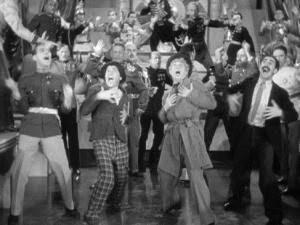
Here’s my first review for the Timely Blogathon for movies 90 minutes or less, hosted by MovieRob and Anna of Film Grimoire. I was pleasantly surprised to see that the Marx Brothers’ Duck Soup really is the hilarious classic it’s hailed as.
This post is the next entry in this month’s A Timely Blogathon being run by Anna of Film Grimoire and myself. This review of Duck Soup (1933) is by S.G. of Rhyme and Reason
Check out her site which is filled with recipes, podcasts and movie reviews galore!
Youth are fools in their prime,
Adept at wasting time.
‘Tis not till age upsets,
They find time for regrets.
If grief will have its day
With innocence’ decay,
May fools find green and gold
Before they grow too old.
_______________
MPAA rating: PG-13
Francis Ford Coppola took a break from epics like The Godfather and Apocalypse Now with his far smaller and more personal adaptation of S.E. Hinton’s The Outsiders. This tragic tale of rival gangs in Tulsa, Oklahoma, is a prime example of a film that I can recognize as good without actually enjoying it. Gang movies have never been my cup of tea; I can appreciate parts of them, like the music in West Side Story, but it’s the kind of youth lifestyle I just can’t relate to in the slightest.
The best thing going for The Outsiders is the cast, a veritable who’s who of ‘80s rising stars. As friends Ponyboy Curtis and Johnny Cade, C. Thomas Howell and Ralph Macchio are two likable kids, Greasers who follow Dallas (Matt Dillon) around as the older boy hits on the prettiest girl at the drive-in (Diane Lane). Patrick Swayze and Rob Lowe join in too as Ponyboy’s elder brothers, while Emilio Estevez and even a snaggletoothed Tom Cruise show up for a few scenes. Howell, Macchio, and Dillon are the only ones to stand out, but seeing all these stars-to-be together was the film’s main pleasure.
After a lethal run-in with members of the well-to-do rival gang called the Socs (pronounced “Soashes”), Ponyboy and Johnny must hide out in an old abandoned church until tensions die down. Despite the relative lack of activity, it is this waiting that forms the high point of the film. The boys bond and read Gone with the Wind, and in a scene I included in my top twelve list of poems in movies, Ponyboy recites Robert Frost’s “Nothing Gold Can Stay,” applying its meaning to his own wish for permanence as the sunset recalls similarly staged scenes in Gone with the Wind. That grand scene is sadly fleeting as the boys must soon deal with sacrifice and gang pressures.
The rivalry between the Greasers and Socs is comparable to any gang rivalry, hinging on class warfare and revenge, but it just seems so pointless. I’m an easy-going, let’s-all-get-along kind of guy who just can’t understand the cyclical vengeance of gangs. I know that most conflicts are not easily resolved, but the small-scale scuffles on display here are the product of attitude and peer pressure and “getting even.” That’s what makes Ponyboy and Johnny so sympathetic; they’re tired of all the strife too, and though some descriptions I’ve read imply the gangs themselves are “the outsiders” of society, it’s really the two friends who stand apart from the petty rivalries into which they were more or less born and aspire to something more, something selfless.
There are glimmers of hope in The Outsiders, from the poem recitation to a scene of understanding between Ponyboy and one of the Socs, but the sad gang mentality remains. While one tragedy is given the respect it’s due, another seems like a total waste that could have been better reproved. I felt for Ponyboy and Johnny, but everyone else seemed to bring friction and violence on themselves, which is hardly something I enjoy watching.
Best line: (Johnny) “Stay gold, Ponyboy. Stay gold.”







 Rhyme and Reason
