
• Home
  • About Me
  • The List
  • THE LIST (2016 Update)
  • THE LIST (2017 Update)
  • THE LIST (2018 Update)
  • THE LIST (2019 Update)
  • THE LIST (2020 Update)
  • THE LIST (2021 Update)
  • THE LIST (2022 Update)
  • Top Twelves and More
  • The End Credits Song Hall of Fame

Rhyme and Reason

~ Poetry Meets Film Reviews

Rhyme and Reason

Tag Archives: Mystery

Mr. Holmes (2015)

12 Tuesday Apr 2016

Posted by sgliput in Movies, NaPoWriMo, Poetry, Reviews, Writing

≈ 1 Comment

Tags

Drama, Mystery


(Today’s NaPoWriMo prompt was for an index poem made up of unconnected snippets of words. Since this experimental idea typically results in a “poem” that defies interpretation, I chose a more traditional form instead.)


When I am in the twilight of my years,
And memories are brittle as each bone,
I wonder if my life will be worth tears
Or only a gravestone.

By then, I will have little need to fret,
But ere my mortal body’s fully worn,
I feel I’ll leave this world with less regret
If someone’s left to mourn.

I could go through this life with blinded eye
Toward anyone whose worth I overlook,
But fools are those who do not verify
The cover of a book.

I could live life content in solitude,
With intellect my only confidante,
But when my mind and body come unglued,
A friend is all I’ll want.
____________________

MPAA rating: PG

With so many adaptations of Sherlock Holmes stories, including Young Sherlock Holmes, it was only a matter of time before a film focused on the detective in retirement, as in last year’s Mr. Holmes (which might well have been titled Old Sherlock Holmes). Ian McKellen fills the title role superbly, though he emphasizes the 93-year-old Holmes’s fragility by showing his own obvious age. (He’s currently 76.) The understated but tremendous acting also extends to Laura Linney and Milo Parker, who play the mother and son who care for the aging Holmes. I should also note (Lost alert!) that Hiroyuki Sanada, who portrayed Dogen in Lost’s final season, plays Mr. Umezaki, an embittered reader who invites Holmes to Japan in search of a plant to aid his failing memory.

Despite the illustrious thespianism on display, the pacing of this unhurried mystery is positively glacial, making it a film to be best watched and appreciated when fully awake. Sherlock Holmes productions are known for foreshadowing and weaving together varied threads to the mystery, and though elements like Holmes’s beekeeping habits and his final case involving a glass armonica and a glove don’t necessarily influence each other, Holmes himself is the touchstone of these several aspects. His current retirement and friendship with young Roger (Parker) serve as a foundation from which Holmes struggles to remember his guilt-ridden past.

One key ingredient of Holmes’s character that so many adaptations have incorporated is his unequivocal bluntness, which often borders on insulting. While not obvious, the personal toll of this habit is finally detailed here. The failure of Holmes’s final case is owed to his self-satisfied assertion of the facts without fully understanding the emotions behind them, and his admirer Roger seems to follow in his footsteps in correcting and humiliating his mother with impertinent disregard for her feelings. So many Sherlock Holmeses, from Benedict Cumberbatch to Robert Downey, Jr., never seem to fully grasp their insensitivity, and seeing an older Holmes express his regret at alienating others is a believable development for the character.

Although Mr. Holmes may threaten one’s consciousness, its muted, handsomely mounted drama is a somber but fulfilling conclusion to the famed detective’s career. It’s also a sterling example of an aging actor proving he’s still got it.

Best line: (Holmes) “And thus concludes the true story of a woman who died before her time, and a man who, until recently, was certain he had outlived his.”


Rank: List Runner-Up


© 2016 S. G. Liput

379 Followers and Counting
 

When Marnie Was There (2014)

21 Sunday Feb 2016

Posted by sgliput in Movies, Poetry, Reviews, Writing

≈ Leave a comment

Tags

Animation, Anime, Drama, Family, Mystery


Out in the marsh where the sandpipers wade
And the reeds allow breezes to bend every blade,
Visions appear in the moonlight and fade
And leave witnesses with a curious scare.

Some think they’re nothing but eyes playing tricks,
And others fear ghosts have escaped from the Styx,
But some explore further with sorrows to fix
And find answers they didn’t know would be there.
___________________


MPAA rating: PG


Studio Ghibli has been crafting outstanding animations for the last three decades, and now that co-founder Hayao Miyazaki is officially retired (again), it looks as if its present hiatus may be permanent. Before the hiatus, though, the studio gave us one more Ghibli gift in When Marnie Was There. Is it among the best Ghibli has to offer? No, but it still has a magical and earnest quality that can hold fast with the likes of Porco Rosso and The Secret World of Arrietty (also directed by Hiromasa Yonebayashi).

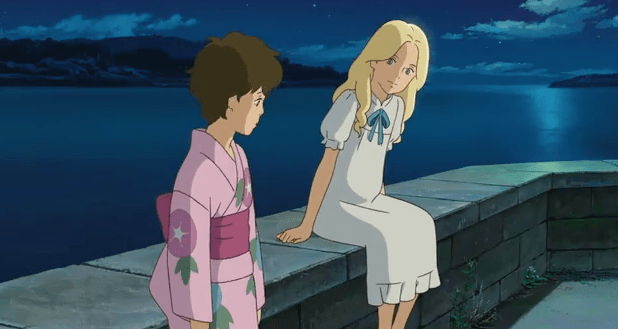
Based on Joan G. Robinson’s 1965 YA novel, which is one of Miyazaki’s favorites, When Marnie Was There is also one of Ghibli’s more mature works, not in a graphic sense like Princess Mononoke, but in an emotional sense. Anna (voiced by Hailee Steinfeld in the English dub) is a deeply troubled girl who keeps all of her griefs inside. As she says, she hates herself, for having asthma, for not fitting in at school, for not feeling at home with her foster parents. When she is sent to the countryside to live with friendly relatives, she remains uncomfortably stoic until she encounters a rundown mansion and the mysterious blonde girl Marnie (Kiernan Shipka) who only appears to her. When Anna crosses the tidal marsh to the mansion, she seems to step back in time, and their friendship grows, allowing Anna to regain her emotions and her self-confidence.

Many Ghibli films are leisurely paced, and this is no exception. The beginning takes time in establishing the characters: the nosy but nice would-be friend, the laconic neighborhood fisherman, the habitual painter fond of Marnie’s mansion. This community is merely a quaint backdrop for the central friendship and mystery between Anna and Marnie. The slowness of the mystery taxes the patience more than the film overall, but luckily there is a payoff, even if the line between dreams and reality becomes more ambiguous over time.

Some comments on the film have considered the girls’ bond in a romantic context with words like “infatuation,” and there were times that I was wondering where exactly their relationship was going. By today’s standards, when two twelve-year-olds meet secretly and dance in the moonlight and express their love, romance is assumed over friendship, while the opposite probably would have been true in the past. Perhaps modern sensibilities have colored people’s perceptions, like the humorous assumptions on Sherlock or the way some people mistake Sam and Frodo’s brotherly camaraderie in The Lord of the Rings for longing. Ultimately, the girls are meant to be only friends, yet the solving of the mystery reveals that their connection is indeed deeper than first thought. Actually, the revelation casts certain scenes in a much more tender and meaningful light, with subtle psychological details unseen in most Ghiblis. (Note the doll that Anna holds during a painful flashback.)

Though it’s not obvious at first, Anna’s greatest misery is being ignored or not wanted. Even the nicest people who seem to pay her attention are easily distracted, leaving her with nothing but personal distaste. Is Marnie merely the subconscious product of her desire for attention or a supernatural answer to it? By the end, it doesn’t really matter. Wishing to belong is nothing new in family films, but When Marnie Is There supplies a satisfying reply with more realistic resonances than most. With so much emotional depth, it’s unfortunate that the film’s visual style can’t quite match it. It has its fair share of memorable Ghibli-style scenes (a moonlit rowboat, wading through a rising tide), but its beauty just doesn’t compare with their best. Though Marnie has earned a nomination for Best Animated Feature, Inside Out is still a shoo-in. Despite this, When Marnie Is There is a bittersweet swan song for one of the great animation studios.

Best line: (Anna, watching her classmates) “In this world, there’s an invisible magic circle. There’s an inside, and an outside. Those people are inside the circle, and I’m outside.”


Rank: List Runner-Up


© 2016 S. G. Liput

364 Followers and Counting


In the Heat of the Night (1967)

03 Thursday Sep 2015

Posted by sgliput in Movies, Poetry, Reviews, Writing

≈ 6 Comments

Tags

Classics, Drama, Mystery

In the heat of the night, there is murder;
In the heat of the night, there is crime.
There is prejudice pointing the critical finger
And a murderer biding his time.

One must see where his biases blind him;
One must see where his aptitudes end.
If another can help, shouldn’t one get behind him,
Even if he’s more ally than friend?

There are many who won’t understand it;
There are many who’ll say it’s not right,
But stretching convention may help to expand it,
And pay off in the heat of the night.
__________________

Rating: G (perhaps PG would be better)

Here’s another Oscar winner I can cross off my list of classics yet unseen. In a strong year with films like Guess Who’s Coming to Dinner and Cool Hand Luke, I was interested to see what made this mystery drama so much more worthy of Best Picture and Best Actor (for Rod Steiger). While the film itself is an excellent police drama, it’s clear that it was the right film released at the right time, and even if it ruffled some contemporaries’ feathers, it made history by doing so.

For starters, a police patrol car winds through the small Southern town of Sparta, passing some of the key players, only to stumble upon the dead body of the richest man in town. While Steiger’s Chief Bill Gillespie chews his bubblegum vehemently, a black man waiting for a train is arrested on a groundless suspicion and reveals himself to be Officer Virgil Tibbs from Philadelphia (Sidney Poitier). Now Tibbs and Gillespie must collaborate to solve the crime.

While the setup seems simple enough and many films since have forced black and white characters to work together, not many carry the tension of these two men who clearly hate their present situation. Gillespie wants only to get Tibbs out of town, but he knows this case is beyond him and that he needs the other’s expertise as a forensics specialist. Tibbs likewise cooperates only under orders, but eventually his sense of pride and responsibility drives him to uncover the truth. Gillespie would gladly condemn the first suspect, and Tibbs isn’t infallible either, but the two of them complement each other in ways they don’t fully recognize at the time.

The period and place turn out to be the most challenging aspects, since Tibbs’s race angers nearly everyone in town as he pokes around for the truth. He earns some respect for his deductions, but whenever someone acts hostile or refuses to cooperate, we’re never sure if they’re acting guilty or simply expressing their racism. The film’s greatest and most famous scene is the infamous slap, in which Tibbs gives as well as he gets and leaves everyone shocked. To be honest, I wasn’t aware of the scene and was equally surprised, considering the when and where the film is set. Considering this was the time of Martin Luther King, Jr., who was killed less than a year after its release, this scene really is a brilliant microcosm of the civil rights movement; Tibbs remains calm as he questions the suspect, but when he is struck, he returns in kind, as any equal man would. I doubt anyone could have pulled it off as effectively as Sidney Poitier, and I thought he deserved the Oscar more than Steiger. (Seriously, Poitier had this role, Guess Who’s Coming to Dinner, and To Sir, with Love [my favorite of the three] all in the same year, but didn’t get one Oscar nomination?)

As a mystery, In the Heat of the Night takes its time with the reveal, employing subtle foreshadowing, though the timeline of events on the fateful night could have been better explained. Ultimately, this is a film about respect, hard-won respect between two outsiders who shouldn’t have judged each other too quickly. For a film tackling difficult issues like race and abortion, In the Heat of the Night is both a hard-hitting product of its time and a dual character study that is still relevant today.

Best line: (Virgil) “They call me MISTER Tibbs!”

Rank: List-Worthy

© 2015 S. G. Liput

337 Followers and Counting

Newer posts →

Recent Posts

  • We Didn’t Start 2025 (Recap)
  • NaPoWriMo 2025 Recap (Finally)
  • Sonic the Hedgehog 3 (2024)
  • It Happened One Night (1934)
  • Spellbound (2024)

Recent Comments

associatesofshellymann's avatarassociatesofshellyma… on My Top Twelve La La La So…
Kit's avatarKit Nichols on Bonnie and Clyde (1967)
lifelessons's avatarlifelessons on Look Back (2024)
Carol Jackson's avatarCarol Jackson on The Thief of Bagdad (1940…
Stephen's avatarStephen on Love Story (1970)

Archives

  • January 2026
  • December 2025
  • May 2025
  • April 2025
  • March 2025
  • February 2025
  • January 2025
  • December 2024
  • May 2024
  • April 2024
  • March 2024
  • February 2024
  • January 2024
  • December 2023
  • November 2023
  • October 2023
  • September 2023
  • July 2023
  • June 2023
  • May 2023
  • April 2023
  • March 2023
  • February 2023
  • January 2023
  • December 2022
  • November 2022
  • October 2022
  • September 2022
  • August 2022
  • July 2022
  • June 2022
  • May 2022
  • April 2022
  • March 2022
  • February 2022
  • January 2022
  • December 2021
  • November 2021
  • October 2021
  • September 2021
  • August 2021
  • July 2021
  • June 2021
  • May 2021
  • April 2021
  • March 2021
  • February 2021
  • January 2021
  • December 2020
  • November 2020
  • October 2020
  • September 2020
  • August 2020
  • July 2020
  • June 2020
  • May 2020
  • April 2020
  • March 2020
  • February 2020
  • January 2020
  • December 2019
  • November 2019
  • October 2019
  • September 2019
  • August 2019
  • July 2019
  • June 2019
  • May 2019
  • April 2019
  • March 2019
  • February 2019
  • January 2019
  • December 2018
  • November 2018
  • October 2018
  • September 2018
  • August 2018
  • July 2018
  • June 2018
  • May 2018
  • April 2018
  • March 2018
  • February 2018
  • January 2018
  • December 2017
  • November 2017
  • October 2017
  • September 2017
  • August 2017
  • July 2017
  • June 2017
  • May 2017
  • April 2017
  • March 2017
  • February 2017
  • January 2017
  • December 2016
  • November 2016
  • October 2016
  • September 2016
  • August 2016
  • July 2016
  • June 2016
  • May 2016
  • April 2016
  • March 2016
  • February 2016
  • January 2016
  • December 2015
  • November 2015
  • October 2015
  • September 2015
  • August 2015
  • July 2015
  • June 2015
  • May 2015
  • April 2015
  • March 2015
  • February 2015
  • January 2015
  • December 2014
  • November 2014
  • October 2014
  • September 2014
  • August 2014
  • July 2014
  • June 2014
  • May 2014
  • April 2014
  • March 2014
  • February 2014
  • January 2014
  • December 2013

Categories

  • Blindspot
  • Blogathon
  • Christian
  • Movies
  • Music
  • NaPoWriMo
  • Poetry
  • Reviews
  • TV
  • Writing

Meta

  • Create account
  • Log in
  • Entries feed
  • Comments feed
  • WordPress.com

Recent Posts

  • We Didn’t Start 2025 (Recap)
  • NaPoWriMo 2025 Recap (Finally)
  • Sonic the Hedgehog 3 (2024)
  • It Happened One Night (1934)
  • Spellbound (2024)

Recent Comments

associatesofshellymann's avatarassociatesofshellyma… on My Top Twelve La La La So…
Kit's avatarKit Nichols on Bonnie and Clyde (1967)
lifelessons's avatarlifelessons on Look Back (2024)
Carol Jackson's avatarCarol Jackson on The Thief of Bagdad (1940…
Stephen's avatarStephen on Love Story (1970)

Archives

  • January 2026
  • December 2025
  • May 2025
  • April 2025
  • March 2025
  • February 2025
  • January 2025
  • December 2024
  • May 2024
  • April 2024
  • March 2024
  • February 2024
  • January 2024
  • December 2023
  • November 2023
  • October 2023
  • September 2023
  • July 2023
  • June 2023
  • May 2023
  • April 2023
  • March 2023
  • February 2023
  • January 2023
  • December 2022
  • November 2022
  • October 2022
  • September 2022
  • August 2022
  • July 2022
  • June 2022
  • May 2022
  • April 2022
  • March 2022
  • February 2022
  • January 2022
  • December 2021
  • November 2021
  • October 2021
  • September 2021
  • August 2021
  • July 2021
  • June 2021
  • May 2021
  • April 2021
  • March 2021
  • February 2021
  • January 2021
  • December 2020
  • November 2020
  • October 2020
  • September 2020
  • August 2020
  • July 2020
  • June 2020
  • May 2020
  • April 2020
  • March 2020
  • February 2020
  • January 2020
  • December 2019
  • November 2019
  • October 2019
  • September 2019
  • August 2019
  • July 2019
  • June 2019
  • May 2019
  • April 2019
  • March 2019
  • February 2019
  • January 2019
  • December 2018
  • November 2018
  • October 2018
  • September 2018
  • August 2018
  • July 2018
  • June 2018
  • May 2018
  • April 2018
  • March 2018
  • February 2018
  • January 2018
  • December 2017
  • November 2017
  • October 2017
  • September 2017
  • August 2017
  • July 2017
  • June 2017
  • May 2017
  • April 2017
  • March 2017
  • February 2017
  • January 2017
  • December 2016
  • November 2016
  • October 2016
  • September 2016
  • August 2016
  • July 2016
  • June 2016
  • May 2016
  • April 2016
  • March 2016
  • February 2016
  • January 2016
  • December 2015
  • November 2015
  • October 2015
  • September 2015
  • August 2015
  • July 2015
  • June 2015
  • May 2015
  • April 2015
  • March 2015
  • February 2015
  • January 2015
  • December 2014
  • November 2014
  • October 2014
  • September 2014
  • August 2014
  • July 2014
  • June 2014
  • May 2014
  • April 2014
  • March 2014
  • February 2014
  • January 2014
  • December 2013

Categories

  • Blindspot
  • Blogathon
  • Christian
  • Movies
  • Music
  • NaPoWriMo
  • Poetry
  • Reviews
  • TV
  • Writing

Meta

  • Create account
  • Log in
  • Entries feed
  • Comments feed
  • WordPress.com

Blog at WordPress.com.

Is this your new site? Log in to activate admin features and dismiss this message
Log In
  • Subscribe Subscribed
    • Rhyme and Reason
    • Join 814 other subscribers
    • Already have a WordPress.com account? Log in now.
    • Rhyme and Reason
    • Subscribe Subscribed
    • Sign up
    • Log in
    • Report this content
    • View site in Reader
    • Manage subscriptions
    • Collapse this bar