(I may be late, but not defeated! For yesterday’s Day 11 of NaPoWriMo, the prompt was for a poem that incorporates song lyrics as a refrain, so I drew from a certain musical and went with the suggested example of a villanelle.)
King and kingdom may yet fall,
But my fealty shall remain.
No, never could I leave you at all.
Laughter may yet leave this hall,
Pleasured memories turned pain.
King and kingdom may yet fall.
Our first meeting, I recall,
Was joy God only could ordain.
No, never could I leave you at all.
Peter may yet pillage Paul,
Men and what they stood for slain.
King and kingdom may yet fall.
How’d we get here, warts and all?
Is our love a common bain?
No, never could I leave you at all.
Trapped in adoration’s thrall,
Let the legends mourn the reign.
King and kingdom may yet fall.
No, never could I leave you at all.
_____________________________
MPA rating: G
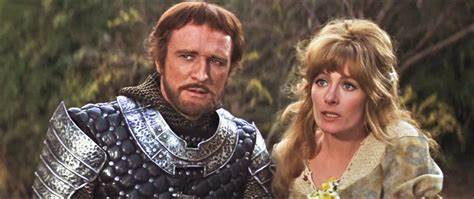
I love musicals, even long musicals like Les Misérables. Yet even I have a limit, and somehow Camelot was too much even for me. Based on the 1960 Lerner and Loewe stage musical, Camelot adapts the King Arthur legend, particularly the creation of the Knights of the Round Table and the doomed love triangle between Arthur (Richard Harris), Guenevere (Vanessa Redgrave), and Lancelot (Franco Nero, with Gene Merlino dubbing his singing voice).
All the events of the legendary scandal are well-portrayed: Lancelot’s boastful self-regard with the skill to back it up, the gradual transition of Guenevere disdaining and then falling for him, Arthur’s exasperation as he tries to overlook the uncomfortable rumor that everyone but he acknowledges, the corruptive role of Mordred (David Hemmings) in bringing Arthur’s idealistic kingdom low. Much of it is laudable, particularly an insightful script and the Oscar-winning score, production design, and costumes bringing Arthurian myth to life, yet it’s also dully self-indulgent at three hours long, in stark need of a skillful editor yet still leaving out songs from the stage version.
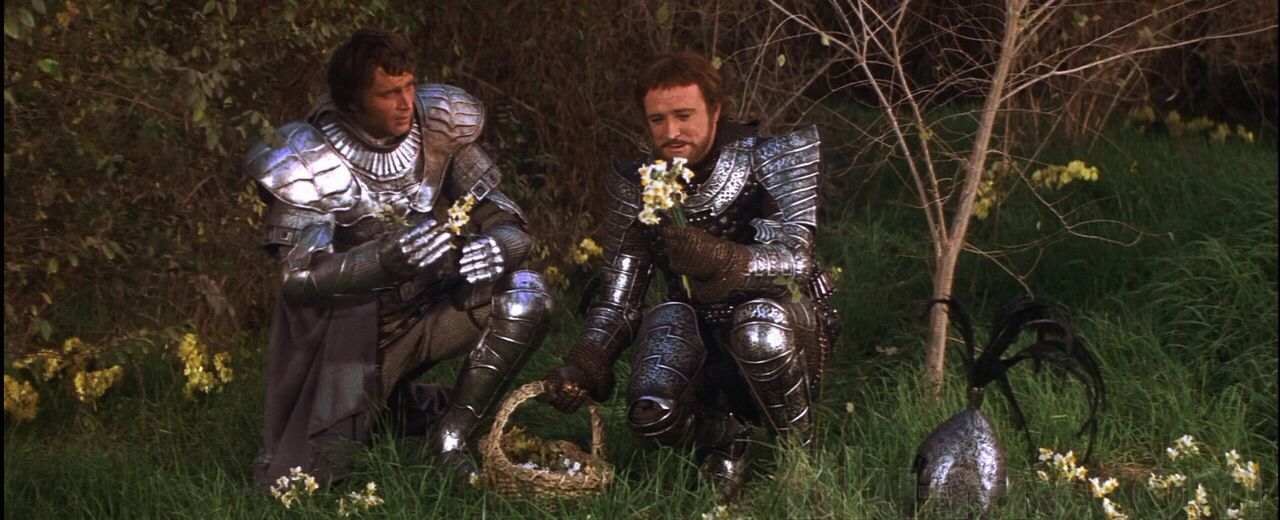
While Redgrave is a bewitching Guenevere and her eventual real-life husband Nero is dashing (if a bit insufferable) as Lancelot, Richard Harris is a strangely mixed bag as Arthur: sometimes, he’s excellent at embodying the king’s charm and deepening desperation while other times have him feeling too frivolous and unregal. It’s funny to think of him growing up to play the more Merlin-like role of Dumbledore, but he was indeed a singer too, known for the original version of “MacArthur Park.” His first number “I Wonder What the King is Doing Tonight” is a good representative of the film’s lack of imaginative staging, as Arthur just dips around some tree branches; Lerner’s lyrics are delightful, yet there’s little in the way of visual interest for the songs. As a poet, I certainly enjoyed the wordplay of “The Lusty Month of May” and “Take Me to the Fair,” but the film around the musical numbers, from its stolid pacing to the strain at an inspiring ending, sadly doesn’t rise above its flaws in my book.
Best lines: (Arthur) “I can’t quite remember all that Merlyn taught me, but I do remember this. That happiness is a virtue. No one can be happy and wicked. Triumphant, perhaps, but not happy.”
and
(young Arthur) “What’s the best thing for being sad?” (Merlin) “The best thing for being sad is to learn something.”
Rank: Honorable Mention
© 2025 S.G. Liput
805 Followers and Counting

