
Darkly do the raindrops fall
Upon society’s withdrawal,
No innocence on which to land,
A wet and distant reprimand
On social rust and moral dusk and nobody who cares to feel.
Remember purer days of light?
They pale to darkness’ appetite,
For dark is omnipresent here
And only dreams escape the drear,
Mere memories that spark unease when we mistrust if they are real.
__________________
MPAA rating: R
There’s always bound to be movies out there that others hail as classics and you just don’t see the appeal. That’s Blade Runner for me. I picked it as one of my Blindspots this year because it’s been hailed as one of the greatest science fiction films of all time and its sequel Blade Runner 2049 is due out this October, returning Harrison Ford to one of his many iconic roles. Yet I found the story of Rick Deckard’s hunt for human-like replicants immensely lacking in both pacing and human interest, even as I recognized why it has become so well-respected.

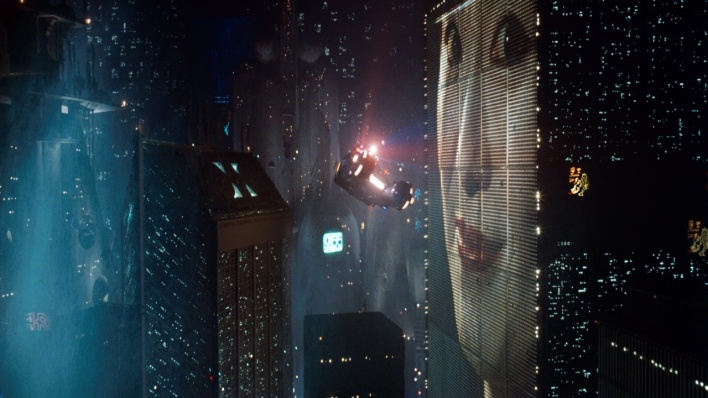
Based off a Philip K. Dick novel and directed by Ridley Scott following his hit with Alien, Blade Runner is often cited as a touchstone and forerunner for the cyberpunk and neo-noir genres, thanks to its grimy rain-soaked visuals of a future Los Angeles. With flying police cars traversing the neon-lit cityscape, I could clearly see this film’s influence on the likes of Minority Report, Ghost in the Shell, and The Matrix. Ghost in the Shell is perhaps the clearest borrower, also boasting a cerebral plot about man-made androids questioning their humanity, so there’s no denying Blade Runner’s impact on the style of much modern sci-fi. The non-digital effects hold up remarkably well, and the cinematography really heightens the bleak otherness of this particular dystopia.
If only this adeptly stylized world were worth spending time in. For all its technical finesse and shadowy cinematography, the strangeness of this future was a turn-off for me, with some of the surreal posturing of its characters reminding me of Dune from two years later. Whereas Dune was dragged down by a surplus of exposition, though, Blade Runner could have benefited from more, with far too many drawn-out scenes left in tedious silence. (I saw Ridley Scott’s Final Cut, but I understand the original theatrical version has a noir-style narration. Honestly, my curiosity about that difference is probably the only thing that would get me to watch Blade Runner again.) It’s a highly visual film, but the visuals weren’t enough to overcome a lackluster story.
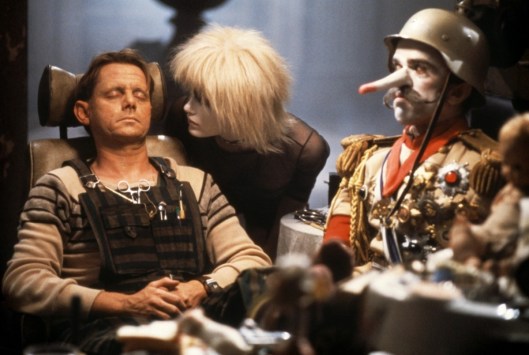
The actors are all decent for the most part, with Harrison Ford playing a good tenacious policeman but never making much of an impression. Likewise, Sean Young as the femme-fatale love interest fills her role in the noir plot, but there’s not much to her thinly written character or to anyone else’s for that matter. Rutger Hauer is perhaps the most memorable as the main villain, Roy Batty, a murderous replicant who seeks to lengthen the programmed four-year lifespan for himself and his fellow rogues (Brion James, Joanna Cassidy, Daryl Hannah). Yet we never get to know the replicants any more than the human characters, and their plight is only half-felt with any sympathy by the end. Batty’s final scenes are also bizarrely anticlimactic after he chases Deckard like Hannibal Lecter on crack.
I recognize a lot of potential depth to the story, with themes of what makes us human, the unreliability of memories, the moral questioning of doing one’s job, and the despair and anger toward the arrogance of a creator (which Scott also incorporated into Prometheus). Yet none of these themes are compelling or explored with any depth, and the intentional ambiguity of several scenes only heightened their underdeveloped potential. Blade Runner is a film such that I can see how critics could watch it repeatedly and wring profound merit from its narrative, but its reputation as a masterful classic is more merit than this slow story deserves, in my opinion.

Owing its R rating to only two scenes (one with nudity, one uncomfortably violent), Blade Runner was quite the disappointment, especially because I typically love science fiction. (I’m not alone too; my equally sci-fi-loving VC was bored and uninterested by the halfway point.) I just don’t understand how a style-over-substance film like this is labeled a masterpiece, when far more entertaining tales, like In Time or Surrogates, are written off as sci-fi hack jobs. The letdown has also spoiled much of my interest in the upcoming sequel, though I’m still curious to see Denis Villeneuve’s take on this world, after the intellectual emotion of last year’s Arrival. Blade Runner is a grittily surreal blending of future and noir, with admirable effects and cinematography and an unmistakable impact on science fiction to come, but it’s also proof that just because something shapes a genre doesn’t necessarily make it a masterpiece.
Best line: (Tyrell, Roy’s designer) “The light that burns twice as bright burns half as long, and you have burned so very, very brightly, Roy.”
Rank: Dishonorable Mention
© 2017 S.G. Liput
487 Followers and Counting
 Rhyme and Reason
I nodded in agreement with this entire review. The whole film amounts to a gorgeous looking snooze-fest.
I’m so happy to hear I’m not alone in that assessment! Somehow I expected something better.
Ah, Blade Runner. There’s no doubt it had influence in sci-fi and dystopian genres the world over…but the movie does drag. I watched it on the recommendation of a friend (mostly to see its influences) and while the sets are very convincing, the whole production is somewhat of an overwrought drag, which is not helped by the gloomy setpieces. Some of the concepts in the movie are interesting on an individual level (such as the replicants), but the final product feels…slow. Glad you wrote an honest review, S.G.!
Honesty is the best policy, after all! I realize it was intended to be immersive like film noir, but the constant darkness got old. There wasn’t one scene in the daytime (except maybe a brief flashback), and it all came off as gloomy rather than compelling. It’s interesting that you saw it for basically the same reasons, to explore its influence. That’s not usually why people watch films like Star Wars or Alien, so I should have known this would be on a lesser level, for entertainment at least.